All posts by NotesonFilm1

About NotesonFilm1

Spanish Canadian working in the UK. Former film journalist. Lecturer in Film Studies. Podcast with Michael Glass on cinema at https://eavesdroppingatthemovies.com/ and also a series of conversations with artists and intellectuals on their work at https://josearroyoinconversationwith.com/

Le gorille vous salue bien/ The Mask of the Gorilla (Bernard Borderie, France, 1958)

le gorille
Ventura gets no billing until the end of the film

Why would anyone want to see an unpretentious genre film – not particularly stylish; by no means the best example of its kind – like Le gorille vous salue bien?

Well, for one, it’s interesting to see what the French conceived of as their ‘no. 1 secret agent’; makes an interesting change in comparison to James Bond – friendly and street-smart gorilla instead of charming know-it-all gentleman with sardonic sense of humour and sadistic tendencies ; it’s interesting to see the care that the film takes with its beginning and ending, the one responding to the other as in classic cinema; it’s interesting also to see how the film carefully structures its narrative, balancing it with spectacle, leavening it with humour: its constantly engaged with a popular audience and might be part of the reason the film remains engaging: it’s interesting to compare the fight scenes (see below) to the ones we see now, how they seem slow and inexpert, with blows clearly faked, yet often shot in a combination of long-shot and with lengthier takes than we get now — Le gorille lets us see actions completed.

Screen Shot 2016-08-19 at 10.37.02
Lino completes an action

It’s interesting to remember that this type of popular genre film (it was a considerable box office success) co-existed with New Wave Cinema and the previous kind, what François Truffaut would call the ‘cinéma de papa’, straddled both, would supersede them all and would make inroads into all Western European markets.

le_gorille_vous_salue_bien01
Le Gorille in Germany

Fans of Hollywood gossip will be interested in seeing Bella Darvi, named by Darryl Zanuck in a burst of megamoguldom after himself and his wife (Darryl and Virgina, thus Darvi); its interesting to see how in their scenes together, the camera always favours her and leaves the gorilla in shadows. But to no avail; attractive as she is, she’s no star: Lino on the other hand…

Screen Shot 2016-08-19 at 13.31.02.png
lighting and placement favour Bella Darvi

The main reason to see the film today is that Le gorille vous salue bien is the film that would make a star of Lino Ventura. The year of its release, he’d already appeared in three films in supporting roles, high profile ones such as in Maigret tend un piège, Ascenseur pour l’échafaud/ Lift to the Gallows (Louis Malle, 1958), Montparnasse 19/ Modigliani of Montparnasse (Jacques Becker, 1958) for top directors such as Delannoy, Malle, Becker. Here it’s only Borderie. But ‘Le gorille’ is star-making role. In the opening credits we’re teased by billing merely listing ‘Le gorille’; by the end of the movie, we know the gorilla is Lino Ventura and we want to see more of him. The success of this film would lead to many more Gorilla films but they’d have to settle for Roger Hanin in the title role: Ventura would go onto bigger and better things and would become one of the most popular and durable stars of French cinema.

Screen Shot 2016-08-19 at 10.43.39.png
the making of a star

José Arroyo

On The Get Down, As of Episode 2


Disco music mixed with salsa and opera, a lead character that spouts poetry, a teenage romance with a showbiz background, lots of disco dancing, Jimmy Smits in good form and a slightly camp look at a late 70s setting: The Get Down could have been made for me.

Screen Shot 2016-08-17 at 22.13.09.png
Blood (and glitter ball reflections) on the dance floor

I loved the first episode (directed by Baz Luhrmann) and was intrigued by Ben Travers’s argument in IndieWire that TV series aren’t movies or novels, that they’re tv shows and constructed that way. But that the Get Down might be an exception in that the series, ‘isn’t constructed like a string of small arcs cut together to form a greater one. Instead, it really is put together like a film: one big arc made up of stunning, stand-out moments in between. Some of those moments function as satisfactory end points, while other episodes conclude seemingly at random — almost as though they were dictated by time’.


Screen Shot 2016-08-17 at 22.18.16
Dreams up in flames.


I’ll have to wait and see for myself. What I can say on the evidence of having seen only up to the second episode is that there are indeed stunning, stand-out moments – visually, musically, dramatically and in terms of performance – that are so far keeping me watching.

In the second episode, ‘Seek Those Who Fan Your Flames,’ directed by Ed Bianchi, I loved Grandmaster Flash teaching the kids how to spin a groove, Cadillac discoing his way to child murder and  the beautifully visualised moment where all of the young characters’ dreams go up in flames.

I am particularly smitten by what  Jimmy Smits is doing as Francisco ‘Papa Fuerte’ Cruz: he conveys the man’s ambition, the carnie tent barker qualities that make him a politician, the steel that makes him dangerous. He’s taking considerable chances in his acting choices:  each can potentially cross a line and become too much. But they haven’t yet. He’s been consistently entertaining – he’s performing with an audience in mind; each gesture is done for effect– without yet being embarrassing. Quite the opposite. For me, his slightly florid performance is enough of a reason to see the show: in the clip below for example, I love the way he says the ‘not prohibited’ bit in the line ‘Violence is discouraged but not prohibited’ and the way he uses his hands and his eyes to accent the word ‘spiritual’ at the end of the clip. It’s marvellous. But marvellous as Smits is, The Get Down is as of yet offering so much more.


José Arroyo


Maigret voit rouge (Gilles Grangier, France/Italy, 1963)

maigret voit rouge


A minor Maigret. I’d thought Jean Delannoy’s direction of Maigret tend un piège (France/Italy, 1959) efficient but unexciting. But Gilles Grangier’s work here makes Delannoy seem Jean Renoir in comparison: Maigret voit rouge is visually uninteresting, the plot is recounted in great and very dull detail, often by Gabin, who seems tired, perhaps because he’s been asked to do what is usually relegated to supporting players. Too bad he didn’t feel insulted: it might have given a little fire to his performance. That said, he’s Gabin: he’s always watchable; and there’s Françoise Fabien in an early role as Lily, a gangster’s moll; Michel Constanstin looking like an even more threatening Jack Palance, as Cicero, the American killer; and the always droll Guy Decomble as Maigret’s sidekick, Inspecteur Lognon. The fight and chase scenes are not terrible either. It’s not nothing; but it’s not much.

The story begins with an unknown person being shot down by a passing car. Inspector Lognon is a witness. But when the police arrive, the body has disappeared. Lognon follows a lead to an American bar and gets badly beaten up on his way out. Inspector Maigret takes over the case, discovers that the bar is run by Pozzo (Vittorio Snipoli) an American of Sicilian origin and that Lily, the Belgian barmaid who works there, is involved with an American and has been hiding his mafiosi buddies. Maigret calls in the help of Harry McDonald (Paul Carpenter), an American diplomat who turns out to work for the BFI. All is not as it seems. Maigret will discover that what’s at stake is a key witness to a Mafia case in the US and he’s got to find him before the American gangsters do.

The film is most interesting when seen from an ideological perspective. Maigret voit rouge  is set during the height of the Twentieth Century’s American Empire, and at the very peak of it’s most glamorous moment, the Camelot years of John F. Kennedy’s Presidency. France seems in thrall to everything American (see images at the very bottom): Chicago, gangsters, bowling alleys, transistor radios, Rocky Graziano; jeans, t-shirts and talking as if one’s mouth is full, like Marlon Brando. But there’s always a twist. Here the transistor radio plays jazz. Moreover, though France has reason to be grateful to an America so recently France’s liberator, it’s not just going to roll over and let them take over the country. I wonder how audiences reacted to the clip above where the American says:

‘I warn you I’m going to have to call Washington.’

‘And I warn you that I’ve been obliged to inform the Ministry of the Interior.’

‘It will become a diplomatic incident.’

‘Better then a judiciary error.’

‘This affair is not what it seems. I belong to the FBI.’

‘And I to the PG, each to his business.’

‘But listen to me Jules.’

‘There’s no more Jules. If you want to discuss the affair get in touch with Inspecteur Maigret at Quaie des Orfèvres from 8 o’clock’.


I imagine audiences of the time in France applauded the exchange. Needless to say, there’s a reconciliation at the end with Maigret and McDonald, and thus France and the US, becoming friends once more. But this time on terms set by Maigret. It’s very vividly dramatised and the only element of the film I found fascinating. I’m not surprised that this, Gabin’s third outing as Maigret, was also his last.

An excellent critique of the new release of the blu-ray box-set may be found here: 

José Arroyo


GWTW in L’Armée des ombres/ Army of Shadows

Screen Shot 2016-08-18 at 12.27.23.png

For Gone With The Wind fans: There’s a lovely scene in L’armée des ombres/ Army of Shadows (Jean-Pierre Melville, 1969) where two heads of the French resistance — Phillipe Gerbier (Lino Ventura) and Luc Jardie (Paul Meurisse) — are in London for a meeting and they end up at the pictures watching Gone With the Wind (Victor Fleming, USA, 1939). As they come out of the cinema and onto the street, in probably the most brightly lit moment in the film, with the GWTW billboard shown in what looks like a brilliant Technicolour palette,  Jardie says, ‘For the French the war will be over when they can read Le Canard enchaîné and see this marvellous film’. Once again entertainment, bright light and brilliant colour signifying the utopian hopes of a grey, war-torn London in a film about shadows, armies and resistance to existing realities.


José Arroyo

Le chat (Pierre Granier-Deferre, France, 1971)

le chat

A film that makes one re-think notions of good and bad in cinema: On the one hand, Pierre Granier-Deferre is such a heavy-handy director,  with the conceptual and symbolic dimensions of Le chat so underlined and over-signalled: birds fluttering outside windows, sirens circling, golden youth of long ago seen through hazy irises in flashback; the little house surrounded by wrecking crews turning the old world to dust; garbage trucks regularly reappearing at their front door, perhaps to pick up the wreckage of the protagonist’s lives: there are times where one can’t control the giggling (see the trailer posted below). On the other hand, any director who can get actors to do what Jean Gabin and Simone Signoret do here, alone and together, deserves all the praise there is. They are so gobsmackingly good — so electric – and the roles they play so great — offering such scope and variety of human character and emotion, and changing through time to boot — that one can only offer admiration and gratitude.

Julien Bouin, a retired typesetter, has been married to his wife Clémence (Simone Signoret) a former circus worker for over 25 years. He now can’t stand her. Everything she does irritates him. Why, she asks? Is it cause she got old and fat, cause she drinks? He doesn’t know. All he knows is that one day he stopped loving her. Because of that, she now hates him too. They shop separately at the same shops, keep their food under lock and key in separate cupboards, cook different dishes in the same kitchen, sleep in the same room but in different beds, do little mean and spiteful things to each other. Every day.


Screen Shot 2016-08-15 at 23.52.03
Gabin’s Julien on the left; Signoret’s Clémence shut out of his life and thus a reflection on the lower right hand side of the screen.

Gabin plays  Julien as quiet, all closed-in; neat, carefully dressed. A mild-mannered man who does things carefully, systematically but who won’t be pushed to do what he doesn’t wants to. He’s a man who takes pride in doing things carefully and well. Also, he still needs to love; and not the kind of physical love that one can get anywhere either but an outlet for real feeling. He finds it in his cat. It drives Clémence mad that a cat who neither needs it nor appreciates it becomes the recipient of the love Julien should be bestowing on her. She tries to shoo the cat away, attempts to lose him in the supermarket. But no, he returns to steal the attention, the caresses, the love that rightfully belongs to her. So, one day, she kills the cat….

Screen Shot 2016-08-15 at 13.09.59
Julien spying on Clémence

We know Signoret was a great beauty. She’s someone who did speak many languages, and we can believe she plays the seven instruments Clémence claims to be able to. And we can understand the bewilderment, anger, fury that this little typesetter not loving her incites. We see the defiance in every glug of whisky, the determination in the speed with which she manouvers her bad leg through the shops, no limp is going to hold this woman back: the Chinese silk robe in the loud red of someone who demands being noticed. The cigarillo on the side of a mouth. Only the loss a her husband’s love could lead her to crocheting with the fury of someone who wants to commit murder. But the film underlines one can’t hate that much without it being overlaid by love: Signoret communicates the tenderness beautifully. Gabin also.

Screen Shot 2016-08-15 at 13.24.50
Clémence once had an exciting life she gave up for Julien

Le chat beautifully conveys a gamut of human emotion – characters who feel that much is Simenon’s gift to the filmmakers; it is fitting that he is billed alongside the ‘monstres sacrées’ of french cinema and above the title of the film . The director’s gift to the actors is to give them the space to be these people and to showcase them properly for us. Then the actors…well. Watching Gabin and Signoret together play this couple is like watching two great opera singers duet in a Verdi aria: raw, vivid, fine, delicate, explosive…. And watching them seems to me to be essential to anyone who wants to know what great acting in the cinema can be; they bring out areas of human feeling, emotion and experience that lesser actors don’t even known exist.

In the interview that accompanies the Studiocanal DVD, Granier-Deferre speaks about how the producers had not wanted Signoret. Jean-Pierre Melville’s L’armée des ombres, her previous film, had been a failure, and she was (most unjustly) being blamed for it. They went through all the other names of fancy actresses and finally Gabin asked Granier-Deferre: ‘you’ve really got your heart set on that Signoret?’ ‘Yes’. He calls the producer and says ‘If Signoret is not in it, I don’t do the film’. ‘Six hours later I got Signoret,’ remembers Granier-Deferre. Good thing he did too. Because Signoret and and Gabin are the only reasons to watch the film; they make one feel it’s essential viewing; and it certainly is to fans of Gabin, Signoret, Georges Simenon or anyone who’s interested in seeing great acting in the cinema.


José Arroyo


Le tueur/ Killer (Denys de la Patellière, France/Italy, 1972)

le tueur.jpg

A narratively crude but visually elegant French cop flick, Le tueur is a fatalist noir that doesn’t psychologise and doesn’t explain. It’s told very leanly through a series of chases and shootings, often filmed on location, and well evoking the seedy underbelly of the Pigalle of the period, with its porn films, sex shops, shady cons. It’s got one musical motif, very effectively deployed throughout the film (and not to be confused with the dreary theme song at the end that sings out the themes of the film to us), and perhaps over-uses the zoom so characteristic of the period. Change is one of its themes, and we see it not only in the narrative  conflict between old and new styles of policing  but also in the film’s use of landscape and location. Le tueur is a document of Paris in the process of change, with the building sites that would become the Tour Montparnasse and the Forum des Halles used prominently and effectively.

Commissaire Le Guen (Jean Gabin) has spent seven years of his life catching ruthless killer Georges Gassot (Fabio Testi) only to find him judged mentally imbalanced and locked up in relative comfort. As the film begins Gassot, fakes his way through several tests and fights his way out of captivity. His brother François (Jacques Richard)is waiting for him outside and drives him away to the relative safety of Marseilles. However, Gassot can’t keep himself from going out of his hideout and into the city’s red light area, where he hooks up with Gerda (Uschi Glas), a prostitute from Hamburg but also gets spotted and returns to Paris with Gerda. François Tellier (Bernard Blier) puts pressure on Le Guen to catch him as quickly as possible and Le Guen, after seeing several of his ploys fail and only three months from retirement, places Fredédo Babasch (Gérard Depardieu) in jail so as to befriend François, who’s been caught, and help capture Georges.

Almost a century of cinema greatness in twenty seconds: Gabin and Depardieu share a shot.

            What’s unusual about Le tueur is that, as the title suggest, the protagonist is the killer. He’s not crazy but he’s ruthless. As the film begins we’re told that he’s fated to have bad luck. He knows it; even attempts to cut the bad luck line out of his hand with a knife; all he dreams of, dreams he shares with Gerda, is to get a bit of money and run off to a hot country. But it is not to be.

Screen Shot 2016-08-11 at 22.00.43.png

Fabio Testi, is very handsome, very athletic, and very inexpressive. I found him perfect for the part. The film has Gabin, with watery grey/blue eyes that have seen everything and can hide as much as they reveal. His Le Guen is an old school strategist, not above trying to orchestrate events to get the justice he believes Gassot deserves and that the courts won’t grant him. There’s also Bertrand Blier as Le Guen’s boss, with his crushed hound dog face, every look an expression of disappointment and evocation that nothing good in the world will happen ever. In the last quarter of the film, Gérard Depardieu appears in one of his first roles, a live-wire whose every movement is energy, humour and hope. And in the middle, what they’re looking for, who they’re all chasing after is….a blank.

The world that this cypher, this bearer of bad luck, this dreamer who’s every attempt to realise that dream makes life more of a nightmare, is beautifully framed and lit for us by the great Claude Renoir in the Eastman colour that so vividly brings out certain blues and yellows and reds. Here, as is right, blue predominates. I’ve put a considerable selection of stills from the film, in chronological order, so you can appreciate, the compositions, the use of colour, the artful creation of this dark, blue, world that the film presents so well.


In spite of its cast and it’s look, the film has been accused of offering the same satisfactions as episodic television; a judgment I find harsh but understandable; how one appreciates this might depend on whether and how much one values lean spare storytelling and a relative lack of psychologising.

José Arroyo

Cinema Cesspit

The film theatre is often romanticised as a communal space, curlicues of smoke lending atmosphere to an audience hypnotised by utopian adventures and united in shared responses that in turn help shape them. We also hear of the cinema as a place for courtship rites, as a free space where certain types of sexual encounters were possible both for heterosexuals and homosexuals, the back rows and the dark providing a measure of safety. However as we can see in this clip from Dernier domicile connu (José Giovanni, 1970), it could also be a dangerous place for single women. And as we can also see, the ethics in resolving this could be underhanded: entrapment was common. Here, Marlène Robert is the bait, Lino Ventura the strong arm of the law.


José Arroyo

Maigret tend un piège/ Inspector Maigret (Jean Delannoy, France/Italy 1958)


I love the Maigret films; they offer the double satisfaction of thrilling you with some of the worst humanity has to offer – though usefully shown tastefully – and then restoring order; moreover, that rebalancing is itself done in an orderly and systematic manner; one we’ve learned to know and enjoy playing along with.

In this one, Gabin’s first outing in the role, (he would inhabit it twice more, reunited with director Jean Delannoy in Maigret et l’affaire Saint-Fiacre / Maigret and the St. Fiacre Case (1959) and Maigret voit rouge/ Maigret Sees Red, (Gilles Grangier, 1963), the first images we see are a knife being thrown right into the heart of Paris, then we’re shown the shadow of a pipe in close-up (see below). It seems to me that those images, which start the film, embody the appeal of this type of detective film: violence at the heart of a community and threatening to rip it apart and then the cozy comfort of a pipe, with its suggestions of pensiveness, its indication that brains will win over brawn, that reason will transform chaos into order, that homeliness will be restored. These films do not disown the animal, the emotional and sexual impulses, but they’re always the source of the crime. Intelligence and thought are the way to remove such unruly impulses from social structures: the films are a paean to reason. If Maigret sets his traps correctly, the killer will be caught.

Screen Shot 2016-08-11 at 15.30.28.png
The murderer’s always hidden, filmed partially or from behind, or, like here, in shadows

Maigret tend un piège starts at Place des Vosges, in the Marais district. It’s set in the film’s present but it already has a nostalgic tone. The Place des Vosges has a butcher shop, ladies knit and chat with their neighbours outside their flats, everyone seems to know each other. Then, we’re introduced to a young woman returning from work, a violinist, husband at the café, child asleep upstairs. Of course, she’s murdered. Typically, we’re not shown who’s done it. We see only a gesture of gloved hands re-arranging a belt: a gesture that will prove telling. Then, again, in typical fashion, Maigret is called for (anonymously), we’re introduced to the basics of the case (a serial killer on the loose in the Marais, one who’s already committed four crimes, and is after the same type of woman), and then we’re introduced to the main character (Maigret is longing to retire, we’re made to think he’s alone but then a wife is introduced; he’s got a whole corner display case on top of a cabinet to hold his many pipes, they’ve built a house in the country in the village his wife’s from – this is a film that assumes Parisians have strong links to rural areas); lastly the suspects are introduced one by one, as one by one suspicion is removed until the real killer is found.


Screen Shot 2016-08-11 at 16.02.03.png
A typical moment of humour: ‘Gorilla’ Lino Ventura gets thrown over the shoulder by a woman training to become one of Maigret’s traps

One of the wonderful things about the Simenon films, and true also of this adaptation is how tightly plotted they are. So here for example, the first suspect is Barbereau (Alfred Adam). He’s married to Louise (Jean Boitel) who had an affair with the previous owner of the butcher shop and is thus resented by his widow Adèle (Lucienne Bogaert), and the son Marcel (Jean Desailly). Marcel is married to Yvonne (Annie Girardot), just the type the serial killer’s been murdered. Marcel will be a suspect; Yvonne will be both a suspect and a potential victim. But who has access to Barbereau’s butcher shop? Everything is neatly tied together.

Screen Shot 2016-08-11 at 21.18.34.png
Gabin’s every expression is a joy

The film offers many pleasures: the depiction of milieu, the tight plotting, the way the narrative is constantly interspersed by comic bits (I particularly love Guy Decomble, whom you might remember as the exasperated schoolteacher in Les quatre cent coups/ The Four Hundred Blows (François Truffaut, 1959),  ‘performing’ a phony suspect for the waiting press) , Lino Ventura as Maigret’s sidekick, Annie Girardot. But above all there’s Jean Gabin. I don’t know if it’s due to his training in the music hall but he makes everything interesting. He’s on, never overdoes it, but every little gesture, every response, even the act of listening is rendered worth watching. There’s a lovely moment, where he’s at home, tired and wiggles his pudgy middle-aged toes that I think his symptomatic. He conveys the character’s feeling but also gives the audience a flourish; he knows we’re watching and wants to give us something extra. It’s expressive and endearing.

Maigret tend un piège  is a well-paced film. Delannoy keeps the camera in constant motion in a way that is unobstrusive yet creates a flow. On the other hand, everything seems to be shot with the camera at eye-level, which I can’t quite figure out as I suspect some of the scenes might have been more dramatic with more variation in angles.


Spoilers Ahead


What bothers me most about the film is that what initially seems the casual sexism of the period turns into something more vicious by the end. There’s a scene when one of the suspects, a cabaret entertainer, is at home drinking tea and his girlfriend appears from the shower to show her breasts to the audience and one thinks ‘oh French cinema was so advanced!’ But later we learn how the killer is coded as being homosexual (he’s never had sex with his wife in all the years they’ve been married. It’s what drove her into the arms of the dancer and later to murder; moreover, it’s all the fault of his mother. If she hadn’t driven him to paint and play sonatas, he might have ended up a normal boy, who didn’t kill women because he couldn’t get it up for them. These films, striving, as they do to reassert social order are also quick at removing any kind of otherness. They’re inherently conservative. I don’t generally mind. But I did here.

An excellent critique of the new release of the blu-ray box-set may be found here: 

José Arroyo

Jeanne Moreau in Touchez pas au grisbi

Casual cocaine-taking in Touchez pas au grisbi. Jeanne Moreau gets slapped for it. But I find it remarkable that she’s doing it in plain sight, if a little furtively, in a 1954 film. Watch out for the look that she gives René Dary at the end.

Le fauve est lâché/aka The Tiger Attacks/ aka The Beast is Loose (Maurice Labro, France, 1959)

le fauve est lache
The original poster


An efficient cop film, with touches of the spy thriller; not a masterpiece but a good and representative example of the genre in France, worth seeing today for the considerable pleasures it offers; and of historical interest because: it confirmed the stardom Lino Ventura had achieved the year previously in Le Gorille vous salue bien (Bernard Borderie, 1958); the screenplay is adapted and with dialogue by Frédéric Dard, one of the most famous and prolific crime writers of the last half of the twentieth century; the screenplay is also co-written by Claude Sautet who was also First Assistant Director on the film, and it is this meeting between Sautet and Ventura in Le fauve est lâché that would lead to Classe tous risques (1960) and L’arme à gauche (1966); and, on a more minor and perhaps personal note, it deploys Boris Vian’s great ‘Fais-moi mal Johnny’ in a scene where it evokes the associations you’d wish it to: rebellious youth in a slightly dangerous bohemian setting.

Screen Shot 2016-08-11 at 10.23.04

Le fauve est lâché begins excitingly with an assassination. Important papers touching on national security are stolen, and the French Secret Services (DTS) arrive on the scene. As this is happening, Paul Lamiani (Lino Ventura), a former forger turned resistance hero and secret agent, now retired, is shown busily running his own bistro and blissfully ensconced in family life. Secret Services try to reel him back into his old life, ‘For France’. But it involves betraying an old comrade and Lamiani will have none of it; with a touch of Bogart’s Rick in Casablanca, he replies, ‘You keep your mind on France, I’ll take care of my bistro and nothing else’.

The DTS, Direction de la surveillance du territoire, the French National Police operating as a domestic intelligence agency, won’t take no for an answer. They play dirty, plant some fake money in his mattress, and threaten to revoke his license and his family’s livelihood until he co-operates. Thus the film sets up a tension between male friendship, the family and national security. It’s a tension that is missing from many contemporary cop flicks or action movies and whose value is worth underlining: the action is always underpinned, motivated, given emotional resonance by weightier and more complex consideration. What’s important in life? What is the value of friendship? What is one willing to sacrifice for family and children? What is it to be a man in France in 1959?

As a ‘polar’, a cop flick, Le fauve est lâché has plenty of fight scenes, well-filmed and interesting to us because of the divide between what was considered exciting in 1959 and now. Could a simple punch up between two men with little cutting be exciting? Well, yes. Moreover, Labro lets us see a completed action: thus, when the squat if not quite podgy Ventura jumps down a cliff, you see him do it, and understand what it’s cost the character physically. To say that action is imbued with feeling in the film is not to deny the pleasure of the set-pieces, particularly the spectacular one shot outside the cliffs of Etretat and also the one within the cliffs, where Lamiani is imprisoned by barriers, surrounded by enemies, and with the high tide threatening to drown him. It looks extraordinary (see below) and generates suspense.

In Lino Ventura (Editions First: Paris, 2014), Phillipe Durant claims that Ventura had no confidence in Labro’s handling of the action sequences and that Claude Sautet, 1st Assistant Director as well as screenwriter on the film, took over the filming of the ‘falaises d’Etreta’ sequences: ‘With the star’s support, the assistant becomes director…With him the scenes achieve an intensity that Labro would no doubt have been unable to achieve….Thanks to Sautet, Le fauve est lâché, acquires a new dimension. Not that of a great work but at least that of an honest action film’.[1]

Ventura’s contract for the film had stipulated, amongst other things, not only a salary of 3 million francs, twice what he’d earned for Le Gorille vous salue bien, his first big hit in a starring role, but billing above the title: so he went into the film as it’s star. However, the success of the film confirmed that stardom. Le fauve est lâché was a box office hit. Budgeted at a modest 82 million francs, it did almost as well as Le Gorille vous salue bien with 2.1 million tickets sold and better than Le Valse du Gorille, the sequel to Le Gorille vous salue bien, which Ventura had turned down amidst fears of typecasting and in which he’d been replaced by Roger Hanin.

The trailer for Le fauve est lâché (see above)is most instructive on what Lino Ventura’s star persona represented in 1959. Trailers are so interesting for highlighting, revealing, explaining a star’s persona at any given point. The trailer offers a promise of certain characteristics on view or to be displayed by the star; a promise to the audience to explain the particular embodiment of a type with the associated pleasures audiences may expect from it. The voiceover tells us, ‘You know only him but look at him well. See how this time he’s calm, tranquil, a quiet father retired from business, at least a certain kind of business. He’s all placid behind his counter. But don’t believe it! It’s sleeping waters. Dynamite which covers…and here is the wildcat released, unchained…This man is dynamite, a sort of force of nature against which we’re helpless…This is the hero of Le fauve est lâché. There he is, more violent, more captivating than ever. This man is Lino Ventura’.


The film delivered on the promise of the trailer. Ventura has presence and he embodies the type well. But what the audience was allowed to discover for itself was just how good an actor Ventura had become. See the scene above: Gangsters have kidnapped his son in exchange for the secret papers and he’s calling Secret Services to inform them that this is where their dirty tricks have led to and that his son means more to him then his country. It’s all done in one shot which begins with him bouncing down the stairs, pushing his employees out of the way, dialing, getting his gun out of the drawer and into his pocket, and as the camera slowly moves into a close-up, unleashing his wildcat onto the authorities. See how his fists clench, how his voice rises to almost a scream, but how his eyes remain focussed, still. It’s this emotional unleashing from a place of relative emotional placidness that gives it the power that it has. And it’s also an example of how the film gains by building its action sequences on family melodrama.

The film was released on the 21st of January 1959; as we’ve seen, a considerable hit; and well-reviewed: Jean de Baroncelli in Le Monde wrote: Yesterday ‘gorilla’; today, wildcat; Ventura has in a few months become the no. 1 heavy-weight champ of French Cinema’. Watching Le fauve est lâché one understands why[2].

In A Personal Journey Through French Cinema, Bertrand Tavernier argues that this film was also the making of Claude Sautet, for reasons he explains below:


José Arroyo

[1] Soutenu par l’acteur principal, l’assitant deviant réalisateur…Avec lui, les scenes atteignent une intensité que Labro n’aurait sans doute jamais pu susciter…Grâce a Sautet, Le fauve est lâché acquiert une nouvelle dimension. Pas celle d’une grande oeuvre mais au mons celle d’un honnête film d’action (loc 1783 on Kindle, translation my own)


[2]Hier “gorille”, “fauve” aujourd’hui, Ventura est devenu en quelques mois le “pos lourd” no 1 du cinema francais. Translation my own, Phillip Durant’s Lino Ventura, loc 1783, Kindle.


Designed by Yves St. Laurent; performed in and with Romy Schneider; mise-en-scène by Chabrol

1 Screen Shot 2016-08-04 at 16.20.50.png

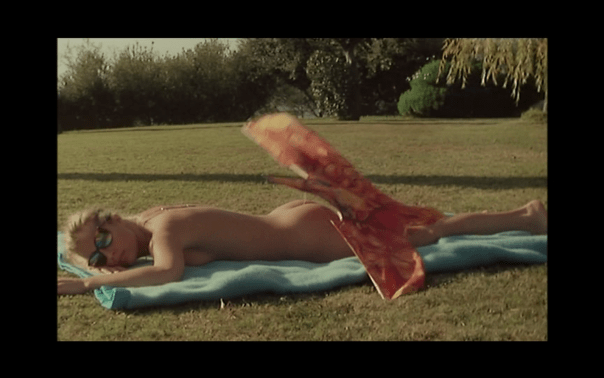
Les innocents aux mains sales/ Dirty Hands is an ingenious thriller by Claude Chabrol with a glorious opening: Romy Schneider plays Julie Womser, a St. Tropez housewife saddled with a rich but impotent husband (Rod Steiger as Louis Womser). As the film begins, she’s sunbathing nude, a kite falls on her bum, a cute man (Paolo Giusti playing Jeff Marle) chases after his kite, she asks him to remove it and offers herself to him. She brings him home; the husband’s there, drunk; they make out anyway; and in what seems a nanosecond, they’re planning his murder. I won’t go into the plot because it’s full of clever twists and continues to surprise until the end. Suffice it to say that it’s an elegant, almost minimalist chamber piece, with outstanding use of sound and the zoom lens so typical of that period.
Screen Shot 2016-08-03 at 13.04.22

What I want to focus on here are the clothes. The 70s are often seen as something of a sartorial joke; and that may be true of men’s fashion, particularly when we look at old family photographs of ourselves wearing psychedelic prints, long pointy collars, flares and platform shoes. But it’s a glorious period for women’s fashion, so influenced by vintage forties clothing with it’s variant on the platform, the knee-length suit, the cinched-waisted gowns etc. And as the 2015 exhibit, Yves Saint Laurent + Halston: Fashioning the 70s, at the Fashion Institute of Technology in New York in 2015 demonstrated, ‘No two designers defined and dominated the decade more than Yves Saint Laurent and Halston. They were the era’s most influential and celebrated clothing creators, becoming celebrities in their own right. Both have been the subject of countless books, articles, films, and exhibitions.’

I have already in this blog commented on St. Laurent’s clothes for Romy Schneider in Max et les ferrailleurs and César et Rosalie. I here simply want to explore the various looks developed by Romy Schneider, Chabrol and St. Laurent in Les innocents aux mains sales and how they function as aspects of the mise-en-scène to evoke something about the type of woman Romy Schneider’s Julie Womser is, how she’s feeling, how she’s hiding what she’s feeling; how they express what’s  happening to her; how the clothes serve the storytelling, characterisation and mood in the film.

Look 1:

After her nude introduction, we’re shown Romy Schneider in a sexy, hip-hugging black dress; elegant, with a jewelled strap but also showing lots of flesh. What’s evoked is wealth, elegance a sexyness that remains distanced , sober and sheathed, but that nevertheless is offered up to Jeff Marle on a white shag rug as soon as her husband has drunk himself into a stupor


Look 2: The kaftan, such a staple of 70s clothing, particularly St. Laurent’s, here conveying elegant couture casual; perfect for St. Tropez and the opposite of what we associate with Demis Roussos. It’s the setting where the husband surprises her with the gift of the car that is to play such an important part in the plot subsequently.


Look 3: The murder

How does a murderess look? Well, a chignon helps. Here Julie/Romy is  dressed in black,  the collar a hint of the sexuality that drives the passion and edges it into murder. Note too the cut of the dress, the bit of leg and the heels, which seem as much of a weapon as the chignon.


Look 4:  The Sleepless Night. Light blue on a darker shade of blue for ‘une nuit blanche’ when she thinks she’s murdered her husband, can’t sleep and gets ready to make up her lies, dress them into view, and lie convincingly to the police.

Screen Shot 2016-08-04 at 18.31.12.png


Look 5: A Kaftan for The Morning After a Murder. This evokes and might be a precursor to St. Laurent’s famous Russian and Chinese inspired collections of the late 1970s. See also look 7.

Look 6 and 7 : Changes to Call the Police, in a darker shade of blue, closer to her sheets than her nightgown in Look 4,  but then returns to Kaftan though this one is slightly different than the one above whilst clearly aiming to recall it. Romy’s Julie clearly’s got a collection in her closet


Look 8 and 9:


She returns to look 2, where her husband had bought her the car, but this time to receive a letter from her lover; and then goes to meet with her bank manager and the police at the bank but in the same dress she called the police  in earlier but now wearing a black widow’s cape. The looks are clearly associative, symbolic, meant to unconsciously render situation and character whilst also recalling situations and events (here she’s wearing the kaftan she wore when she received the car that was her husband’s token of love but which we’re here told is how her lover drove away the husband’s body. Love turned to murder via money and passion)


Looks 10 and 11, Turbaned in black and wearing a respectable and elegant grey tweed to meet her husband’s friend and business manager, where she once more meets with the police who are getting suspicious of her. When she goes to see the judge she wears the same sober and elegant colour scheme but in a different outfit (see image three, below right). It’s like at this point in the plot the looks, colours, even textures of the character are seeping into one another.


I also want to bring in here some of the associations turban sand berets have for us: Frenchness, as we can see below with Michèle Morgan; a Parisian variant of it we associate with the ‘we’ll always have Paris’ flashback in Casablanca with Bergman and Bogart; the intelligence and coolness we associate with De Beauvoir (here with Nelson Algren; the turban was a signature look for her as it avoided having to do her hair, clearly not a problem for Julie/Romy); and lastly the underworld of noir femme fatales evoked by Bergman’s take on Dietrich in Arch of Triumph (Lewis Mileston, USA, 1948)

Look 12: At her nadir, when all the evidence points against her plotting with her lover to kill her husband; Chabrol and cinematographer Jean Rabier film her in silhouette in a flowing dress, with a flowing scarf; when she comes in we see her all in black, like the unfortunate black widow she believes herself to be. Then, when her husband tells her what happened we flash back to her making love to her lover, the glittering strap being all that’s needed to associate this scene with the beginning (Look 1) where she had sex with her lover and which we now know her husband watched. Now she offers herself to her husband in an echo of the first time she offered herself to her lover, naked and in the sunshine; here enclosed in darkness and distance. At the end, he pays her, like the whore he believes her to be.


Look 13: After her husband returns and pays her to have sex with him, Julie makes herself up to be her version of an elegant whore, with St. Laurent seeming to draw inspiration from Lauren Bacall’s look at the end of To Have and Have Not (Howard Hawks, USA, 1944) and Dietrich in Blonde Venus (Josef Von Sternberg, USA, 1932). The Dietrich reference also recalls how in her biography of her mother, Marlene Dietrich by her Daughter, Maria Riva recounts how hard Dietrich worked at her looks, that she designed them in consultation with Von Sternberg and Travis Banton, and how her performances were powerfully based on the progression of ‘looks’ that had a narrative and dramatic function in the film, particularly as ‘put on the scene’ by Von Sternberg as part of his mise-en-scène

Screen Shot 2016-08-06 at 11.59.39


Look 14: In black now, still trying to pretend she’s the innocent and respectable widow but the mise-en-scène showing us the situation is not as as clear as it seems. The grey tweed jacket she wore when she went to see her lawyers is hanging nonchalantly from the chair she’s sitting in and later revealed to be accompanied by a matching skirt:


Look15: In most of the last half-hour of the film Romy’s half black/half tweed turns into full black, eventually accompanied by a crochéd shawl of the sort you’d expect rural peasant widows to wear (and echoing the cape she wore in Look 9 when she first went to meet the authorities). It’ s in this dress that the plot and the actress goes through a whole series of events: she’s discovered not to be a widow, the lover she though dead returns, she gets raped in that dress, and she discovers that when she was thought to be guilty there was no sentence whereas when she’s known to be innocent there is. She does a lot of running — seeking help, fleeing danger — in this dress; and the hem seems to be weighted so that it moves beautifully, in sync and as a result of Julie’s turmoil and distress. It’s the ‘little black dress’ in motion and in performance as put into the scene by Romy Schneider and Yves St. Laurent


Look 15:


Still in black, after she’s been rescued from a rape, and comforted by a red and black tartan blanket, of the sort one associates with Canadian lumber jackets, kilts, homey blankets, and worn like a shawl.


Screen Shot 2016-08-06 at 12.45.03

Look 16:


Telling her lawyer (the wonderfully cynical and funny Jean Rochefort), ‘when I tried killing my husband, nothing happened to me, now I try to save him and I’m been punished’. Her look is entirely calm, sophisticated (the hairstyle), demure (the heavy scarf/collar) and as we can tell not only from the cut and fabric of the clothing but from those earrings, rich. However, the chignon seems to bear witness to murder.

Screen Shot 2016-08-06 at 12.48.28.png

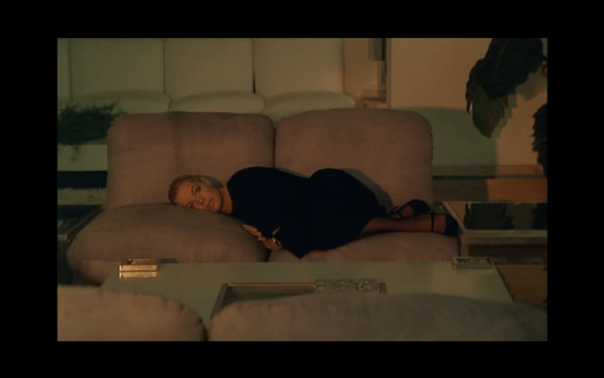
Look 17: Suffering chic-ly in minimalist modern interiors that evoke wealth, richness (the gold cigarette lighter on the otherwise empty table), anomie and lonelyness and before the great finale where the darkness calls out her name.
Screen Shot 2016-08-06 at 12.50.09


Undressing and Dressing:


In a way the whole film is about dressing and undressing Romy Schneider. She’s a mystery the film 9and the audience) is meant to uncover. We first see her in shades, a reflection of the audience’s desires, a morsel eager to be eaten. The film, then often films her in shadow, partially, in silhouette (see image two below)

The film undresses Julie/Romie only to dress her up in various guises, so she performs different types of femininity for her husband, her lover, the police, the judge, and the audience. She’s often shown having agency over this costuming/construction, the clothes part of her masquerade, the body a kind of currency with which she pays and rewards, both part of the way she performs the various aspects of Julie’s character into being. The most telling point is when her husband returns, pays her to have sex like the whore he thinks she is, and she curls her hair and dresses in white in that Bacall/Dietrich echo is that is the only moment we see her in white in the entire film.

In between displaying her body, selling it or having it raped, the film dresses her mostly in black, with various types of accents; shiny for the lover, sober and sleeklined for the murder, enclosing blue when she talks to the police, or framed by grey tweed at the solicitors, or accented by different shawls. The only moments of colour and brightness are the kaftany casualness with the husband or the moment where she contrasts in binary whiteness to accept that she’s prostituted herself to her husband and is wiling to accept the bargain. It’s really quite extraordinary what a look at the uses of clothing in a film can reveal about character, story and storytelling, not to speak of the performer’s art (which I have not quite done so here though Romy Schneider is glorious). It’s a gorgeous wardrobe by Yves St. Laurent, expressively worn by Schneider and beautifully deployed by Chabrol.


José Arroyo

Les_innocents_aux_mains_sales


Suicide Squad (David Ayer, USA, 2016)

suicide squad


Jared Leto’s look and performance were the only thing I really loved about Suicide Squad: he moves from innocent, heightened, romance to some leering looney almost before our eyes; the kind of transformation one remembers from childhood cartoon characters;  and he brings a completely new spin to the role  Heath Ledger put such a strong stamp on that it’s been his until now. But no longer. Leto seems all sweet and innocent and then he begins to leer in a lewd and suggestive way; it’s like sex mixed in with innocence and somehow rendered sweet instead of pervy because it’s the meeting of souls that the Joker and Harley Quinn are after.I though Leto wonderful; he and Margot Robbie together looked like they’d been sketched by the same artist and their relationship is a looney romance that lifts the film every time they share a scene. Most of the rest of the performers were fine, and they did look the part, especially Robbie, though maybe because her role is larger than Leto’s it was easy to see how repetitive it became as the film unfolded. I did find Cara Delevingne quite terrible in the long shots, like she had no idea how a Goddess should move and was simply trying to remember what frenzy had been like in the High School Discos.She’s not much better in the close-ups. Her performance and that of Viola Davis made me think what a straight-jacket ‘realism’ has become to American acting. Like they can’t imagine a stylised performance structured purely for the purpose of effects. What a pity.

But the performers weren’t the problem….At the moment none of these big budget movies seem to know how to do action; yet that’s their bread and butter; they do the look: things exploding, characters poised for movement, explosive backgrounds. But there’s no thrills at, say,  an action completed because the quick cutting prevents one from seeing it; and narratively, there doesn’t seem to be anything at stake in the action: we don’t know the consequences of a shot or a movement, or even what the characters need to do to get out of a situation: it’s barely narrated and it’s not dramatised at all. And yet these films are almost all action; so if that’s not working, the spectacle actually ends up not being very spectacular. I found it dull and noisy. And I’m sorry to say that as I’ve really admired David Ayer’s work in End of Watch and Fury.


José Arroyo


Ghostbusters (Paul Feig, USA, 2016)

ghostbusters

Ghostbusters does have some laughs. But it’s so bad it’s exhausting to watch: everything seems out of kilter, mis-timed, the gags obvious and over-elaborately set up; and one just looks at one’s watch, thinks of leaving, but the charismatic performers and the occasional laughs keep one hoping. It’s the worst-directed comedy I can think of. The movie relies for its energy on the editing, terrible in a comedy. And one just ends up tired and with a headache. Leslie Jones and Chris Hemsworth were standouts; and I do love Melissa McCarthy. Even in this.

The twitterstorm over the reboot has been ridiculous. I saw the original when it came out and liked it. It was a fun summer film with a truly great comic performance from Bill Murray – wry, slobby in appearance, cutting in attitude, smartly knowing and totally endearing. He’s what was great. As a film, the original Ghostbusters (Ivan Reitman, USA, 1984) has been fetishized beyond all comprehension.

The reply to the sexist reception of the reboot has been that a lot of women seem to like the film. Part of the reason has to be Melissa McCarthy. She’s got warm eyes, seems human in her gestures and responses, and has crack timing. She’s really the biggest female star of the moment, practically the only one to have a star persona so defined as to be deployed in high concept films. The only thing many of her films have going for them is her; it’s not as if she’s the weak element coasting on the success of the other aspects of her films. They’re not much to speak of and yet she turns them into hits: audiences like her.

But she’s not enough in Ghostbusters (and perhaps to the film’s  credit and as validation of it’s feminist politics, she’s not the best thing about it either: everyone has their moment in this ensemble). I liked the buddy aspect of the film, and the interaction between the women. But some of the rah-rah sisterhood stuff felt really forced and the last shot of the four women hugging…well…Add to that that the whole supernatural aspect of the plot seems pointless, undramatic and uninspired and one isn’t left with much. On the other hand, and to be fair, one can’t deny that it creates a fair share of laughs; and to paraphrase Lubistsch, I wouldn’t sneeze at such laughs, especially in a comedy.


José Arroyo


Gérard Depardieu in Sautet’s Vincent, François, Paul …. et les autres (Claude Sautet, France, 1974)

Screen Shot 2016-08-01 at 10.53.26.png


One of the many great pleasures of Claude Sautet’s marvellous Vincent, François, Paul ….et les autres (Claude Sautet, France, 1974) is to see Gérard Depardieu, at the beginning of his film career in 1974, the very same year he became a star with Bertrand Blier’s Les Valseuses alongside Patrick Dewaere and Miou-Miou.

In Vincent, François, Paul ….et les autres, he plays Jean Lavallée, a factory worker and part-time boxer who is one of ‘les autres’ in the title: not a starring part but a beefy supporting role. He’s Vincent’s surrogate son – the son of one of Vincent’s childhood friends since passed away — and their interaction here — loving, affectionate, physical — is a champions meet of working class heroes; from different generations but speaking the same language.

I want to write about Yves Montand’s great characterisation of Vincent in another post. Here I just wanted to draw attention to Depardieu, partly because he’s young, coltish, graceful; so many qualities we no longer associate with his star persona but which nonetheless inform it; and also because he has this marvellous nervous energy – Judy Garland, Jane Fonda, and James Cagney all had it – that is electric and seems to displace air.

He’s completely relaxed and capable of stillness and focus but also gives the impression that he prefers running to walking; that he’s so alive he’s constantly in process of becoming: each of his character’s reaction will be one amongst limitless possibilities and a continual surprise to the viewer.


Screen Shot 2016-07-31 at 12.35.29.png
Depardieu doesn’t walk when he can leap


His face is all angles; it’s at once the face of an everyman – it’s not quite pretty – yet surpasses mere handsomeness and brings us into the realm of beauty. His body is also that of a fit young man but awkwardly shaped too; already the tummy’s too round, the legs aren’t long or strong enough, the muscles those of someone who will most likely be ko’d in the next round.


Screen Shot 2016-08-01 at 12.18.23
The embattled imperfect body of the working class

His is an image possible to identify with and of course Depardieu’s acting make that identification not only easy but almost inevitable. It’s good to remind ourselves of that with Depardieu. Plus, is there a more fearless actor? Here he’s got a shower scene where Michel Piccoli, Serge Reggianni, and at least half a dozen other actors, all fully dressed, are congratulating and arguing with him in the shower and he’s the only one nude. Is there a bigger nightmare for an actor? It’s a complex shot too, the camera starts on Depardieu, moves away from him to the point where his pubic area is clearly visible but then fixes on Michel Piccoli’s Franćois and follows him out of the room. It must have taken many takes to get it so right. It’s a scene completely unimaginable a generation earlier; one that few actors of his generation would have dared and that fewer still would dare do today.

Daring and danger:


José Arroyo

Jason Bourne (Paul Greengrass, USA, 2016)

jason bourne

I tuned out of the last chase sequence AND the last fight sequence of the new Bourne film: I don’t know what I missed and I didn’t care. I hate the way Greengrass films action. And yet….I quite liked Jason Bourne. It has a terrific cast, all-star, an interesting development in the story, that great final song, the explicit commentary on the political, and that continuing sense of being completely alienated from everything except survival. I never get tired of watching them on tv. And I’m sure I’ll see this one many more times to come. A contradiction I suppose.

The all star cast includes Tommy Lee Jones, Alicia Vikander, Vincent Cassel and Julia Stiles, all in great form and a pleasure to see.


José Arroyo

Favourite Films July 23, 2016

New FB game doing the rounds. An FB friend asks you to list your X favourite films. Kevin Stenson gave me 21 and I wrote the first ones that came to mind, in order, without reflecting. It will almost certainly change tomorrow. I nonetheless thought it worth sharing.

1. Law of Desire
2. A tout prendre
3. Tokyo Story
4. Rocco and His Brothers
5. Spirit of the Beehive
6. Some Like It Hot
7. Vagabond
8. Les Parapluies de Cherbourg
9. La Verité
10. Written on the Wind
11. Aliens
12. Meet Me in St. Louis
13. Swing Time
14. A Star is Born (Cukor version)
15. Dog Day Afternoon
16. Foul Play
17. North by Northwest
18. Big Deal on Madonna Street
19. Bringing Up Baby
20. Pixote
21. Los Olvidados


José Arroyo

Le Samouraï (Jean-Pierre Melville, France, 1967)


‘Alain Delon ne parle jamais si bien que quand il se tait’/ ‘Alain Delon never speaks so well as when he’s silent’, François Mauriac, Le Figaro littéraire.1

le samourai
Spanish poster outside the Cine Doré

Le Samouraī is all slate-grey sadness edged by Courrèges-like white modernist elements and encased in lazy jazz. Plus Alain Delon in his prime: Gorgeous. I had the luck to see it at the Cine Doré, the cinema where Benigno (Javier Camará) goes to see the silent ‘The Shrinking Man’ in Almodóvar’s Talk to Her and which acts as a metaphor for a loving violation. It’s worth remarking that the Spanish title of Le Samouraï, El silencio de un hombre, which translates literally as ‘A Man’s Silence,’ here markets noir, whereas a woman’s silence, like the women in Talk to Her, women whom circumstance prevent their speaking their truth, would instantly connote melodrama. The connections between noir and melodrama interest me and Le Samourai, like Talk to Her, is mired in muteness.

Delon’s Jeff Costello appears to us as languid loneliness enveloped in puffs of smoke from the first shot and he remains – not autistic, not even impassive – rather recessive, detached throughout. Is it that he can’t speak his ills or that he simply doesn’t know them? No matter, Melville and the film do, and every frame and camera move speaks them. The world of Le Samourai is a dirty one for a professional hit-man who claims some honour. Delon’s Costello is focussed on doing but disconnected from being, yet wanting. He’s desired but unable to reciprocate such longings: desire would imply longing, wanting and indicate a rooted and fleshly existence that Costello seems detached from. It’s a glorious film. Lovely print too. My main visual memory is an image of Delon as Costello, filmed outside his car window, rendered out of focus by fog and rain. The most memorable scene is the last one, where his professionalism battles his honour and Being succumbs to Nothingness.

samou2
Italian poster

José Arroyo

  1. Cited in Bernard Violet, Les mystères Delon, Paris: Flammarion, 2000, p. 188. Translation my own.


Weekly Film Roundup 6th of July

Now You See Me: The Second Act (John M. Chu, 2016)

now you see me

I rather liked Now You See Me; and I love caper films, magic, Mark Ruffalo, Woody Harrelson, Jesse Eisenberg and Morgan Freeman. But all of that together didn’t add up to liking Now You See Me: The Second Act. Daniel Radcliffe is a very unsatisfactory villain; that he’s often paired with Michael Caine in the frame invites comparison and only highlights his shortcomings: one can see that Radcliffe is giving a performance that’s been thought through but Caine still squeezes more out of one tired  look or the way he says ‘bastard’ than Radcliffe does from his whole frantic performance. Moreover,  the camera woozes about all over the place. And the cons have to be painstakingly explained as an addendum at the finale. It wasn’t painful to watch. And there was a moment where one of the wonderful card-trick set-pieces was revealed, where the guy behind me said ‘Ooohh that’s so sexy’. But it could have been so much better. The inclusion of Chinese elements (language, location, casting) as a way of catering specifically for that market I have mixed feelings about: it could be enrichingly multicultural or it could seem a cheap commercial gimmick. Here it feels the latter. Too bad.


The Legend of Tarzan (David Yates, 2016)

tarzan

Will anyone care that The Legend of Tarzan is terrible?: Christoph Waltz is the villain and Alexander Skarsgard swings half-naked from trees on IMAX. The filmmakers have tried really hard to resolve issues of racial representation. It’s everywhere evident. But they’ve failed, again; and it might just be that they are insurmountable if one takes Edgar Rice Burrough’s world as a given. This is all a fight against the King of the Belgians enslaving the peoples of the Congo; so its got a historical basis which neatly creates a villain whilst leaving a history, not to mention an analysis, of British colonialism untouched and neatly off the hook: the racial politics are, at best, contorted. Margot Robbie is acceptable but doesn’t shine. Samuel L. Jackson is Samuel L. Jackson. Waltz is Waltz. Djimon Hounsou looks and acts better than both. But Hounsou’s performance and Alexander Skasgård swinging half-naked from a tree do not compensate: the film is terrible.


Absolutely Fabulous: The Movie (Mandie Fletcher, 2016)

ab fab

I loved Ab Fab the movie. It’s trashy, inconsequential, uneven but with great jokes and many real laugh-out-loud moments. Like the show, but with everyone looking 20 years older and the film making that it’s central issue. When discussing the film with friends, I was surprised that so many of them took issue with Jennifer Saunders. She’s shy and stiff and awkward and not a natural performer. But she makes that funny to me. This is the type of film where Joan Collins appears in multiple cameos as herself, all trying to look 25. If you can’t see the humour in that, or in the film actively responding to internet rumours that Patsy might really be Patrick, stay home. If you think Kate Moss drowning in the Thames might make front pages internationally and care about Jean-Paul Gaultier, this film is definitely for you.

Badlands (Terence Malick, 1973)

badlands

A real treat to be able to see Badlands again in a gorgeous print at The Electric Cinema in Birmingham: the landscapes, the tone, Sissy Spacek: all were better than I remembered; and Martin Sheen wasn’t as bad. I first saw it when I was a teen and then found it dull and unexciting. I have seen it since, but on a small screen, and the effect of the landscape also passed me by. It’s simply gorgeous in this print and on a big screen; it affects you viscerally in a way that it hadn’t me when seen on a TV monitor. I learned to appreciate it as I got older but didn’t really love it until now. It is definitely a serial killer road movie. Spacek not only looks the part so terrifically but she does tiny gestures, lovely, that flesh out a performance ever so beautifully and that are communicated clearly and powerfully on a big screen. I’m still uncertain about Sheen. Personally, I don’t find Spacek falling for him so quickly is credible: his tightly worked-out but pinched and slightly contorted body, his lack of height, which no careful staging can conceal; his age. Why he falls for her is clear; the reverse isn’t quite. I took it as a conceit of the film; something one simply decides to accept. Sheen is interesting because everything he does is good  but I can imagine other people being more effective in that part (for some reason Jan-Michael Vincent, then a hot up-and-coming star but not nearly as good an actor, is the first to come to mind as better casting; someone with a real sexual threat that doesn’t need unexpectedly shooting people to convey it); a fascinating oral history of the film in GQ mentions that Don Johnson and Robert De Niro were also mooted for the part. All then had the sexual threat and the charisma that Sheen lacks here. On the other hand, this is all speculative. Sheen is a wonderful actor and is better than good here. And really, it’s all quibbling. Badlands is a work of poetry and a truly great movie.


José Arroyo


Gods of Egypt (Alex Proyas, US, 2016)

Gods of Egypt

On the evidence of Gods of Egypt, Gerald Butler might have found his calling playing villains. He’s terrific and so is the movie. It’s like the very best ‘Sword and Sandal’ films of the 50s — lots of gorgeous semi-naked people cursing fate and doing graceful things with their bodies they call ‘combat’ –but with more interesting and sophisticated visuals. The film shows us Gods twice the size of mortals in the same frame throughout. It’s visually extraordinary i.e. like he major spectacular moments of films like Ant-Man but treated nonchalantly, not really drawn attention to, just part of this magical world conjured up by Alex Proyas. It’s a look that becomes gobsmacking upon reflection and in retrospect — and that’s just one aspect of this gloriously imaginative film. Some of the acting, however, is still at moments bad enough to bring out a camp response. So, all in all, rather perfect.


I was surprised to see that the reviews have been so bad. It seems performances are all professional critics pay attention and performances are a problem in Gods of Egypt . However, Butler has never been better. Rufus Sewell, who was so memorable in Proyas’ classic Dark City is still looking very handsome and is very good as a cold and conniving architect. Some have expressed surprise he’s never quite become a star but he’s had lots of chances. People can’t seem to identify with him, one of the many reasons he’s so effective in this. There are a few duff performances, but not offensively so (Nicolaj Coster-Waldeau is no different in Game of Thrones and no one seems to mind; and except for the final speech he makes at the end, I thought he was fine); and I think the story is an interesting one (the origin of the kings of Egypt), well told, and timely (it’s partly about the need of the 1% to listen to the 99%).

I think Proyas is a master at constructing arresting and meaningful visuals. The film is tons of fun, with superb set-pieces, action that genuinely engages and thrills and is visually pretty breathtaking at times. I know there’s been a brouhaha about the casting. But no one’s wearing blackface; how exactly were Egyptian Gods supposed to look like at the Dawn of Creation? And even if we admit that there’s a tinge of racism to the casting of this film, why is this more the case here than in any other big budget spectacle film? Gods of Egypt will undoubtedly become a staple of television schedules for year to come but there may not be too many opportunities to see it in its full glory. If you can, go for the full IMAX 3-D treatment. It’s worth it.


José Arroyo

Love and Friendship (Whit Stillman, USA, 2016)

love and friendship movie poster

Based on Jane Austen’s Lady Susan, Love and Friendship won me over in the end. But I did wonder if it wasn’t too slight, derivative and possibly better as a play. It’s a stupid think to say — and wrong also –but for lack of a better way of putting it: I at first didn’t think it was cinematic enough (except for the explanatory subtitles at the beginning and in the letter -reading/writing scenes which structure the narrative). I thought it too talky. But then the film’s languid rhythms, its classic but slightly askew compositions and it’s tone – which a friend described as on the right side of arch – won me over. I did end up loving it. But I wasn’t sure I would until it ended.

Adrien Garvey has described Love and Friendship as a sketched-in heritage film, which I think describes it beautifully. It doesn’t offer the visual pleasures of the traditional heritage films such as A Room with a View (James Ivory, UK, 1985) or other Jane Austin adaptations: the sumptuousness of place (here the stately home is slightly run-down), costume (modest for the period, slightly worn, like the best clothes of those who can’t quite afford them) or setting: none of this is used as spectacle here. But then, to its credit, it also eschews the nostalgic tone of heritage in favour of a smarter, slightly more worldly and wittily cynical flavour. Unlike Chlōe Sevigny, who’s every appearance as Alicia Johnson seems to leap off the screen, Kate Beckinsale seems to lack charisma in the first scenes. But then her performance wins you over on merit: Her Lady Susan takes no relish in her wickedness; she doesn’t underline or make a show of it; all Beckinsale does simply becomes who the character is. It’s a shrewd, witty and understated performance. And then there’s James Fleet who steals every scene he’s in with mere intonation.

Love and Friendship is an elegant chamber piece that feels slight, echoey, thin and empty at the beginning but fills out, gets richer, more resonant, and more enjoyable as it unfolds. Very typical and very good Whit Stillman.

Pamela Hutchinson has written a wonderful piece on the film’s use of intertitles that you can find here.

José Arroyo