All posts by NotesonFilm1

About NotesonFilm1

Spanish Canadian working in the UK. Former film journalist. Lecturer in Film Studies. Podcast with Michael Glass on cinema at https://eavesdroppingatthemovies.com/ and also a series of conversations with artists and intellectuals on their work at https://josearroyoinconversationwith.com/

Paul Bush at the Escuala Internacional de Cine y Televisión (EICTV) in Cuba

bush 1


Paul Bush from the National Film and Television School arrived at the Escuala Internacional de Cine y Televisión (EICTV) in Cuba on Monday to show some of his films and talk about his practice. He’s of the Damien Hirst generation that studied Fine Art at Goldsmith College he says, but was always more interested in conceptual art than painting and somehow drifted onto film (I was amused by the translator, who was excellent with all the difficult terms and technical language, not knowing who Damien Hirst is, as was evidenced by the many different gos she had at the name).

He puts a picture of a cow onscreen, not showing the film but indicating how that was from his first film, entitled The Cow’s Drama (1984), the result of following a cow in a field in Wales for two days, and how it took him over a decade to make the first film he was paid for, His Comedy (1994), a stop-motion rendering of Dante’s Inferno, using Gustave Doré engravings as a model through which to cut right into the celluloid. The cutting into the colour film was a surprise, as he found himself also scratching into layers of colours, thus creating a series of striking colour effects, at first unintended, then worked through and consciously deployed.

bush3

It’s a very beautiful work and led to his being able to make a living making short films, a considerable achievement. He says he was of course aided by the founding of Channel Four in those years which had as its remit a provision of minority programming, which aside from works for the disabled, people of colour, gay communities etc, also included a remit for experimental cinema, a term he says he dislikes due to its connotations of seriousness and dullness. He says he likes movies, shown in a theatre and that there’s room for frivolity and fun in seriousness.

Bush also showed his latest work, The Five Minute Museum (2015), beginning with stop-motion images of stone, then swords, porcelain, chairs, clocks, all giving the impression of being constantly in flux. The most striking of these was a montage of the drawings on Greek pottery, through which he created the striking sensation of the history of the world being all about love, sex, art and war all in communication with each other and all exploding together before ending in a museum behind glass.

bush2

His work is intriguingly conceptual; in Furniture Poetry (1999), he takes Wittgenstein’s question of ‘Is a chair a chair when we’re not looking at it? Does it become one only in response to our gaze?’ a starting point to show us tables changing before our eyes, then green apples turn red, apples turn into pears and so on, converting before our eyes, 24 x a second. In Dr. Jekyll and Mr. Hyde (2001), Bush uses the same set-ups that Victor Fleming deployed in the 1941 MGM version with Spencer Tracy, Ingrid Bergman and Lana Turner, but condensed in stop-motion and accompanied by dream-like excerpts from the original soundtrack to create an effect similar to human schizophrenia by subtly changing every single frame but leaving the narrative superficially intact. It’s marvellous.

Bush offers the usual advice to students — ‘keep your collaborators with you as long as you can even though there will be fights’ – but what I remember most is his example of the concept of ‘tree’; how when we read the word ‘tree’ in a book we all share in the imaging of a tree but the tree which each of us actually imagines is different, and thus the role of the filmmaker is to create that ideogram, that image which each member of the audience can share but also take hold of, create something with it they can treasure, that is also uniquely theirs. Lovely thought from a stimulating talk by a charming man.


José Arroyo, EICTV, April


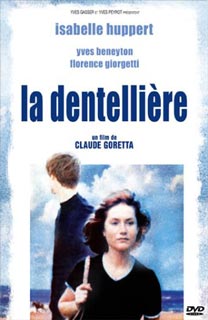
La dentellière/The Lacemaker (Claude Goretta, France/ Switzerland, 1977)

ladentellieredvd 2

A young girl nicknamed Pomme (Isabelle Huppert) works is an assistant at a beauty salon, living a quiet live with her mother and enjoying a close friendship with Marylène (Florence Giorgetti), the owner of the salon, a bitter, aging romantic who seems to lay herself open to any new relationship only to be regularly dumped. Marylène and Pomme go on vacation to Couburg, on the coast of Normandy, so that Marylène may recover from her latest heartbreak. This happens swiftly and Pomme is left alone, to her own devices, and rather vulnerable. Pomme is quickly spotted by François (Yves Beneyton), a tall angular bourgeois who’s charmed by her reticence and purity. They fall in love. He tests her, asking her to close her eyes and follow his directions so that he takes her right to the edge of the cliff to prove her trust in him. But really she shouldn’t have.

On their return to Paris, and wrapped up in each other and in a haze of love, they quickly set-up home together in a tiny apartment. Soon, however, class differences appear, start pecking at their happiness, and eventually shatters it: She doesn’t know how to handle the cutlery at dinner in his parents’ country house; the best his mother can say about her is that she’s honest; she can’t really participate in the conversation with his radical intellectual friends. But he really can’t explain the dialectic to her, much less its historical materialist variant. For all his tremulousness, delicacy, and shows of concern, he’s a selfish phony. Eventually, he leaves her. He’s surprised and guilty that she offers no resistance. But she sinks into a depression, faints on the street and is brought to a sanatorium. He goes visit her, but Mr. Sensitive needs his friends to come along for support. He’s more interested in being reassured that he hasn’t done anything wrong than in seeing how she really is. He asks her what she’s been doing. She’s been to Greece she says. Has she been with other men? Oh yes, many. He takes his leave and she returns to the sanatorium reading room, adorned by tourist posters of Greek holidays she’s obviously only been to in her dreams, as she starts to knit her lace; her future a reliving of the only love she’ll ever know, from one, who like her father, and like all of Marylène’s friends, wasn’t worthy.

It’s a lovely film, edited in languid rhtyhms, and interestingly feminist. The film begins at the salon, women beautifying themselves, making themselves up, putting on masks of femininity so that they can perform the masquerade as they leave the salon, masks which Pomme rejects: she can’t help being too much herself; she’s got no guile; it’s what will attract François to her and the reason he’ll eventually leave her. Despite living for the ideal of romantic love, none of these women get to experience it past the first stage of courtship and sex, except the intellectual Marxist friend of François, the independent woman, who by the end of the film is settled with her husband and expecting a baby.

Isabelle Huppert is extraordinary, first as a plain girl, barely past adolescence, then someone mysterious and astonishingly beautiful (one can understand why François is so taken with her) and lastly as someone so withdrawn she’s barely there, with a measured tentative walk and a pinched blank face; her future an endless clicking of herneedles; her lace-making ensuring that any thought is kept mechanically but efficiently at bay. A close-up image of her so made-up that she’s like a mask of the woman she thinks he wants — which then turns out to be the moment he chooses to reject her so that the mask is shattered by tears — is moving, beautiful and mysteriously resonant. It’s an extraordinary performance and the main reason to see the film.

But not the only one. Claude Goretta is probably best known in Britain as one of two young Swiss filmmakers (Alain Tanner was the other) so inspired by the two first Free Cinema programmes that they were inspired to make the marvellous Nice Time (1957) documenting London’s Piccadilly on a Saturday night. But abroad, Goretta made a name for himself in the 70’s and 80s with acutely observant and complex films such as Pas si méchant que ça/ The Wonderful Crook (1974) and La Provinciale. Pauline Kael said of the former, rather derisorily, ‘we know we’re seeing films made by artists’. But we do; and we are; and they’re worth seeing again. The Lacemaker is an excellent place to start.


José Arroyo

Seen at EICTV in Cuba


A very brief note on gay ‘sensibility’ in Foul Play


This thought was incurred by the Before Stonewall programme of films at Lincoln Centre and by Guy Madden’s excellent programme of films at Harvard, as well as the suspicion that retrospectives of ‘gay’ films almost always dwell on instances of representation rather than ‘sensibility’ or ‘structures of feeling’ or other elements that are harder to classify but just as clearly communicated, and historically perhaps even more important, as they were a subcultural form of communication but clearly understood through mainstream media, something akin to the minstrelry Henry Louis Gates Jr. describes in Blues, Ideology, and African American Literature, A Vernacular Theory, when he describes blacks donning black-face in minstrel shows and performing to a mixed audience in a way so inflected that the black audience were aware but the white audience possibly not.

I saw Foul Play when I was 14 and it’s the first film I saw which I knew was somehow gay without it having any gay characters to speak of. Today there are many things one can point to: the film’s empathy with outsiders and misfits of all kinds (though some might find the scene above on the verge of being offensive; the film makes amends later); the feminist overtones which then over-hung the incipient gay liberation movement — a girlfriend gives Goldie Hawn’s Gloria a whole array of tool with which to defend herself against male aggression; the San Francisco setting; the way the Dudley Moore character travels through the saunas and discos in search of a quick shag in ways much more characteristic of gay men of the period than heterosexual ones; the type of cinephilia, with its adoring send-ups of thriller/horror tropes; the opera sub-plot and it’s comic use of Gilbert and Sullivan’s The Mikado; the plot to kill the pope; the camp humour with which it’s all told; the tracing of this sensibility to its director, one of the first to be openly gay, who had written Harold and Maude before and would later go on to direct such camp classics as 9 to Five and Best Little Whorehouse in Texas before dying of AIDS in 1988: one easily notes the patterns of the films and of the career.  Back then, the only thing I could point to was how in the last shot, the extras looked like the pornstars that then adorned the covers of Blueboy or Mandate magazines, and were later to adorn the covers of Falcon videos. As you can see from the clip above  — where Goldie Hawn plays a librarian who is being chased for a microfilm she doesn’t know she has by a killer nicknamed The Dwarf — it’s all very gay, in every sense of the word. And one knew it, even then, even at 14 but without quite knowing why.


José Arroyo

Screen Shot 2016-03-07 at 18.55.43.png
An image that seemed suspiciously like porn

The Bling Ring (Sofia Coppola, USA, 2013)


BlingRingPB_CoverFINAL

When I saw The Bling Ring on its initial release I wrote myself a note: ‘Permit me a speculation: If Sofia Coppola were a male director or if a greater proportion of film critics were female, there would have been shouting from the rooftops at the appearance of The Bling Ring’. Seeing it again on Monday confirmed my first impression. Sofia Coppola is a great filmmaker, in every way the equal of anyone of her generation – she’s only in her early forties; young for a director — and with a very particular style: beautiful compositions that are edited dynamically but elliptically, long sequence shots in which character complexity is allowed to be slowly revealed, the use of different textures of image (video footage, computer screens, phones) to allow for different points of view on the narration; all of this mixed in with montage-sequences set to music that are almost like video clips but here with the juxtaposition of images and sound used to communicate an idea or a state of mind rather than to sell you the song; and all her films demonstrate a brilliant use of an eclectic range of music (here the electronic techno sound familiar to e-culture clubbing but with an American hip-hopping rap overlay).


Coppola’s also got a point of view: a wry, sharp intelligent look, sometimes ironic, sometimes empathetic; always understanding but without necessarily condoning; one that suggests rather more than is shown; that hints there are implications other than the immediate ones and that the audience might find things to treasure if they not only looked but also thought about what they had seen and not seen, what they had heard and how. Her films treat the audience as intelligent beings interested in finding out more about what their world is like through the very particular ways she fictionalizes the world that she shows us in ways that we understand they are also our own; on what it is to be human today through the people her actors bring to life; Coppola communicates precisely but ambiguously too. It’s fodder for the audience’s particular experience and thoughts, through getting the audience to see and feel – but it’s always for the audience to decide. She’s smart, tactful, and as skilled and talented as any director working today.


Coppola’s oeuvre also contains a set of themes she constantly returns to: what contemporary culture feels like to a girl (e.g. The Virgin Suicides), the pleasure and power of pretty things in a shallow world (Marie Antoinette), but also what a culture so heavily centred on the acquisition of those things does to people. Pretty people worship pretty things in most of her films, and not all of them are bad for doing so but we all suffer when such acquisitions become practically the only lauded and supported desire in a consumer culture, our culture, which is based on the creation of such wants. Her work focuses on middle-class people or upwards, and usually deals with celebrity culture in particular (Lost in Translation, Somewhere, Marie Antoinette) and the anomie, the distance from the self and from others that such a state of celebrity creates in such a shallow culture. Part of the reason her films are great is because she illuminates the distance between her characters’ understanding and their feelings, the former so shallow, the latter so complex and alive; the two together an illustration of the frenzy the self is driven to when alienated from others and the world.


Her work is funny in an understated way, eliciting a knowing chuckle rather than a guffaw. But her camera and compositions first depicts a set of very privileged people commodified by their own desires, and then slices away all illusions humanely but uncompromisingly, to show us what is left. She’s worked with great cinematographers, Lance Accord who shot Lost in Translation and Marie Antoinette and also, and importantly, Harris Savides who filmed Somewhere and enough of The Bling Ring to have established its look before dying during its filming — Coppola dedicates the film to him in the opening credits.

In ‘Frame by Frame, the Best Shots of 2013’, ’ ‘The Playlist Staff’ ranks the shot where we’re shown the robbery of Audrina Patridge’s house in The Bling Ring as the 2nd best shot of the year (Roger Deakins’ shot of the tree in Prisoners beat it to no. 1) and writes, “We’re not sure who was responsible for the shot, since the original cinematographer Harris Savides passed away during shooting (Christopher BlauveltSavides’ longtime first assistant took over from him), but whoever did created the film’s most memorable sequence as the camera slowly pushes in while the robbery occurs, all in one single shot, without the accompaniment of music or many sound effects (a car drives past here, a dog barks there). The shot operates like a mini-essay about insignificance, about how notions of privacy crumble in the face of a celebrity culture that is all about putting oneself on display for consumption, but also Coppola’s detached, voyeuristic camera summons up her frequent themes of the alienation and isolation of modern life—how nobody cares this is going on in plain sight and how everyone, like the gang themselves, feels removed from any real consequences.”


The Bling Ring is based on an article Nancy Jo Sales wrote for Vanity Fair, ‘The Suspects Wore Laboutins’ and which Sales later turned into a book, called The Bling Ring, after the movie, in which a still from the film, also the central image for the movie poster, is used as a cover (see the very first image above). It’s a tie-in, what would normally be a novelization of the film’s story, but here used to expand the account of the true story that forms the basis for the film. As the back cover shrieks, ‘The True Story That Inspired the Sofia Coppola Film’ in large print and in blue, then going to recount in a smaller size but bold ‘It was one of the most brazen crimes in recent Hollywood history: Paris Hilton, Lindsay Lohan, Orland Bloom, Rachel Bilson robbed – more than $3 million in clothing, jewelry, shoes and handbags reported missing. Who had the audacity to commit such a crime? Meet the Bling Ring. A gang of rich, beautiful, wild-living Valley teens…with everything to lose.’ And then in regular print, ‘Over one year, seven teens allegedly burgled the homes of the biggest names in Hollwood, using Google maps, Facebook and TMZ to track the targets’ whereabouts’. So, in a nutshell, we can see what drew Sofia Coppola to turn the story into a film: teens on the cusp of adulthood obsessed with celebrity culture, feeling lost but coveting luxe, and using social media and new technology to get the goods they covet and get close to who they want to be even as they search to connect with one another.


Part of the richness of the film, and perhaps part of the reason why audiences didn’t quite embrace it, lies in its structure: on the one hand the leader of the gang is Rebecca (Katie Chang); on the other, the biggest star in the film is Emma Watson who plays Nicki and who in the film embodies all that’s wrong with contemporary American culture; yet, the central character and the film’s narrator is Marc (Israel Broussard); and at the core of the film is the love affair between Marc and Rebecca, an almost archetypal gay boy/ straight girl love affair. The film has a trio of protagonists, each with a different import and resonance in the film’s narrative.

Rebecca is the teen femme fatale: smart, the object of the gay boy’s desires, duplicitous, unknowable. ‘I loved her,’ he says, ‘that’s what’s so terrible about what happened I really loved her, like a sister’ There’s a scene in the car, after they’ve just committed a robbery and edited together by a series of fades to black, when he asks her would she ever rob him if they ever stopped being friends. ‘No I would never do that to you’. And then, at the end, she un-friends him on Facebook.

The film’s …. villain might be too strong a word, the film is too complex to pick a facile target, let’s say the dramatic embodiment of the film’s critique of American culture is Nicki; home-schooled by her mother in ‘The Secret’ using wish-boards about Angelina Jolie as a teaching tool; so uneducated she thinks Africa is a country; having celebrity and the acquisition of high-end luxury designer goods as her main goal in life; willing to use her body to get what she wants; and completely amoral not through design but through circumstances and education. She’s an embodiment of the hyper-real; she knows the right things to say, the right way to seem (‘I want to lead a large charity organisation’; she’s merely been a victim of her friendships) but has no more moral or ethical thoughts beyond that. Rules don’t apply to her. She seems to exist in a mediated world and understands the world only as it is mediated by celebrity culture. Interestingly Marc, the narrator, appears in the second shot and is also given the second-to-last shot where the story proper ends; the last shot is the punch-line, the afterwards, the way the film seals its critique.


The Bling Ring’s focus is on the gay boy. He’s a Mama’s boy with bruised lips who suffers from anxiety and depression. He wants friends, wants to fit in. He already knows and is comfortable with his desires but has not yet learned to be ‘gay’. There’s a brilliant shot near the beginning where he’s out of focus at the high school and he comes into being, he comes into focus, once he sees Rebecca, once he makes a friend. It’s kind of a queer film by a heterosexual woman and the sympathy is with the boy. The shots at the end where the steel door to his future gets shut down on his way to the LA county jail — one’s heart just cracks at the idea of what this sensitive boy will face there — whilst the girl played by Watson gets interviewed at the end by TMF, transforming every question the interviewer asks about Lindsey Lohan into one about her own sensitivity and suffering, lying through her teeth, selling her website and angling for the reality TV series the character she’s based on eventually got.

The girls are meaner, they know what they want, they’ve been around, and are capable of being wanton bullies. They’re girls on the make and their willingness to make out with VIP customers at the club who may be of use to them in the future is what will make and unmake them. I love the way that Coppola looks at girls, the tribalness of girl culture, the deceit and lies and seeking of status, how they can be so casually or so calculatingly hurtful at will, how they hierarchise their relationships within the group in a way that’s invisible but instantly knowable to all, but also the support and affection. The scene with the gun during the Megan Fox robbery, where one of the girls threatens Marc with it; then, as soon as he resists, threatens ‘’are you pushing a girl, is as charged and dangerous as any I’ve seen and a wonderful contrast to a similar scene in Spring Breakers (see clip below): Coppola sees the relationships between the girls as complex and multifaceted; Korine doesn’t. Unlike Coppola, Korine has to sexualize a moment in order to motivate a shift in tone.

The Bling Ring is a critique of celebrity culture that simultaneously makes our obsession with that culture understandable. Each of their robberies is almost foreshadowed by what’s happening to Lindsey Lohan. Coverage of her court appearances punctuate and comment on the film’s action. The narrative is interestingly made up of scenes for which there are real-life equivalent available to see on You Tube (the Nick Prugo webcam ‘Drop It Low’ sequence (this has now been removed); the CCTV footage of the Audrina Patridge robbery). The narrative is also made up of different textures, the differences brought to the narrative when it’s TMZ footage, or CCTV, Facebook, or selfies. For example in the ‘Drop It Low’ sequence, it starts in black and white, the texture and colour of the image indicating that it’s on webcam, going out into the world, then moving into the film’s real diagetic world via a change in grain and colour with the question now over-hanging that this boys innermost private desires are now being made public and visible to who knows who, how vulnerable that makes him, and how unaware he is of it all. The film’s use of many different textures that are each conduits to a whole series of different narrative devices whilst making the overarching story seem so simple is but one of the things that makes the film so rich.


In The Politics of Aesthetics Jacques Rancière writes that he’s ‘concerned with aesthetic acts as configurations of experience that create new modes of sense perception and induce novel forms of political subjectivity’. So should we all; and that’s what Sofia Coppola provides us with in The Bling Ring: a way of understanding celebrity and consumer cultures that makes understandable the lure and danger of pretty things whilst simultaneously providing a pretty devastating critique of it.


José Arroyo

IN PRAISE OF THE CINEMATECA PORTUGUESA – MUSEU DO CINEMA

IMG_3163A few weeks after returning from Lisbon I’m still in thrall to the memory of my visit to the ‘Cinemateca Portuguesa – Museu do Cinema’. It took us a while to find. We originally thought that it might be the building on the majestic Avenida de Libertadores that is also part of the Museum and that was then holding Saturday screenings of children’s films as part of a festival of children’s cinema taking place throughout the city.

IMG_3142.jpgThe Cinemateca itself is housed in a grand building just off the grand boulevard, on Rua Barata Salgueiro. When we went in the afternoon to buy the tickets – I was eager to see Nicholas Ray’s They Live By Night on celluloid — the ticket-seller apologised for the price, €5 instead of the normal €3. It was more expensive because it was considered a special event: the great Bernard Eisenschitz, surely one of the world’s foremost authorities on the work of the great American director, was giving nightly introductions to a series of less celebrated Ray films: On Dangeous Ground (1952), Bitter Victory (1957), Wind Across the Everglades (1958) and We Can’t Go Home Again (1971-1980).

IMG_3143

We would be missing Víctor Erice, the celebrated director of El espíritu de la colmena/ The Spirit of the Beehive – in my view one of the all-time masterpieces of world cinema – who would be arriving the following week to introduce and discuss Ray’s Party Girl (1957). The reason for Erice’s visit was not accidental. As José Manuel Costa, Director of the Cinemateca Portuguesa – Museu do Cinema noted in his introduction of Eisenchitz, Erice had been the programmer of the Cinemateca’s previous retrospective of Ray’s films in the 80s, around the time he wrote his full-length study of Nicholas Ray’s work with Jos Oliver, Nicholas Ray y su tiempo/ Nicholas Ray and his times (Madrid, 1986).


It was a thrill to listen to Eisenchitz on They Live by Night later that evening. He wore his learning lightly, spoke with humour, without notes and whilst looking directly at audience in the sold-out screening. He was very illuminating on the credit sequence, the film’s ending and the meaning and affect of the film, particularly as they relate to the presentation of Farley Granger. I felt lucky to be there.


But to say all of the above is merely to say that the Cinemateca is doing an excellent job at what it was set up to do. It has a superb programme, with distinguished guests sharing their knowledge of cinema with a local audience. It has an archive, a library, a publication arm that’s clearly as cutting edge as any (a two volume collection on Queer cinema caught my eye), a superb if slightly expensive bookshop, permanent and temporary exhibits on some aspect of cinema.

IMG_3155.jpg

The Cinemateca Portuguesa has all you’d expect of a great film institute and something I’d never much thought of, took it for granted really, until it was lost: The Cinemateca offers a public space in which cinephiles can meet, study, exchange ideas, work on projects. It has a cheap but pretty café where people were hypnotised by their laptops alone, working on projects with others, just waiting for the film to start; all without the pressure that the table might be needed by someone who could spend more. It made me conscious of the encroachment on public spaces by private interests that we suffer from in England and elsewhere. That public spaces are no longer public, that in film institutes they at best have to pay for themselves; at worst generate profit to help fund the institute; and in having to do so, they lose an important reason they were originally set up for: as places were ideas could be nurtured, exchanged, circulated.

IMG_3162.jpgThat the building itself was also beautiful, with a grand Art Deco-ish double stairway leading from the cinema up to the café bookshop and through various exhibits, was a bonus. The programme, the events, the space to think and discuss, the possibility of pursuing art and knowledge — and all in such a beautiful setting – it felt ennobling.


José Arroyo


Johnny Guitar/ Women on the Verge: A Cinephile Moment at the Cinemateca Portuguesa


johnny guitar original

I had a fantastic cinephiliac moment at the Cinemateca Portuguesa – Museo do Cinema in Lisbon. As I was walking into the cafeteria with a friend, I noticed that as part of the permanent exhibition and hidden behind an old projector there was a poster for Johnny Guitar (Nicholas Ray, USA, 1954), but rather different than the one originally designed to advertise the movie upon first release in America.

There, as we can see above, what was advertised was Joan Crawford, billed above the title and in lettering that seems even larger than that of the title itself. The tagline at the top trumpets ‘Joan’s greatest triumph’. The image of Joan Crawford occupies almost all of the left hand side of the poster. She’s wearing trousers but the light emphasises her bust. Joan is imaged as a ‘pistol-packin’ mama’, but a glamorously made-up one, and with romance evident beneath and between her legs, against a backdrop of a canyon cliff rising towards her crotch.

Joan Crawford was not only instrumental in selling the film but the driving force behind it being made at all. In Nicholas Ray: The Glorious Failure of an American Director, Patrick McGilligan delineates how ‘Crawford was considered the picture’s de facto producer’ (p.244), how she not only owned the rights to the novel but had bought them before publication and may ‘indeed have commissioned it’(p.246) with Roy Chanslor first writing the novel as a lengthy treatment in the film.

In the bottom quarter of the poster we see a lot of other things the film promises: Sterling Hayden with a gun, a posse with Mercedes McCambridge, small but dead-centre in the lower section of the poster’s composition. We also see fire and explosions. Below the title are the other famous people in the film in order of importance and in relatively small print, amongst them Hayden and McCambridge but also Scott Brady. That the film is in ‘Trucolor’ is also advertised; as is the fact that the film is a Republic Picture, in yellow and on the bottom right. This might have been unwise as Republic was known as the cheapo studio even though this was one of its priciest products, ostensibly budgeted at $2 million. That Nicholas Ray directed is shown in half the size of the co-stars billed under the title and a mere fraction of the size of Joan Crawford’s own billing. This is significant because it is so unlike the poster at the Cinemateca Portuguesa.

IMG_3151


If the original poster promised a ‘kiss-kiss, bang-bang’ western with Joan controlling the kissing and the banging, the later poster offered something else: a ‘Nicholas Ray Film’. As you can see in the poster above, Nicholas Ray is billed first, in lettering that seems the same size as the title but in a font that makes it seem less; the title of the film seems twice as large as the name of the director. Thus the poster conveys a particular message, which could be relayed as: the director, the film, the image; the dialogue or one of the most exchanges of dialogue in a superb scene from one of the most famous films by one of the greatest directors. The scene is of course, the famous ‘Lie to me’ scene; a gorgeous composition with Joan Crawford as Vienna, carefully framed and looking onto Hayden, occupies much of the centre of the poster. The image gives more importance to the stars than the billing in the poster does, in which Crawford is billed below the title and on the right, thus after Haydn: she might be rolling over in her grave now at the very thought.


Underneath is the dialogue (which I’ve taken from the film itself), some of the most famous in the history of cinema:


Johnny: ‘Lie to me. Tell me all these years you’ve waited. Tell me.

Vienna: ‘All these years I’ve waited’

Johnny: Tell me you’d have died if I hadn’t returned

Vienna: I would had died if you hadn’t come back’.

Jonny: Tell me you still love me like I love you

Vienna: I still love you as you love me

Johnny: Thanks. Thanks a lot.


Towering_inferno_movie_poster

One could say that comparing the two posters indicate a shift in the appreciation of the importance of the director versus that of the stars. However, as we know from the tortuous billing of The Towering Inferno in the 1970s right down to the discussions of how much money James Toback can raise on the names of Alec Baldwin and Neve Campbell in 2013’s Seduced and Abandoned (only 4-5 milion) stars remain central to the whole commercial cinematic apparatus. It would perhaps be more true to say that the posters for Johnny Guitar are addressing two different types of audience, one commercial, contemporaneous with the film and seeking to highlight what might attract it; the other, a later cinephile audience seeking art and film history. Does this shift over time and in terms of audience address not carry within it a soupçon of sexism? It’s almost like Joan Crawford and all she once meant has to be buried so that ‘Nicholas Ray’ can acquire its own set of meanings; auteurism, so founded on particular sets of specialised knowledges,  as a kind of unwitting and socially unaware sexist erasure.

fabulous JOhnny Guitar poster

What incurred that moment of Cinephilia at the Cinemateca Portuguesa was not just the reference to the film, although that is potent in itself: I admire what David Thomson called its ‘bold incursion into camp’ and even remembered Truffaut’s assessment: ‘a string of preciosity, truer than truth…The bold, violent color (by TruColor) contributes to the sense of strangeness; the hues are vivid, sometimes very beautiful, always unexpected.’ However, at the Cinemateca there were also posters for so many other films that had meant as much to me just next to it (see the lovely one for the Astaire and Rogers Top Hat below).

IMG_3160.jpg

What thrilled me at the Cinemateca was the memory of how Almodóvar had deployed the exact dialogue displayed in the poster in one of the most famous scenes in Women on the Verge of a Nervous Breakdown. Pepa (Carmen Maura) is on the verge of a nervous breakdown. Her lover has just left her. She’s got something important to tell him and he won’t let himself be found. They’re both actors who dub films. She’s at the studio dubbing Joan Crawford’s part in Johnny Guitar, her absent lover has already over-dubbed Sterling Hayden’s voice with his own.


As you can see above, Almodóvar starts with the mechanics of the film projector, cuts to an over-head shot that places the light thrown by the projector in the very middle of the frame, amidst the darkness of dimming lights, and creates a dream-like tone of feeling, of sadness and longing, that Pepa ads her voice to, that she voices but that also speaks her (and by turn Almodóvar and many of us).

In a stimulating round table on Cinephilia and the work of Jacques Rancière, Erika Balsom cites Serge Daney’s notion that ‘Cinephilia is not only a love for cinema. It’s a relation to the world through cinema’. That’s what we see in Almodóvars integration of the ‘Lie to me’ scene into the very narrative of Women on the Verge of a Nervous Breakdown. As her absent lover whispers in her earphones what Johnny (Hayden) is telling Vienna (Crawford), ‘Lie to me. Tell me something nice’, the camera resting on Carmen Maura’s face, lined, lived-in, so much more human than the architectonic iconicity Crawford’s conveys. But we do not see Crawford. Indeed, as you can see in the clip, we do not see Johnny Guitar in this moment of the film. It’s only the dialogue, the dialogue from the Johnny Guitar poster at the Cinemateca Portuguesa, overdubbed so that it’s what Pepa and her lover, who cannot say this to each other in ‘life’, may do so through film. Johnny Guitar speaks Pepa’s relation to the world through cinema, and indeed, I would argue, as we can see through so many of his films, Almodóvar’s.

Later in the Rancière round-table, Balsom cites Raymond Bellour’s notion that the film body is a body that flees from us and we’re always left trying to recapture it through different kinds of practices. Not just a love of cinema but a set of practices that happen after and that try to recapture this lost experience. Perhaps that is what Almodóvar is doing in Women on the Verge. For me, the sight of the poster ignited a concatenation of old memories and new questions: What did the poster advertise? Who was it made for? Did Almodóvar see it? Were those bits of dialogue generally famous with a cinephile audience? Were they also part of a shared queer culture of the moment? My cinephile moment was not just an attempt to recapture the feeling of seeing this moment in Johnny Guitar, or in Women on the Verge, or in the relation between the two, though it was all of that; it was also a spark to action: to realise there’s more to discover and to know; a moment of trying to recapture something lost that simultaneously leads to the accretion —  perhaps creation — of something new.

85johnny_guitar_johnny_guitar_1954_nicholas_ray_ingl

José Arroyo

Caribe Pop Starter Pack

I thought Nicolás Gerardi’s manifesto on ‘Caribe Pop’ so great I was moved to translate it. I’ve done my best and hope i’ve captured some of the flavour of the original. Those of you who speak Spanish can go right to the original which Mediátio has placed immediately after my translation. It’s a great piece, sure to have an impact and can be found here: http://reframe.sussex.ac.uk/mediatico/2016/02/22/caribe-pop-starter-pack/

José Arroyo

A Bigger Splash (Luca Guadagnino,Italy/France, 2015)

A-Bigger-Splash-poster-600x889

Ralph Fiennes is the worst dancer in the history of the movies and demonstrates an admirable lack of vanity in showing it off at every opportunity in A Bigger Splash: he’s very endearing. The film itself is an old-fashioned ‘art-house’ movie that I nonetheless liked very much.


Tilda Swinton plays Mariane Lane, a Bowie-esque rock singer who’s lost her voice. She’s recuperating in an Italian Eden with her partner of six years, Paul de Smedt (Mathias Schoenaerts), a former alcoholic, now on the mend. They’re enshrouded in a cocoon of love and sex, sun and contentment, when snakes sidle into Eden in the form of Harry Hawkes (Raph Fiennes), Mariane’s producer and former lover, and the grown-up daughter Hawkes has only recently been made aware of, Penelope Lanier (Dakota Johnson).


As is to be expected from the director of I Am Love, A Bigger Splash is about love and it offers a nicely complicated view of it. Hawkes is out to woo Mariane away from Paul. Mariane is contented with Paul but still has feelings for Harry. Harry could happily fuck any of them. Penelope is a temptation not only to Paul but to her own father. Paul and Harry have a deep friendship but might yet fight to kill.

swimming-pool--the---la-piscine

The film evokes quite a lot of film classics, some of the settings and existential dilemmas are borrowed from Otto Preminger’s Bonjour Tristesse (1958) and Antonioni’s L’Avventura (1960). The basic plot is a take on Jacque Deray’s La Piscine (1969), though neither Swinton, Johnson nor Schoenaerts quite convey the horny sizzle that Romy Schneider, Jane Birkin and Alain Delon were able to evoke there for Deray. I am also reminded of the 1973 documentary Jacques Hazan made of Hockney and named after his famous painting, the original A Bigger Splash, and which I mainly remember from seeing the poster as a tween and finding it so alluring and forbidden. This the film doesn’t quite achieve either, despite all the nudity.

a bigger splash 1973

This A Bigger Splash is about love, but also about existential despair amongst the rich as they eat freshly-made ricotta and frolic naked by day on the Mediterranean and by night by their own handy piscine to take full advantage of the moonlight. Whilst the rich try to find the right hillside restaurant known only to locals, masses of refugees wash onto the shores, many dead; those alive get to be imprisoned; those not imprisoned get to meander through the hills in search of food and shelter as they inadvertently terrify the rich. Money and celebrity win out but the rich and famous themselves are shown to be not without feelings nor immune to tragedy.


All the actors are great for different reasons: Fiennes energises the film with his good nature, his self-knowledge and his lack of vanity each time he steps into the scene. Swinton is particularly beautiful here: in some shots she looks like a very young Kate Hepburn, in other like Bowie, in others like ageing Eurotrah; she barely speaks throughout and mimes a great performance. Schonaerts has a marvellous confession scene at the end where we see Paul break down and confess to Mariane and where tears seem to pour out of his skin. Johnson is a marvellously knowing Lolita.

hockney_bigger_splash_vintage_large

A Bigger Splash is ambiguous, symbolic, it’s very interesting in how it narrates time, and it offers an interesting critique of contemporary European culture. It’s a film that well fits Pauline Kael’s sneering description of some sixties art movies as a ‘Come-dressed-as-the sick-soul-of-Europe-parties’. I liked it very much.


José Arroyo


Utopia: Visuals and Violence

A great video essay by Andrew McGee, Utopia: Visuals and Violence, that asks: are the visuals superfluous and is the violence gratuitous? After watching the short video essay, one is convinced  that this is the form in which this particular argument could best be made, that prose alone would not render it as intelligible, as instantly graspable, as convincing.

A high resolution version can be seen here: https://vimeo.com/155866858

Otherwise:


José Arroyo

The Acting Equivalent of An Aria


The acting equivalent of an aria, performed by one of the very greatest actors, Spencer Tracy. at the peak of his powers in one sublime long take beautifully staged by George Cukor for The Actress. Look closely and gurgle with delight at the skill involved in conveying so much so simply.

José Arroyo

It would be too cheap

it-would-be-too-cheap.gif

A favourite moment from Double Indemnity

There are innumerable reasons to value Double Indemnity (Billy Wilder, USA, 1944): it’s not only one of the great works of cinema but possibly the ur-text of what started off as a cycle of films and eventually became a genre: film noir. It’s got dialogue that still snaps, a structure so tight nothing’s extraneous, lighting so expressive it’s led critics like Richard Schickel to see the film as, ‘a drama about light, about a man lured out of the sunshine and into the shadows’. I love the actors, the badinage between Edward G. Robinson and Fred Macmurray, the tough-guy voiceover, the way the film evokes a combination of cool cynicism and overheated desire. Its influence continues to be felt. As we can see in the cabezudos scene in Almodóvar’s La mala educación/Bad Education (Pedro Almodóvar, Spain, 2004), Double Indemnity’s images are instantly recognisable, regularly re-deployed, still very evident in the culture and still wielding power (see clip below).

My own favourite moment (see clip at the very top)  is a close-up of Barbara Stanwyck in the scene where Phyllis (Stanwyck) is driving her husband to the station whilst Walter Neff (Fred MacMurray) is hiding in the back seat waiting to off him. Her husband’s been haranguing her, ‘why do you turn here!’ She honks the horn. ‘What are you doing that for!’ Then, as if to answer him, the camera cuts to Walter crouched in the back and rising for the kill. The film then cuts back to a close-up of Stanwyck. ‘Why are you honking the horn!’ as we hear a thud. The camera remains on her face as her husband gets killed and it’s this moment that remains indelible to me.

What do we see on Stanwyck’s face? She bounces with apprehension at the blow that kills her husband, mouth a little open. Then, as lights ricochet past her face, what does Stanwyck convey about Phyllis’ thinking and feeling in that last close-up before the scene dissolves? Disquiet, a hardness, efficiency, a vengeful ‘he only got what he deserved’ look, the slightest glimmer of a smile; could it be glee? And could it be sexual? One feels it’s so without knowing quite why. It’s in that evocation of the precise and the evanescent, the material and that which reverberates just out of reach – it has so many associations it can’t quite be pinned down – that Stanwyck’s great artistry makes itself manifest. It’s a glorious moment, one of many, and part of the reason why, to quote Woody Allen, Double Indemnity is ‘Billy Wilder’s greatest film, practically anybody’s greatest film’.

PS In a wonderful conference on noir at the University of Warwick on 19th of May 2017 — Hardboiled History: A Noir Lens on America’s Past — Kulraj Pullar speaking on ‘Veronica Lake and L.A. Confidential: Nostalgia, anachronism and film history’ iterated a fascinating redeployment of Baldwin’s notion that the ‘negro’ is a white invention in relation to the femme fatale. I don’t identify, I didn’t create, I don’t need the negro says Baldwin: so how, when and why do white people need this term? Thus how, when and why do men need femme fatales like Stanwyck’s Phyllis?


IMG_4628.jpg

José Arroyo


The Lives of Robert Ryan by J.R. Jones

Robert-Ryan-book-cover

Robert Ryan had small sad eyes inset on a chiselled face atop a long lean frame. The body seemed a promise of America: large, agile, powerful – he often played cowboys (The Naked Spur, The Wild Bunch) and looked the part – but his eyes often contradicted his physique. There we often saw fear, hatred, suspicion, racism, cowardice, defeat, loneliness, want, despair. Ryan’s face is also one of the most memorable of post-war American film noir (Crossfire, Act of Violence, The Racket, Odds Against Tomorrow). It’s like his eyes were the beatniks to the Eisenhower America that was his body, one a critique of the other; a self ill at ease, in tension – often in contradiction with itself and certainly the ‘other’: Crossfire, Bad Day at Black Rock, Odds Against Tomorrow.

Ryan’s career trod that fine line between being one of the most famous actors in America but not quite being a star — the kind of ‘name’ that often headlined low budget movies (Best of the Badmen, 1951) but was relegated to support in the big pictures — between playing villains and tough-guys, which, as embodied by him, became almost indistinguishable. In his heyday, when he was billed above the title in a big-budget movie, he often played the bad guy (Bad Day at Black Rock, 1955). In his fine new biography of the actor, The Lives of Robert Ryan,  J.R. Jones writes, ‘’Long after Ryan had grown frustrated with his sinister screen persona, he continued to play men twisted by hatred or bigotry if they promised great drama that would change minds’.

He had the good fortune to work with directors we continue to be interested in: Jean Renoir (The Woman on the Beach, 1947), Joseph Losey (The Boy With Green Hair, 1948), Jacques Tourneur (Berlin Express, 1948) Max Ophuls (Caught, 1949), Nicholas Ray (Born to be Bad, 1950; Flying Leathernecks, 1951: On Dangerous Ground, 1951), Fritz Lang (Clash by Night, 1952), Bud Boetticher (Horizon West, 1952), Anthony Mann (The Naked Spur, 1953), Sam Fuller (The House of Bamboo, 1955) and many others..

act-of-violence-ryan

It was also luck that landed him at RKO at a time when the studio was in dire need of leading men due to the war; and at a time when — partly due to resources, partly to post-war malaise – RKO began to specialise in the kind of lower-budget mood films, ones where shadows articulated the distress and longings of a generation of men themselves struggling with –processing — a knowledge — sometimes a personal experience of — transgression, of the quasi- criminal, that men who’d lived through the war so often didn’t want to speak about; that’s what Ryan’s small, deep-set eyes, so full of sorrow and tenderness, so quickly prone to anger and violence, could so beautifully express. Jones’ book charts the extent to which ‘he invested the genre with a string of neurotic and troubling portrayals that still reverberate through popular culture’.

I learned a lot from reading J.R. Jones The Lives of Robert Ryan (Wesleyan University Press, 2015). The book is very good at delineating Ryan’s childhood. Ryan came from a well-to-do family, one well-established in the city’s Democratic machine, oiling it appropriately and getting well-greased in return by benefitting from the patronage the party, when in office, could offer. Ryan’s family ran a construction company, The Ryan Company, one that in the late twenties was worth $4 million. Whilst his background in sport in general and boxing in particular was heavily publicised by his home studio, there were other aspects that were seen as being less useful to his persona: his class background, his degree at Ivy-League Dartmouth, the fact that Nelson Rockefeller was a fraternity brother at Psi Upsilon.

the naked spur

I was intrigued to read that Ryan had got a relatively late start as an actor, 28, and that he’d studied with Max Reinhardt. Ryan delighted in the acrobatics of Douglas Fairbanks and adored comediennes like Fanny Brice and showmen like George M. Cohen. But in terms of acting, the book highlights his admiration for Spencer Tracy (‘one of the great masters,’ loc 2937, Kindle), Henry Fonda (with whom he founded the Plumstead Playhouse, a regional theatre company) and Fredric March (‘Ryan’s hero’, loc 5317).

There’s a superb anecdote about the making of The Iceman Cometh (John Frankenheimer, 1973) where Jeff Bridges is cast but not sure he wants to do the film, as he’s then thinking of maybe pursuing a career in music, until Marvin calls him, yells ‘stupid ass!’ and hangs up. One could learn a lot from working with Fredric March, Lee Marvin, and Robert Ryan. ‘As an actor,’ says Bridges of Ryan, ‘he stood alone for me’. Of their scenes together, Jones writes, ‘Bridges is the one who looks nervous, giving the role his all but often giving too much; Ryan, ever the minimalist, pared his performance down to the bare essentials but made every reaction count. Spencer Tracy had upstaged Ryan in much the same fashion nearly twenty years earlier, in Bad Day at Black Rock’.

So much attention has been devoted to The Method that one forgets that there are other traditions of acting in American cinema, ones that come via the American Academy of Dramatic Arts, repertory theatre, television or even, as in Ryan’s case, Reinhardt. One can see a commonality and lineage amongst these groups of actors (Tracy, March, Fonda, Marvin, Ryan, Bridges) and that these traditions are also ones that deserve closer scrutiny.

Ryan was part of a rare handful of film stars – Henry Fonda, Katharine Hepburn, Fredric March, Charlton Heston –that was truly passionate about acting and that kept trying to learn and expand their range by returning to the stage, often in classic roles. Ryan played Coriolanus on Broadway and was Anthony to Katharine Hepburn’s Cleopatra in rep; he did several Eugene O’Neill classics (Long Days Journey Into Night, The Iceman Cometh) and other more homegrown staples of the theatrical repertoire (Born Yesterday, The Time of Your Life, The Front Page, Our Town etc.). He even inaugurated a Berlin musical on Broadway in 1962 playing the title role, Mr. President.

Ryan was a lifelong liberal and, as a child of the Democratic machine in Chicago, he knew the power that comes from mucking in and getting involved in politics. J. R. Jones notes his involvement most of the famous liberal candidacies of his day: He supported Helen Gahagan Douglas’ run for an open Senate seat against Richard Nixon’s dirty smear tactics, and would later support Adlai Stevenson and J.F.K ; he got involved in the civil rights struggles through his friendship with Harry Belafonte; he spoke out against the Vietnam War and supported Eugene McCarthy; in fact, he stumped for all the high profile left liberal causes of his day, like so many movie starts did. J.R. Jones interestingly points out, however, that unlike many of his peers, he was a political pragmatist. He did not, for example, vote for Henry Wallace. ‘Wallace wanted to give equal rights to women and racial minorities, abolish the Un-American Activities Committee, and dismantle America’s nuclear arsenal, all attractive positions to Ryan.’ But he thought votes for Truman would throw the election to the Republicans and he lived the dogma he’d been raised on: ‘Vote the Party, not the Man’.

What is to me more interesting is Ryan’s political involvement at a grass roots level. Jones meticulously delineates the efforts of Ryan and his wife, Jessica Cadwalader, a free-thinker and novelist, with the launching of the Oakwood School, the various negotiations with neighbours, the conflicts with the Board of Governors, the ultimate success in getting the right head teacher. According to Jones, ‘Ryan often told people the school was the most important thing he’d ever done’.

Jones’ The Lives of Robert Ryan is richly researched and very illuminating. Jones got access to an undated twenty-page manuscript Ryan had written on his family and early life for his children. He also got access to manuscripts Ryan’s wife Jessica had left behind on Hollywood and the movie business. He charts Ryan’s career and is even able to give figures for the salary he got for most pictures.

ryan bobby soxerI finished reading the book wishing Jones had delved more deeply into the films themselves. For example, of my own favourite, The Set-Up, Jones tells us that according to his wife, Ryan ‘takes more pride in that movie than any other he ever made’. We’re shown how the film was based on a narrative poem that became a New York Times best-seller in 1928 and that Ryan had first read it in college; how the original protagonist was changed from black to white for the movies; how, like Hitchcock’s Rope, the duration of the narrative is the film’s running time, how the film influenced most other boxing films including Scorsese’s Raging Bull; how the film made Ryan a beefcake favourite with the bobby-soxers, and how after he saw it Cary Grant told Ryan, ‘My name’s Cary Grant. I want you to know that I just saw The Set-Up and I thought your performance was one of the best I’ve ever seen’. Re-reading the section on The Set-up I realised that it’s very good on the film’s production, its style, its reception and conclude that if he’d devoted as much time to each film, the book would be impossibly long.

Jones tells us more than a lot, in a carefully annotated style that provides evidence for what he says. It is to his credit and that of Robert Ryan’s enduring fascination that we want to know more.


José Arroyo

Orry-Kelly, ‘Women I’ve Undressed’

IMG_0094.jpg

Orry-Kelly was a bachelor all his life; he was chief costume designer for Warner Brothers between 1932 and 1944;  lived with Cary Grant in the late Twenties and was furious when Grant moved on to Randolph Scott in the Thirties; was bestie to Texas Guinan, Ethel Barrymore, Marion Davies, Fanny Brice, Hedda Hopper and other formidable women; and oh did he love his mom. But it was only upon finishing the book proper and reading Catherine Martin’s Foreword and Gillian Armstrong’s Afterword to Women I’ve Undressed that I could be sure he was gay.

Gilliam Armstrong, the superb Australian director of Mrs. Soffel (1984), Starstruck (1982) and many other films that deserve to be classics (Little Women, 1994), had made a documentary on Orry-Kelly called Women He’s Undressed (2015). Orry-Kelly, born in Kiama, New South Wales, Australia and winner of three Academy Awards for costume design, was internationally one of the most famous Australians of the first half of the twentieth century — his billing in Australia often read ‘costumes by our Orry-Kelly’ — and of clear interest to an Australian filmmaker and an Australian audience (and beyond). It was amidst the publicity surrounding the release of the film that the memoir came to light. As Armstrong recounts, ‘ I mentioned Orry in an interview on a Newcastle radio station and a friend of Orry’s grand-niece contacted me, wondering if I’d be interested in meeting his niece who, by the way, had his memoir! She had been keeping Orry’s memoirs in a pillowslip in her laundry cupboard for her mother for over 30 years.’


IMG_0095
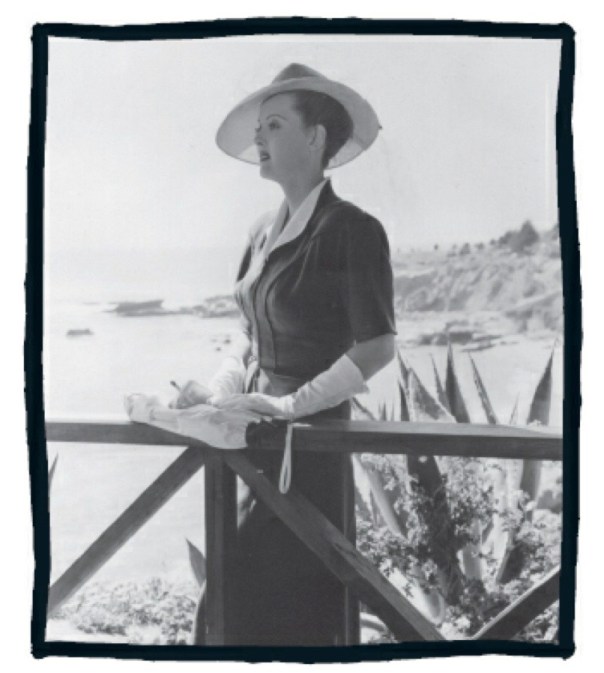
Bette Davis in Now, Voyager

The main reason for reading this book is because Orry-Kelly remains one of the outstanding costume designers of the classic era: when you visualise the Busby Berkeley musicals, or Warners gangster films or Bette Davis at her peak or Ingrid Bergman in Casablanca, you’re re-invoking the dreams, characters and stories that Orry-Kelly helped to create. Only Adrian, Travis Banton, Edith Head and Irene could be considered peers in Hollywood’s classic era. Plus, after his Warner’s period, he designed the costumes for An American in Paris (Minnelli, 1951), Auntie Mame (Morton D’Acosta, 1958), Some Like it Hot (Billy Wilder, 1959) and many other classics. As Catherine Martin, the costume designer who in 1994 finally superseded Orry-Kelly as the Australian to win most Academy Awards notes, his influence continues to be felt, beginning with the impact his work had on hers, and illustrating it with a comparison between the costumes Orry-Kelly designed for Bette Davis in Now, Voyager (Irving Rapper, 1942) and what she herself designed for Nicole Kidman in Australia (Baz Luhrman, 2008).

IMG_0096
Nicole Kidman in Australia

Orry Kelly wrote the book for an audience of the time after his peak (the late fifties, early sixties) but not quite yet for publication so it’s full of all kinds of obfuscation that act as a kind of discretion (what kinds of crushes where those that Cary Grant had on all those women; were they akin to those I have when I meet a new friend — a kind of romantic idealisation of who they are – or was it sexual. It’s not clear) and all kinds of indiscretions that would never have made print had the book been published in his lifetime (Errol Flynn’s drug consumption, Joan Fontaine’s imperious demands, Monroe’s exhibitionism in Some Like It Hot). The book is full of superb anecdotes: Flynn explaining that he hadn’t stolen that emerald necklace in Sidney – it had been a gift; Fanny Brice eagerly watching and dissecting Bette Davis’ performances like the true fan she was; Katharine Hepburn ensuring that Ethel Barrymore regularly received fresh flowers in her last years…an many more.

IMG_0100
Louche life in Sidney

The book offers a wonderful evocation of lost worlds: Bohemian Sidney post WW1; the underworldly New York of gangsters and speakeasys. These raffish milieus take on an even brighter sheen if, to borrow Alexander Doty’s phrase, one makes things perfectly queer; that is to say not only a personal and subjective reading but one informed by a knowledge and understanding of gay cultures and identities in the first half of the twentieth century, an important if rarely valued kind of cultural capital. Read through a ‘gay lens’, those milieus where prostitutes and petty criminals intersected with show business are not only where Orry-Kelly got his start designing but also those that intersected with homosexual sub-cultures; the rage and hurt expressed by all the bitchy attacks on Cary Grant become those of a deserted lover rather than merely an ungrateful room-mate; the love for the nightlife of Hollywood and Vine becomes textured with sexuality; the friendships with George Cukor, Cole Porter, and Somerset Maugham, a network of middle-aged homosexuals gallantly staving off the worst ravages of middle-aged spinsterdom.

IMG_0104
Texas Guinan offers Mae West support during her obscenity trial

I’m not sure that the book is doubly inflected in the way that Harry Louis Gates Jr. indicates in Blues, Ideology and African American Literature: A Vernacular Theory, where he writes of black performers putting on blackface to perform minstrelsy but doing so in such a way that white audiences remained unaware and understood it one way whilst black audiences understood that it was a black person performing and understood it another. Did Orry-Kelly doubly-inflect it that way so that his gay friends and contemporaries understood a layer of meaning unavailable to other audiences? I’m not sure. Can it be read to bring out this double (at least!) inflection? Without a doubt and to great pleasure and advantage.

IMG_0103
Archie Leach, before he was Cary Grant and whilst he was living with Orry

It’s a fascinating book; I now look forward to the film.


José Arroyo


Garland’s Acting in Meet Me in St. Louis


Seeing Meet Me in St. Louis (Vincente Minnelli, USA, 1944) again yesterday brought to mind a half-remembered anecdote from some long-forgotten biography where, in the mid forties, L.B. Mayer fired a writer in a fit of pique for giving the wrong answer to the question: ‘who are the greatest actors on the MGM lot’? ‘Spencer Tracy and Judy Garland’ seemed to Mayer a wiseass answer when Greer Garson was the reigning queen of the lot. But who wouldn’t side with the writer now? By then, Garson was doing ‘great lady parts’ in a way so ripe for satire that Garland did just that in the ‘The Great Lady Has an Interview/aka Madame Crematon’ sequence of Ziegfield Follies (various directors but Minnelli is credited with this Garland sequence, USA, 1945). Garbo was long gone; Katharine Hepburn was on the lot but the only good material she got was the material she brought to the studio earlier (The Philadelphia Story in 1940, Woman of the Year in 1942) and later (Adam’s Rib in 1949, Pat and Mike in 1951); the mid-forties is one of the low-points in Hepburn’s career: Dragon Seed (Harold S. Bouquet and Jack Conway, 1944), Undercurrent (Vincente Minnelli, 1946),  The Sea of Grass (Elia Kazan, 1947), Song of Love (Clarence Brown, 1947), etc.


Screen Shot 2016-01-16 at 14.29.35.png
‘If she only knew what we had in store for *her*!’

What tends to be regarded as great acting is often extremes of emotion in extreme situations (Daniel Day Lewis in My Left Foot [Jim Sheridan, UK, 1989); Charleze Therzon as Aileen Wuornos in Monster [Patty Jenkins, USA, 2003]) and more subtle, more complex, more humane, mundane but no less affecting realms of emotion – the kind Garland so beautifully depicts — are often ignored. But look at what she’s able to accomplish in a few shots of the Christmas Ball sequence of Meet Me in St. Louis extracted above.

Esther Smith (Garland) and her sister Rose (Lucille Bremmer) have planned an evil tease on Lucille Ballard (June Lockhart) because their brother Lon (Henry H. Daniels Jr.) had planned to attend the ball with her but she instead came with the boy Rose had set her eyes on, Warren Sheffield (Robert Sully). As revenge, they’ve filled her dance-card with the least desirable men at the ball. But it turns out that Lucille really wants to be with Lon and Warren Sheffield wants to be with Rose. The plans have been changed, Esther is left holding the bag, her grandfather discovers what they’ve been up to, and Esther chooses to take over Lucille’s dance-card and suffer the punishment they’d planned for her so as not to impede the other couplings and so that the social niceties may be maintained. Their last Christmas in St. Louis, planned as a triumph has derailed into self-sacrificial torture.


Screen Shot 2016-01-16 at 14.30.18.png
Trying to deflect the situation

Ignore if you can Minnelli’s gorgeous and complex mise-en-scene, the compositions, the way the couples are paired off or enter the frame (though I have in the past written here, and on this film in particular, as to why you shouldn’t); ignore if you can how purposefully and beautifully staged it all is. But let’s not bypass every element. When evaluating acting, the long take is a consideration. Not all actors can do them and it has become a test of a film actor’s skill. George Cukor famously observed that whilst Joan Crawford could act any emotion, she was incapable of showing transitions from one to another; she could only do one at a time; but then her whole face would scrunch up like Dr. Jekyll to Mr. Hyde when transitioning. Thus there always had to be a cut between one emotion and another. She couldn’t do it in long take. But see what Garland does here.

Screen Shot 2016-01-16 at 14.31.31.png
She accepts her punishment

We first see her enthusiastic entrance into the group, kind of gleeful at the plans afoot, ‘I’ve been very anxious to meet you’. Then there’s a cut to the three girls where she explains that they’ve taken the liberty of filling out her dance card. Note the look Esther gives her sister and note the laugh Garland achieves in that look as if indicating ‘Ha, she doesn’t know what’s in store!’ Then note the change in Garland’s expression, all within the same take, as Lucille responds with extraordinary kindness, offering to give them a party when they arrive in New York. Garland’s face is transparent, first we see a hint of guilt, her mouth opens, she’s bewildered. Her sister nudges her, ‘The plans have been changed’. Then the couples pair off, leave the shot, Garland still slack-jawed with bewilderment and then her grandfather enters the shot. She’s been caught, she hides the dance-card, attempts to laugh away the situation and flee. Then look at her expression as her grandfather reads out the names. ‘Clinton Badger’? She nods, it’s brutal and she’s been caught. She doesn’t respond to the next one, it’s unbearable. Then see what she does with her face when Sidney Gorsey’s mentioned. We see shame, embarrassment, the sense she now deserves everything that’s coming to her.

Screen Shot 2016-01-16 at 14.35.56.png
Great physical gags in the dance sequences


Garland is extraordinarily transparent through a range of emotions, often conflicting or contradictory, and often played for laughs, she seems to pluck them out of thin air and achieve effects few actors are capable of. It’s quite remarkeable in quite a low key way. Then in the next shot, when Lucille goes to get her dance card and Garland says she’s made a mistake, note her reading of the line ‘This is mine’. She’s achieving laughs facially, vocally, and in the series of dances that follow she proves herself a superb physical comedienne; all whilst simultaneously evoking a range of feeling, sometimes complex and contradictory, that is emotionally recognisable as truthful.

It’s great acting.


José Arroyo


Douglas Fairbanks: The First King of Hollywood

first king


Tracey Goessel’s The First King of Hollywood: The Life of Douglas Fairbanks (Chicago: Chicago Review Press, 2016) is such a marvellous book; superbly researched, including exclusive access to Mary Pickford’s letters, full of new information and elegantly written. The reasons to be interested in Fairbanks are innumerable: an icon of his age, founder of United Artist, a man who helped shape our understanding of entire genres (swashbuckler), still potent archetypes (Zorro, Robin Hood, ‘The Gaucho’, D’Artagnan) and mythos (The Thief of Baghdad). His influence is everywhere still: his Zorro is what inspired Bob Kane’s Batman, particularly the Bruce Wayne/ Batman dual identity. In fact he was one of the main shapers of what we’ve come to understand as Hollywood.

I wish I had more time to write more extensively on the book and the actor. But since I don’t, I’d like to point you to Thomas Gladysz excellent ‘Best Film Books of 2015′, which is how I came across the book, assert its many virtues and offer you an idea.The First King of Hollywood: The Life of Douglas Fairbanks extensively documents how from the moment Fairbanks moved to the Triangle Picture company in 1916, where he started his first independent production even before he officially formed his own production company, Fairbanks had enormous control over what projects he starred in and how they were shaped. This is true from beginning with In Again, Out Again (d: by John Emerson, scripted by Emerson and Anita Loos, USA, 1917) right to his founding of United Artist along with Mary Pickford, D.W. Griffith, and Charles Chaplin in 1919.

Once he started at UA, he was not only financing his films but helping to shape their every aspect, from the narrative of The Mark of Zorro (Fred Niblo, USA, 1920), camera placement and stunts in The Three Musketeers (Fred Niblo, USA, 1921) the cutting and distribution of all of his works throughout the 1920s, and even the look of the two-strip Technicolor used in The Black Pirate (Albert Parker, USA, 1926). He was clearly as much the author of his films as anyone; and as the one with final say, much more so than any director. The book doesn’t quite make the argument of star as auteur in silent cinema but it is there implicitly, at least as regards Fairbanks. The book also implicitly makes the case that this would be true of Mary Pickford and by implication anyone else who had a similar kind of control and final say over their pictures. Perhaps silent cinema is awash with female authorship that we have yet to discover or render explicit. It’s a thought.


José Arroyo

The ‘I Love Dogs’ sequence from Jupiter Ascending


‘You can be had,’ Mae West said to Cary Grant in She Done Him Wrong, which opened in January, 1933, and that was what the women stars of most of his greatest hits were saying to him for thirty year, as he backed away – but not too far’ writes Pauline Kael in her great essay on the actor, ‘The Man From Dream City’.

Watching the moment in  Jupiter Ascending ((Andy and Lana Wachowski, USA, 2015; see clip above), where Mila Kunis is coming on to Channing Tatum only for him to back away — she’s royalty now; he’s half dog, oh but she loves dogs! —  made me think of Kael’s argument on Grant. Tatum is the male love object of the film and one of the leading sex symbols of the day. Since the Step Up musicals, it’s a rare film where his body hasn’t been prominently on display. It’s Jupiter’s/Kunis’ desire that Jupiter Ascending expresses . The narrative aligns the desire of the protagonist and that of the audience in that it presents Tatum as the object of desire — elegantly skating through space, often with his shirt off —  to both; furthermore it presents Kunis/Jupiter as a point of identification in the narrative and aligns the audience’s gaze with hers. Female expression of desire as depicted in Kunis’ lovely and witty performance and that alignment of the gaze of female star with that of the audience is still so rare in cinema , and rarer still in this particular type of cinema, as to invite commentary, and perhaps incite discomofort.

Writing on Grant and Redford, Kael argued that both were ‘sexiest in pictures in which the woman is the aggressor and all the film’s erotic image is concentrated on (the male).’ Redford, for example, ‘has never been as radiantly glamorous as in The Way We Were, when we saw him through Barbra Streisand’s infatuated eyes.’ Yet a similar moment in Jupiter Ascending, that extracted in the clip above, whilst offering a moment of glee to me personally, doesn’t seem to work in quite the way similar moments worked with Redford or Grant. Clearly Tatum isn’t as debonair; he lacks the lightness; he’s too earnest. However, could it be more than that?

As star personas metamorphise over time, can there be some moments that come too late to work in a work, i.e. is it conceivable that the ‘I love dogs’ moment might have worked better had the film been released after Dear John (Lasse Hälstrom, USA, 2010) and The Vow (Michael Sucsy, USA, 2012)  or perhaps as late as Magic Mike (Steven Soderbergh, USA, 2012) but pre 21 Jump Street (Phil Lord and Christopher Miller, USA, 2012) and Foxcatcher (Mark Schultz, USA, 2014)? After all, there was a point where one simply went to a movie with Tatum to look at that body in motion. When did it start to matter that he was ‘wet’; that there seemed a cloud of depression perpetually overhanging that pudgy face; that he comes across as not-too-bright (though considering the choices he’s made recently, he can’t be  as dumb as he looks); that he seemed to take everything too seriously; that he could be a serious bore; that whereas better romantic comedians like Grant are different with the heroines than they are with anyone else in the film, Tatum can only do ‘sad-serious-and-slow’, or at least until the use of his body brings a different kind of kick and energy to his performance? Was it perhaps that moment when critics began to talk of him seriously as an actor?

Or does that striking moment ‘not working’ simply characterise a film of brilliant ideas that seems also laughably silly pretty much throughout? And yet, I’ve now seen it twice…can it be that we’re not used to seeing sci-fi where the female star is the desiring subject, the active agent, the focus of the film’s drama? Or that we’re not seeing used to seeing sci-fi in such traditional melodramatic terms? Jupiter (Mila Kunis) is a cleaning lady, a migrant born in the middle of nowhere who ends up becoming a queen with the whole of the earth as her personal playground. There’s a wedding interrupted at the last moment and love that has to skate through galaxies , class and ethnic barriers and many disasters before being consummated. There’s also Eddie Redmayne’s excessive, intriguing and camp performance which seems to belong to a different genre. There seem to be all kind of intriguing and brilliant clashes and displacements in the film. Maybe what Jupiter Ascending is providing so brilliantly is so far removed from audience expectation that the only response to that clash is uncomfortable laughter?


Just some thoughts,


José Arroyo

A Thought on Ben Whishaw

wishaw cloud atlas
Frobisher in Cloud Atlas


I’d put off seeing In The Heart of the Sea (Ron Howard, USA, 2015) because the trailer looked dull, because I’ve never seen a fully satisfying film about man versus whales, because another attempt to demonstrate American ideals of human courage under fire, or under water or even against aliens from another dimension, all seem the same and all make one just want to curl up and die.

I’d loved Rush (Ron Howard, USA, 2013), the previous Howard/Hemsworth collaboration, but I suspected, rightly, that the undoubted excitement it incited might be a one-off: Howard is too nice — and perhaps has been too lucky — to draw out complexities and contradictions and dramatise them compellingly, e.g., In the Heart of the Sea tells us that the greed, barbarity and cost to people and the environment that drove the American whaling industry in the 19th Century is not that different than that which would later drive a different type of oil industry: oh, okey dokey.

W as Bond
Q

What got me to the theatre on a cold winter’s day was seeing that Brendan Gleeson, Cillian Murphy and Ben Whishaw were also in the cast; and, really, it was the tantalising thought of Whishaw as Herman Melville that was the clincher. In the end, he was disappointing. The part is a thankless one; a mere narrative device through which to get Gleeson to narrate the story that would then form the basis of Moby Dick. Whishaw isn’t on for very long; he doesn’t have much to do; it’s a part that could have been played by many others and just as well. But what Whishaw offers that others might not is the potential for surprise. It could have been different, exciting, unexpected, delightful; it has been so many times in the past

wishaw lilting
Lilting


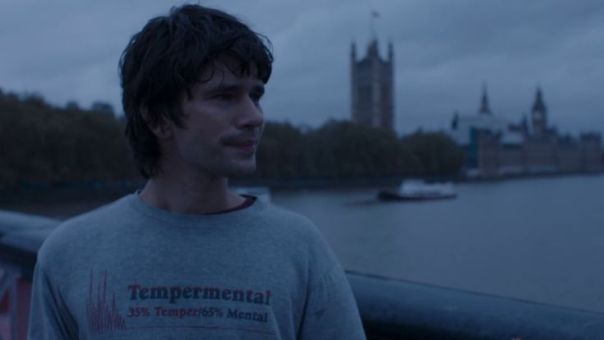
Since 2011 and his marvellous introductory scene (see clip above) in The Hour (Abbi Morgan, UK, 2011) , where he looks straight at the camera and prophetically announces, ‘You haven’t seen my best yet’,  I’ve adored him as Frobisher – composer/prostitute/petty thief and unabashedly in love — in Cloud Atlas (Tom Tykwer/Andy Wachoski/ Lana Wachowski, USA et al, 2012) arguably the most romantic gay hero in all of contemporary cinema; as the too-geeky-to-be-a-hipster Q in the Bond films; as the loving gay man in Lilting (Hong Khaou, UK, 2014), who tries to maintain a relationship with the Chinese mother of his deceased partner despite cross-cultural barriers preventing the son from coming out to the mother; as the voice of Paddington (Hugh Bonneville/ Sally Hawkins, UK, 2014) — no one else could have brought the purity, the optimistic and loveable innocence he brought to his voicing of the iconic teddy bear; as the abusive husband in Suffragette Abi Morgan, UK, 2015); as the singleton who does manage to find a wife whilst not quite escaping the horror in The Lobster (Yorgos Lanthimos, UK et al, 2015); as the understanding homosexual supporting Eddie Redmayne through his transformation from Einar to Lili in The Danish Girl (Tom Hooper, UK, 2015); and of course there’s his work in London Spy (written by Tom Rob Smith, UK, 2015) as Danny, a sub-prole variant of his role in Cloud Atlas, this one with Jim Broadbent hopelessly in love with him rather than laughing in his face at his advances, as in Cloud Atlas.


wishaw lond spy
London Spy


Ben Whishaw may be the first out young star who, whilst playing a great variety of roles, nonetheless is building quite a repertoire of homosexual characters. It’s instructive to compare what he offers to, say, someone like Stanley Tucci, who in the last few years has also played a whole variety of roles, gay and straight, but seemingly specialising, at least since The Devil Wears Prada, in ones clearly coded as homosexual (The Hunger Games films, Burlesque, Gambit), and playing them all in one smug note as the sort of fey cultural deviant that raises a superior eyebrow at what everyone else is saying whilst criticising their dress sense for their own good. That’s the limit of how Tucci can imagine ‘gay’.


What Whishaw brings at this point, as his star personae unfolds and changes, is the imbuing of humanity to a category; his ‘gays’ could be a widower trying to connect over his loss with his ‘mother-in-law’, or sub-proles trying to fight the system over that which is just, or marginalised people trying to find a connection, or romantic heroes who cannot see life beyond art and love. ‘Gay’ is not what defines these characters when Wishaw plays them, as is so often the case when Tucci does (and ‘gay’ always means ‘camp’ and ‘supercilious’ for Tucci). Another interesting point about Whishaw is that other than when I saw him in Mojo onstage, he never seems to depict characters with any sexual threat (and his Baby in Mojo was a psychotic so…); they might be sexy but passively so, their minds are on love and sex always seems to be connected to some higher plane of feeling, even when the narratives hint that this was not always so in the past.

Anyway, a thought.


The Danish Girl (Tom Hooper, UK/Germany/USA, 2015)

The Danish Girl


I finally got to see The Danish Girl  and was unexpectedly moved. My opinion of Tom Hooper hasn’t improved. There is a reason why his company’s called ‘Pretty Pictures’: he can make them pretty but he can’t mobilise that prettyness into meaningfulness. He’s obviously superb with actors and I think Eddie Redmayne and Alicia Vikander are believable and affecting; the former in a very risky part; also it feels like a kind of bourgeois filmmaking: all this delicate and thoughtful suffering in exquisite settings whilst thinking of art and higher things…and yet, on an emotional level, it still gets to you. It’s interesting.

There are complex themes around identity that revolve around sex, gender, but also artistic production. The need to express oneself is in this film as important as that of becoming one’s idea of who one wants to be in the face of harshly punitivie social prohibitions. The Danish Girl doesn’t necessarily present these ideas in a complex manner. For example, sometimes the film presents the question of sex as an essence struggling to overcome the boundaries of the wrong body that imprisons it; sometimes it shows gender in the very process of its construction as its costumed, painted and slipped on. Sometimes it confuses the various categories it seems to be dramatising. But what it might get muddled analytically it more than makes up for emotionally. The film gets us to understand and feel for ‘The Danish Girl’ and when he asks his wife ‘I don’t know what I’ve ever done to have earned such love’, I welled up. It’s a question often asked but this time we know the answer.


In The Danish Girl, there seems to be an overt contradiction between representing social transgression as a pathway to truth whilst deploying the most conservative aesthetics means to do so, which act as obfuscation, a kind of show-and-hide and perhaps an appeasement of potential audience reactions via gentle and extraneous pleasures. I at first thought Eddie Redmayne was too young to already seem so mannered. But then began reading the initial overdone gesture as a foreshadowing of the transformations to come and ended by thinking it a really marvellous performance. Vikander is just as good in a less showy part. Mathias Schoenaerts, Amber Heard and Ben Whishaw appear intermittently to offer unstinting support and very considerable glamour.


José Arroyo

Mr. Six (Guan Hu, China, 2015)


Mr.-Six_poster_goldposter_com_16-400x559

One of the pleasures of being in London for a few days is you come across films you’ve never heard of, have never seen publicised, take a punt, and come out entertained, moved, enriched; and this by a film you may not fully understand.

Mr. Six was such a film. Don’t get me wrong; it’s a popular film, a male melodrama, one not too different in basic thematics from Home from the Hill or Rebel Without a Cause. It’s about being a man, about how to be one, what it means to be one, the necessity of the striving to embody such ideals, and the inevitable failures such attempts entail. At the heart of it is a relationship between a father and a son; and that father and someone else’s son; a triangular relationship that cuts through class. And the context for it is a changing culture, one that worships money and consumer items, that has lost touch with a recent past, one where age-old conventions no longer apply and thus also about the generation gap that results from it: one where women are important but peripheral. At heart Mr. Six is a critique of the new political/moneyed/ business class in China; it’s a film that asks audiences to feel for, cry over, and accept cultural change.

The basic story is about an aging gang leader, Mr. Six (Fen Xiaogang), old now and done his time in jail but still respected in his community for achieving justice for his neighbours, a man who finds that negotiation can be can be just as effective as brute strength in resolving most problems. He hasn’t heard from his son Bobby (Li Yifeng) for a while, searches for him, and discovers that he’s got himself embroiled in gang dispute that involves a girl, a Ferrari, and a jealous boyfriend called Kris (Kris Wu), who happens to be both a spoiled rich brat and also the scion of a family of gangsters. As he tries to rescue his son, he gets into muddier and muddier waters at a higher and higher level.


As is traditional in the genre, the film is highly symbolic. There’s an imprisoned ostrich that makes a last bid for freedom through the crowded streets of Beijing. There’s a caged bird that can parrot only one phrase. There’s beautiful imagery of icy rivers that can be skated over or fought on but which can support or break. Snow, real snow, falls over the characters as they run to and away from hospitals and treatments that they don’t understand. Food and drink offer a setting over which men remember, brag about and regret their past. The film works ritualistically also, as classic Hollywood did, with events – the seeking of direction, the lighting of a cigarette – repeated in different contexts in a way that affects plot, meaning, tome. Mr. Six offers an imaginary reconciliation of real contradictions in which the troubles between neighbours is no different than the trouble in the country, the bond amongst friends are the same as those which tie a community together; the struggles between the generations, ones that can be overcome.


There are certain things that linger in the mind: the extraordinary calmness of Fen Xiagang’s central performance as Mr. Six — the actor, who I understand is primarily known as one of China’s most financially successful directors, seems to convey a zen calmness to other characters whilst letting the audience see how quickly he can spring into action; There is gorgeous cinematography by Luo Pan that shows fog and snow and things that are not quite clear in a clearly considered way; one of the themes seems to be that the world is full of people struggling with existential problems that cannot be treated like a reality show, that we as audiences and as people need to cultivate empathy and respect; that Guan Hu is director who’s not afraid to let his camera linger, a director to look out for.


The film has no surprises other than the style of its telling. It’s amazing how the re-enactment of clichéd structures can wield such force, can be so moving, when directed as confidently and sensitively as this director does. It’s a superb example of great popular filmmaking. The audience, almost entirely Chinese, laughed at things I didn’t understand but, like myself, stayed until the credits ended, as if not wanting to let go of the world they’d been immersed in, one with such similar problems, but one that offered much more honourable and satisfying resolutions. It’s a film to look out for.


José Arroyo