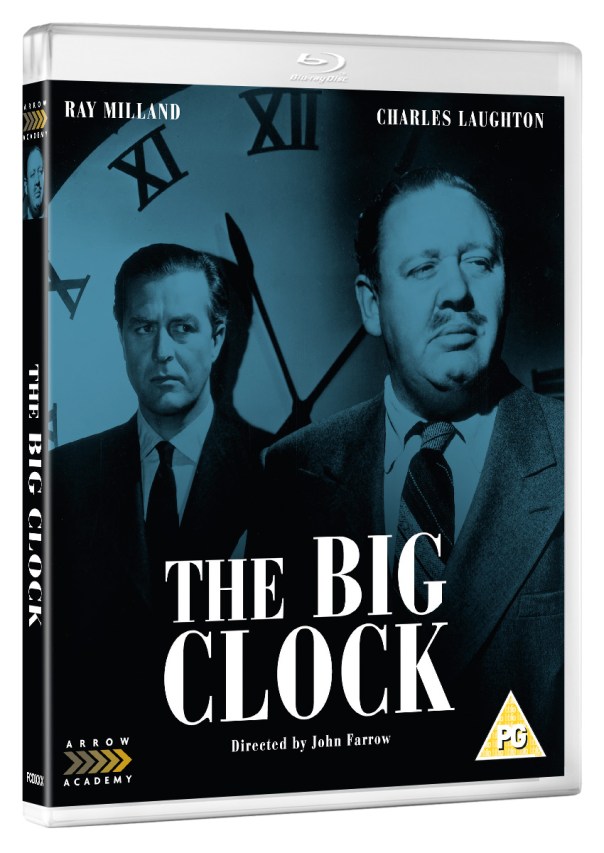
The Big Clock (John Farrow, 1948)

The Big Clock


A justly famous noir with an ingenious opening sequence tied together by a first person voice-over narration from Ray Milland as magazine editor George Stroud that sets up a theme, a structure for the narrative, the look and feel of a particular world, an objective and a deadline in which to achieve it, as well as thematic tropes (see below).

It stars Ray Milland, Rita Johnson and Maureen O’Sullivan (then married to director John Farrow, and mother of Mia). But it is the supporting cast, George Macready, Elsa Lanchester, Henry Morgan, and particularly Charles Laughton (see below), who delight.

A you can see above Charles Laughton creates a whole series of effects and personality traits through a series of fascinating choices: the way he looks at his watch but then looks in the other direction, the drawling voice, the pinky clearing up the corner of his mouth. He makes the banal fascinating and revealing.

I love this very intense little scene, shot from below, Laughton’s masses of flesh roiling from the massage a very young Hernry Morgan as Bill Womack is giving him as Earl Janoth (Charles Laughton) instructs him to kill. Is Womack more than his henchmen? They never look at each other and we know that Janoth is involved with a woman. Yet the way Farrow sets up these images of evil have an undoubtedly pervy sexual component, one maybe made more potent by not being quite clear.


The film includes a very fine montage which poetically indicates a drunken evening, references the magazine, the job, and the deadline; the wife leaving without him and those pressures; the significance of the painting he outbid the painter to purchase (we don’t yet know that he’s an admirer and collector). There’s something interesting to be explored in how modern art signifies in film noir. In Phantom Lady it’s an indicator of perversion and evil. Here, particularly through Elsa Lanchester’s eccentric and witty performance, it’s treated as a joke. Lanchester’s performance is a delight but the way the film conceptualises the character she plays — Louise Patterson — is unworthy of the film, a cheap stunt amidst work that is otherwise very fine.


The film is of course told in the classic style and has wonderful ‘teachable’ moments like the use of anticipatory space above.

The set-piece at the end is visually dazzling, tense, thrilling, structurally coherent, picking up from the initial voice-over and responding to it. Much of eighties cinema starts from, is organised around, this type of set-piece as spectacular attractions, often forgetting the narrative weight that is built into forties’ versions such as this one. Kevin Costner starred in a loose remake this film, No Way Out (Roger Donaldson, 1985)

Eileen McGarry in her entry on  the film in The Film Noir Encyclopaedia writes that the only visual device of note is the ‘slightly–too-wide-angle’ lens, which is used for close-up of Laughton during his vilest moments’. I hope I have shown above that is clearly not the only visual device of note. But it is a most interesting one: ‘his face is (rendered) just ugly enough to break startlingly with naturalism. The use of this subtle distorition increases quite gradually during the film, until, when the flashback catches up with the opening of the film, the viewer may be convinced of the arch villain’s both superhuman and subhuman capabilities. (p. 39).

The superb Arrow Academy edition contains a very informative discussion of the film by Adrian Wooton and a film commentary by Adrian Martin. If you can get past how actory Simon Callow is in his every intonation, he gives a superb demonstration in how Charles Laughton is in top form in what is a fallow period of his career and in what basically amounts to a supporting role.

José Arroyo

Postcards from London (Steve McLean, 2018)

postcards from London.jpg


The type of queer film sure to set some of my friends’ teeth on edge: gloriously poncy, self-conciously pastichy, super-stylised, delightfully artificial, all about sex, beauty and art. Jim (Harris Dickinson) is an Essex boy who arrives in London to make his way in the world, ends up on the streets and becomes a rent boy. But not just any rent-boy, a high class one, part of The Raconteurs who service rich artists and intellectuals by offering them not only sex but informed conversation on art. The film’s London is a queer one of myth and legend seen through a particular lens, more Jarman, less McInnes. Jim goes from being a rent-boy to being a muse to becoming so sensitive to art he faints when close to the real thing, a service that ends up being very useful to auctioneers and antiquarians. Finally, Jim goes from being the talk of the town, the most beautiful boy in London, to an active agent, from being beautiful to creating beauty. Threaded through this narrative are discussions of art, of Dyer and Bacon,  of Caravaggio and baroque painting, of Fassbinder and Jarman, on the pleasures of reading Stendhal, the glories of the Colony Club etc. I can already hear some of you screaming but I loved it. The film’s Soho is sketched in through neon lights, a bit like the Girl Hunt number in The Bandwagon and is glorious to see, as of course is Harris Dickinson, for whom this is must have been a brave choice after Beach Rats.


José Arroyo


Suddenly Last Summer (Joseph L. Mankiewicz, USA, 1959)

suddenly.png

Suddenly Last Summer is another of those films i seem to have been aware of my whole life but had never seen until now. It’s an extraordinary work, like three extended arias, a medium one by Hepburn at the beginning, a long one by Taylor through most of the middle, and then a coda by Hepburn once again as she goes up the lift and into madness. Taylor throws herself into the role and is quite extraordinary. But it’s Hepburn who is thrilling, an acting lesson for anyone interested in the subject, her line readings a work of art on their own. Mankiewicz films most of it in clever long takes that have a rhythm and find increasing intensity in extraordinary close-ups. Clift is sad to see, like a distorted dissolve of his previous self, and is there mainly as ‘straight man’ to set the context and feed the lines so that two great actresses can soar. The dialogue is self-consciously poetic, beautifully stylised, and yet one is lulled into…cannibalism, rape, madness, exploitation, cruelty. It’s quite something.

The film is almost incantatory, like a hallucinogenic.; the language is extraordinary; Mankiewicz’ direction is under-rated. And Hepburn is really in a league of her own. I can’t imagine even Bette Davis doing something so fine.

As for Taylor, can anyone think of another box-office queen who at the peak of her stardom performed Shakespeare, Williams, Albee, Rattigan, Marlowe and Dylan Thomas in major motion pictures?

The image in this Indicator edition is lovely, rich, deep black and whites with a whole array of greys in between. A wonderful ‘print’.

José Arroyo

Bowfinger (Frank Oz, 1999)

Bowfinger.jpg


Another comedy about Hollywood filmmaking, this one written by Steve Martin, who knew a thing or two about it, that somehow passed me by when first released. Eddie Murphy plays the biggest star in Hollywood (and his cousin). Steve Martin is  making a film on the fly, starring Murphy´s character, without his knowing it. It´s full of terrific gags, a very pointed commentary on the Hollywood of the time. But the Heather Graham character comes across as too sexist now I think, and Baransky as an earnest, slightly deluded diva, doesn´t quite make up for it. Robert Downey is very good as a Hollywood insider. Murphy is phenomenal.´We´re trying to make a movie here, not a film!

The Spearchucker bit above and the Buck the Wonder Slave gag below are terrific:


José Arroyo


Hellzappoppin (H.C.Potter, USA, 1941)

hellzappoin.jpg

Thinking about films about filmmaking and/or Hollywood led me to Hellzappoppin. I don’t know why I avoided it for so long. I suppose I thought the humour would be dumb, cheap, low-down, coarse, which of course it is. But it is also very clever with it. It tries to get laughs from practically everything at all times and I often succumbed. It has great audio-visual gags, humour made possible only by the medium itself, something which contemporary comedy directors could learn from.


Some examples below:


As you can see above some of the humour, well done as it is, is cartoonish, talking dogs that comment on talking bears, the leaky suit etc.

But some of the gags are unthinkable without cinema, here above, following from The Invisible Man, making an entire sequence around disappearing tops and disappearing bottoms, and ending the gag with the double exposure. Hellzappoppin was based on a hit Broadway play but the mediu was definitely taken into account for the movie.

‘Ít´s a great picture see how much it weighs.’ Ít´s a movie, we change everything’. The dialogue is brilliant and the visual gags fantastic. See how the pictures talk back, the comment on the story, which is a comment on cinema. A friend said Olsen and Johnson don´t just break the fourth wall, they explode it.

‘There never has been a picture without a story and there never will be a picture without a story’ But there is space and here Olsen and Johnson move through a whole series of spaces in the studio.

There are songs throughout, good ones, and some terrific lindy hopping but then note how the whole Stinky Miller gag is developed here, through writing over the images, then we see the shadow of Stinky leaving the theatre, before the protagonists also draw their own vision of happyness on-screen. Brechtian evokes some of the techniques but none of the pleasures. The film takes pleasure, and makes humour from,  every aspect of cinema, uses the form to make gags with, and even goes beyond it to the projection booth and the audience.

Hellzappoppin is not seamless, there will be elements that will jar. But it is brilliant and made me think of this great video essay by Tony Zhou. Everything that Zhou admires in Edgar Wright´s comedy (and finds lacking in much of the rest of contemporary comedy films) can be found in Hellzappoppin. In spades. Mischa Auer is terrific, and seeing Martha Ray on the rampage after him is a sight to behold.

José Arroyo

hellza2

My Name is Julia Ross (Joseph H. Lewis, 1945)

my name is

A Columbia quickie, on the Gothic end of the noir spectrum, directed with great flair by Joseph H. Lewis, director of Gun Crazy (1950) and The Big Combo (1955), and thus one of the most significant figures in noir. Nina Foch, pre An American in Paris is Julia Ross,  a middle-class working girl on her uppers and desperate for a job. George Macready, pre-Gilda, is Ralph, quick to temper and overly interested in knives. His mother, Mrs. Hughes (Dame May Whitty) is the only who can control her son and is overly protective. She has set up a whole personnel agency just to  find the right live-in personal secretary. There’s a great point made about no family and no attachments and we’ll soon learn why.

Julia goes to work one night and wakes up a prisoner in a grand cliff-side house in Cornwall, with the staff told she’s Ralph’s wife and so nuts they must ignore what she says. Why are they doing this to her? How will she escape? The film bears a loose resemblance to Rebecca and is worth seeing today for the ingenious ways Lewis figures a woman imprisoned in a world of shadows (see images below).

my name is 2.jpg

The Arrow Academy release features a very good introductory essay by Adrian Martin and an intriguing discussion by Nora Fiore, of Nitrate Diva Fame, on the relationship between the film and the social context it was made and released in.


José Arroyo

Too Late for Tears (Byron Haskin, 1949)


Too Late for Tears.jpg

A film noir I hadn´t seen before. Cheap, pulpy, lurid, hard-boiled, and rotten to its core. Just the way I like ’em. A bag of cash is thrown into the wrong car and the rest of the film is about everyone it doesn´t belong to trying to get their hands on it. Lizabeth Scott makes a bid to be the most fatal of femmes in the whole of film noir. She lies, and lies and lies. She cons and schemes and scams and is also able to come up with a new story every time she´s cornered. She´s so cool and collected she drives even Dan Duryea to drink. ´Don´t ever change,’ he tells her, ‘I wouldn´t like to see what you´re like with a heart’. Good thing because her heart is nowhere evident. Men fall like flies. Scott is totally inexpressive and completely great. She only livens up when her eyes focus on cash, diamonds or furs. Her heart beats only to the good life and she positively glistens to a kill. As to the saps…I mean the men… Oy, vey! The film is nothing special visually. Except for Lizabeth Scott and Dan Duryea, the cast is second-rate. But it´s got real narrative propulsion and completely basks in the seamy underside of life like great pulp is meant to. I loved it.


The Arrow Academy transfer is a pleasure to watch with very fine extras by Alex K Rode and a documentary on the film´s restoration. A must have for noir aficionados.

tooo latre for tears

José Arroyo

Born Yesterday (George Cukor, 1950)

born yesterday


Of the films I´ve been seeing recently that I loved as a child, Born Yesterday has been the most disappointing. It´s relative of course. The film is certainly interesting and entertaining; and the political satire, a relatively brave choice for a popular entertainment in the midst of the McCarthy era, seems more relevant than ever. The travelogue elements of how we´re shown Washington D.C. must have been a real attraction then and still work now. And surely playing writers chased by Gloria Swanson and Judy Holliday in two of the hit films of that year — Sunset Boulevard was the other one —  is what must have catapulted William Holden into being a proper box-office star? Still that said, the film is overly pat and a little preachy, Broderick Crawford´s performance is a bit coarse, and Holliday, whom I adore, seems overly rehearsed. She´s great — it´s her most celebrated performance — but not quite real, every line reading fuelled by a clearly visible intention for very particular effects. The revelation of the re-watching has been Holden: A subtle performance, really understated and yet bringing charm and liveliness to a completely thankless role.It makes me uneasy also that the villain is a working class self-made millionaire who´s worked since he was twelve. The faith in the system is touching, its mythification less so. There are reasons the Garson Kanin´s play isn´t much revived: everything´s a bit pat and mechanical, though Cukor´s direction is controlled, masterful really, and opens up the play in interesting ways. 


The Arrow Academy transfer is lovely and Pam Hutchtinson´s introductory essay is excellent. But talking-head discussion, even by prominent academics, make for quite dull extras. A disappointment, if only in relation to my memory of it. 

José Arroyo

The Heiress (William Wyler, 1949)


9sz3vbRXkTqk8NwSzvyuOZpuDaZ60k_large.jpg

The Heiress is so great. There must be other films that are about the slow, brutal realisation that one is unloved, even by one’s nearest and dearest, and how that knowledge closes off and diminishes a person, but I can’t think of any. It would make a great double bill with Now, Voyager which has an almost opposite trajectory, ie learning to value and love oneself. Also interesting is the different traditions of acting all the protagonists –Olivia de Havilland, Ralph Richardson, Montgomery Clift, Miriam Hopkins –work in, and which Wyler prevents from clashing. Montgomery Clift is arguably at his most beautiful in the opening sequences. Wonderfully directed too so that space itself becomes allegorical (the uses of the staircase in the house).  I want to explore the ending of the film more because doesn´t she in fact end up doing what her father wanted to and she herself railed against? In a way isn´t she defeated, bitter, vengeful and shut-in in her house, as her father wanted. Doesn´t patriarchy still win out in spite of Monty knocking desperately and helplessly at the door?
The Criterion is a great edition, and hidden amidst the extras is a fascinating short film on the role of the costume designer, using Edith Head’s decision making process through a film as a means to illustrate it.
José Arroyo

Frame Grabs from Godard´s Le mépris

I hadn´t seen the film for years. I´d forgotten how beautiful it is. Each frame a painting, as they say, filmed by Raoul Coutard. And each evocative, expressive, beautiful. But it´s 24 of them a second, part of a shot, often accompanied by dialogue or Georges Delerue´s beautiful score. And there´s Bardot, and Piccoli, and Jack Palance and Lang and Bazin and cinema as it once was, and even then in the process of becoming something else. I couldn´t stop myself from grabbing frames. It´s on MUBI.


José Arroyo

An image from Henri-Georges Clouzot´s La Vérité, 1960

Gilbert (Sami Frey) to Dominique (Brigitte Bardot): ‘If Bach  doesn´t wow you, who does’? ‘Marlon Brando’:

frey Bardot

A note on the ´33 and ´49 versions of Little Women

The Greta Gerwig Little Women needs to be great because the Cukor-Hepburn one is perfect. Plus having the additional bonus of being, along with King Kong and Mae West, the sociological phenomenon of 1933. It´s a pity it´s not more seen:


Watching the ´49 version of Little Women only made me appreciate the 1933 Cukor-Hepburn version more. The 1933 version roots it in the Civil War, privation, self-sacrifice, kindness, family, sisterhood, complicated interpersonal relationships, and with a kind of yankee fierceness that is completely lacking in the sop of the ´49,. To see June Allyson after Hepburn is merely to see lack, where Hepburn was romantic, tomboyish, determined, longing to be an artist and a free woman, Allyson simply lowers her voice and juts her jaw. And even with that she´s better than Peter Lawford. A starry cast almost entirely wasted, Mary Astor certainly is, though Elizabeth Taylor and Margaret O´Brian have their moments (if only a few). Comparing the two is like comparing the illustrated comic of the novel to the novel itself. Same plot, more gloss, more shine, less depth and way less charm. I´d forgotten how important the Christmas setting is to all versions


José Arroyo

From Black Orpheus

octopus

When you see a great classic of the cinema but what you can’t shake from your mind is this.


Montparnasse 19 (Jacques Becquer, France,1958)

I saw Montparnasse 19 as a child and never forgot it. Seeing it again now I understand why it is unforgettable: the framing, the lighting, the composition of Gérard Philipe as Modigliani, in medium close-ups, suffering for his art, which no one is interested in, as Lilli Palmer, Anouk Aimee, and other women who love him look on helplessly, is very powerful. I’d forgotten Lino Ventura is also in it. Jacques Becker is such a great director, leaving actors their space and privileging their faces, and in this case that of the greatest romantic actor of his generation. Every frame does indeed seem not so much a painting as a work of art in itself. The Arrow edition is beautiful. It includes an appreciation by Ginette Vincendeau, which I look forward to seeing.


I’ve written previously on a memory of the film vs an encounter with a portrait of Modigliani here.


José Arroyo

Eavesdropping at the Movies: 202 – Cats


The podcast you´ve all been waiting for. Mike is so traumatised, he can only continue watching from the safety of the exit. I was entranced. There was cosplay in the audience. We disagree throughout. it´s great:


The podcast can be listened to in the players above or on iTunes.

With José Arroyo of First Impressions and Michael Glass of Writing About Film.

Eavesdropping at the Movies: 201 – Marriage Story

A beautifully observed, intelligently written and transparently played drama, Marriage Story shows the separation of two people with deep and ongoing love for each other, and how they change under the stress of their marriage breakup. Mike argues that it’s an advert for therapy, the unread notes in which each partner describes what they love about the other, with which the film opens, returning structurally despite the descent into legal hell and gamesmanship. José remarks upon the generosity the film has towards its characters and the magic that Scarlett Johansson and Adam Driver bring, and Mike picks up on the length of some scenes, scenes that move smoothly and in real time through evolving conversations.

Marriage Story is on Netflix now and worth your time.

The podcast can be listened to in the players above or on iTunes.

With José Arroyo of First Impressions and Michael Glass of Writing About Film.

Atom Eyogan Interview for Cinema Canada

IMG_8310.jpeg


What one finds trawling through the internet: This was the cover story for the October 1987 issue of Cinema Canada, on the occasion of the release of Egoyan´s Family Viewing and timed to coincide with that year´s Toronto International Film Festival. The image above is a sad photocopy of a too-used magazine of what was originally quite a beautifully coloured image. The full article can be accessed by clicking on the link at the botton:


SCREENSHOT 2019-12-20 AT 09.05.37.jpeg


For the full interview click on the link below:

cinema canada atom egoyan

Eavesdropping at the Movies: 199 – The Report


Adam Driver and Annette Bening shine in writer-director Scott Z. Burns’ historical drama The Report, about Senate staffer Daniel Jones and Senator Dianne Feinstein’s work to investigate the CIA’s use of torture after 9/11. Mike’s been filling up on this stuff lately, quite by coincidence, watching old episodes of The Daily Show; José didn’t even know what the film was about, and the difference in our responses is perhaps quite telling, the film not going out of its way to help its audience into its murky waters, leaving it up to them to pick up on what it’s on about.

In that respect, it’s a film that requires and respects its audience’s attention and intelligence, though it could do more in dramatic terms to earn it. It’s rather a dry affair, though not without its charms – in particular those of its lead actors, who captivate every second they’re on screen. The story is told partially in flashback, depicting the use of “enhanced interrogation techniques” in the immediate aftermath of 9/11, and the main plot covers the better part of a decade, shifting from initial questions to the depths of Jones’ secretive study, to the fight he and Feinstein face to get it published – and Burns structures all of this well and narrates it admirably smoothly. Unfortunately, he’s content to descend into bog-standard platitudes about the greatness of America being its desire to admit its own mistakes and rancid behaviour, without ever addressing the idea that behaving that way might be equally American.

We compare the film, as we so often do with films about institutional failure and corruption, to Spotlight, the story of the Boston Globe’s exposure of child abuse in the Catholic Church, in particular the complexity of that film’s investigation and apportioning of blame, Mike arguing that the Globe’s realisation of its own part in the cover-up is a crucial and necessary complicating factor, and not something we see here, with the goodies of the Senate and the baddies of the CIA entirely separate – there’s indictment of the people behind the programme of torture that was known to be useless was pursued, but only the barest, most superficial indictment of the culture that produced and allowed it.

Despite these issues, Mike remains a fan of the film, finding it a well-told story for the most part that does more than simply illustrate its historical context and the arguments therein, and José, who is less familiar with this stuff and has less of an interest in it, is also glad to have seen it, and our discussion was an enjoyable one. The Report is on Amazon Prime and worth a watch.

The podcast can be listened to in the players above or on iTunes.

With José Arroyo of First Impressions and Michael Glass of Writing About Film.

The Simulacro Magazine Interview

An interview with moi-même. Julia Scrive-Loyer had the wit to ask the questions. Delighted that it´s for Simulacro, one of the prettiest and most engaging of cinephile magazines . And the photo is by the great Jaime Guerra. It´s in Spanish, so those of you who don´t speak the language get the added thrill of looking it all up in the dictionary like early Anglo cinephiles did with Cahiers:

SCREENSHOT 2019-12-18 AT 06.53.27

The link to the magazine is here: https://www.simulacromag.com/entrevistas/2019/12/17/eavesdropping-con-jos-arroyo?fbclid=IwAR24UMJr0kilgu_KzWoJq99lRrd3iz0Jf2USUxxbVRVXrjQITdghAJzjixQ


José Arroyo


Eva Kastelic and José Arroyo on ‘Avatar: The Last Airbender’

Eva Kastelic and José Arroyo explore the slow unravelling of character personalities and psychologies in ‘Avatar: The Last Airbender’, the anime-influenced and critically acclaimed Nickelodeon animated series.