José Arroyo in Conversation With….Misha Iakovlev on SKAM (Shame)


SKAM (Shame) is a Norwegian teen drama, originally aimed at young girls, and produced by NRK P3, which is part of the Norwegian Public Broadcaster, NRK. It’s elicited fervent fan reaction, particularly in Russia. The concept has since been sold around the globe and there are versions in France, Italy, etc. addressed to a local audience.  I’d never heard of it until the Queer Television Reading Group at Warwick brought it to my attention, asking us to see two episodes from the third series (Episode 1 ‘Lykke til Isak’  & Episode 8 ‘Mannen i mitt liv’) and asking us to read two scholarly articles:

  • Saara Ratilainen, ‘Norway Reimagined: Popular Geopolitics and the Russophone Fans of Skam’, NORDICOM Review, 41.S1 (2020), 139–53: &
  • Emelie Bengtsson, Rebecka Kallquist, and Malin Sveningsson, ‘Combining New and Old Viewing Practices: Uses and Experiences of the Transmedia Series “Skam”’, NORDICOM Review, 39.2 (2018), 63–77:


The reading group raised all kinds of fascinating questions on the transnational & the transmedial, on Russophone cultures and Queer Nations, and on fandom and desire.

I wanted to continue the discussion and no one of my acquaintance knows more about SKAM than Misha Iakovlev,  a researcher on Queer Theory, Gender, Sexuality& Race in Russian Cinema During its Transition from Communism. In the podcast, Misha and I discuss form, aesthetics, the representation of race & sexuality, queerness & queering & how the TV show is both an example of  transnational and the transmedial but also raises interesting questions about how those categories are conceptualised.  We hope you find it interesting and useful,

The podcast can also be listened to on Spotify here: https://open.spotify.com/show/2zWZ7Egdy6xPCwHPHlOOaT

and on itunes here: https://podcasts.apple.com/gb/podcast/first-impressions-thinking-aloud-about-film/id1548559546

José Arroyo


‘American Honey: Redefining the Road Movie Through the Female Gaze’, by Edie Straight

American Honey: Redefining the Road Movie Through the Female Gaze’, by Edie Straight


This video essay aims to explore how American Honey utilises the female gaze to depart from the traditional masculine aesthetic of the road movie, so as to achieve a better understanding of how the female gaze is constructed – visually and thematically – and of why the film is so ground-breaking within its genre.


When I first watched American Honey I was struck not only by its focus on the story of a young female protagonist, but how it framed the women of the film with an unobjectifying and realistic perspective. This was especially significant as its status as a road movie placed it alongside an archive of genre films that predominantly prioritised male protagonists and the exploration of masculinity. As Timothy Corrigan notes, it’s “a genre traditionally focused, almost exclusively, on men and the absence of women”,[1] and even when they are included, they’re relegated to the roles of, as David Laderman describes, “passive passengers and/or erotic distractions”.[2]


When I began to delve further into an investigation of American Honey’s style (one that evoked feeling, compassion and total absorption) I realised how wholly it diverged from the cinematic viewpoint of the male gaze.[3] Instead of fetishizing the women of the film, treating them as objects viewed purely from the heterosexual masculine perspective, it aligned the viewer with them and gave them the space to express their own desires and needs. During my research I came across a masterclass given at the 2016 Toronto International Film Festival on the female gaze.[4] Delivered by Joey Soloway, the lecture highlighted how the female gaze is a way of shooting a film that allows the audience to be plunged into its world through the visceral and tactile visuals of the feeling/seeing camera, and to not just experience how it feels to be seen as an object of the male gaze, but also how it feels to take ownership of it (and subsequently return it). With the knowledge of this theory, I began to explore how and why American Honey was an exemplary instance of the female gaze in action.


Instead of just “inserting female protagonists into this male-orientated genre”, which Shari Roberts asserts “neither simply subverts or subsumes its masculinist tendencies”,[5] the film uses a variety of formal aspects and thematic techniques to redefine the road movie from a feminine perspective. The film’s poetic cinematography that reveals both beauty and brutality, the camera’s physical proximity to Star, as well as its expression of the world from Star’s perspective as we follow her gaze, establishes this. Simultaneously, the audience experiences how it is to be gazed by the male characters that Star encounters throughout the film.


The format of a video essay fully lends itself to the ability to express these points, as a visual and aural engagement with the text is necessary to experience the female gaze in totality. The soundtrack of American Honey is equally significant in establishing the film’s ambiance and reinforcing identification with the characters. Therefore, the ability to incorporate this iconic music into my video essay aided in recreating the atmosphere of the film, a tone that was an integral product of the female gaze.


BIBLIOGRAPHY

Arnold, A., ‘Director Andrea Arnold on the Cross-Country Party that Produced American Honey – Interview’, The Verge, (September 29, 2016), https://www.theverge.com/2016/9/29/13109072/american-honey-movie-director-interview-andrea-arnold-tiff-2016, date accessed January 30, 2021.

Cohan, S., Hark, I., (ed.), The Road Movie Book, (London/New York: Routledge, 1997)

Corrigan, T., A Cinema Without Walls: Movies and Culture after Vietnam, (New Jersey: Rutgers University Press, 1991)

Laderman, D., Driving Visions: Exploring the Road Movie, (Texas: University of Texas Press, 2002)

Mulvey, L., ‘Visual Pleasure and Narrative Cinema, Screen, 16(3), (Autumn 1975)

Roberts, S., ‘Western Meets Eastwood’, in Cohan, Hark (ed.), The Road Movie Book, pp. 45 – 69

Soloway, J., Masterclass lecture given at the Toronto International Film Festival, 2016, https://www.youtube.com/watch?v=LukysI8R4g8&ab_channel=FestivaldeCannes%28Officiel%29, date accessed January 2, 2021


FILMOGRAPHY

A Perfect World (Dir. Clint Eastwood, Prod. Malpaso Productions, USA, 1993)

American Honey (Dir. Andrea Arnold, Prod. British Film Institute/Film4 Productions/Maven

Pictures, United Kingdom/USA, 2016)

Badlands (Dir. Terrence Malick, Prod. Warner Bros., USA, 1973)

Bonnie and Clyde (Dir. Arthur Penn, Prod. Warner Bros. Pictures, USA, 1967)

Die Another Die (Dir. Lee Tamahori, Prod. Eon Productions/Metro-Goldwyn-Mayer

Pictures, United Kingdom, 2002)

Duel (Dir. Steven Spielberg, Prod. Universal Television, USA, 1971)

Easy Rider (Dir. Dennis Hopper, Prod. Pando Company Inc./Raybert Productions, USA, 1969)

Fish Tank (Dir. Andrea Arnold, Prod. BBC Films/UK Film Council, United Kingdom, 2009)

Mad Max 2 (Dir. George Miller, Prod. Kennedy Miller Entertainment, Australia, 1981)

Midnight Run (Dir. Martin Brest, Prod. City Light Films, USA, 1988)

The Mask (Dir. Charles Russell, Prod. New Line Productions/Dark Horse Entertainment,

USA, 1994)

Thelma & Louise (Dir. Ridley Scott, Prod. Pathé Entertainment/Percy Main

Productions/Metro-Goldwyn-Mayer, USA, 1991)

Vertigo (Dir. Alfred Hitchcock, Prod. Alfred J. Hitchcock Productions, USA, 1958)

Wasp (Dir. Andrea Arnold, Prod. FilmFour/UK Film Council/Cowboy Films, United Kingdom, 2003)

[1] Timothy Corrigan, A Cinema Without Walls: Movies and Culture after Vietnam, (New Jersey: Rutgers University Press, 1991), p. 143

[2] David Laderman, Driving Visions: Exploring the Road Movie, (Texas: University of Texas Press, 2002), p. 20

[3] Laura Mulvey, ‘Visual Pleasure and Narrative Cinema, Screen, 16(3), Autumn 1975, pp. 6 – 18

[4] Joey Soloway, Masterclass lecture given at the Toronto International Film Festival, 2016

[5] Shari Roberts, ‘Western Meets Eastwood’, The Road Movie Book, Steven Cohan, Ina Rae Hark (ed.), (London/New York: Routledge, 1997), p. 64

Helen Rose’s dresses and designs for Designing Woman (Vincente Minnelli, 1957)

Helen Rose was MGM’s chief designer from the late forties to the late sixties and designed many of MGM’s major films throughout the fifties. She worked with Minnelli on Father of the Bride, won an Oscar for his The Bad and the Beautiful and also did The Long Long Trailer. The Cobweb (uncredited) and other of his films. In her day she was perhaps most famous for designing the wedding dresses for Elizabeth Taylor’s marriage to Nicky Hilton and for Grace Kelly’s marriage to Prince Rainier of Monaco.

The story of Designing Woman was suggested by her and in a short film that accompanies the Warner Home Archive version of the blu-ray, she speaks of trying to make chic, flattering but basically simple clothes, the outfit basically a setting for the woman, like the setting for a jewel.  I find her clothes do the opposite of this,.They’re fussy, often bordered by useless frills or statement enhancements like mink. The clothes move well but are not properly fitted and sometimes bunch up in the most inappropriate ways and in the most inappropriate places. The backs tend to be bunched up hideousness.  I like her sense of colour, but they’re designs that are best seen at a distance. She’s not generally ranked among the major designers of the classic era (Adrian, Orry Kelly, Travis Banton, Irene, Edith Head, etc.) She’s also not represented in Deborah Nadoolman Landis’ Hollywood Sketchbook: A Century of Costume Illustration. That said, there are images below where you’ll see how glorious Lauren Bacall looks in them.

I offer the images below not as an analysis but mainly as a teaching tool. This is a film about a designer where the designer of the film is based on not only gets to design clothes for its two leading ladies (over thirty changes for Bacall alone) but also gets to create a fashion show in the middle of the film. I’ve provided images for all the outfits,  from various angles, and in chronological order, partly because they are a pleasure to see, and partly because it might be a useful teaching tool to some of you.

Helen Rose and her Designs:


Lauren Bacall’s Changes of Outfits in Chronological Order and viewed from different angles:


Dolores Gray’s Outfits, also in chronological order and viewed from different angles.


The Fashion Show, also in chronological order and viewed from different angles.

José Arroyo

Queering Kirk Douglas and Hoagy Carmichael in Young Man With A Horn

I’m going to make it a project to acquire some photoshop skills over Easter….but in the meantime here’s Kirk with Hoagy in ‘Young Man With a Horn’

It was actually quite difficult to put lipstick on Kirk. It’s not only that he’s got thin lips, usually wrapped around a trumpet here, but that his stance and look are so macho and self-possessed. It made me think that my previous choices were all in moments when Henry Fonda or the others were anguished or troubled or in pain, as if that was somehow the necessary factor to ‘queer’ them. So this time I took moments of pleasure and blissed them, though with difficulty.


José Arroyo

Matthew Smolenski, ‘Here, There and Everywhere’: Movement in the Beatles’s Fiction Filmography


Creator’s Statement

In this video essay I discuss the Beatles’ fiction filmography that spans from 1964 to 1968, constituting A Hard Day’s Night (Richard Lester, United Artists, UK, 1964), Help! (Richard Lester, United Artists, UK, 1965), Magical Mystery Tour (The Beatles, Apple Films, 1967), Magical Mystery Tour (The Beatles, Apple Corps, UK, 1967), and Yellow Submarine (George Dunning, United Artists, UK, 1968). Although my focus on the movement of the central performers’ bodies could certainly be extended to Let It Be (Michael Lindsay-Hogg, Apple Films, UK 1970), I was primarily interested in the integration of this movement into specifically narrative cinema that opposes a “safer” audio-visual context that isolates musical performance as its primary attraction, such as the band’s legendary appearance on The Ed Sullivan Show.

For both this reason and for chronological convenience, A Hard Day’s Night proved a natural starting point for a consideration of the Beatles’ movement within a narrative context, which works towards putting the Beatles within the familiar comfort zone of tele-concert spectacle. As a ‘low-budget exploitation film’, [1] A Hard Day’s Night’s narrative could be considered a vessel for its musical performances, and so Tom Gunning’s ‘Cinema of Attractions’ theory of early and avant-garde cinema, defined by the act of display and direct, self-conscious address, emerged as an obvious comparison point. [2] The film’s structure contains a degree of self-awareness that centres diegetic fans as stand-ins for its diegetic audience who eventually have their desire for the “attraction” of pure performance fulfilled with the same direct address of, for example, an Edison Company film, but through this comparison I wanted to highlight that the narrative’s continuous flow covertly turns every moment into one of performance. In the same way that much of the appeal of a Beatles’ concert lies in the band’s sarcastic banter in-between songs, movement between and within specific locations in the narrative becomes its own attraction rather than an obligation, defined in this essay as ‘macro’ and ‘micro’ movement respectively. If this ‘macro movement’ can be considered analogous to deep focus cinematography that provides multiple ‘micro movements’ to choose from, A Hard Day’s Night certainly merits Andrew Sarris’ evaluation of it as ‘the Citizen Kane of pop musicals’.[3]

As this video essay defines its selection of films in relation to its musical stars as auteurs rather than its filmmakers, I wanted its structure to depend more strongly on the concept of discography than filmography, using its focus on rhythm and movement to instil within the spectator the feeling of voraciously consuming the ‘macro’ of every Beatles album within the ‘micro’ of its short run-time. ‘Glass Onion’, from 1968 album The Beatles, reveals the self-referential nature of the Beatles discography, explicitly calling back to older songs such as ‘I Am The Walrus’, ‘Strawberry Fields Forever’ and ‘Lady Madonna’ in its lyrics with intertextual aplomb that assumes listener familiarity, and as such this video essay could also be considered a tribute. After a long silence, its filmography is accompanied by ‘Her Majesty’, the final hidden track on the band’s final album, as both a reference to the musical legacy that scores the video and as a reminder of the essay’s condensation of a much deeper career. One advantage of this condensed structure is an absence of didacticism. Although the recurrence of trains in early cinema is explained in relation to the linear, continuous flow of A Hard Day’s Night, the video’s continuous flow need not be broken by frequent comparisons to Help’s planes, Magical Mystery Tour’s coach or Yellow Submarine’s submarine; these comparisons are instead invited by the temporal proximity of the images.

Speaking of the amount of cover songs on the Beatle’s first album in an NME review of Please Please Me, Hamish McBain writes that ‘the Beatles at this point were born interpreters’.[4]  A similar impulse exists in my reliance on comparisons to early cinema and Italian Neo-Realism in ‘Part One’, defined by a sense of the Beatles “interpreting” cinematic language, and just as the Beatles’ discography eventually phases out cover songs altogether, comparisons increasingly focus on previously discussed Beatles’ films, with a prominent comparison to the work of Busby Berkeley even considered a bad object for its pollution of the essence of the performers. In this instance, the Beatles do not provide an interpretation of another artist, studio, and period’s style, but rather an imitation. A handover of sorts could be said to occur around the midway point of the video, with the introduction of psychedelia destabilising conventional cinematic means of representation and forcing a centralisation of the Beatles’ boundary-pushing internal world, which is reinforced by an accelerated reverse montage that gives the video’s first half a pseudo-palindromic structure. “Essence” is thus articulated as intrinsic, and so apparent are its virtues in the cinematic movements of the Beatles that I have considered the act of depiction as self-evident, instead staging my argument around the framing of this essence in each film.

The essay’s concluding argument essentially turns its opening question on its head: yes, the Beatles provide a valuable lens through which to consider cinematic movement as a pleasure in and of itself, enforcing its privileged position within a cinematic hierarchy through their inability to conform to the plotty mould of the Bond film, the limpness of its laboured enforcement in Magical Mystery Tour or its totalising effect on the world of Yellow Submarine. However, what is also revealed in this analysis is the value of cinema as an archive of the Beatles’ movement in a context that prioritises it through form, and it is this that cannot help but shine through in not only this selection of films, but the video essay itself. The spotlight enjoyed by the Beatles was indeed as ephemeral as A Hard Day’s Night’s ninety deadline-oriented plot structure, but testament to their energetic optimisation of that spotlight is my hope that even the ten-minute spotlight of this video should convey even the periphery of the band’s capability during this period.

Matthew Smolenski


Bibliography

Armour, Nicole, ‘The Machine Art of Dziga Vertov and Busby Berkeley’, Images, 5, November 1997

Dyer, Richard, In the Space of a Song: The Uses of Song in Film (New York: Routledge, 2012)

Glynn, Stephen, A Hard Day’s Night: Turner Classic Movies British Film Guide (Bloomsbury Academic, 2005)

Gould, Jonathan, Can’t Buy Me Love: Beatles, Britain and America (London: Piatkus, 2008)

Gunning, Tom, ‘The Cinema of Attractions: Early Cinema, its Spectator and the Avant-Garde’ in Early Cinema: Space, Frame, Narrative, ed. by Thomas Elsaesser and and Adam Barker (London: BFI Publishing, 1990), pp. 56-61

Gunning, Tom, ‘Now You See It, Now You Don’t: The Temporality of the Cinema of Attractions’, Velvet Light Trap(1993) 3-12

Kirby, Lynne, Parallel Tracks: The Railroad and Silent Cinema (Durham: Duke University Press, 1997)

MacBain, Hamish, ‘Looking Back On The Beatles’ “Please Please Me”’, NME, 2016 <https://www.nme.com/blogs/nme-blogs/the-beatles-please-please-me-769691> [accessed 4 February 2021]

Mulvey, Laura, Death 24x a Second: Stillness and the Moving Image (London: Reaktion Books, 2006)

Neaverson, Bob, The Beatles Movies (Michigan: Cassell, 1997)

Roth, Mark, ‘Some Warners Musicals and the Spirit of the New Deal’ in Genre: The Musical: A Reader, ed. by Altman, Rick, (London: Routledge & Kegan Paul in association with the British Film Institute, 1981), pp. 41-56

Sarris, Andrew, ‘Bravo Beatles!’, The Village Voice, 27 August 1964, p. 13

Filmography

A Hard Day’s Night (Richard Lester, United Artists, UK, 1964)

The Beatles: Eight Days a Week – The Touring Years (Ron Howard, StudioCanal, UK, 2016)

Bicycle Thieves (Vittorio De Sica, Produzioni De Sica, Italy, 1948)

Escamotage d’une dame chez Robert-Houdin (Georges Méliès, Star Film Company, France, 1896)

Help! (Richard Lester, United Artists, UK, 1965)

Footlight Parade (Lloyd Bacon and Busby Berkeley, Warner Bros., USA, 1933)

‘Four (August ’64 to August ’65)’, Episode Four, The Beatles Anthology, UK, ITV, tx. 17.12.1995

‘From the ABC Theatre Blackpool’, Blackpool Night Out, UK, ITV London, tx. 1.8.1965

Gold Diggers of 1933 (Melvin Leroy and Busby Berkeley, Warner Bros., USA, 1933)

The Kiss in the Tunnel (George Albert Smith, UK, 1899)

Lady Lazarus’, Episode Eight, Mad Men, Fifth Series, USA, Sky Atlantic, tx. 8.5.2012

L’arrivée d’un train en gare de La Ciotat (Louis Lumière and Auguste Lumière, Société Lumière, France, 1896)

Magical Mystery Tour (The Beatles, Apple Corps, UK, 1967)

Man with a Movie Camera (Dziga Vertov, VUFKU, Soviet Union, 1929)

Trapeze Disrobing Act (Thomas Edison, Edison Company, USA, 1901)

What Happened in the Tunnel (Edwin S. Porter, Edison Company, USA, 1903)

Window Water Baby Moving (Stan Brakhage, USA, 1959)

Workers Leaving The Lumière Factory in Lyon (Louis Lumière, Lumière, France, 1895)

Yellow Submarine (George Dunning, United Artists, UK, 1968)

[1] Stephen Glynn, A Hard Day’s Night: Turner Classic Movies British Film Guide (Bloomsbury Academic, 2005), p. 9

[2] Tom Gunning, ‘The Cinema of Attractions: Early Cinema, Its Spectator and the Avant’ Garde’ in Early Cinema: Space Frame Narrative, ed. by Thomas Elsaesser and Adam Barker (London: BFI Publishing, 1990), pp. 56-61 (p. 57)

[3] Andrew Sarris, ‘Bravo Beatles!’, The Village Voice, 27 August 1964, p. 13

[4] Hamish MacBain, ‘Looking Back On The Beatles’ “Please Please Me”’, NME, 2016 <https://www.nme.com/blogs/nme-blogs/the-beatles-please-please-me-769691> [accessed 4 February 2021]

Giulia Tronconi: In the Mood For Love: A Visual Poem


A wonderful video essay where one feels one is learning something more about the form of the film through feeling and thinking, and the video essay demonstrates the condensation of effects that achieve this. …and without voiceover. The Creator’s Statement is essential to the understanding and appreciation of the video essay and I include it below:


Creator Statement


Through In the Mood For Love: A Visual Poem I express my admiration for Wong Kar-Wai’s ability to let visuals speak poetically. I resort to film theory and literary criticism to explore how images on screen may be employed as objective correlatives and subsequently traced back to semantic fields, which in return convey physical and emotional sensations to the spectating subject through what Barbara Klinger has named the arresting image. Although Klinger’s original formulation contemplates the presence of just one arresting image in a film, I conjugate her theory in a slightly different fashion, dissecting the film’s mise-en-scène according to a range of emotions, interlinked yet discernible. Simultaneously, I engage with theories of haptic visuality as formulated by Vivian Sobchack, exploring how the cinematic image may stimulate the viewer’s sensorial receptivity in order to achieve emotional impact, framing the film experience as “a system of communication based on bodily perception as a vehicle of conscious expression”[1]. Through my essay I investigate whether film may be considered a poetic medium: I understand the use of certain elements of mise-en-scène as a visual extension of literary devices, ultimately enhancing the medium’s expressive capacities.

In the Mood for Love is an invitation to feeling – material and emotional. Wong Kar-Wai subtly creates tensions which carry throughout the film, allowing the viewer to physically perceive, albeit virtually, the textures, prints and patterns on screen; to experience the tender feelings of loneliness, yearning and heartbreak which permeate the text. Thus, I divide the essay in three chapters corresponding to these emotions, which together encompass what the viewing experience of In the Mood for Love is to me. I consider each section to be a semantic field comprising of a number of objective correlatives and provide a range of arresting images which epitomise the moment of highest emotional intensity.

The objective correlative is a literary device coined by T.S. Eliot and defined as the only truly artistic way of expressing emotion: “a set of objects, a situation, a chain of events which shall be the formula of that particular emotion; such that when the external facts, which must terminate in sensory experience, are given, the emotion is immediately evoked.”[2] Eliot envisions the objective correlative as a powerful tool whose presence in the text inevitably arouses an emotional reaction. The correlatives themselves contain a universally understandable meaning, affordable to any reader; they do not require explanation on behalf of the author, for they are objectively expressive[3]. Objective correlatives tend to respond to semantic fields: a collection of words and images employed to subtly establish a specific idea, atmosphere, emotion[4]. References to such literary devices advance my claim of In the Mood for Love as a visual poem, in that the film presents what I name visual objective correlatives: camera movements, framing devices, details such as food, clothing and cigarettes, which work together to convey loneliness, yearning and heartbreak. These semantic fields culminate in arresting images, namely what Klinger refers to as ‘memorable cinematic fragments’, a ‘site of lingering affective power and uncertain meaning’[5]. The arresting image holds significant evocative force, for it slows down the narrative. The film’s forward motion is momentarily suspended, allowing for the contemplation of an ‘exquisitely composed, significantly evocative and/or uncanny image’ [6].

Objective correlatives, semantic fields and arresting images all emphasise the strongly affective dimension of art, its capacity to agitate the reader’s sensorial and emotional receptivity. Klinger attributes the allure of the arresting image to the way it exploits the emotions that have been mounting in the spectator throughout the film[7]. In the Mood for Love progressively creates meaning by leveraging the sensorial nature of the cinematic medium, building patterns of motifs which trigger emotions. The video essay references haptic theory as conceptualised by Vivian Sobchak: “we do not experience any movie only through our eyes. We see and comprehend and feel films with our entire bodily being, informed by the full history and carnal knowledge of our acculturated sensorium.”[8] Film, although inherently immaterial, is a medium which manages to establish sensorial engagement and emotional involvement. This form of participation entails identification, prompting the recollection of past events and past selves, necessarily affecting the viewing experience[9]. For such reason, I focus much of my research on tangible, perceivable objects which speak to the viewer universally, encouraging to reminisce of certain smells, flavours, sensations on the tip of the finger.

Therefore, I associate semantic fields as follows. Loneliness, the primary feeling experienced by the two characters during the film, conveyed through visual techniques such as the horizontal pan, the mirrored image and the frame within frame. I manipulate, superimpose, contrast the footage to show how the text speaks of solitude by creating movement in cramped spaces, obstructing vision and centring the frame around reflected figures rather than actual characters. I provide this image as the epitome of loneliness, where all visual devices are suspended to create a puzzling moment of contemplation.


Yearning, the impulse to pursue passion and the painful refusal to do so, symbolised by food, hands and the qipao. First, I find one arresting image for the act of eating as alternative expression of sexual desire; secondly, a different image, containing both the objective correlatives of the hand and the qipao, expressive of the acknowledgement of the impossibility of fulfilled love.

And finally heartbreak, the end of love and the bittersweet closing line of the film. I find one arresting image for the objective correlatives of cigarettes and one for the pink slippers, as two moments with an unusual temporal status, almost appearing outside of time, in a fantasy dream-like dimension[10].


By selecting these images, I find frames in the film which seem to stand outside the narrative flow, marked by a profoundly affective, puzzling and arresting quality. Physical and emotional feelings travel from the screen to the viewer by means of expressive images which function as visual metaphors and infuse the film with its distinct poetic aura. I let the images speak for themselves, allowing an uninterrupted flow on screen, temporarily arrested only to encourage the viewer to experience a brief, yet profound, sense of loneliness, yearning, heartbreak.


[1] V. Sobchack, The address of the eye: A phenomenology of film experience (Princeton University Press, USA, 1992), pp. 9;

[2] T.S. Eliot, Hamlet and His Problems 95-103, The Sacred Wood: essays on poetry and criticism (Methuen Publishing, UK, 1960);

[3] Olsen, F., Eliot’s Objective Correlative: Tradition or Individual Talent? (Sussex Academic Press, UK, 2012);

[4] H. Rapaport, The Literary Theory Toolkit: a Compendium of Concepts and Methods (Wiley Backwell, USA, 2011)

[5]B. Klinger, The art film, affect and the female viewer: The Piano revisited, 19-41 (Screen, 47:1, 2006, Oxford University Press, UK), pp 26;

[6] B. Klinger, ibid., pp 26;

[7] B. Klinger, ibid., pp 24;

[8] V. Sobchack, Carnal Thoughts: Embodiment and Moving Image Culture (University of California Press, UK, 2004), pp 63;

[9] B. Klinger, op. cit, pp. 21;

[10] B Klinger, op. cit, pp 25;


Filmography

  • In the Mood For Love (Wong Kar-Wai, Block 2 Pictures, Jet Tone Production, Orly Films, Paradis Films, China, 2000)

Bibliography

  • Ciment, Michel, Niogret, Hubert, Interview with Wong Kar-Wai: In the Mood for Love / 2000, Positif 477 in (ed.) Kar-wai Wong, Silver Wai-ming Lee, Micky Lee, Wong Kar-Wai: Interviews (University Press of Mississippi, USA, 2017);
  • Eliot, Thomas Stearns, The Sacred Wood: Essays on Poetry and Criticism (Methuen Publishing, UK, 1960);
  • Kar-wai Wong, Silver Wai-ming Lee, Micky Lee (ed.) , Wong Kar-Wai: Interviews (University Press of Mississippi, USA, 2017);
  • Klinger, Barbara, The art film, affect and the female viewer: The Piano revisited 19-41 (Screen, 47:1, 2006, Oxford University Press, UK);
  • Olsen, Flemming, Eliot’s Objective Correlative: Tradition or Individual Talent? (Sussex Academic Press, UK, 2012);
  • Rapaport, Herman, The Literary Theory Toolkit: a Compendium of Concepts and Methods (Wiley Backwell, USA, 2011);
  • Sobchack, Vivian, The address of the eye: A phenomenology of film experience (Princeton University Press, USA, 1992);
  • Sobchack, Vivian, Carnal Thoughts: Embodiment and Moving Image Culture (University of California Press, UK, 2004).


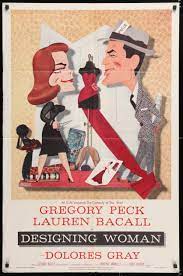
Designing Woman (Vincente Minnelli, 1957)

DESIGNING WOMAN got good reviews and Lauren Bacall claimed it as a favourite role. When I saw it last night – and in spite of the visually gorgeous Warner Home Video version – I found it hard to understand why. It had all been done more expertly, with greater lightness and depth, in George Stevens’ WOMAN OF THE YEAR (1942).It’s perhaps no accident that Bacall would be attracted to the role of Tess Harding, and have a big hit with it as a musical on Broadway in 1981.  If you can forget the controversial ending, Woman of the Year seems a masterpiece next to DESIGNING WOMEN. Bacall and Gregory Peck sink every joke here. They’re game but no cigar. No circus going on in THEIR heads when they say those lines either.

Minnelli makes everything look beautiful. Peck and Bacall ARE beautiful but…. In some ways this career woman vs sports writer offers an interesting exploration of masculinity but a tentative one that backtracks at every opportunity. Here, a choreographer played by the great Jack Cole, himself the choreographer of the film, defeats a whole mob of gangsters with dance steps…but he reassures everyone that he’s married and a father of three. And if you already haven’t gotten the message, he’s named Randy Owens. The film is an interesting commentary on appearances and very Minnellian for that but also a liminal step out of the closet that backtracks into it at the highest speed possible. The story is autobiographical and suggested by designer Helen Rose, my least favourite Hollywood designer. She has a great sense of colour but the dresses all bunch up in the most inappropriate and least flattering places. I was sorry I’d shelled out so much to get the film, however beautiful the version.

It’s perhaps a measure of the film’s limitations that it takes one cute poodle joke and doesn’t know when to stop:

José Arroyo

Eavesdropping at the Movies: 282 – Lapsis

First-time writer-director Noah Hutton imagines, in Lapsis, a near-future gig economy dystopia that isn’t that different from our own. Unable to pay for his brother’s healthcare, Dean Imperial’s Ray takes on contracting work for a Google-esque tech giant, hiking through forests laying cables. Imperial’s performance is a standout, his Ray always sympathetic and legible, and Hutton’s sketchy, piecemeal world-building suits the film – until it doesn’t. Lapsis creates a recognisable milieu and has a leftist politic with which we broadly agree and are happy to see, but as its story develops it wants to evoke the feeling of doom one would expect of a revealed conspiracy, without the burden of having to bring together its disparate subplots and building blocks in order to explain anything.

Despite our reservations, we enjoyed Lapsis and are glad to have seen it, and are keen to see what comes next for Noah Hutton and Dean Imperial.

The podcast can be listened to in the player above or on iTunes.

With José Arroyo of First Impressions and Michael Glass of Writing About Film.


José Arroyo & Richard Layne on Downpour (Bahram Beyzaie, Iran, 1979), Wales One World

We continue our discussion of the Iranian programming at the Wales One World Film Festival with Bahram Beyzaie’s great, Downpour (1972),  influenced by Italian Neo-realism and European Art Cinema, one of the films that spearheaded the Iranian New Wave counter cinema, poetic and critical, and managing to synthesise realism and allegory. A great film.

The film was part of Martin Scorsese’s World Cinema Project (No. 3). It received a restoration from the Cineteca di Bologna in 2011 and now has a Criterion release. The podcast refers to Hadmid Naficy’s very interesting piece on the film and the Iranian New Wave that you can access here.

https://soundcloud.com/user-766042506/jose-arroyo-richard-layne-on-downpour

The podcast can also be listened to on Spotify here: https://open.spotify.com/show/2zWZ7Egdy6xPCwHPHlOOaT

and on itunes here: https://podcasts.apple.com/gb/podcast/first-impressions-thinking-aloud-about-film/id1548559546

In the podcast we discuss, the brilliant editing, the imaginative choice of editing, the variety of impactful shots, the beauty of the images, and some of the ways the film allegorizes. We criticise the sub-titles and wish they’d been better.

Ehsan Khoshbakht, the director of Filmfarsi, contextualises Downpour and The Deer in this brilliant Q&A, shown as part of Wales One World Film Festival:


In the discussion Ehsan refers to Chess of the Wind as part of this New Wave. We podcast on it from Bologna here: 

José Arroyo

The Youssef Chahine Podcast No. 32: Youssef Chahine’s Cinema — An Egyptian Perspective, Part II


We continue our discussion with Hussein, to garner an Egyptian perspective on the career of Youssef Chahine to 1985. We touch on Son of he Nile/ Nile Boy (1951), The Blazing Sun,/ Struggle in the Valley (1954) ‘The Turn of the Decade’ films (Forever Love/ Forever Yours (1959), In Your Hands (1960), A Lover’s Call (1960), A Man in My Life (1961). We continue with all his major films and discuss how some phrases from them have become common parlance in Egyptian culture. We also touch on the complicated relationship with Mohsen Mohieddin Mohsen Mohieddin and we end with Dalida and The Sixth Day (1986). It’s a conversation still to be continued, and we will cover the last phase of his career in the next podcast.

The podcast can also be listened to on Spotify here: https://open.spotify.com/show/2zWZ7Egdy6xPCwHPHlOOaT

and on itunes here: https://podcasts.apple.com/gb/podcast/first-impressions-thinking-aloud-about-film/id1548559546

Hussein also sent some wonderful photos which he describes as follows.

First photo (above) is a film poster from one of his first films, not sure which.

Second (below) is from Forever Love, the first of the four “turn of the decade” films.


Third is a photo  I took on my way home from work today of the building where Chahine lived most of his life till death, he lived in one of the three upper floors with the many windows. He actually shot many scenes there, in Egyptian Story (1982), Alexandria Again and Forever (1989), Cairo as seen by Chahine (1991)and Silence on Tourne (2001).


The last one is the plaque at the entrance of the building memorializing him. He used to live in the downtown Nile island of Zamalek, one of the more affluent neighborhoods of Cairo back in the days and still today.

José Arroyo

José Arroyo and Richard Layne on The Deer/ Gavaznha (Masoud Kimiai, 1974)


We continue with our exploration of the Iranian Cinema on offer at the Wales One World festival with a discussion of the extraordinary The Deer/ Gavaznha (1974), a metaphor for pre-revolutionary Iran’s social relations, focussing on down and outs living in a courtyard with a heroin addict and a bank robber as heroes. The influence of Italian neo-realism is everywhere present in a film that is simultaneously symbolic but also pulpy and visceral. It’s an iconic film extra-textually as well: a cinema showing the film was burned down killing hundreds of people. It’s a film that is still banned in Iran. Behrouz Vossoughi gives an extraordinary performance.

Thanks to a friend, Richard and I have also been able to see the film’s original ending where Ghodrat (Faramarz Gharibian) believes Seyed (Behrooz Vousoughi) has betrayed him and shoots him. As Seyed is on his knees he explains that friendship comes before anything and Ghodrat , visibly moved, gives himself up to the police. The film ends with the promise of the two friends re-uniting at the end of the prison term with the promise of healing and solidarity in the aftermath of the current situation. It’s very moving.

The podcast can also be listened to on Spotify here: https://open.spotify.com/show/2zWZ7Egdy6xPCwHPHlOOaT

and on itunes here: https://podcasts.apple.com/gb/podcast/first-impressions-thinking-aloud-about-film/id1548559546


A ban robber tries to convince a heroin addict to change

A life imprisoned. Setting doves free will be a metaphor. In the meantime, it’s all barbed wire.

When people are seen as sheep but also as ranking below them to the extent their homes are turned over to animals

The courtyard

Is it a queen who’s long hair gets shaved in prison?


Ehsan Khoshbakht, the director of Filmfarsi, wrote us a quick note to pick up on some of the points discussed in the podcast on The Deer:

‘The Deer is a black & white film and the colour version on YouTube is ….(an) unauthorised digital colorization. Colour films were very rare in Iran, even as late as mid-70s.
‘Another point that I wanted to raise is that with the exception of the opening dialogues added to the film in post-production (which you read in bracketed subtitles), this was the most complete version of the film which I telecined from Kimiai’s own battered print — the only way I could show it in the west. So this was the uncensored version, but since I didn’t have access to the separate audio track of the film, I couldn’t remove those forced lines and the best approach was to present them in brackets’.
Many thanks to Ehsan Khoshbakht for his film, for helping the The Deer circulate, and for answering some of the questions we posed in the podcast.
Those of you who want to follow a more extended discussion on Iranian genre  cinema in general and The Deer in particular can do so in this fascinating conversation  between Kaveh Askari and Ehsan Khoshbakht
here:

Ehsan makes an interesting comparison of it with Butch Cassidy and the Sundance Kid, particularly the ending

José Arroyo


José Arroyo & Richard Layne on Filmfarsi (Ehsan Khoshbakht, 2019) Wales One World Festival


The podcast can also be listened to on Spotify here: https://open.spotify.com/show/2zWZ7Egdy6xPCwHPHlOOaT

and on itunes here: https://podcasts.apple.com/gb/podcast/first-impressions-thinking-aloud-about-film/id1548559546


A discussion of Filmfarsi, a film by Ehsan Khoshbakht, on a mode of filmmaking extremely popular in Iran — urban gangster films, melodramas, musicals — set in urban working class milieus, that evoked and challenged the country’s vaunted leap in modernity. IAccording to Ehsan Khoshbakht, the film’s director, ‘Something rare, euphoric and mad was recorded on celluloid: the Iranian way of life after the second world war, with all its paradoxes. Even the sleaziest films became documents. If the majority of key Iranian arthouse films of the 1960s and 1970s were set in villages and rural areas (a tradition continued until after the revolution), filmfarsi was about the thriving cities, which were expanding blindly, thanks to petrodollars’.

t’s very different to the type of cinema Abbas Kiarostami was also doing in this period. It’s a cinema quickly banned after the ’79 revolution, and a cult on VHS. The filmmaker shows the wide range of filmmaking, its transnational perspective, its ritual and fetishistic post -79 consumption, and well evokes why it was so powerful, why it’s been banned and why it is so cherished.

He’s also offered a wonderful introduction in The Guardian, which can be found here.

It begins with: ‘Shortly after the 1979 Iranian revolution, the country’s national newspapers published a joint subpoena, unique in film history. All the key stars of “filmfarsi” – a form of popular cinema that embodied the aspirations and illusions of a modernising society – were summoned to the revolutionary court. The careers of hundreds of actors and directors ended overnight. Unlike the Hollywood blacklisting of the McCarthy era, there was not even the opportunity for a mock hearing. The cinema, seen as emblematic of corruption, “westoxification” and the decadence of the ousted Pahlavi regime, was consigned to oblivion.


Those of you interested in watching the film can follow up bookings here. Many thanks to Wales One World for their superb programme and for the free screenings.

You can see Ehsan Khoshbakht speak to David Gillam on Filmfarsi here:


José Arroyo

Eavesdropping at the Movies: 281 – The Day of the Locust

Another discussion of — if not a classic — a still remembered film, on Hollywood, and — to add a cherry on top — with the great Karen Black.

An expensive flop in its day, The Day of the Locust maintains a cult intrigue for its critique of Hollywood and descent into madness. It’s new for both of us, and we discuss the qualities its cast brings, what could be better about its industry commentary, its moments of surprisingly graphic violence, and who, or what, its titular locusts are.

The podcast can be listened to in the player above or on iTunes.

With José Arroyo of First Impressions and Michael Glass of Writing About Film.

A quick note on End of the Century (Lucio Castro, 2019)


If you liked Andrew Haigh’s Weekend (2011),  you might want to give End of the Century/ Fin de sieglo  a go. Ocho (Juan Barberini) and Javi (Ramón Pujol) meet in Barcelona. Ocho’s Argentinian, living in Madrid and has just ended a twenty year relationship. Javi is a native of Barcelona but is now living with a husband and child in Berlin. They cruise each other, have wild sex and meet again the next day to wonder around the city. As they chat, they remember they met and mated twenty years before in the same city. A slow-paced absorbing film, sexy and romantic, wistful and sad. There are about 12 minutes with no dialogue and it is not missed. The last section, a what might have been, is particularly affecting. I think it better than Weekend and highly recommend. It’s on BFI and on Vimeo through Peccadillo pictures.

José Arroyo

The Youssef Chahine Podcast No. 31: An Egyptian Perspective of A New Day

The podcast can also be listened to on Spotify here: https://open.spotify.com/show/2zWZ7Egdy6xPCwHPHlOOaT

and on itunes here: https://podcasts.apple.com/gb/podcast/first-impressions-thinking-aloud-about-film/id1548559546

This podcast has been very lucky with its listeners. Hussein, not only provided us with a possibility of viewing the wonderful Dawn of a New Day, but produced the sub-titles necessary to understand it. We can’t thank him enough. I took the opportunity of talking to Hussein to ask him about things we as English-speaking viewers might not have understood. i.e an Egyptian perspective on the politics, the history, the significance of streets and buildings, the customs, the reputation of the actors in the film(Saifuddin Shawkat, Sanaa Gameel) and in Chahin’s other work (Mohsen Mohieddin) . All proved illuminating and enlightening and has certainly helped me understand Dawn of a New Day better. The conversation then continues onto Chahine as a figure in Egyptian cinema and culture and it was so interesting and informative that we will continue with that strand of conversation onto the next podcast.


Hussein has also kindly provided us with a link to two interesting stories:

Click on “the cairo tower” and “if lions could speak”. The first is the tower’s story, the other on the two lions on each side of the bridge that tarek crosses to meet Nayla. Hussein tells us, ‘They are of extreme importance in our history and almost became synonymous with downtown Cairo’.
José Arroyo

Lecture on Rocky (John G. Avildsen, 1976)


A camera move from The Shop Around the Corner (Ernst Lubitsch, 1940).

When a series of blows deflates the very life out of you, in one co-ordinated camera move. From The Shop Around the Corner:

A note and reminder on/of You Only Live Once (Fritz Lang, 1937)

You Only Live Once is surely one of the great works of cinema. I had a discussion with a friend on Facebook about whether Fury was superior but I haven’t seen that for a decade. I remember I  liked this more not for its sentimentality but for its sentiment. The thank you for loving me line is so beautiful, and frankly doesn’t seem excessive at all considering the circumstances.

Visually, it’s astonishing, with Lang’s typical control of camera and expressionist lighting that, particularly in the prison scenes, convey how Eddie Taylor (Henry Fonda) is imprisoned not only physically but psychically. The play with sound and silence in last dinner scene in jail, so suspenseful and expressive. The frog scene is a superb instance of how editing functions with images and rhythm to allegorise feeling: that gorgeous bit with the water rippling and then concretising the moment as it stops, and then cutting at precise moments to evoke what the characters feel for each other. Gorgeous. And the performances by Silvia Sydney as Joan and Henry Fonda as Eddie are of great power and delicacy.

I wondered why with all its shadows, it’s darkness, the expressionist lighting etc. it isn’t counted amongst noir. My conclusion — apart from it being 30s –is that the couple here — surely two of the greatest performances in American cinema — are in love in an almost ideal way, no kink or deviancy — though theirs is clearly a relationship of the body as well as the mind. Heat of body as well as soul, but all in a socially-sanctified way. Also their ejection from the mainstream is a tragedy, not a chosen pathway due to confusion or trauma. Still as V.F. Perkins’ great piece on the film explains, even their relationship is more complex than evident at first glance:


I enclose the’ thank you for loving me ‘ scene here only because it’s so unusual an expression then and so current now. If I was only looking for great, I might have chosen the frog scene, or Fonda’s rejection of Sidney in jail. It’s a film of brilliant scenes, nothing is off. It’s a film I shall return to. In the meantime:


José Arroyo

Eavesdropping at the Movies: 280 – A Sun

We explore a wonderful Taiwanese film that Netflix forgot it had, A Sun. An intimate yet epic drama about the effects of a single mistake that reverberate through a family and down the years, it’s gorgeously lit and shot, and although it feels as long as it is, every moment is earned and valuable. It asks fundamental questions of its characters and of us, the most important of which is: What does it mean to be a good person?

The podcast can be listened to in the player above or on iTunes.

With José Arroyo of First Impressions and Michael Glass of Writing About Film.


Playing with Hank