EPISODE THREE OF BERLIN ALEXANDERPLATZ: A HAMMER BLOW TO THE HEAD CAN INJURE THE SOUL.

Franz Biberkopf (Günther Lamprecht) is trying to turn legit and the world won’t let him. He’s had to quit a job selling a Nazi paper because he has to wear the swastika and it’s turned former friends against him. His girlfriend Lina ( Elizabeth Trissenaar)is too religious to let him sell the sex-education booklets. There are ¾ of a million people in Berlin. How are they to live? Lina’s ‘uncle’ Otto (Marquard Bohm) advises them to join him selling shoe-laces door-to-door door-to-door. Franz meets a vulnerable widow. He looks like her husband. They have sex and she gives him money. Franz makes the mistake of telling Otto and sharing the money with him. But Otto betrays him and uses the knowledge Franz unwittingly provided to rob the widow. Betrayed by the people he trusted most, Otto runs away. His girlfriend goes in search of him in the dosshouse he’s staying in  but he doesn’t want to be found. There are some lessons he’d rather not have learned.

What caught my eye in this episode was

  1. The whole brown and amber of the film, even more pronounced in this episode.
  2. The way so many shots include a background separator –store-fronts, internal doors and windows, mirrors, that frames faces or cast shadows.
  3. The way Fassbinder adopts Döblin by including bible passages, songs into the narration itself.
  4. The way intertitles re-direct narration (see below).
  5. the beautiful passage where he goes buy flowers for the widow (see below).


Intertitles

Flowers for death

José Arroyo

Episode Two of Berlin Alexanderplatz: How Is One to Live If One Doesn’t Want to Die

What caught my eye in the extraordinary second episode of Berlin Alexanderplatz is as follows:

The credit sequence. It’s most unusual in that the opening credits acknowledge the contributions of the main pillars of Fassbinder’s team, and this includes not just actors but also camera crew, sound people, production managers, editors etc. The end credits to each episode convey credits more conventionally (see above).

The denunciation of marriage as an institution, which is repeated twice (see above).

The heartfelt anger over Paragraph 175, first expressed by the newsagent then read in a beautifully expressive way by Gunther Lamprecht as the story of a man whose life was ruined because he met his sunshine, the boy who gave his life meaning and made it all worthwhile. Further proof, if needed, that who makes movies matters (see above).

The standoff with the communists in the tube, with the extraordinary shot where they all remain still, a tableau, as the camera circles around them 360 degrees, and Fassbinder in voice-over, speaks poetically, alliteratively in a way that comments on the action and reproduces some of what Döblin in the novel does with sounds, found poems, bits of the bible, songs etc (see above).

José Arroyo


Thinking Aloud About Film: Stella Dallas (Henry King, USA, 1925)

In the accompanying podcast, we discuss the latest in the series of magnificent Film Foundation Screenings, the 1925 version of STELLA DALLAS directed by Henry King and restored by MOMA. It’s a glorious experience to see a film now almost 100 years old, looking brand new, probably seeing it in a better condition than most audiences would have seen it upon first release, particularly if they didn’t live in major metropolitan centres. The quality of the image, the toning, the tinting: it’s a sensuous joy. We also praise the film itself. It’s a work that continues to move. We compare it to two later versions: King Vidor’s 1937 film with Barbara Stanwyck and John Erman’s 1990 version with Bette Midler. We discuss the treatment of class in all three films. José argues for the superiority of the 1937 version and praises Stanwyck and the extraordinary last shot of that film. That aside, we also discuss why we love this marvellous silent film, praised as a masterpiece when it first came out and then sidelined as a mere ‘woman’s film’ for many generations.

An experience greatly enhanced by Stephen Horne’s wonderful score, orchestrated by Ben Palmer.

The podcast can also be listened to on Spotify here: https://open.spotify.com/show/2zWZ7Egdy6xPCwHPHlOOaT

and on itunes here: https://podcasts.apple.com/gb/podcast/first-impressions-thinking-aloud-about-film/id1548559546

Support materials for the film screening, including an introduction by Gina Telaroli, interviews with film critics such as David Kehr etc, may be accessed here here: https://delphiquest.com/film-foundation/restoration-screening-room/stella-dallas?fbclid=IwAR2CdlBDagS0zPCFNiUI0S7SHkN0Cqaxb4RzUT8Ms944SPHrt4QG-Sq0gN8

The ending of the 1937 version of Stella Dallas:


José Arroyo

Berlin Alexanderplatz (Burhan Qurban, Germany/Netherlands/Canada, 2020)

The over-arching question in BERLIN ALEXANDERPLATZ is how to be a good man in a society that’s corrupt and wicked. In the novel, Franz Biberkopf killed his wife in drunken rage. He knows he can’t atone for it but, after serving his sentence, he desperately wants to live the rest of his life as a good man. What the novel then dramatizes in its detailed, montage-y, kaleidoscopic and cacophonous manner is the impossibility of such a quest in a society’s whose single-minded pursuit of profit reifies and dehumanises. Biberkopf won’t be allowed to be a man at all much less a good one. Ideas of masculinity and goodness are intertwined and central to the novel’s drama and its critique.


The strength of the narrative through-line, and the elasticity of its central, now archetypal characters, is evidenced in Burhan Qurban’s 2020 adaptation. Franz (Welket Bungué) , formerly Francis, an undocumented refugee from Guinea-Bissau, arrives in Germany having seen and done terrible things to get there but now determined to be good. The impossibility of that is narrated by Mieze (Jella Haase), the woman he loves and who he ends up pimping. Reinhold (Albrecht Schuch) is here a misogynistic repressed homosexual with an unacknowledged desire for Franz and an active hankering to impede every happiness that’s not shared with him. The world they move in is one of human trafficking, drugs and sex work. And it’s one that’s updated from the novel to include people of colour and an expanded range sexual identities (there’s an important trans character).


It’s a very slick film told in five episodes lasting over three hours. It’s a pleasure to see but ultimately unsatisfying. Whilst the filmmakers do an interesting job of reinterpreting the world and the characters in terms of race and sexuality, they’ve not quite updated the attitudes to gender. Thus practically every woman we see in the film is a prostitute. Of course, we are seeing a particular world, but they could have made Pums, the gang leader a woman, or had women drug-dealers or nightclub owners. It’s a problem and creates a particular tension in the film, one somewhat mitigated by having Mieze narrate. Though this tension between Mieze’s narration and what happens to Franz also sadly sideswipes the particular sexual fetishization involved in black masculinities in a white culture. It’s not acknowledged therefore the film can’t dramatize how Mieze and Fritz negotiate such questions between themselves to arrive at a more personal and human interaction.  Lastly, the film also has a utopian epilogue that seems to betray everything the film (and the original novel) has been about. That said, a very interesting work that  I’m very glad I saw and recommend.

Those of you interested  in comparing the novel, the 1931 version, and the TV series will enjoy this lively and informative discussion between Peter Jelavich and Johannes Binotto. Jelavich considers the Qurban 2020 version a masterpiece:


José Arroyo

Berlin Alexanderplatz (Phil Jutzi, Germany, 1931)


Tegel to Alexanderplatz

In preparation for Fassbinder’s sprawling  15-hour television adaptation of BERLIN ALEXANDERPLATZ, I’ve been reading Alfred Döblin’s magnificent novel and looking at other adaptations. The 1931 version directed by Phil Jutzi is included in the Criterion box-set of the TV series. Jutzi joined the Communist Party in 1928 and, conveniently, the Nazi Party in 1933, and the ideological tensions and opportunism are evident in the film. I saw it last night and enjoyed it, though at 92 minutes it necessarily cuts out much of the novel’s plot and complexity.

It does capture some of the montage-y aspects of the novel, though you’d expect the film to be more inventive in this regard and it’s not. For Berlinophiles such as myself however, watching all that documentary footage in the film of Alexanderplatz as it was between the wars is a real pleasure. There is also a ‘People-on-Sunday’-ish interlude that well evokes the simple pleasures working people take even in very challenging economic times.

No government can forbid it…

The film has several songs, of which my favourite goes something like ‘Love comes, love goes, no government can forbid it.’ There’s a Weimar feel in the film’s attitudes to love and sex, and a depiction of a picaresque and dark Berliner humour. I also thought Heinrich George made for a very appealing if uncomplicated Franz Biberkopf. Döblin worked on the adaptation so he presumably sanctioned and had a hand in what was done to his novel. A not particularly good film of a great novel, though not without its pleasures.

The End

José Arroyo

THE THIRD GENERATION/ Die Dritte Generation (Rainer Werner Fassbinder, West Germany, 1979)

Fassbinder, after THE MARRIAGE OF MARIA BRAUN, once again handling the camera as well as directing,  and in a more Godardian mode: a searching intelligence trying to make sense of the world he lives in and unafraid to use whatever is within his reach to try to understand, dramatize, critique and convey.

The film has a collage-y dimension: the use of graffiti from men’s rooms, a class that begins by asking the significance of the revolution of 1848, a phrase from Schopenhauer used as code (“the world as will and imagination”), readings from Bakunin, discussions of Bresson and Tarkovsky. Fassbinder in intellectual mode and with a very precise setting — the place and dates of shooting: Nov. 1978 to Jan 22, 1979. The narrative nonetheless still clearly conveyed, the collage-y aspect in tension with the precision of the setting and a relatively linear narrative, with aspects clearly meant to irritate: there are overlapping sounds that become difficult to distinguish; the burnt-in text passing too quickly to fully comprehend.

At the beginning, the film promises: “A comedy in six parts about social games full of suspense, excitement and logic, cruelty and madness, like the fairy tales told to children to help them bear their lives unto death”. The plot revolves around a rich industrialist, P.J. Lurz (Eddie Constantine) who works in computers and surveillance, but his stocks are down as there is currently no demand for the services he provides. To fix that he’s funding a terrorist cell made up of ordinary middle-class people — a secretary (Hannah Schygulla, record shop assistant(Harry Baer), pianist (Udo Kier), housewife (Margit Carstensen) and teacher (Bulle Ogier – to kidnap rich industrialists, increase fear and thus increase demands for his products. What we see is a divided nation, a police state where truth is mediated through images. It’s a society of spectacle where, taking of from and reversing Godard’s famous dictum, ‘Film lies 25 times a second’, the extra second to take into account films on tv running a second faster. This is the film that begins with a computer screen and ends with an action and a television screen’s mediation of that action. within the same frame.

Manufactured Terrorism

According to Thomas Elsaesser, ‘after the first generation of idealists and the second of pragmatists comes the third generation of opportunists’. Here that third generation is a disorganised idealist bunch, alarmingly quick to submit unquestionably to the rules set hierarchically by the group, in all aspects of their lives, including sexually. Volker Spengler is the double agent, in Lurz’s pocket financially, and the one who betrays the groups in a Shrove Tuesaday that turns into a bloody carnival as cameras record a relatively open-ended ending. It’s a film I’ll need to think about some more.

Lies 25 frames a second

Ian Penman, worth quoting at length (from THOUSANDS OF MIRRORS):

“140. The triumphant rise of the Consumer Society is interrupted by its apparent nemesis or antithesis: terrorism. But is it really threatened by this danger – or ultimately strengthened? Isn’t terror in fact its mirror-image doppelgänger or twin? Ready at a moment’s notice to prop up its threatened values and unreliable economy. This is why Fassbinder’s The Third Generation is such a eky text: Consumer Society + Terror State x Digital Info +Surveillance = The Future. “

José Arroyo

Natasha Rambova’s designs for Camille (1921)

A bonus of the Warner Archive blu-ray of Camille is the celebrated 1921 version directed by by Ray C. Smallwood, a lesbian-lead project (Nazimova starred and produced, June Mathis wrote it, Natasha Rambova designed the production). The sets and costumes, a combination of art nouveau and arts and crafts design, is very striking, as indeed is Nazimova’s startling performance. Valentino plays Armand, completely at ease and clearly already a star:

The opening with the introduction of Valentino and a real star entrance from Nazimova:

Elisabetta Girelli has written an excellent piece on Valentino, which begins with a nuanced analysis of the acting in the opening scene (above).  It can also be accessed here: Girelli_2015_FI_TheSheik_AM

José Arroyo

Thinking Aloud About Film: Water Drops On Burning Rocks (François Ozon, France, 2000)

Today’s Fassbinder is a podcast on François Ozon’s adaptation of Fassbinder’s play, WATER DROPS LIKE BURNING ROCKS (France, 2000). This is the second of Ozon’s adaptations of a Fassbinder work, the other being  PETER VON KANT, which José thought dreadful. We discuss the play, which remained unproduced in Fassbinder’s lifetime; how the theatrical is rendered cinematic in Ozon’s fine adaptation; how it is amazing that a 19 year-old Fassbinder can imagine and do such a fine job of dramatizing this roundelay of relationships (homosexual, bisexual, heterosexual, transexual) in 1964 Munich: lucid, clear-eyed, aware of interpersonal dynamics, of sexual power plays. We discuss the extent to which the play brings in elements we know of Fassbinder’s own biography; we relate it to Fassbinder’s other films (FOX AND HIS FRIENDS)…. and much more:

The podcast can also be listened to on Spotify here: https://open.spotify.com/show/2zWZ7Egdy6xPCwHPHlOOaT

and on itunes here: https://podcasts.apple.com/gb/podcast/first-impressions-thinking-aloud-about-film/id1548559546


There are different productions of the play available to see, interesting to compare to Ozon’s film, and they can be accessed here:

A different production :
José Arroyo

THE MARRIAGE OF MARIA BRAUN/ Die Ehe der Maria Braun (Rainer Werner Fassbinder, West Germany, 1979)

The personal is always related to the social in Fassbinder’s work. With THE MARRIAGE OF MARIA BRAUN, the personal and the social are also interlinked to the historical. The film has been read as an allegory for the Federal Republic of Germany (Bundesrepublik Deutchsland) during the period of the ‘Economic Miracle’ – Maria Braun with her fine clothes and furs but dead inside – and is considered to be the first of what’s been called the ‘BDR’ trilogy, alongside LOLA (1981) and VERONIKA VOSS (1982).

It’s true that the film begins with a picture of Hitler crashing down, ends on a scene of the BDR’s victory over Hungary in the 1954 FIFA World Championships, where we hear the Federal Republic of Germany declared ‘Champion of the world’ over the radio, and then the final images, negatives of all the BDR chancellors to the time the film was made with the exception of Willy Brandt, who had exiled himself from Germany during the Nazi regime, and shown as negatives except for the last one where we see the transformation of the negative into the positive, giving the impression of devils made flesh. There’s no question that the film is making a commentary on history and the nation.

Germany in Ruins

That said it’s important the film also be considered as about Maria Braun. It’s a woman’s film and a melodrama, not unlike MILDRED PIERCE in some ways. A woman with responsibilities, living through hard times that make for difficult moral and ethical decisions but who ends up a successful business-woman. As books like Marta Heller’s A WOMAN IN BERLIN and Miriam Gebhardt’s CRIMES UNSPOKEN: THE RAPE OF GERMAN WOMEN AT THE END OF SECOND WORLD WAR, the period between the end of the War in 1945 and the end of the occupation in 1955, resulted in an unprecedented period of sexual violence.

Maria’s material success

Maria has few choices, she dabbles in the black market, she becomes a ‘hostess’, she navigates the world sexually: lucid, clear-eyed, intelligent and unsentimental about what she’s got to do to keep what’s left of her house fed, clothed, warm. Her mother prays for her soul but end up sewing her the type of dress she needs for her new ‘business’. The way she jumps on a cigarette, a sweet of a sip of alcohol whenever Maria brings something home vividly expresses the basic privations of the period. Yet as Maria says, ‘My mother loves me, supports me and cries with me over my pain but she leaves all the thinking up to me, thus leaving me no time to dream’.

The Mata-Hari of the Economic Miracle

The film is a melodrama in that you do side with the powerless, it’s ‘excessive’ and it’s designed to make an audience cry. The most important thing in her life is her marriage. But she only gets to enjoy it for one afternoon and one night after which her husband is sent to the Eastern Front. We see her with his picture on her back going day after day to the rail station to see if anyone’s seen him. She’s later told he’s died but he hasn’t. He returns to find her in the middle of coitus with a black man she’s now pregnant with. In the ensuing fight between the men she kills the American GI, Bill, who she’d been fond of. At the military hearing, when her husband hears her say she was fond of Bill but loves her husband, he decides to take the rap for her. She loses her baby. When the husband’s jailed, she vows she’ll learn to work and make enough money to build the house he would have built for them. She seduces an industrialist who falls in love with her and does exactly as she promised. Only to find in the end that it was all for nought. Except for her husband and her family, she’s put aside all feelings, feelings don’t keep you warm or fed. But it all blows up in her face.

Defiance Amidst the Ruins

If the film is about Maria, it’s also about marriage: THE MARRIAGE OF MARIA BRAUN. Maria fervently believes in it. There’s that wonderful screwball scene at the beginning when in the middle of a bombing they chase after the document and make sure it’s stamped. An institutional approval of their love. The certainty of her feelings for her husband, of her wish for a married life, is one of the films that make the film so romantic. Her husband feels the same way. Hearing of her love for him is what makes him take the rap for her. But this marriage, bounded between two explosions, what has it amounted to? One afternoon and one night of married life. After which, she’s cut of her feelings and sold her body. He’s suffered prison and ends up pimping her out. There illusions are romantic, the reality as with Fassbinder is something else again. It’s a film that begins with marriage but also with deadly explosions.

Marriage as Romantic Prison

A great film, I think, with a mysterious and charismatic performance by Hannah Schygulla. It’s the film that made her into an international star, and it was also West Germany’s biggest box office success internationally to that point.

José Arroyo

DESPAIR (Rainer Werner Fassbinder, West Germany/ France, 1978)

Fassbinder’s first English-language film is a tony affair. It’s based on a novel by Vladimir Nabokov. Tom Stoppard gets sole credit for the screenplay, the first instance I can think of where Fassbinder himself did not collaborate extensively on the script for one of his films. At 6 million DM ($2.6 million) it was his biggest budget to that point and you can see all the production values on the screen.
It’s all Art Deco gorgeousness, designed by Rolf Zehebetbauer, beautifully lit by Michael Balhauss, with a fluid, precise and imaginative mise-en-scène from Fassbinder, often filmed through windows, glass cages, onto mirrors to dramatize the disassociation of the protagonist, his splits of consciousness and finally his psychic disintegration. It’s sublime work with what must be one of Dirk Bogarde’s greatest performances: to watch him acting changing responses timed through the movement of a zoom, where when the zoom ends he creates a change in signification just through the co-ordination of his expression to the rhythm of the camera move is simply awesome . Yet the whole is here less than its parts and this is a curiously inert film, one that doesn’t ‘play’, hard to follow, with little narrative tension.

boxed in despair – mise-en-scéne

I had to see it twice just to figure out what the hell was going on. And I don’t think the problem was me. There was a three-hour cut by Reginald Beck. Then Julia Lorenz and Fassbinder edited did a two and a half hour cut that all the collaborators now remember as magnificent, then Lorenz and Fassbinder cut it to under two hours to fulfil their contractual obligations. Now it doesn’t quite make sense.

first dissasociation

Film within film doppelganger

It’s a film full of discordances. Some seem deliberate: the ironic playfulness of the acting is a productive counterpoint to the progressive grimness in the narrative. The casting of Klaus Löwitsch as Hermann’s doppelganger adds an element of narcissistic desire and self-delusion to Hermann’s madness. But discordances in the film’s sound, so much clearly dubbed, with actors from different countries (Andréa Ferréol, Volker Spengler, Bogarde, Löwitsch) all speaking in English with varying accents and sound levels that seem oddly mixed, that just adds an element of strangeness and distance that feels alienating.

Doppelganger mis-recognition

There are several intersecting aspects to the story: the state of Herman Herman’s business and the coming of the Nazi; Hermann’s disengagement from his life, his descent into madness with his doublings, doppelgangers, fracturings; a murder story that goes awry; and finally a protagonist finding light and relief from despair in his own madness. The German subtitle is a JOUNEY INTO LIGHT and Hermann is supposed to find some light and release – from the obligations to his wife, his chocolate factory, his exile – as he descends into madness: I’m an actor, he says at the end, a bit like Gloria Swanson SUNSET BOULEVARD. The Film is dedicated to Antonin Artaud, Vincent Van Gogh and Unica Zürn.

Desire and doppelganger

It’s a curious experience. It’s a film that doesn’t work, that doesn’t ‘play’, and yet it has so many beautiful elements that I enjoyed my second viewing even more than the first. The rationale for the second viewing had been utilitarian: how to make sense of the film. But the result was a sensuous enjoyment of the pleasures the film had to offer in décor, mise-en-scène and performances. It’s not ‘good’ but it really is quite extraordinary in some ways.

Broken beginnings, shattered endings

Intimations of the camps.

José Arroyo

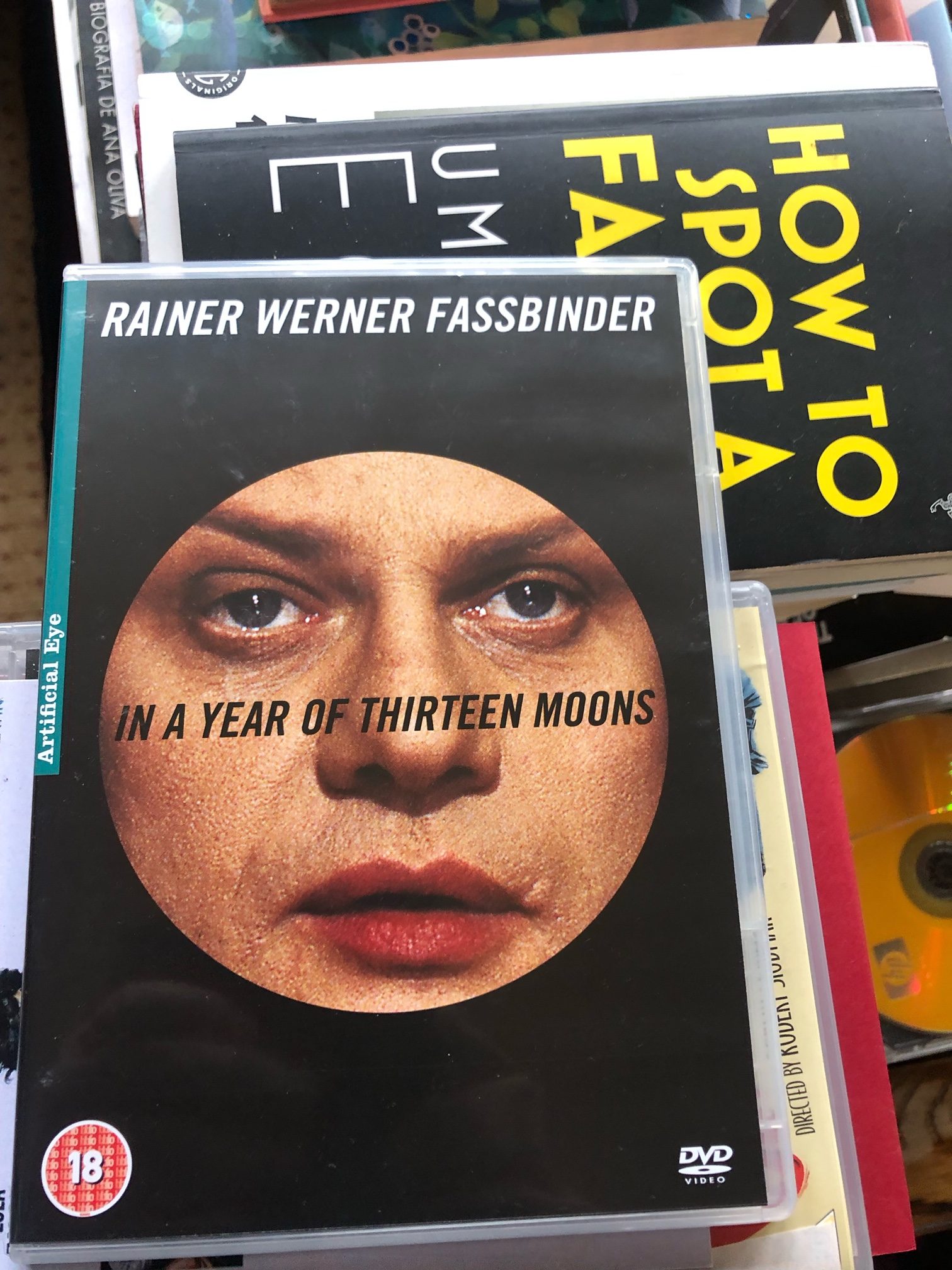
IN A YEAR OF THIRTEEN MOONS/ in einem Jahr mit 13 Monden (Rainer Werner Fassbinder, West Germany, 1978)

Watching IN A YEAR OF THIREEN MOONS has proven an overwhelming experience, one that’s resulted in trouble keeping within the terms of the exercise  I’ve set for myself, which is to see a Fassbinder film in the evening, and then take no more than half an hour to write about it the morning after, with maybe another hour or so gathering or making the clips and images necessary to illustrate whatever I’ve written. The film is so beautiful and harsh, with a structure that seems episodic and free-floating but that inexorably constructs the pathway to the tragic, with such an extraordinary performance from Voken Spengler as Erwin/ Elvira Weishaupt, the soft-spoken gentle giant who’s given up everything for love only to find himself without it, that my first impulse is to see it again and get a better grip on what I’ve seen. But that will have to wait, otherwise this Fassbinder journey will never end.

The film begins precisely on July 24, 1978. Men are cruising in a park by the river in Frankfurt. Titles tell us that ‘Every seventh year is a moon year. People whose lives are strongly influenced by their emotions suffer more intensely from depression in these years. To a lesser degree this is also true of years with 13 moons. When a moon year also has 13 moons, inescapable personal tragedies may occur.’ Needless to say 1978 is a year when that dangerous constellation occurs. And Erwin/ Elvira is its victim. They’ve gone cruising to buy themselves sex, something they find less humiliating dressed as a man than as a woman. They find someone who also finds them attractive but, as they begin to fumble with each other, the trick discovers that Erwin/ Elvira has breasts and lacks a penis. He’s outraged, begins to attack Erwin/Elvira and furthermore calls for all his mates nearby to join him. Thus the tables are turned on that trope of vulnerable gay men attacked by a braying mob of sadistic heterosexuals with fragile masculinities; here they are the attackers and Elvira is their victim. Another extraordinary opening scene from Fassbinder.

Goethe/ abbatoir

Elvira is so gentle, kind and loving, so needy for love, that she’s everybody’s victim. As Erwin, she was a happily married man who loved his wife and daughter. Then he fell in love with Anton Saitz (Gottfried John), a survivor of Bergen-Belsen, who made his fortune organizing whorehouses around techniques he’d learned in the concentration camp, now making an even bigger fortune in property development. Anton told Erwin that he’s heterosexual but would return his love if only Erwin were a woman. Erwin took this careless statement as a mission, went to Casablanca and had the full operation, gave up his whole life — family, work, sexual identity, gender – for love…and then never saw Anton again…. until an incident in the narrative results in Elvira’s searching and finding him.

Tombstones/ A Time to Love

Erwin’s tale is told episodically. He goes to the orphanage he grew up in and a nun there tells him that when he arrived as a baby everyone loved him. Then a couple decided to adopt him but they needed the biological mother’s permission to proceed. She wouldn’t give it because she was married at the time, the father was not her husband, and in fact since the child was born in wedlock the father would have to give permission, something that would reveal the adultery. The nuns feeling guilt and sadness over the child’s fate, started keeping a distance and the child experienced this as a withdrawal of love that he learned to live with. Later, in the extraordinary abattoir scene that for me culminates in the verses from Goethe — ‘..and though a man be silenced by his pain, a God gave me the power to express how much I suffer —  Elvira tells of how she wanted to be a goldsmith but could only find an apprenticeship as a butcher in an abattoir, how as Erwin he married and loved a woman he met there, now a teacher with ‘a life that is worth so much more than my own’.

Fairy Tales and Family Cannibalism

Fassbinder made IN THE YEAR OF THIRTEEN MOONS after the suicide of his lover Armin Meier. He wrote, directed, edited and was the dop on this project, an attempt to understand Armin, his life, his suicide, the place of love, need and desire in all of this, the price people pay for non-conforming, and perhaps his own guilt around how his own actions might have contributed to Armin’s fate. The story is told episodically: there is documentary footage of Fassbinder himself speaking, fairy tales, poetry, absurdist takes inspired by Martin and Lewis, all of which magically add up to a seamless narrative. Erwin/Elvira’s life ends on August 28th.

On suicide

The film leaves me with a desire to see it again immediately but also with several questions. Why hasn’t Queer Studies made more of this and indeed more of Fassbinder’s entire output. It seems that in the valorisation of New Queer Cinema and the development of  Queer Theory that arose almost simultaneously there’s a real erasure of post-Stonewall pre-AIDS gay cultures, of which I would rank Fassbinder’s work as the most significant.

It was so hard to conform

The other last question arises with the certitude that this is a great work but one which it would be very difficult to show. Can we screen films that offend or disgust? Should we block things because they make uncomfortable viewing. My view is of course not, we can and must, but ….I can imagine classes walking out en masse at the abattoir scene and perhaps losing them in toto. So the question becomes not only of what to make of IN A YEAR OF THIRTEEN MOONS, how to understand it, but also under which conditions, how can one contextualise it so that it can be screened at all, a fundamental preamble to any further discussion.

José Arroyo


The FASSBINDER EPISODE in the portmanteau film GERMANY IN AUTUMN/ DEAUTCHSLAND IM HERBST.

I’ve never seen a filmmaker expose themselves to this extent, a slab of meat, naked and poisoned on the outside and dramatizing quite extreme character traits and forms of behaviour, ones people normally prefer to hide. It’s a fascinating example of Fassbinder’s genius as a dramaturge, as it’s an episode where nothing seems to happen yet much is revealed.

A nice authoritarian ruler

It’s a piece of structured biography in which Fassbinder returns from Paris to his boyfriend Armin in Munich. It’s Autumn of ’77; an industrialist has been killed by terrorists, a plane has been hijacked and three terrorists have conveniently been killed under suspicious circumstances. Fassbinder tries to make sense of this through conversations with Armin, who doesn’t have the cultural capital to respond in a reasoned manner; with his mother, who is very cultured but is also a living embodiment of the legacy of Nazism —  she thinks the solution to these problems is a nice, kind-hearted Führer; and with his ex-wife, Ingrid Caven, who is a help but who is in Paris and doesn’t know very much about what is going on.

frames-within-frames

Fassbinder’s mother and Armin, are structural opposites in terms of class and education. Interestingly.  Tony Rayns claims Armin was the result of one of the Nazis’ genetic experiments to breed the perfect Aryan but who was then left to be raised on his own, becoming a functionally illiterate butcher and former rent boy. Fassbinder’s mother is the German translator of Breakfast at Tiffany’s. Yet their opinions do not diverge by much, though Fassbinder’s mother articulates hers much more clearly.

Armin consoles.

The Fassbinde episode begins with Fassbinder talking to a journalist about marriage, how he depicts it in his films, why he is against it, and how he hopes the representations of the institution in the films will make viewers’ question their own. The depiction of Fassbinder’s own relationship with Armin is as brutal as I’ve seen. Fassbinder treats Armin as his slave, demanding coffee, food, waking him up to dial his phone calls, kicking him out of the house when they disagree because it’s ‘his’ flat. Many of the episodes starts with Fassbinder bullying like a big powerful baby, and end with him crying, with Armin reaching out, consoling, understanding. In spite of his awful behaviour or as part of his awful behaviour, Fassbinder is also needy, jealous, desiring of Armin. As bleak and complex a depiction of a relationship as I’ve seen.


Addiction

Throughout all of this, another layer in the drama, and further proof of Fassbinder’s genius for dramatizing, Fassbinder is in the midst of addiction. He’s ostensibly quit but calls his dealer for more coke. He’s paranoid. By the state of the mess on his kitchen table he’s clearly in the midst of a binge, we see both withdrawal and vomiting. How much are his rages against Armin connected to his drug dependency? He paints himself as an unreasonable bully, completely selfish, obsessed with work, keen to understand the world and completely oblivious to the needs of those around him. It’s almost as they exist only as a function of his needs rather than people in themselves. Armin and Fassbinder’s mother might reveal traces of fascist ideas, but the authoritarian Führer presented in this episode is Fassbinder himself.

How he presents himself is at least as interesting. In some sections he’s got a big fat, puffy face, further distorted by being filmed as reflection of his coke mirror. He films himself naked, stroking himself whilst he’s discussing political issues on the phone with others. If the genitalia are upfront and close-up, the moments of feeling, of break-down of need, are filmed in long-shot, in Sirkian frames-within-frames that highlight, contain and restrict. It’s an episode that palpitates with anger, and need, a mind searching whilst a body breaks apart. Nothing that comes in the rest of the film matches its force.

naked

PS whilst much has been made of Fassbinder’s cruelty to Armin Meier, it’s worth pointing out that the credits of Germany in Autumn don’t even bother to spell his name right. The disdain for the lower-class outsider is not attributable solely, if at all, to Fassbinder.

José Arroyo


CHINESE ROULETTE/ CHINESISCHES ROULETTE (Rainer Warner Fassbinder, 1976)

A dazzling work of mise-en-scène. Fassbinder and Michael Ballhaus deploy a gliding camera, shifts in focus, compositions that group alliances or fractures, social and internal, with beauty and precision. Has anyone made more expressive use of a glass drinks cabinet? Doublings, decompositions, reflections, often filmed through glass or on mirrors. Nothing is as it seems in this movie and the process of discovery is brutal: ‘eavesdroppers often hear false truths’.

mirrors and reflections;


The setting is the real life Ballhaus family Schloss, but empty and with echoes of recent occupying army ransackings. The film has been compared to an Agatha Christie country house murder narrative such as AND THEN THERE WERE NONE. But there are limits to such a comparison: there are gun shots but no one is killed in this movie; and the wounding, psychic as it is, is also deep, primal and savage, going into areas Christie wouldn’t dream of.

Discovery

The plot revolves around a couple, significantly named Ariane (Margit Carstensen) and Gerhard Christ (Alexander Allerson). He’s ostensibly going on a trip to Oslo; she to Milan. But in fact both have arranged assignations with their lovers; he with his long-time mistress, Irene (the divine Anna Karina); she with Gerhard’s assistant Kolbe (Ulli Lommel, then Anna Karina’s partner). The problem is that their assignations are to take place in the family schloss, so they end up discovering each other’s adultery. All are sophisticated people of the world and try to behave elegantly. But things become more somber and delicate with the realisation that this has all been organised by the Christ’s daughter Angela (Andrea Schroeber).

Symphonic Opening Scene

Angela believes that her parents blame her for ruining their lives; that her father first took on a lover when she was diagnosed with a crippling disease that hampered the use of her legs; and that her mother took on a lover when Angela’s disability was pronounced incurable. In fact Angela thinks her mother wishes her dead, and the whole weekend has been designed by Angela, with the same precision that she enacts the role play of the dolls that surround her, to drive her mother to murder her. In fact games, strategy, enactments, role-play, through dolls, cards, chess, are running motifs in the film, culminating in Chinese Roulette, played viciously and with murderous intent. In the process the victim will become the victimiser, the Bad Seed,  or as John Mercer more colloquially puts it, The Exorcist’s Linda Blair on crutches.

games

The two couples are in tension with another set of four: Mrs. Kast (Brigitte Mira) who has some kind of underground or criminal relationship with Mr. Christ – ‘Ali Ben Basset has been murdered in Paris. We are the only two left,’ he tells her, a sort of McGuffin as this remains external to the main narrative but adds clouds of narrative possibilities that overhang but are never brought into focus. Just like Mrs. Kast’s son Gabriel (Volker Spengler), boot-boy and plagiarist, at the beginning of the film when he asks the petrol station attendant. ‘Have you ever been to hell?’ ‘Yes’.

dolls

The other two of that outside four are Angela herself and her nanny, Traunitz (Macha Méril). Traunitz has the kind of easy relationship with her charge that Angela wishes she had with her mother. They listen to techno – Kraftwerk: fun, rhythmic, partial —  instead of symphonies (Mahler’s Symphony No.8)  aiming for the totalising and divine. Traunitz herself is conducting a sexual relationship with Gabriel, who reciprocates though he seems himself as more androgynous, sexually more anarchic; and that includes a sexual tension depicted with Angela, who discovered he was a plagiarist years before and has the upper hand.


Fassbinder turns the tables here and explores the cruelty and harshness of the small and the weak to show the power and ruthlessness of the victim. That is basically the function of the character of the daughter. The mother is as is usual with Carstensen’s characters for Fassbinder, the target and recipient of much of the film’s sadism.

rhyming shot and another kind of discovery

When the game of Chinese Roulette begins, the verbal rapiers begin to wound, culminating in the question, ‘What Would This Person Have Been in The Third Reich?’ The film ends mysteriously with the sound of a gunshot, a night-time procession and a quotation from Christian wedding vows; a somewhat reductive ending as the film seems to have been about so much more than that.


According to wiki, Andrew Sarris devoted a whole university course to CHINESE ROULETTE.  I can understand why.


José Arroyo


Thinking Aloud About Film: The Bill Douglas Trilogy

We discuss The Bill Douglas Trilogy: My Childhood (1972), My Ain Folk (1973), and My Way Home (1978). The first with it’s echoes of Maxim Gorky must be one of the greatest films in the history of cinema, and a discovery. My Ain Folk, like My Childhood of medium length, we also claim is a great film. We have greater doubts about the third film, My Own Way Home, the only one that really qualifies as feature length. We compare the films to Turkish films we’ve been seeing recently such as A Dry Summer that describe a way of life that seems centuries old but is in fact very recent. We also compare the works to the novels of Douglas Stuart (Shuggie Bain; Young Mungo). These are works that subtly hint at the psychic effects of horrific economic conditions, families that are fractured, abusive, exploitative and lacking in love or even common decency, all rendered somewhat understandable. Lastly, we wonder to what extent class bias affected Bill Douglas’ career, a talent as is evident here with such a short filmography…


The podcast may be listened to here:

The podcast can also be listened to on Spotify here: https://open.spotify.com/show/2zWZ7Egdy6xPCwHPHlOOaT

and on itunes here: https://podcasts.apple.com/gb/podcast/first-impressions-thinking-aloud-about-film/id1548559546

More on the class issue may be found here: “Douglas’s contemporaries remain divided by class and aesthetic (Loach and Leigh versus Jarman and Greenaway) and I don’t think it’s overstating the case to say that this division arrested – still arrests – British culture.” https://katewebb.wordpress.com/2012/06/02/bill-douglas-among-the-philistines-cineaste/


There also are some interesting background articles on Bill Douglas and the trilogy here:

https://www.bdcmuseum.org.uk/about/

José Arroyo

SATANS’S BREW/ SATANSBRATEN (Rainer Werner Fassbinder, West Germany, 1976)


Fassbinder continues to surprise, this time with an all-out comedy, a high-pitched farce, dealing with the vulgar, explicit and extreme in a way that’s designed to be offensive and to push as many of the audience’s buttons as possible. How did he get away with it? In the first ten minutes of the film, we get fellatio with gun à la CHANT D’AMOUR, a murder enhanced by poppers during coitus, a dildo-drawer with a gun, a woman slapping down her brother-in-law’s erection in close-up, a prostitute getting her nipples tweaked for a laugh… It’s like a grunge explicit version of boulevardier farce about masochistic power relations, drained of any trace of elegance. I found it discomforting and funny.


The plot revolves around Walter Kranz(Kurt Raab), once the poet of the revolution, now suffering from writer’s block, and in constant need of money. He has a long-suffering wife, several mistresses, a brother who’s not all there (and who seems to be modelled on the fly-eating Renfeld, Dracula’s side-kick). He takes adoration as his due and exploits all his inter-personal relationships, including his long-suffering parents, whom he tricks out of the money they’ve saved for their funeral.

designed to be offensive

After two years when he hasn’t been able to write a word, he finally recites some lines he likes. He’s delighted at the break-through only to be told that the lines are not his but those of Stefan George, the famous symbolist poet. So he decides to become George by performing him, by hiring a coterie of young gay men to worship his poetry readings and by becoming gay himself, something he ends up not being too successful at. Performing identity, performing society’s expectations of identity and finding liberation in madness are key themes in the film.

male full frontal

Like in a good farce, everything is over-turned and comes full-circle in a ‘happy’ ending. Walter, who’s surprised when his brother likes the whipping he gives him, ends up finding his own masochistic side, thereby losing the provincial acolyte he’s been dominating, Andrée (Margit Carstersen) but getting together with Lisa, who previously enjoyed an open marriage with Rolf, who has now gone off with the newly liberated Andrée. He finally ends up writing a novel: NO CELEBRATION FOR THE FÜHRER’S DEAD DOG, a book who’s thesis is that Fascism will triumph, a hit with his publishers.


The film is book-ended by a quote from Antonin Artaud: ‘What differentiates the heathens from us is the great resolve underlying all their forms of belief, not to think in human terms. In this way, they are able to retain the link with the whole of Creation, in other words with the Godhead’, ie thinking from a non-hiuman point of view is a way of maintaining contact with the divine. Fassbinder described the film as a ‘comedy about me if I were what I perhaps am but don’t believe I am” Thomas Elsaesser found the film “a rare attempt at comedy from a filmmaker who, as most commentators have noted, is entirely devoid of humour’. A bit harsh I think, though how funny people find it might depend on how far they are willing to be pushed.

José Arroyo


Conversation Piece (Luchino Visconti, Italy, 1974)

Saw two Burt Lancaster films yesterday, Valdez is Coming and The Conversation Piece. Valdez is one of several anti-racist Westerns Lancaster did in this period. In Valdez he plays a Mexican constabulary on the borderlands trying to get a hundred dollars for the Indigenous wife of a black man wrongly shot at the beginning of the film. It’s Edwin Sherin’s first film, and he doesn’t have a feel for the camera, all the symbolism is externalised (Burt is tied to a cross, but it’s filmed as just him plonking down a forest in mid-shot). It’s a film that’s carried by the screenplay and the performances but that still works.

The other is Visconti’s great The Conversation Piece, where he plays a professor whose life of quiet contemplation is altered when he rents his upstairs apartment to a right-wing countess (Sylvana Mangano) for her gigolo (Helmut Berger). In both, Lancaster’s performance is pared down, acting with his eyes, and in which every gesture counts, such as his very moving and beautiful last one below. One can imagine some of Lancaster’s contemporaries playing Valdez (though hmmm even William Holden would be a stretch in the part) but that someone who so gorgeously embodied the joyous physicality of The Crimson Pirate could then inhabit Visconti’s Professor is truly wondrous. He’s so moving in it.

95879471_4437070119652331_6303506140634284032_o

Here,  he’s clearly a repressed homosexual, who wakes up one night and finds a bisexual orgy in his library. Full male nudity, frontal, in 1974. I´m keen to find out more about the reception.


The Masters of Cinema Edition has a wonderful appreciation of Burt, the person and the performer, by all the behind the scenes people who worked on the film.

CHAOS AS USUAL: CONVERSATIONS ABOUT RAINER WERNER FASSBINDER (Applause: New York, 1997), edited by Juliane Lorenz,

Today’s Fassbinder is on CHAOS AS USUAL: CONVERSATIONS ABOUT RAINER WERNER FASSBINDER (Applause: New York, 1997), edited by Juliane Lorenz, the editor of all of Fassbinder’s films after DESPAIR, and his ‘wife’, in quotation marks only because their marriage was not legally binding. They did live together for the last few years of his life; she’s the one who found his body; and she succeeded Fassbinder’s mother as the head of the Rainer Werner Foundation.


After reading it, I wished all my favourite filmmakers would get a book like this, an affectionate but critical account of what working with a director was like, of how the personality impinged on the work, and the various trials and attractions of working with such a compulsive and demanding workaholic. Most of the interviews are conducted by Lorenz herself; and she writes of how in the first interviews she was overly sensitive to perceived slights of Fassbinder and how she learned to loosen up so that people could speak freely. These are interviews by people who knew each other, who all worked with him. Mainly, there’s real affection but interviewer an einterviewee each know the other is all too familiar with the faults as well. In any case, the interviews are about the work, the working together and what that was like and what that produced. Though of course, it’s impossible to leave the man’s personality out of it altogether. And who would want to? Interestingly the only interview that is reproduced from another source is Ingrid Caven’s CAHIERS interview and I did wonder if Caven being Fassbinder’s first wife had anything to do with it.


If my first impulse was to wish this type of book for other favourite directors; the second one was for me to undertake a similar project on Almódovar; and then the third was the realisation of its impossibility. This book can exist in its present form, partly because the subject died so young. If one waits until the filmmaker dies to undertake such a project, most of his collaborators would also be six feet under. Indeed ,even though Fassbinder died when he was only 37, key people in his life and in his work had already preceded him (Armin Meier, El Hedi Ben Salem) and others would die before the book was conceived (importantly, Kurt Raab).


If one undertakes such a project whilst the director is active, producers, actors, dop’s etc will not speak freely if they hope to get work or if they’ve got an axe to grind because they haven’t received work. Thus this remains a unique discussion, a frank discussion by people who knew him well, some who worked with him consistently (Michael Balhauss, Peer Raben, Dietrich Lohman, Peter Märthesheimer); friends from the early days (Daniel Schmid, Hannah Schygulla, Irm Hermann, Ursula Strätz); his actors (Margit Cartensen, Brigitte Mira, Barbara Sukowa, Armin-Müeller-Stahl, Gunther Lamprecht, Gottfried John); his fellow directors (Werner Schroeter, Wim Wenders, Margarethe von Trotta), even a relative (Egmont Fassbinder).  And I found it genuinely interesting about a mode of making cinema and insightful about individual films.


For those who’ve been watching the Arrow collection of Fassbinder’s work, Julia Lorenz is the warm, clear-eyed, organised and liberal woman who appears in quite a few of the extras, talking about the shoots of individual films, their context, and occasionally brining out a copy or two of contracts for particular films to flesh out memory with concrete detail.


José Arroyo

FEAR OF FEAR/ ANGST VON DER ANGST (Rainer Werner Fassbinder, West Germany, 1975)

FEAR OF FEAR is a made-for-tv movie, a ‘woman’s’ film, a chamber piece in which a small set of characters and their inter-relationships are used to evoke a world, a social setting, a condition and an individual’s relationship to that world. As the film begins, Margot (Margit Cartensen), a middle-class housewife, beautiful and competent, happily married to an understanding husband (Ulric Faulhaber), is expecting her second child and understandably anxious. That anxiety turns to full-blown depression once the baby is born. Her in-laws live upstairs and whilst sometimes a help with baby-sitting, her mother in law (Brigitte Mira) criticises her housekeeping, her sister in law (Irm Hermann) is jealous and aspish, and her brother-in-law (Armin Meier), whilst kind and supportive, might also have sexual designs on her. The in-laws here are basically the Küsters but with their worst aspects highlighted and brought into focus: narrow-minded, petty, judgmental; an agent of social control; and heaven protect those that deviate from the narrow constraints they hold to be proper.

Margot is anxious and afraid, tired, and in such a deep funk she thinks she’s going mad. Her husband works during the day; studies at night; and though sympathetic to her, is not quite there for her or the children. Fassbinder shows us Margot, in frames within frames, hemmed in by the doorways of her ugly apartment, filmed at an angle to show her disassociation from her environment. There are lots of shots of her looking at mirrors where she questions the person she sees. Who is she? Who is she to her self? What is her ‘self’? Her inner state is often indicated in point-of-view shots where what she’s seeing is indicated by a blurred, wavy image as if she’s not quite there, and can no longer be objective about what’s out there either. The loss of her grip on reality is often signalled by an electric version of the type of score typical for melodrama.


Margot’s husband is concerned and they go to a doctor, who prescribes Valium, which helps, but soon she’s hooked on it and has to supplement the Valium with alcohol. Her sister-in-law catches her drinking in the middle of the day (the slattern!);, her mother in-law finds her dressed up with full on make-up in the daytime (it makes her feel better); her brother-in-law sees her in the swimming pool doing frenzied laps (what’s wrong with her?) and soon the in-law are checking on her constantly: has she fed the children, does she cook, does she need aspirin?: she’s a bad wife and mother who always though she was superior to everyone else. Is Margot mad? Or is this what trying to live up to impossible social norms that make no space for the wishes and dreams of women like Margot do to women like Margot?


Soon Margot is a drug-addict and a drunk, whoring herself out to the neighbourhood pharmacist (Adrian Hoven) for Valium. One afternoon, she tells him she wants to leave her family to be with him and he basically tells her she’s wonderful but that’s not an option. When she gets home, she slices a wrist; not to commit suicide, there’s her children, whom she loves. But just to feel something.


Kurt Raabe appears as Mr. Bauer, with all the charisma and creepiness of Peter Lorre, as a neighbour; her doppleganger – he’s just come out of an institution —  or her worst fear? He’s the only one who recognises what she’s going through. But every encounter with him on the street brings trauma. At the end of the film, when Margot has gone to a sanatorium, received help, and is back to normal, she looks out her window and sees that Mr. Bauer is in a coffin and hasn’t made it, the image begins to blurr and get wavey again. Is this a spark to regression? It’s ambivalent.


A tight, well-made film, like an un-glossy Sirk, that still feels relevant and lingers in the mind.

José Arroyo


MOTHER KÜSTERS GOES TO HEAVEN/ Mutter Küsters’ Fahrt zum Himmel (Rainer Werner Fassbinder, West Germany, 1975)

A film that incited laughter, tears, and, towards the end a palpable sense of sustained dread – ‘please don’t let that happen’. Indeed, there is an alternate ending –gentle and utopian –that was filmed but shown only in the US, where it doesn’t.  As I watch Fassbinder’s work, mainly in chronological order, some films detach themselves from the rest as more beautiful, more meaningful, better; films I want to revisit again: THE MERCHANT OF THE FOUR SEASONS, THE TEARS OF PETRA VON KANT, FEAR EATS THE SOUL. And to that I would now add MOTHER KÜSTERS GOES TO HEAVEN.

The film is set in Frankfurt, then the financial capital of West Germany, and already a site of terrorist actions. What we’re shown first is a close-up of plugs being assembled. Frau Küsters (Brigitte Mira) is a working-class housewife, making extra money by doing piece work from home. Her son Ernst (Armin Meier) is helping out as her daughter-in-law, Helene (Irm Hermann) makes a salad. She’s got a stew in the oven, one that needs more sausages, the way her husband likes it, and she’s multi-tasking with the plugs and the stew and conversation with her children about their upcoming vacation in Finland, the danger of preservatives in meat, the pros and cons and salads, when they overhear a report that some man in a factory got into an argument with a personnel supervisor and killed him before committing suicide himself. That man is Frau Küsters’ husband.

Soon the press descend. Her daughter, Corinna (Ingrid Caven), a cabaret singer returns home to support her mother but also to get press for her career. The whole family is interviewed. Her daughter Corinna starts an affair with the news reporter she trusts the most (Gottfried John) but even he twists all their words and her husband, who she sees as a nice, even-tempered man who never complained, fair and reliable, is headlined as a monster in the press.

The Spectre of Marlene still hovers (see above)

Is it significant that all of Mother Küster’s children are played by Fassbinder’s former or current lovers? Mother Küster loves all her children unconditionally. She accepts everything from them. And they love her also. But they’ve got their own lives. The first third of the film reminded me a little bit of Ozu’s TOKYO STORY. Everyone has their reasons. They do love each other and it’s nobody’s fault. But her son and daughter-in-law end up going on their vacation to Finland and missing their father’s funeral. The daughter exploits her father’s tragedy and moves out of her mother’s house and in with the journalist. At the funeral she vows to restore her husband’s name. But how? She’s all alone.

She’s befriended by a couple played by Margit Cartensen and Karlheinz Böhm , journalists, members of the Communist Party, and the wealthiest most bourgeois couple in the film. They offer her warmth and understanding and they’re the only ones who seem interested in clearing her husband’s name. The husband will be turned into a working class martyr murdered on the altar of capital.  Of course they’re using her, her daughter tells her. ‘Everybody’s out for something,’ she replies, ‘once you realise that, things get simpler’. Mother Küster’s simple, unaffected and naïve oration at the Communist Party meeting moved me to tears, partly because it contrasts so strongly with the film’s ironising of power relations, social, institutional and interpersonal.

It’s worth pointing out that all the film’s possibilities for exciting action (the revolt at the beginning, the shoot-out at the end) are left off-screen(see below).

 That’s not what Fassbinder’s interested in. Instead, we get Brigitte Mira’s sensitive, common-sensical and accepting everywoman, so emotionally transparent and so moving. Ingrid Caven as a low grade diva playing cheap dives and making the most of her moment in the spotlight with sub Marlene Dietrich, sub Brecht-Weill cynical chansons; a queerness that seeps through into laughter with the fat man dragged up as a ballerina, shaggy dark chest hair jutting out of his tutu, pirouetting for his life in the nightclub scene; and then that incredible last scene of the occupation of the magazine offices, where Mother Küster thinks she’s just participating in a sit-in to clear her husband’s name but, to her surprise, a gun appears and the whole action descends into tragedy.

Mother Küsters speaks to the Communist Party (above)

A critique of labour relations, of how the press distorts and manipulates, and an interrogation of whether left-wing parties and action groups are really interested in improving the life of a the proletariat. A moving portrait of complex family relations in the process of dissolution. A truly great film.


José Arroyo

WORLD ON A WIRE/ WELT AM DRAHT – Part II (Rainer Werner Fassbinder, West Germany, 1973)


In the second part of WORLD ON A WIRE, Fred Stiller (Klaus Löwitsch) finds that an ‘identity unit’ called Einstein is the contact person a between his world and the computer program. But it then occurs to him that his own world might itself be a computer program. Is he smoking a cigarette or someone’s idea of a cigarette? Is the coffee he’s drinking brown or has it been programmed to be brown and is really purple? Moreover, someone now has financial skin in the game, the program is not just being used for scientific purposes but also for commercial ones. As soon as he suspects he too might be someone else’s construct, an identity unit like those he’s programmed and overseen, the show takes on the form of the conspiracy thrillers then so in vogue (THE PARALLAX VIEW, THREE DAYS OF THE CONDOR, THE CONVERSATION). Is Fred mad or does someone want to kill him because of what he knows. He keeps getting headaches, losing consciousness; is someone out to erase him?

Michael Ballhaus, who so dazzingly filmed this, was executive producer along with Roland Emmerich, of THE THIRTEENTH FLOOR (Josef Rusnak, 1999) an American adaptation of the novel that is also WORLD ON A WIRE’S source material, SIMULACRON-3 by Daniel F. Galoueye. Rusnak’s is a handsome, expensive looking film, but it gets nowhere near the philosophical complexity, social critique or the dazzling play with form that we get in WORLD ON A WIRE. It has some attractive and skilled actors (Armin Mueller-Stahl, Gretchen Mol, Vincent D’Onofrio), a loud score, quick editing, a focus on the individual; an easy nostalgia for the past (the constructed world is 1937 Los Angeles) and a rather naïve optimism about the future. The group, a sense of collective, of politics, of competing economic forces, none of this is to be found in what can feel like an overly individualistic quasi monadic exercise; pretty and banal.

There are so many things I love about this second part of WORLD ON A WIRE: the carnality of what are meant to be identity units. Lowitsch is constantly filmed with his shirt off, his sexual potency winked at through a play of mirrors and statues in the mise-en-scène(see above).

And I love Barbara Valentin as the ur-blowsy bruised blond, madly in love with someone who doesn’t deserve her but happy to play around; she knows the ways of the world all too well but doesn’t quite seem to be fully in it (see above).

I love how the figure of Marlene Dietrich is deployed to bring up ideas of spectres and simulations and how that’s tied to power (see above). There’s a clear sense here that computer programmers begin to think themselves as God, can too easily get to love totalitarian power, and have no moral compass about the effects of their decision on others – something entirely lacking in the THIRTEENTH FLOOR.

I love also the extraordinary long take with Fred on the run (see above), where we see Klaus Löwitsch do extraordinary physical feats jumping through fences, but unlike with someone like Burt Lancaster who does it with such grace, power and ease, here you also see the effort it costs: Fred is tired, he’s fit but these feats cost; and he might not make it.

And always the queerness seeps through; in the filming of Lōwitsch, the use of Marlene, the scenes set in the nightclub with the musclemen cooks, and the grotesque men who appear with bright lipstick like something out of a painting by George Grosz or Otto Dix.

I love Kurt Raab’s design (see the extraordinary take above), which seems to be made of cling film and aluminum foil, shiny, reflective but not quite real, flimsy and on the verge of disintegrating. I love the use of Eddie Constantine (see below), part of what the show tries to achieve by using old movie stars with strong personas to indicate a constructed world, and partly also a nod to ALPHAVILLE.

There are some dazzling 360 degree long takes, and quite astonishing images with guns and mirror, distorted multiple reflections, always expressing a feeling and a point-of-view on the world it’s filming (see a mere sampling, below).

Made on a tight budget, for television, an appreciation of its achievements – intellectual, political, aesthetic, as a viewing experience only grows when comparing it to what was remade in THE THIRTEENTH FLOOR. I’s influence on THE MATRIX now seems  unquestionable.

José Arroyo