Monthly Archives: September 2021

The Youssef Chahine Podcast No. 40: Let’s Talk (Marianne Khoury, 2019)

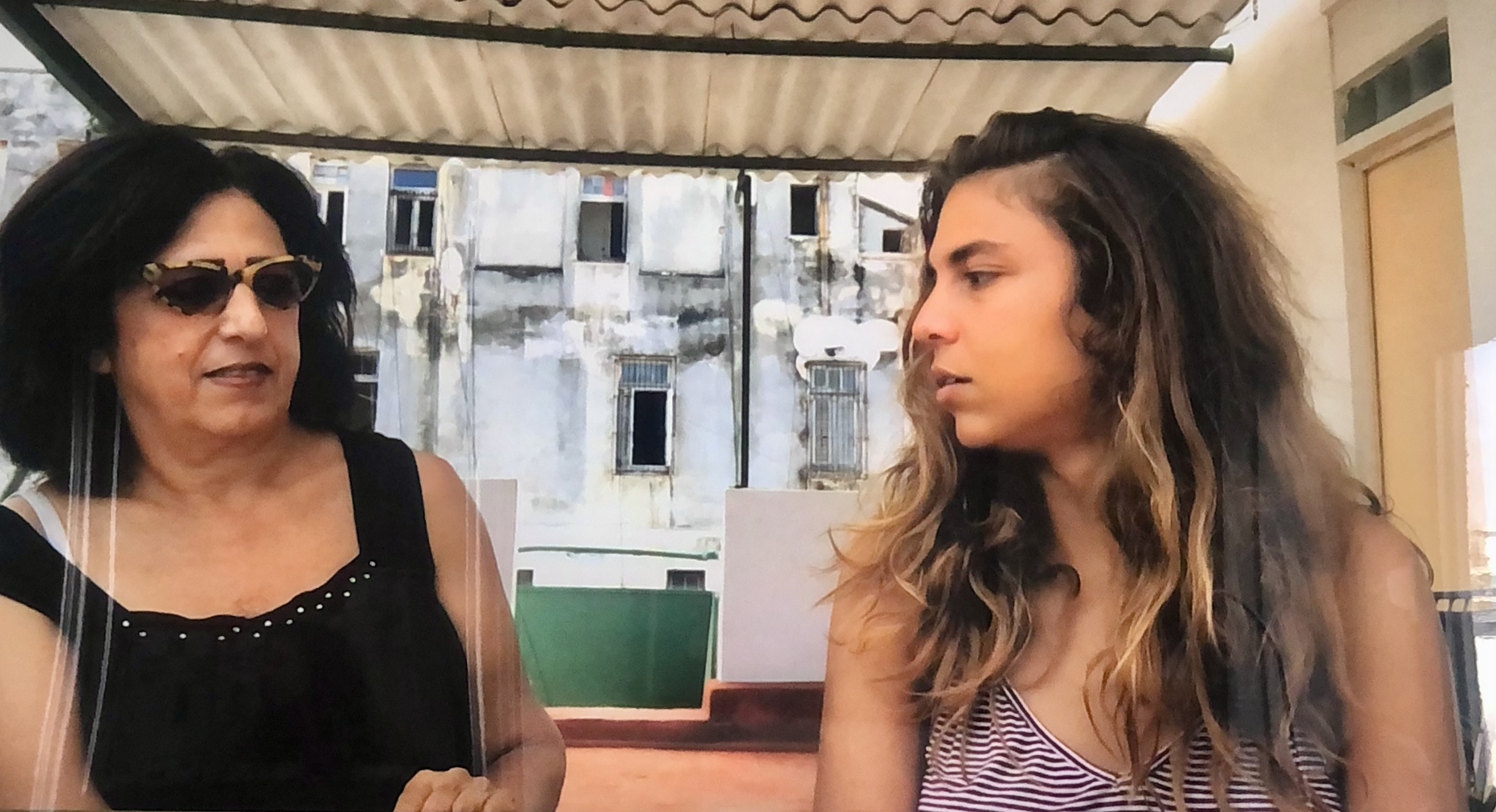
Let’s talk about ‘Let’s Talk‘, Marianne Khoury’s exploration of mother/daughter relationships across generations. The film is of interest to us because we wondered if it would enhance our understanding of Chahine’s cinema; and it does! Marianne’s mother was Chahine’s sister, and the raw materials of her story finds echoes in Chahine’s in Dawn of a New Day (1964). Khoury also demonstrates how part of the family’s narrative is the origin and source of strands of Alexandria …. Why (1979) and An Egyptian Story (1982), so the accounts on this film give us an interesting spin on how Chahine treats the same material. We discuss the relationship between Iris and Marianne and Marianne and her own daughter Sara: is it self-reflexive enough? Is the film aware of the historical context in which those lives were lived and various decisions were made? We discuss cosmopolitism and language (a gift/ a burden?); the pleasure of the old photographs and how they evoke whole ways of life; we rant about BFI Player; José purrs when he sees footage of the EICTV film school in Cuba and at the footage in Havana. We recommend as a film that enhances our understanding of Chahine’s work and also a film that is a very personal reflection of mother/daughter relationships.

The podcast may be listened to below:

The podcast my also be listened to on Spotify here: https://open.spotify.com/show/2zWZ7Egdy6xPCwHPHlOOaT

and on itunes here: https://podcasts.apple.com/gb/podcast/first-impressions-thinking-aloud-about-film/id1548559546

José Arroyo

Eavesdropping at the Movies: 317 – The Night House


Listen on the players above, Apple PodcastsAudible, Google Podcasts, or Spotify.

Based on the trailer, Mike was interested in The Night House, a horror film about a recently bereaved woman and the secrets she discovers her husband was keeping – but it took him a good third of the film’s duration to remember why. It’s an ugly film, one of the poorest-lit you’re likely to see, and the culmination of its mystery is almost offensively stupid. José finds the thematic ground it covers has potential, and Rebecca Hall’s performance is very good – she’s unafraid to make herself unlikeable, which is likeable indeed. Still, she’s really the only reason to see it. If you actually can see it through the terrible lighting.

With José Arroyo of First Impressions and Michael Glass of Writing About Film.

Mike Parker, On The Red Hill (Penguin/ Random House, 2019)

M

If I’d known the Mike Parker who wrote ON THE RED HILL was the Mike Parker from TV I might not have bought the book. But I’m glad I did. Mike and his boyfriend meet an elderly gay couple, George & Reg, become friends with them and inherit their house when they die. The book is an account of those lives, covering over a century between them, in the wider social and historical context of changing attitudes to homosexuality in the UK and in tension with how those lives are lived in their particulars, and not in the metropolis but in a small village in Wales. Each chapter in the book is divided into an element, a season, a cardinal direction and a person (thus Air, Spring, East, Reg). When it began with dense and lengthy descriptions of woods, and flowers and trees and moss and funghi I almost dropped it. But I persevered. Two homosexual Englishmen in rural Wales, one of German-Polish origin, makes for a fascinating story of lives lived on various kinds of margins, and the author weaves many explorations onto it (eg. Welsh history, migration, language, homosexual oppression, Foster and Carpenter, the ladies of Llangollen). I would have liked to have known more about George & Reg and less about the house and the landscape. But people who feel more attached to houses, gardens and nature than I might feel different.

José Arroyo

Eavesdropping at the Movies: 316 – Shang-Chi and the Legend of the Ten Rings


Listen on the players above, Apple PodcastsAudible, Google Podcasts, or Spotify.

A new day, a new entry in the MCU, and on this occasion we’re introduced to an entirely new set of characters and mythos: Shang-Chi and the Legend of the Ten Rings fills us in on the history of a young Chinese-American man and his dad’s magical jewellery. Like Doctor Strange and Black Panther, it’s a film whose connection to the wider MCU is light, establishing characters, a setting, and story elements that are certain to tie in to subsequent films, but free of the obligation to prioritise them at the expense of itself. And like Doctor Strange and Black Panther, that freedom works in its favour – it’s of a piece, interesting, pretty, and entertaining.

We discuss the film’s setting in a Chinese-American immigrant context, comparing it in particular to The Farewell and Crazy Rich Asians: all three films dramatise the cultural differences between the new and old country, and the ways in which the younger generation might face challenges in visiting or returning to their ancestral home. Indeed, Awkwafina appears in all three films, and, even in supporting roles, expresses this subject all by herself. We also think about the MCU’s use of the film to address its own past, a character from Iron Man 3 returning: Shang-Chi not only rejects the way the earlier film totally reconfigured him from the comics, but also addresses the Orientalism with which he has historically been associated.

And there’s more besides – Tony Leung’s beautiful, evocative performance of a character that nonetheless doesn’t quite work; the quality of the action, much of it a cut above what we typically expect from Marvel; and that classic Disney trick – if in doubt, animate a cute animal. Shang-Chi and the Legend of the Ten Rings is a promising start to the MCU’s next phase, and we look forward to finding out how its world will integrate down the line, but it’s worth seeing on its own terms.

With José Arroyo of First Impressions and Michael Glass of Writing About Film.

A quick note on Scott Eyman’s ’20th Century Fox: Darryl F. Zanuck and the creation of the Modern Film Studio’

I wizzed through this yesterday. A highly readable, chronological account that gives a good overview of the studio. I sometimes quibbled with his opinions of particular films, though not often, mainly because this is a book that doesn’t deal much with particular films. It’s an overview of the studio, focussing mainly on personalities (Fox, the Zanucks) and technology (primarily CinemaScope). I also didn’t find any errors…and still. It feels a thin book, one based on secondary research done by an assistant and whose only primary research seems to be conversations with a handful of personalities (and really I don’t think it’s wise to take what Evie Johnson says at face value). On the other hand, the Lev and Wasser books on Fox, so rich and detailed, also seem less rounded an overview than this one (the Lev book focusses only on the years 35-65 but feels fragmentary even taking that into account). I’m a fan of Eyman and I’ve read most of his books. His latest before this, only last year, a very good one on Cary Grant. Is he writing too much, too quickly? The books with Wagner, enjoyable as they were, were good for movie star books. The book on the friendship between James Stewart and Henry Fonda was excellent for film buffs. But this is a writer who’s written important, enriching works on Lubitsch (my favourite of his books, from 1993), Ford, De Mille , Louis B. Mayer and so many others; and this feels like a come-down. On the other hand, it’s an erudite, fast-paced and well-written overview that is a pleasure to read. It would make an excellent gift for a sixteen year-old film buff.

José Arroyo

Jaguar (Ramón Campos, Gema R. Neira, 2021)


I’m enjoying Jaguar, a Netflix series about Spanish survivors of German concentration camps  who group together as Nazi hunters in early 60s Spain. The twist is not only that they’re Spanish but that they’re hunting down Nazis within a fascist regime. Action sequences are interpolated with brilliant young singers versioning the coplas of the period. Maria de Madeiros with her wide dark eyes and soft tentative voice, appears as the secret head of the operation, always at the Prado museum, framed against beautiful paintings that are a backdrop, a point of conversation between the characters, and an added signifier to the narrative. Madeiros is lovely to see. I also enjoy the animated credit sequence (though not the song). Only two episodes in; commercial fare not of the top rank; and stylistically it’s nothing to scream about, but the story is holding me, clichés and all. It’s on Netflix.

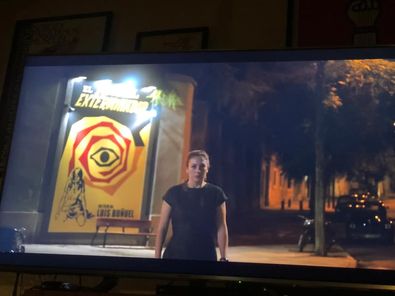
The show is set in the Spain of the early 1960s but looks nothing like it. No poor people. No peasants wondering around selling their garlic on street corners. Jaguar seems to have been made by a generation without memory, or is it perhaps just means? Pop music does help with this, Marisol singing Tombola; Spanish versions of Rolling Stones hits on the radio; you sometimes get the occasional poster (Buñuel’s The Exterminating Angel appears as a background poster but even that, though correct to the period feels anachronistic).

Jaguar has a look that is out of time, contemporary, generic. A depiction of a Francoist Spain made by Spanish filmmakers who seem to have very little knowledge of it. There’s a bit where Blanca Suárez as Isabel Garrido/Jaguar, a waitress in an expensive restaurant frequented by Germans, walks around the streets of Madrid in trousers where you think ‘in Madrid in 1962? A waitress wearing trousers? Never!’  The upside to this ahistoricism, at least in relation to film history, is that the protagonist is now a woman, the head of the operation is also a woman, and one of the gang is a gay man struggling with his sexuality and finding sympathy and understanding from his colleagues (in a Spain with severe anti-gay laws and where there had until recently been concentration camps for gay men).

her

But perhaps none of this matters. I binged it, and did so with pleasure. It’s clichéd but competently done and moves along at pace. It’s comic book scenario — and this is not meant as an insult. I love comic books and I suspect that there’s a comic book the show is based on that’s better than the series — but with a great central idea, a modern approach to a Mission Impossible-type scenario (a group on a mission — in this case Nazi Hunters in Spain), the  the narrative propulsion of a good serial or comic book, interspersed with pleasurable actions sequences throughout. I look forward to the next series.

José Arroyo

A note on Hayley Mills’ ‘Forever Young: A Memoir’

I had to get it of course. Her films are my childhood. But a little more cheekiness would have made for a better book. It’s too Pollyanna-ish, overly determined to see the good in everybody, excessively kind, and so determined to see everybody’s point-of-view that it takes the shine off the extraordinary people she met – none were Saints –and the extraordinary circumstances she lived through…. Her father’s solicitor mishandles the trust set up for her movie money and she ends up having to hand over 91 % of it to the government when she turns 21, and this on already pre-taxed income; ie like so many other child stars she ends up with nothing. But she can’t bring herself to sue because the solicitor’s an old friend of the family. And this is before the ‘spiritual journey’ bit, at which point I almost gave up. It only takes us to the birth of her first child at 28 so I hope she learns to wink before she starts on the sequel.

José Arroyo

Eavesdropping at the Movies: 315 – The Courier

Listen on the players above, Apple PodcastsAudible, Google Podcasts, or Spotify.

Benedict Cumberbatch gets himself embroiled in the Cuban Missile Crisis in The Courier, a dramatisation of the true story of Greville Wynne, a British businessman recruited by MI6 to smuggle Soviet secrets provided by high-ranking GRU officer Oleg Penkovsky. It’s a film that offers pleasures in its performances and in the telling of a story you likely haven’t heard, but its storytelling is often banal and sometimes unclear, and, José contends, it’s full of tricks and tropes that are just there for effect – and often not very good ones. Steven Spielberg’s Bridge of Spies, set in a similar period of the Cold War and also telling a true story of a citizen’s recruitment to engage in an overseas mission, is an obvious point of comparison, and perhaps The Courier‘s greatest gift is that its mediocrity helps to show off just how assured and polished is Spielberg’s cinematic technique, even if the ideological purposes to which he puts it leave us rolling our eyes.

The Courier isn’t a terrible film, and its performances do make it worth a look… but it isn’t a very good film, either.

With José Arroyo of First Impressions and Michael Glass of Writing About Film.


Thinking Aloud About Film: Return Of Prodigal Podcast: The Youssef Chahine Podcast No. 39: Youssef Chahine on MUBI

We return to the work of Youssef Chahine, spurred on by by MUBI’s decision to screen a selection of his works, in what turns out to be marvellous copies. We focus on two of his films, Daddy Amin (1950) and The Devil of the Desert (1954), we compare the visual quality of the MUBI versions to those we saw previously, confirm our admiration for Youssef Chahine’s skills as a director, José takes a dig at the arrogance of a British film culture that assumes one can just move from writing or directing for the stage to directing a movie, and not even Richard can stop José from sighing over Omar.

The podcast my also be listened to on Spotify here: https://open.spotify.com/show/2zWZ7Egdy6xPCwHPHlOOaT

and on itunes here: https://podcasts.apple.com/gb/podcast/first-impressions-thinking-aloud-about-film/id1548559546

A comparison of the quality of Daddy Amin from the version we saw to the MUBI version:

The version we saw previously:

The MUBI version:

Omar’s introduction in The Devil of the Desert:

The Battle Sequence in The Devil of the Desert as an example of cinematic staging:

The introduction of Omar Sharif in The Devil of the Desert:

You may also be interested in our previous podcast on Daddy Amin:

The Youssef Chahine Podcast No. 18: Baba Amin (Youssef Chahine, Egypt, 1950)

…annd on our previous podcast on The Devil of the Desert/ aka Devil of the Sahara aka The Desert’s Devil:

The Youssef Chahine Podcast: No. 21 – Devil of the Sahara/ The Desert’s Devil/ Devil of the Desert

The Tom Stoppard article Richard refers to may be accessed here.

Also. You might be interested in this:

José Arroyo

José Arroyo in Conversation with ….Ana María Sánchez Arce on The Cinema of Pedro Almodóvar (Manchester University Press, 2020)

t


Pedro Almodóvar is arguably the most written about Spanish filmmaker since Buñuel. Is there anything more to say of his work? After reading The Cinema of Pedro Almodóvar, the answer is a resounding ‘Yes!’; and I wanted to talk to its author — Ana María Sánchez-Arce — to find out more: What did she seek when starting out on the project and what did she find? What has now come to light about the Movida that was missing from earlier accounts? What are the benefits of analysing the film in chronological order and what do we learn about Spain’s culture and history in doing so? Were Spanish critics really that blind to Almodóvar’s accomplishments and that mean to his person? Did Almodóvar really invest his own money into the production of Law of Desire (1987)? There was so much talk about — we could have gone on for several hours more — that we only really cover the first parts of his career, trailing off after the controversies of Tie Me Up, Tie Me Down!  (1989) and Kika (1993). Those of you who find it interesting can turn to the book for more. The podcast can be listened to below:

José Arroyo

A quick note on Christopher DiRaddo’s The Family Way

To create a novel that is at once suffused with kindness and yet a page turner is a rare and wondrous thing. I can’t recommend Christopher Di Raddo’s The Family Way enough. It’s not a literary novel and it won’t gobsmack you with the beauty of its sentences nor the sophistication of its theoretical underpinnings . But it has characters you’ll recognise in places you’ll be familiar with wondering about things you might be wondering about now. It is a gentle, nuanced exploration of the importance of various kinds of families — the ones we make, the ones we’re excluded from, the ones we’re born into, the ones that are thrust on us, and, after being initially resistant to what I saw as the yuppyness of it all,  I ended up being very moved by it. But the main reason I’m going on about it so is that I was gripped by a narrative propulsed by kindness. It’s Di Raddo’s second novel and I’ll bet it will find a big audience if marketed properly. Certainly those on the lookout for a hit TV mini-series would be smart to have a look.

José Arroyo

Eavesdropping at the Movies: 314 – Free Guy

Listen on the players above, Apple PodcastsAudible, Google Podcasts, or Spotify.

Ryan Reynolds’ schtick, so irritating for so long, is winning us back, and Free Guy is built around his entire star persona, the self-effacing originality of which José remarks upon. Reynolds plays Guy, a videogame non-player character – an extra, essentially, following a programmed routine within a virtual world – with a lightness and sweetness that defines the tone of the entire film.

We discuss what the film represents about videogame culture and what it discards, the desire for romance that drives the story, what Mike questions about its ending, and more. Free Guy is a charming and entertaining action comedy, whether you know games or not.

With José Arroyo of First Impressions and Michael Glass of Writing About Film.