Monthly Archives: June 2020

Eavesdropping at the Movies: 235 – Vitalina Varela

Listen on the players above, on Apple Podcasts, or on Spotify.

A slow, careful drama, Vitalina Varela – named for the non-professional actor at the centre, who plays a version of herself – tells a story of grief, anger, and discovery. Vitalina, abandoned by her husband in the 1980s, travels to Portugal from Cape Verde to confront him, but finds that he has passed away just days ago. She is left to explore the house he has left empty and the life he led without her for some forty years, and the film gives ample time to the feelings and questions that arise within her.

We discuss the economic situation depicted – this is a slum in Lisbon, built into the ground, feeling a world away from the vibrant, wealthy capital nearby – and Varela’s visual power, her performance one of presence as much as acting, as she moves slowly through the town like a ghost. Leonardo Simões’ cinematography is extraordinarily beautiful, thoughtfully composed and intricately lit, and Mike remarks upon how the edges of the 4:3 frame blend into the blackness of a widescreen television, giving a feeling of an expanse of darkness. We ultimately disagree on how much we liked it: José was engrossed throughout, Mike found the tempo a trial – but stories like Vitalina Varela’s are necessary to tell, rare to see, and worth experiencing.

With José Arroyo of First Impressions and Michael Glass of Writing About Film.

The Youssef Chahine Podcast with José Arroyo and Richard Layne: No. 4 Saladin aka Saladin the Victorious/ Al Nasser Salah Ad-Din (Youssef Chahine, Egypt, 1963)


A discussion of Youssef Chahine’s Saladin which offers some context on the cinematic representation of Saladin in relation to Richard the Lion Heart, some historical information in its relation to Egyptian President Gamal Abdel Nasser’s efforts to maintain a United Arab Republic, and Chahine’s attempts to narrate those aspirations through the story of Saladin. We admire the film’s use of the CinemaScope frame, its staging in depth, its use of colour, and editing; and bemoan the way some of the action is directed. A huge popular success in its day. An Arab answer to the epics then so popular in Hollywood, not least in offering an Arab point-of-view on the Crusades; and a cultural mainstay through its regular rotation on television: this was also reputedly Nasser’s favourite film.

As time goes on, Richard and I are becoming better informed, partly just through watching more of Chahine’s work, but also through the arrival of different types of information that we will post on here as and when we get it. This week’s arrivals are a wonderful book on Chanine’s work by Malek Khouri, The Arab National Project in Youssef Chahine’s Cinema (Cairo: The American University in Cairo Press, 2010).

malek khouri

According to Khouri, ‘When Chahine embarked on the making of Saladin (1963) the atmosphere in Egypt and the Arab world was still experienced (sic) the negative effects of the failure of the attempt to create a United Arabl Republic (AUR). The disbanding of the Union in the aftermath of a secessionist military coup d’état in Syria in 1961) was a major blow to the Nasser revolution and its pan-Arab project. Whilt the move in Damascus exposed frustrations with repressive Egyptian administrative and political praactices in Syria with the miliatry and economic elite, the secession, nevertheless, did not reflect the deep-rooted pro-Arab unity sentiments in Syria. Jst two years later a counter coup took place in Damascus, restoring pro-union supporters to power. TheUnited Arab Republic, however, did not re-emerge after the change of leadership in Damascus, and Egypt alone remained in the union until its name was changed in 1971 after the death of Nasser’ (p.42).

Khouri sees Chahine’s film as ‘the most pivotal of the 1960’s) and one ‘clearly informed by this critical moment in contemporary Arab history with all its preoccupations, hopes, and anxieties over the prospect of national unity’ (p.44).

According to Chahine himself, ‘in Saladin, I was not hesitant in telling Christians that they were wrong in coming over to occupy our land. I, myself a Christian, have lived in the heart of Muslim culture where 90 per cent of the people whom I loved were Muslims…From the time of Andalusia to (today’s) Alexandria, the idea of diversity within a predominantly Muslim culture has been much more integrated than it has ever been within mostly Christina societies. There are not just words…This is exactly how I feel (cited in Khouri, p.45). The podcast can be listened to below:


I have included some clips we refer to in the podcast. Here the murder of the pilgrims which Khouri praises for its use of colour and for its focus, ‘on the symbolic rathe than on literal interpretation and presentation).


The film has marvellous cutting and a very inventive use of CinemaScope. Khouri notes how ‘Theatrical and print advertisements touted its Cinemascope technology (a first in Arab Cinema), its star power (an ensemble featuring many popular Egyptian actors), and its massive number of extras.

You can further admire the use of widescreen and staging in depth in the clip below, though I posted it mainly for its unusual portrait of female warriors (though admittedly Virginia is also the villain of the piece)

The film has brilliant use of a dramatic, theatrical, split screen:


The film provides further proof of the sensuality evident in Chahine, such as in the clip below where a dancing girl is paid to gather information.


and the homoeroticism is also evident:

Screenshot 2020-06-29 at 16.03.10

According to Khouri, ‘The film positions Saladin as a man of moral integrity, in radical contrast to the way he has traditionally been imagined in western cinema’ (p.45). Richard, however, argues that this is not quite the case, pointing to De Mille’s The Crusades (1935) and providing the original New York Times review of the film which argues that, ‘A gallant victor, Saladin abandoned his plan to add Berengaria to his harem, sent her back to Richard and threw the Holy City open to Moslems and Christians alike.It is Saladin, in fact, who emerges as the real hero of the photoplay.’ This view is ratified by a recent review of the same film in The Guardian.

Richard also pointed me to a youtube clip from the Doctor Who version – Saladin played in blackface but sympathetic in opposition to Richard the Lionheart (we discuss Saladin’s  ‘whitefacing’ of westerners in the podcast);  and a trailer for the 1954 version of King Richard and the Crusaders, which looks hilarious. But again it seems to be a sympathetic portrayal of Saladin and the villains are Richard’s underlings.

chahine

The other arrival this week that enhanced my understanding of  Saladin was Twflik Hakem’s book of interviews with Chahine, Youseff Chahine, Le révolutionnaire tranquille (Paris: Capricci, 2018). There, Hakem claims Chaine convinced President Nasser that Saladin could be no other than himself and charmed him into putting his army and his administration at Chahine’s disposal so he could make the film (Tu as pu faire croire au président Nasser que Saladin ça ne puvait être autre que lui et il a mis à ta dispoition son armée et son administration pour que tupuisses mettre en chantier une superproduction et réaliser ton rêve hollywoodien’ (loc 256 of 1750 on Kindle).

We learn from Hakem that Nasser adored the film and Chahine tells him, ‘yes, he wanted a copy on hand (by his bed). Whenever a visitor came to see him, he had the film projected. He would usually fall asleep because he’d seen it hundreds of times but would wake up at the end and say ‘good he?’ All of that is true but the first truth is that the film is not at all to the glory of Nasser, it’s nreally not. (Oui, il avait une copie du film sous le lit. Chaque visiteur qui venait le voir, il lui faisait projeter dans sa salle de projection. Lui dormait, parce qu’l avait vu cent foies et il se révellait juste avant la fin pour dire au visiteur: v”Alors? C’est bien hein? Tout cela est vrai mais la véritér première est que le film n’est pas du tout à la gloire de Nasser, mais vraiment pas.’


The Ritrovato Catalogue’s entry on the film is below:


According to Khouri, Saladin was extremely popular, ‘in a contemporary assessment of the overwhelming popular uccess of the film, a local newspaper described how Saladin played to full houses in almost every large theatre in Cairo and Alexandria for weeks in order to allow pople to watch it along with their entire families: ‘This is a film which makes us all feel proud…and it is a miracle indeed that it was made in the first place (p.49)! The film continues to resonate across the Arab world. Over twenty-six years after the film was released, according to Khouri, one local critic wrote, ‘I asked a friend of mine, a woodworker, did you see the film Saladin last night and he said, If this film was shown a hundred times in a hundred days I would still sit and watch it.

In the UK however, Time Out, wrote a very dismissive three-line review.

Barrie Wharton has written a very interesting article on the creation of national identity in Nasser’s Egypt that references Saladin:

Barrie Wharton, ‘Cultivating cultural change through cinema; Youssef Chahine and the creation of national identity in Nasser’s Egypt,’ Africana, Vol.3, No. 1, 2009

and can be found by clicking  here:

Cultivating-Cultural-Change-Through-Cinema-AFRICANA-Vol3-No1


José Arroyo


In Conversation with Gary Needham on The Boys in the Band

gary needham

When I was growing up, everything I heard or read about THE BOYS IN THE BAND was terrible. Recently, after the Broadway revival, it was meant to be ´period´and wonderful. I´d never seen the film until now and found it a difficult and unpleasant watch, an experience I’ve written about here. When I had the opportunity to talk to Gary Needham about CRUISING, I also took the opportunity to ask him about THE BOYS IN THE BAND. Gary’s work on queer cultures is by now extensive and wide-ranging:


His is the voice of reason; thoughtful and considered on the initial reception of the film, its relation to the play and its subsequent afterlife. I come across as quite brattish. It makes for a lively conversation, one that references a range of films, from Pillow Talk (Michael Gordon, 1959) to My Hustler (Andy Warhol/Chuck Wein, 1965) to The Queen (Frank Simon, 1968) to Philadelphia (Jonathan Demme, 1993). We discuss the film’s uses of camp, Friedkin’s interest in sub-cultures, the stageyness or not of the mise-en-scène, the possible classist dimension of the film, and Tom Waugh’s argument on the duality of sound and image in My Hustler in relation to the hustler and the queen with the hustler afforded the image  and the queen given power over the sound. The discussion can be listened to here:

If you’re interested in further exploring The Boys in the Band, I highly recommend Matt Bell’s The Boys in the Band: Flashpoints of Cinema, History, and Queer Politics as a wonderful addition to Gary’s insights and as a possible corrective to my contributions:

matt bell boys in the band

Matt Bell has also written a very interesting piece on the 2018 Broadway revival (and its various contexts) for The Huffington Post called ‘Taking Pride in The Boys in the Band‘ that can be accessed here.

As with the podcast on Cruising, Gary has kindly made available a range of resources:


An entire issue of After Dark, featuring an interview with Leonard Frey where the actor discusses the filming of Boys in the Band, and the strong possibility that it might result in a better film than play: After Dark (Boys in the Band)

Screenshot 2020-07-01 at 13.51.19

An interview with Mart Crowley on the 25th anniversary of the play’s premiere: An_emotional_state_Mart_Crowle

An interview with Mart Crowley that discusses various productions in the context of the recent revival of the play on Broadway: And_the_Band_plays_on

A discussion from 1973 on reasons to see the touring production in San Diego: Boys_still_good_theatre

An appraisal of the film’s DVD release by Peter Burton: Playing_up…

An image of the New York Cast Album, which featured dialogue from the play: Screenshot 2020-07-01 at 10.21.19

A 1969 review of the LA touring production praising ‘the authenticity of the dialogue’: Reflections_on_’Boys’

A 1979 interview with Robert La Tourneaux for Gay News: Robert_la_tourneaux

An ad for the San Francisco production with an invitation to the cast paty: YEQWMD727018207


Various reviews and ads for other touring productions:


Images from the film (and the play — you can see Natalie Wood in the centre below):

…and perhaps the greatest find is this episode of Emerald City, where the great Arthur Bell —  whose columns in The Village Voice in the  early 80s were so important to me personally — interviews Robert La Tourneaux on the 10th anniversary of the release of the film. Bell talks about how he didn’t like the film then or now but how he still acknowledged the ‘piercing moments of truth’. La Tourneaux is frank about hustling and equally frank about how appearing in the film affected his career giving concrete examples of how his mere appearance in the film was reason for people like Bob Evans to not even see him for roles much less interview or audition, and this from the horse’s mouth. A fascinating show, with the ads in between the interview being at least as fascinating as the interview itself. It can be seen here:


José Arroyo

In Conversation with Gary Needham on Cruising (William Friedkin, USA,1980)

mvasx-Xi

I can think of no one who knows more about Cruising (William Friedkin, USA, 1980) than Gary Needham. He’s already written extensively on Warhol, Queer TV, Brokeback Mountain (Ang Lee, 2005) and many aspects of Queer Histories from various historical perspectives, and has recently published, ‘CRUISING IS A PICTURE WE SINCERELY WISH WE DID NOT HAVE TO SHOW’ United Artists, ratings, blind bidding and the controversy of William Friedkin’s Cruising (1980) in his own co-edited collection.


The discussion in the podcast ranges from the film’s production history to New York S&M clubs to Disco Music to Queer Representation and Queer Politics, to ‘New’ American Cinema of the period to the film as a text characterised by incoherence, doubt and ambiguity. The kind of commentary a 40th anniversary re-issue of this still alluring film deserves.

Aside from his scholarly work, one of the reasons I so wanted to talk to Gary about the film was the series of brilliant images related to the film that he had been publishing on Twitter. Gary has kindly provided some of them. Here is a series of images documenting the protests the film sparked during the filming itself and after its release:

Here are a series of images from gay people defending the film:

Here are a series of images referred to in the podcast:

And Gary has also kindly provided two pdf’s of contemporaneous coverage of the film: ‘Cruising, Blueprint for Carnage’: QKPZCB716161002

and an article from Gay News: Cruising, The Lure – The Novel of Death: REVMIB524278205


Lastly, Kevin Heffernan has kindly directed me to a long three hour forty-five minute  podcast on Cruising by Mike White and The Projection Booth Podcast: for those of you who can’t get enough of the film.

Peter Rehberg has written a very interesting piece on the film which may be accessed here:

José Arroyo

The Youssef Chahine Podcast No. 3: Cairo Station/ Bab al-Hadid (The Iron Gate) (1958)

Our third podcast on Youssef Chahine films, this one on Cairo Station, a combination of Dickensian melodrama, Marxist analysis, neorealist aspirations, film noir techniques, and with a contemporary relevance in its Incel-on-a-rampage theme. A brilliant work, probably the best we’ve seen so far (though those with a penchant for romance might prefer The Blazing Sun or Dark Waters).  The podcast can be listened to here:


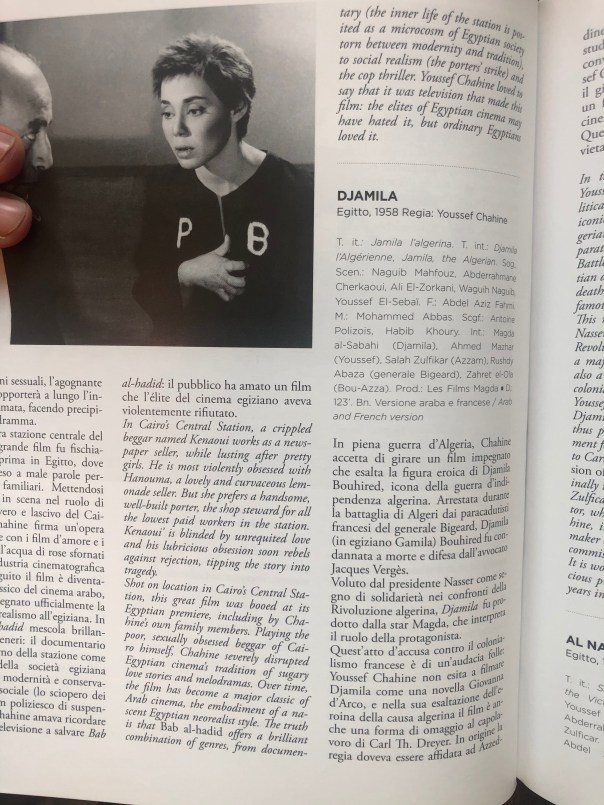
In the past few podcasts we´ve been noting how wrong wikipedia is in its description of the films so far, and how it is evident from so many of the reviews that many reviewers haven´t seen the films well enough to describe them accurately.Richard even refers us to the BFI.An exception to this pattern is this brief description of the film in the Ritrovato catalogue.


IMG_1059
Description of Cairo Station from Bologna’s Ritrovato Catalogue


These are excerpts from the film that are described or referred to in the podcast: we. talk about the sensuality in the film and how shocking that must have been in its time

We talk about the conflict between modernity and tradition in relation to this excerpt featuring Mike and His Skyrockets, who have their own website but who interestingly don´t mention their appearance in this film. There is even an update from Mike himself.And it turns out that one of the Skyrockets, Asaad Kelada became a director in Hollywood with extensive creditsin television.

We talk about the film noir elements in a film that has often been described as neorealist and of the extraordinary conceptualisation of shots and use of depth of field, which can be seen in this excerpt-

Likewise the images below are illustrations of some of the aspects discussed in the podcast, the compositions, the themes of sexual obsession, labour organising, the compositions, the way the frame is peopled, etc.:

Lastly, a description of Chahine and his career from the Ritrovato catalogue:

IMG_1054
Introduction to Chahine and his work from the 2019 Ritrovato Catalogue

and lastly Mark Cousins also makes for very interesting reading on Cairo Station in his The Story of Film book


Barrie Wharton has written a very interesting article on the creation of national identity in Nasser’s Egypt that references Cairo Station:

Barrie Wharton, ‘Cultivating cultural change through cinema; Youssef Chahine and the creation of national identity in Nasser’s Egypt,’ Africana, Vol.3, No. 1, 2009

and can be found here:

Cultivating-Cultural-Change-Through-Cinema-AFRICANA-Vol3-No1


More on Mike and his Skyrockets: A whole thread on Cairo Jazz: The article from Ebony linked here is really interesting about the Cairo Rock and Roll scene.

Another interesting podcast on  Cairo Station from Holmes Movies Recommends may be listened to here: José Arroyo

The Youssef Chahine Podcast with José Arroyo and Richard Layne No. 2: Dark Waters aka Struggle in the Pier/ Sira` fi el-Minaa (Youssef Chahine, Egypt, 1956)

dark water


rj2

A discussion of Youssef Chahine’s Dark Waters, currently on Netflix. José and Richard discuss how the film introduces the viewer to another culture which might seem sexist and authoritarian to modern sensibilities and that in spite of that is moving, compelling and beautiful.

The podcast ranges over the sensuality depicted, the detection of elements of Shakespeare’s Othello and Hamlet in some scenes, how the frame is alive with community and yet how one detects a patterning in the depiction of that community that connotes a queer culture in that that community which provides comfort and support can also turn on the individual, turn into a mob, and rampage onto murder.

Screenshot 2020-06-24 at 18.47.17
Omar’s Hamlet

There’s a dramatisation of class in the film with lots of parallelisms between aunt and niece and also what turns out, in typical melodramatic form, two brothers raised on opposite sides of a considerable class divide. One begins to detect patternings in Chahine’s films, the extraordinary compositions, the visual poetry, the excitement of the narrative, the visual beauty of the production, a Hollywood-style story telling with a grand romantic finale that takes advantage of the teaming of Sharif and Faten Hamama, glamorous stars that were then a real life couple. There are long takes that often involve difficult orchestrations of movements of large numbers of people. This and The Blazing Sun are also melodramas where, like in noir, it is the man who’s wounded and suffers for love, often due to his own misapprehensions. In spite of certain macho attitudes now alien to us, the film remains engaging, exciting and revealing.

You can see some of the points made above illustrated in the images below:


The podcast may be listened to below:


Those of you who speak French may want to listen to this charming interview between these ‘two legends of Arab cinema’ where Sharif talks about how he had two strokes of incredible luck in his career, one to be discovered by Chahine whilst he was drinking tea and launched into a career as a film star with The Blazing Sun, and then to be cast by David Lean in Lawrence of Arabia, ‘we were young and beauiful then, now we look like an image of the apocalypse,’ says Sharif.  ‘I saw first saw him in the Cinema,’ says Chaine and didn’t take me long to cruise him. How could someone be so beautiful. Then, as he said, I saw him again in a tearoom, Chahine tells a funny story about how they went to the premiere of Lawrence of Arabia together, Sharif shaking because he didn’t know how he was going to be received and then it went well and Chahine was left at the premiere in London dressed in a tux and without a cent. They joke that after that they didn’t see each other for forty years. They went to the same school where they were taught to be ‘gentlemen’ and the interviewer talks of how Shariff represents the greatness, splendor and charm of the Arab world in the West.’ For his part the charmingly self-deprecating Sharif talks about all the mistakes he made, and how Chahine deplored his choices. He also talks interestingly that the only women he knew and lived with and truly loved were his mother and the delicious presence that is FAten Hamama.

The entry on Dark Waters from the 2019 Ritrovato catalogue may be seen below:


In between The Blazing Sun and Dark Waters, Faten Hamama and Omar Shariff also made this film with Chahine, The Desert Devil. The quality is not great but it has English sub-titles:


‘Cinema Sojourns: Time Tripping Through the World of Film’ has published an article worth reading on Omar Sharif: The Youssef Chahine Years, 1954-1956

Other websites of interest include:

www.youssefchahine.us/chahine/bio.htm

https://www.theguardian.com/film/2008/jul/28/youssef.chahine

https://www.criterion.com/current/posts/6468-youssef-chahine-restorations-tour-europe

https://www.latimes.com/archives/la-xpm-2008-jul-28-me-chahine28-story.html

https://mubi.com/notebook/posts/in-the-realm-of-the-senses-the-egyptian-stories-of-youssef-chahine

https://www.egypttoday.com/Article/4/47380/Remembering-the-epitome-of-golden-cinema-Omar-Sharif

https://insidearabia.com/omar-sharif-and-faten-hamama-egypts-legendary-celebrity-couple/

https://martinteller.wordpress.com/2013/10/27/siraa-fil-wadi-struggle-in-the-valley/

https://www.kviff.com/en/programme/film/5228409-the-devil-of-the-desert/

https://www.youtube.com/watch?v=udOs2GN4p80&t=10s

There´s a very interesting overview by Faem el-Tonsi on Faten Hamama from the University of Warwick, which can accessed here:


In case of trouble with access, I enclose it here in its entirety:


February 19, 2010

On Faten Hamama – Lead Actress of Next Film Screening “The Empire of M

Writing about web page http://www.abridgetoegypt.com/entertainment/egyptian_artists/Faten_Hamama

Faten Hamama (Arabic: فاتن حمامة‎) (born 27 May 1931) is an Egyptian producer and an acclaimed actress of film, television, and theatre. She was regarded for her performances in a range of film genres, from melodramas to historical films and occasional comedies, though her chief successes were romantic dramas. Noted for her willingness to play serious characters, she has also acted in some controversial films in the history of Egyptian cinema.

Hamama made her screen debut in 1939, when she was only nine years old. Her earliest roles were minor, but her activity and gradual success helped to establish her as a distinguished Egyptian actress. Eventually, and after many successful performances, she was able to achieve stardom. Revered as an icon in Egyptian and Middle Eastern cinema, Hamama has substantially helped in improving the cinema industry in Egypt and emphasizing the importance of women in cinema and Egyptian society.

After a seven-year hiatus from acting, Hamama returned in 2000 in what was a much anticipated television miniseries, Wajh al-Qamar (وجه القمر, Face of the Moon). She has not acted since then. In 2000, Hamama was chosen as Star of the Century by the Egyptian Writers and Critics organization. In 2007, eight of the films she starred in were included in the top 100 films in the history of Egyptian cinema by the cinema committee of the Supreme Council of Culture in Cairo.

Early life and career

Faten Hamama was born to a Muslim lower middle class family in Mansoura, Egypt (according to her birth certificate), but she claims she was born in Cairo, in the Abdeen quarter. Her father, Ahmed Hamama, worked as a clerk in the Egyptian Ministry of Education and her mother was a housewife. She has an older brother, Muneer, a younger sister, Layla, and a younger brother, Mazhar. Her aspiration for acting arose at an early age. Hamama says she was influenced by Assia Dagher as a child. When she was six years old, her father took her to the theater to see an Assia Dagher film; when the audience clapped for Assia, she told her father she felt they were clapping for her.
When she won a children’s beauty pageant in Egypt, her father sent her picture to the director Mohammed Karim who was looking for a young female child to play the role of a small girl with the famous actor and musician Mohamed Abdel Wahab in the film Yawm Said (يوم سعيد, Happy Day, 1939). After an audition, Abdel Wahab decided she was the one he was looking for. After her role in the film, people called her “Egypt’s own Shirley Temple”. The director liked her acting and was impressed with her so much that he signed a contract with her father. Four years later, she was chosen by Kareem for another role with Abdel Wahab in the film Rossassa Fel Qalb (رصاصة في القلب, Bullet in the Heart, 1944) and in another film two years later, Dunya (دنيا, Universe, 1946). After her success, Hamama moved with her parents to Cairo and started her study in the High Institute of Acting in 1946.

Career

Youssef Wahbi, a famous Egyptian director and actor, realized the young actress’s talent so he offered her a lead role in the 1946 film Malak al-Rahma (ملاك الرحمة, Angel of Mercy). The film attracted widespread media attention, and Hamama, who was only 15 at the time, became famous for her melodramatic role. In 1949, Hamama had roles in 3 films with Wahbi. Kursi Al-I’etraf (كرسي الاعتراف, Chair of Confession), Al-Yateematain (اليتيمتين, The Two Orphans), and Sït Al-Bayt (ست البيت, Lady of the House) were all successful films.

The 1950s were the beginning of the golden age of the Egyptian cinema industry and Hamama was a big part of it. In 1952 she starred in the film Lak Yawm Ya Zalem (لك يوم يا ظالم, Your Day will Come) which was nominated in the Cannes Film Festival for the Prix International award. She also played lead roles in Yousef Shaheen’s Baba Ameen (بابا أمين, Ameen, my Father, 1950) and Sira’ Fi Al-Wadi (صراع في الوادي, Struggle in the Valley, 1954) which was a strong nominee in the 1954 Cannes Film Festival for the Prix International award. Hamama is also known for playing the lead role in the first Egyptian mystery film Manzel Raqam 13 (منزل رقم 13, House Number 13). In 1963, she received an award for her role in the political film La Waqt Lel Hob (لا وقت للحب, No Time for Love). Hamama was also able to make it to Hollywood; in 1963 she had a role in the crime film, Cairo.

In 1947, Hamama married the actor and director Ezzel Dine Zulficar while filming the Abu Zayd al-Hilali (أبو زيد الهلالي) film. They started a production company which produced the film Maw’ed Ma’ Al-Hayat (موعد مع الحياة, Date with Life) in which she starred. This particular film earned her the title of the “lady of the Arabic screen”. She divorced al-Faqqar in 1954 and a year later, she married the famous actor Omar Sharif. In spite of that, Hamama still acted in films of his direction.

In a Youssef Chahine film, Struggle in the Valley, Hamama refused to have the Egyptian actor Shukry Sarhan as a co-star, and Chahine offered Omar Sharif the role. Omar had just graduated from college then and was working with his father; Hamama accepted him as her co-star. Hamama had never accepted to act any scene involving a kiss in her career, but she shockingly accepted to do so in this film. The two fell in love and Omar Sharif converted to Islam and married her. This marriage started a new era of Hamama’s career as the couple did many of their films together. Sharif and Hamama were the romantic leads of Ayyamna Al-Holwa (أيامنا الحلوة, Our Sweet Days), Ardh Al-Salam (أرض السلام, Land of Peace), La Anam (لا أنام, Sleepless), and Sayyidat Al-Qasr (سيدة القصر, The Lady of the Palace). Their last film together, before their divorce, was Nahr Al-Hob (نهر الحب, The River of Love) in 1960.

Controversy in the late 1960s

Hamama left Egypt from 1966 to 1971 because she was being continuously disturbed by Egyptian Intelligence. Initially, Hamama had been a supporter of the 1952 Revolution, but later became an opponent of the Free Officers and their oppressive regime. She said they were “asking her to cooperate” but she apologized and refused. As a consequence, she was forbidden to travel or participate in festivals. She was only able to leave Egypt after many controversial disputes. She lived in Beirut and London during this period.

While she was away, then President Gamal Abdel Nasser asked famous writers, journalists and friends to try to convince her to return to Egypt. He called her a “national treasure” and had even awarded her an honorary decoration in 1965. However, Hamama didn’t return until 1971 after Abdel Nasser had passed away. Thereafter, she played critical roles conveying messages of democracy. She often criticized the laws in Egypt in her films. In the 1972 film Imbarotiriyat Meem (إمبراطورية ميم, The Empire of M), Hamama presented a prodemocratic point of view and received an award from the Soviet Union of Women in the Moscow International Festival. Her most significant film was Oridu Hallan (أريد حلاً, I Need a Solution). In this film, she criticized the laws governing marriage and divorce in Egypt. After the film, the Egyptian government abrogated a law that forbid wives from divorcing their husbands, therefore allowing khul’.

Late career

As Hamama became older, her acting roles declined and she made fewer films compared to earlier in her career, but nevertheless her films were successful. She also made her first TV appearances in her late career. She starred in the TV mini-series Dameer Ablah Hikmat (ضمير أبلة حكمت, Mrs. Hikmat’s Conscience) and was quite successful in her first TV performance.

After 1993, Hamama’s career suddenly came to a halt. It was not until 2000 that she returned in the successful TV mini-series Wajh ِِal-Qamar which was broadcast on 23 TV channels in the Middle East. In this mini-series, Hamama portrayed and criticized many problems in Egyptian and Middle Eastern society. Despite some criticisms, the mini-series received much praise and acclaim. Hamama was awarded the Egyptian Best TV Actor of the Year and the mini-series won the Best TV Series Award in the Egyptian Radio and Television Festival. Hamama entered history as the highest paid actress in an Egyptian TV mini-series until 2006. Rumors have been circulating that Hamama will return in a new TV mini-series called Wazeera ‘ala al-Ma’ash (وزيرة على المعاش, A Retired Minister) in 2007, probably in Ramadan.

Accomplishments in Egyptian cinema

When Hamama started her acting career women were commonly displayed in Egyptian films as unrealistic and bourgeois, spending most of their time chasing (or being chased by) men. It was also customary for an actress to be shown as a sex object. In the beginnings of Egyptian cinema, the casting of female characters was limited to famous singers, dancers or stage actresses. But Faten Hamama was neither a singer nor a dancer, and she had little experience on stage. In spite of that, she was able to magnetize film directors and producers as well as her audiences, which is why she was successful in many of her films.

Before the 1950s, Hamama had leading roles in 30 films, in which she often played the role of a weak, empathetic, poor girl. After the 1950s, Hamama was in search of her real identity and was trying to establish herself as a distinct figure. During this period, her choice of material and roles was somewhat limited. However, film producers soon capitalised on her popularity with audiences in local and Middle Eastern markets and she began to play realistic, strong women, such as in Sira’ Fi Al-Wadi (صراع في الوادي , Struggle in the Valley, 1954) where she portrayed a rich man’s daughter who, contrary to stereotype, was a realistic woman who helped and supported the poor. In the 1952 film Miss Fatmah (الأستاذة فاطمة), Hamama starred as a law student who believed women were as important as men in society.

In Imbratoriyat Meem (امبراطورية ميم , The Empire of M), she played the role of a widow who takes care of her large family and suffers hardship. These films helped in the portrayal of Egyptian women’s problems in a society resistant to modernity. Her most influential film was Oridu Hallan (أريد حلا , I Need a Solution) which criticized the laws of marriage and divorce in Egypt. A law in Egypt that forbade Khul’ ( خلع ) — a divorce initiated by the wife — was annulled immediately afterwards.

Most critics agree that Hamama’s most challenging role was in the 1959 film Dua’e Al-Karawan (دعاء الكروان , The Nightingale’s Prayer), which was chosen as one of the best Egyptian film productions. It is based on the novel by the same name by the prominent Egyptian writer Taha Hussein. In this film, Hamama played the role of Amnah, a young woman who seeks revenge from her uncle for the honour killing of her sister. After this film, Hamama carefully picked her roles. In 1960, she starred in the film Nahr Hob (نهر حب, Love River) which was based on Leo Tolstoy’s well known novel Anna Karenina and in 1961, she played the lead role in the film La Tutf’e Al-Shams (لا تطفئ الشمس, Don’t Turn Off the Sun) based on the novel by Ihsan Abdel Quddous.

Personal life

Though Hamama has lived most of her life in Egypt, she was forced to live in London and Lebanon for several years due to problems in the late 1960s in Egypt.

She admired the director Ezzel Dine Zulficar, and while filming Abu Zayd al-Hilali (أبو زيد الهلالى) in 1947, which he directed, the two fell in love and got married. Their marriage lasted for seven years: they divorced in 1954. Hamama has said that her love for Zulficar was little more than a student’s admiration and love for a teacher. The two remained friends, and Hamama even starred in his films after the divorce. They have one daughter, Nadia Zulficar.
In 1954, Hamama chose Omar Sharif to co-star with her in a film. In this film, she uncharacteristically agreed to a romantic scene involving a kiss. During the filming, they fell in love. Sharif converted to Islam and married her. The couple co-starred in many films, their romantic relationship clearly evident on screen. However, after almost 20 years, they divorced in 1974. They have one son, Tarek Sharif.

Hamama later married Dr. Mohamed Abdel Wahab Mahmoud, a successful doctor in Egypt. Having learned from experience, this time Hamama decided to keep her personal life private. She rarely appears with him publicly or mentions him in interviews. They currently reside in Cairo.

Awards won

Throughout Hamama’s career, she has won many awards for her acting roles

1950s

  • First prize of acting for the movie Ana al-Madi (I’m the Past) (1951)
  • First prize of acting and best Egyptian movie presented in Beirout for Irham Dmoo’i (Have Mercy) (1954)
  • Maw’ed Maa al-Sa’ada (Appointment with Happiness) receives Prize of acting from the Egyptian Catholic Center for Cinema (1954)
  • Irham Dmoo’i receives first Prize of acting from Ministry of Guidance for movies that covered season 1954-1955 (1955)
  • Al-Tareeq al-Masdood (Dead end) & Hatta Naltaqi(Until we meet) receive prizes of acting from the Egyptian Catholic Center for Cinema (1958)
  • Prize of acting on her role in the movie Bain al-Atlal (Among the Ruins) (1959)

1960s

  • Doaa al-Karawan (The Nightgale’s Prayer) receives the Prize of Acting from Ministry of Guidance (1961)
  • Doaa al-Karawan received First Pize of acting from the National State award that covered movies from seasons 1959, 1960, 1961, 1962 (1963)
  • Best actress award from the Jakarta Film Festival on her role in Albab aL-Maftouh (The Open Door) (1963)
  • First Prize of acting from the National State award for the movie Al Leila Al Akhira (The Last Night) (1965)

1970s

  • Al-Kheit al-Rafee (The Thin Thread) received the Special Award in the first Tehran International Film Festival (1972)
  • Special award from the Moscow International Film Festival(1973)
  • A Diploma of honor and the Diploma of recognition for her role and the idea for Oreedo Hallan (I Need a Solution) in the third Tehran International Film Festival (1974)
  • The Organization of Film Critics and Writers’ Prize of Recognition for her role in Oreedo Hallan (1975)
  • The Prize of Excellence in the Festival of Egyptian Films for her role in Oreedo Hallan (1976)
  • Best Actress award from the Tehran International Film festival on her role for Afwah Wa Araneb (Mouths and Rabbits) (1977)
  • Best actress award from the Second Cairo International Film Festival, (Golden Nefertiti Award) for her role in Afwah Wa Araneb (1977)
  • Special Recognition award from President Anwar Al Sadat for her role inAfwah Wa Araneb (1977)

1980s

  • USSR Cinema Prize in Moscow (1983)
  • Lebanese Golden Order of Merit Prize for her role in the movie Leilet Al Qabd Ala Fatma (The Night of Fatma’s Arrest) (1984)
  • Prize of Recognition and Life Achievement Award from the Organization of Cinematic Art for her role in the movie Leilet Al Qabd Ala Fatma (1984)
  • Best Actress award from Carthage International Film Festival, Tunisia for her role inYawm Mor.. Yawm Helo (Bitter Days.. Nice Days) (1988)
  • Best actress award from the Organization of Film for her role inYawm Mor.. Yawm Helo (1989)

1990s

  • Best Artistic Achievement award from the Cairo International Festival (1991)
  • Lifetime Achievement Award from the Montpelier Mediterranean Film Festival (1993)
  • Best actress award from the Egyptian Catholic Center during its celebration for her role in Ard al-Ahlam (Land of Dreams) (1994)
  • Best Actress award from Cairo International Festival for her contribution to the Egyptian Cinema where 18 of her films were selected amongst the best 150 movies ever made until 1996 during the celebration of a 100 years of cinema (1996)

2000 and later

  • The Honorary Award from The Radio and Television Festival for her role in Wajh al-Kamar (2001)
  • The Prize and award of the First Arabic Women presented by Nazik Hariri and Bahia Hariri (2001)
  • Prize of recognition from first Sala international film festival, Morocco, for her contribution to women’s issues through her artistic career (2004)

Nominations

Hamama receives a PhD from the AUC (1999)

Hamama receives a PhD from the AUC (1999)

1940s

1950s

  • Ebn Elnile (Son of the Nile) presented in Venice International Film Festival (1951)
  • Ebn Elnile nominated in Cannes International Film Festival for the Prix International award (1952)
  • Lak youm Ya Zalem (Your Day will Come) selected in Berlin International Film Festival to be part of main competition (1953)
  • Cannes International Film Festival selects the movie Serai Fil Wadi (Struggle in the Valley), to be part of main competition for the Prix International award (1954)

<1960s

  • Berlin International Film Festival selects the movie Doaa al-Karawan (The Nightgale’s Prayer), to be part of main competition (1960)
  • Karlovy Vary International Film Festival selects the movie La Totf’e al-Shams (Don’t Turn the Sun Off), to be part of main competition (1962)
  • Cannes International Film Festival selects the movie Al Leila Al Akhira (The Last Night), to be part of main competition for the Prix International award (1964)
  • Cannes International Film Festival selects the movie Al Haram (The Sin) to be part of main competition for the Prix International award (1965)

Honors

Hamama was also honored on several occasions:

1950s

  • Honored by the Decoration of Creativity of first degree from prime minister, Prince Khaled Shehab, Lebanon (1953)

1960s

  • A Guest of Honor in Moscow International Film Festival. In that event she also had an interview with Yuri Gagarin (first human in space) for the Egyptian Radio (1961)
  • Selected as Jury Member for the Berlin International Film Festival (1964)
  • Honored by the Decoration of Republic of first degree for Art from president Gamal Abdel Nasser (1965)

1970s

  • Honored by the Decoration of State of the first order from President Mohamed Anwar Sadat during first Art festival (1976)
  • Jury Member for Carthage International Film Festival (1978)

1990s

  • Jury Member for Cairo International Film Festival (1991)
  • Selected as the President of Juries for the first Paris Biennale of Arab Cinema (1992)
  • Honorary award from the Egyptian National Festival for Cinema for her long distinguished cinematic career (1995)
  • Prince Talal bin Abdulaziz selects Faten Hamama as an Honorary advisory member in the organization of Children development (1999)
  • PhD from the American University in Cairo (1999)

2000 and later

  • Lifetime achievement award as the Star of the Century in Egyptian cinema at the Alexandria International Film Festival (2001)
  • Honored by the Decoration of “Al-Arz” (Lebanese Cedar) from Lebanese President Émile Lahoud (2001)
  • Honored by the Decoration of Competence and Creation from King Mohamed El Hassan the Sixth of Morocco (2001)

Selected filmography>

Year International Title Arabic Title Role
1939 Happy Day Yawm Said, يوم سعيد Aneesa
1944 Bullet in the Heart Rossassa Fel Qalb, رصاصة في القلب Najwah
1946 Angel of Mercy Malak al-Rahma, ملاك الرحمة Thoraya
1947 Abu Zayd al-Hilali Abu Zayd al-Hilali, أبو زيد الهلالي Caliph’s daughter
1948 The Small Millionaire Al-Millionairah al-Saghirah, المليونيرة الصغيرة Pilot’s girlfriend
Immortality Khulood, خلود Laila / Amal
The Two Orphans Al-Yateematain, اليتيمتين Ne`mat
Towards Glory Nahwa al-Majd, نحو المجد Suhair
1949 Chair of Confession Kursi al-I`tiraf, كرسي الاعتراف Phileberta
Lady of the House Sitt al-Bayt, ست البيت Elham
Every House Has a Man Kul Bayt Lahu Rajel, كلّ بيت له راجل Faten
1951 Son of the Nile Ibn al-Nile, ابن النيل Zebaida
Your Day Will Come Lak Yawm Ya Zalem, لك يوم يا ظالم Ne`mat
I’m The Past Ana al-Madi, أنا الماضي Elham’s daughter
1952 House Number 13 Al-Manzel Raqam 13, المنزل رقم 13 Nadia
Immortal Song Lahn al-Kholood, لحن الخلود Wafa’
Miss Fatimah Al-Ustazah Fatimah, الأستاذة فاطمة Fatimah
1953 A`isha A`isha, عائشة A’isha
Date with Life Maw`ed Ma` al-Hayat, موعد مع الحياة Amal
1954 Pity My Tears Irham Dmoo`i, ارحم دموعي Amal
Traces in the Sand Athar Fi al-Rimal, أثار في الرمال Ragia
The Unjust Angel Al-Malak al-Zalem, الملاك الظالم Nadia
Always with You Dayman Ma`ak, دائما معاك Tefeeda
Date with Happiness Maw`ed Ma` al-Sa`adah, موعد مع السعادة Ehsan / Amal
Struggle in the Valley Sira` Fi al-Wadi, صراع في الوادي Amal
1955 Our Beautiful Days Ayyamna al-Holwa, أيامنا الحلوة Hoda
Love and Tears Hob Wa Dumoo`’, حب و دموع Fatimah
1956 Love Date Maw`ed Gharam, موعد غرام Nawal
Struggle in the Pier Sira` Fi al-Mina, صراع في الميناء Hameedah
1957 Road of Hope Tareeq al-Amal, طريق الأمل Faten
Land of Peace Ard al-Salam, أرض السلام Salma
Sleepless La Anam, لا أنام Nadia Lotfy
1958 The Barred Road Al-Tareeq al-Masdood, الطريق المسدود Fayza
The Virgin Wife Al-Zawjah al-Azra’, الزوجة العذراء Mona
Lady of the Castle Sayyidat al-Qasr, سيدة القصر Sawsan
1959 Among the Ruins Bayn al-Atlal, بين الأطلال Mona
The Nightingale’s Prayer Doaa al-Karawan, دعاء الكروان Amnah
1960 River of Love Nahr al-Hob, نهر الحب Nawal
1961 I Will Not Confess Lan A`tref, لن أعترف Amal
Don’t Set the Sun Off La Tutf’e al-Shams, لا تطفئ الشمس Layla
1962 The Miracle Al-Mu`jiza, المعجزة Layla
1963 Cairo (USA)[29] Cairo Amina
No Time For Love La Waqt Lil Hob, لا وقت للحُب Fawziyah
The Open Door Al-Bab al-Maftooh, الباب المفتوح Laila
The Last Night Al-Laylah al-Akheera, الليلة الأخيرة Nadia / Fawziyah
1965 The Sin Al-Haram, الحرام Azizah
Story of a Lifetime Hikayet al-`Omr Kolloh, حكاية العمر كلّه Nadia
The Confession Al-`Itriaf, الاعتراف Nawal
1966 Something in My Life Shai’ Fi Hayati, شيء في حياتي A’ida
1970 The Great Love Al-Hob al-Kabeer, الحب الكبير Hanan
1971 Thin Thread Al-Khayt al-Rfee, الخيط الرفيع Mona
1972 M Empire Imbratoriyat Meem, امبراطورية ميم Mona
1974 My Love Habibati, حبيبتي Samia
I Need a Solution Oridu Hallan, أريدُ حلاً Fawziyah
1977 Mouths and Rabbits Afwah wa Araneb, أفواه و أرانب Ne’mat
1979 Ladies Should Not Offer Condolences Wa La `Aza’a Lil Sayyidat, ولا عزاء للسيدات Rawya
1985 The Night of Fatima’s Arrest Laylat al-Qabd `Ala Fatimah, ليلة القبض على فاطمة Fatimah
1988 Sweet Days.. Bitter Days Yawm Mur Yawm Hilw, يوم مر.. يوم حلو Aisha
1993 Land of Dreams Ard al-Ahlam, أرض الأحلام Nargis

Television

Year Title Arabic Role
1991 Miss Hikmat’s Conscience (mini-series) Dameer Ablah Hikmat, ضمير أبلة حكمت Hikmat
2000 Face of the Moon (mini-series) Wajh al-Qamar, وجه القمر Ibtisam al-Bostany
2007 A Retired Minister (TBA) Wazeerah ‘ala al-Ma’ash, وزيرة على المعاش
This article is licensed under the GNU Free Documentation License. It uses material from the Wikipedia article “Faten Hamama”

- No comments Not publicly viewable


Add a comment

You are not allowed to co

José Arroyo

The Youssef Chahine Podcast, No. 1: The Blazing Sunaka Struggle in the Valley/ Sira` Fi al-Wadi (Youssef Chahine, Egypt, 1954)


José Arroyo and Richard Layne discovered the work of Youssef Chahine at a retrospective of his work at Bologna last year, are thrilled that so many previously difficult-to-see films of his are now available on Netflix, and hope that these podcasts encourage people to watch and discuss the films. This is the first in a series. We hope to cover as many of them as possible, and in chronological order. We hope you join us on this journey


In Film Alert 101,Peter Hourigan alerts readers to the Chahine treasure trove on Netflix but writes of Blazing Sun: ´BLAZING SUN  (aka Struggle in the Valley 1954, 116 min) An example of his early work, when he was trapped in commercial Egyptian film production. This is a hoary melodrama – but enormously entertaining, and with brilliant b & w photography. There is also an absolutely ravishingly beautiful young man called Michel Chelhoub in the lead.  Later, he was to find fame in the west as Omar Shariff´.

We agree on the film being enormously entertaining and on the extraordinary photography but I also happen to think it´s a great melodrama and a great film, the struggles of the poor against the wickedness of the rich, about love, life, community, the material aspects of life that  reproduce it, all bound with questions of morality and justice. It´s very moving, extraordinarily beautiful to look at — Chahine is a visual poet — and the moments of awkwardness that often accompany cinemas of poverty seem to me to only add to its power. 

A great opportunity to see these films and we hope the podcast will convince you to take a look,

The Blazing Sun


Richard Laine has been able to track another Faten Hamama/ Omar Shariff vehicle, with English sub-titles if not in the best condition, and you can see it here:

‘Cinema Sojourns: Time Tripping Through the World of Film’ has published an article worth reading on Omar Sharif: The Youssef Chahine Years, 1954-1956

Other websites of interest:

www.youssefchahine.us/chahine/bio.htm

https://www.theguardian.com/film/2008/jul/28/youssef.chahine

https://www.criterion.com/current/posts/6468-youssef-chahine-restorations-tour-europe

https://www.latimes.com/archives/la-xpm-2008-jul-28-me-chahine28-story.html

https://mubi.com/notebook/posts/in-the-realm-of-the-senses-the-egyptian-stories-of-youssef-chahine

https://www.egypttoday.com/Article/4/47380/Remembering-the-epitome-of-golden-cinema-Omar-Sharif

https://insidearabia.com/omar-sharif-and-faten-hamama-egypts-legendary-celebrity-couple/

https://martinteller.wordpress.com/2013/10/27/siraa-fil-wadi-struggle-in-the-valley/

https://www.kviff.com/en/programme/film/5228409-the-devil-of-the-desert/

https://www.youtube.com/watch?v=udOs2GN4p80&t=10s

José Arroyo


Youssef Chahine’s first film, made when he was student at Victoria College


Iceberg (Juliana Gómez-Castañeda, Cuba, 2015)


Screenshot 2020-06-21 at 05.41.21EICTV, the International School of Film and Television in Cuba, is making freely available and sub-titled in English some of the work produced at the school. I recommend this beautiful documentary by Juliana Gómez Castañeda. Teresa lives in a small village in an unnamed island off Santiago in Cuba. Her daughter´s away and she´s taking care of her grandaughter, Maria, who she doesn´t see as often as she´d like because she goes to boarding school away from the island. Teresa´s got a dog — Diana — she goes fishing with, on a raft, which she paddles with her sandals. She often comes home with nothing; she mourns her mother, her daughter´s away and she´s anxious about her grand-daughter, she drinks rum, dances and sings her pain with her friends; she goes to Church. A film that gives you a glimpse of a life, leads you to love the central character, and helps you understand structures of feeling that are not your own, with some indelible images, beautifully filmed to capture all the vagaries of light. I loved it and recommend.

Screenshot 2020-06-21 at 05.39.19

The film can be seen here


and here is what Francis Ford Coppola had to say about it:


José Arroyo

The Boys in the Band (William Friedkin, USA, 1970

boys in band


When I was growing up, everything I heard or read about The Boys in the Band was terrible. Recently, after the Broadway revival, it was meant to be ´period´and wonderful. I´d never seen the film until now and found it a difficult and unpleasant watch, with some of the worst-directed acting I can remember seeing. If I´d been invited to this party, I´d have told the host to f**ck off, left within five minutes, and there would have been no play. The most interesting aspect for me was the décor (Fire Island greetings, Marlene in Concert posters), pausing the film to eye up the bookshelves (Berlin Stories, etc), the line dancing scene in the rooftop, and the wonderful pop music of the period that the characters put on (Tammy and Marvin, lots of Burt Bacharach).

Talking about it with friends (worth naming since so many of their views are drawn on and collectively summarised below: Andy Medhurst, Matthew Hays, Andrew Griffin, Matthew Motyka, David Greven,  Lawrence Napper, Bryan Johnson, Andrew Moor), there were lots. of mixed feelings. Most loved the first half, where we´re introduced to each of the characters and New York seems alive with cruising, and sex and secret  and hidden knowledges. They can cite by heart reams of dialogue which remain acidly witty. The camp elements of the period are still recognisable as such and still work, though I wonder if younger people will catch the extent to which all of these characters are talking through a particularly intimate and shared knowledge of the careers of Judy Garland, Joan Crawford, Marlene and Maria Montez. For other generations shared reference points would be Liza and Diana Ross, or Madonna, or Britney or Rihanna and Beyoncé. The film evokes that, brings it to life, vividly. It´s like a secret code made from knowledge of the stars.

Friends have made various comparisons. David Greven for example talks about how the film is like Rope in that it´s about the agony of and violent reaction against the closet. And one can certainly see that. Other friends such as Matthew Hays have made comparisons to Albee and Waiting for Godot and Abigail´s Party. And again those comparisons are understandable but to my mind only superficially so. I think even existential theatre has some utopian dimension that drives it, there´s no emphasis on the fun of company, even of the repartee (most of it is meant to hurt), of the joys of sex, or the pleasures in overcoming oppression or even of the pleasures in being marginal. It´s relentlessly grim, and thus I find it untrue.

I´ve seen a marvellous production of Virginia Woolf with Imelda Staunton recently and it was alive with pain and hopes and a kind of deep love within the hurt that is nowhere evident in this. I´ve also been seeing a lot of Pinter, and this certainly doesn´t have all the significant ’empty spaces’ within the dialogue that he does. So he might have been inspired by Pinter but it doesn´t feel Pinteresque.

The interesting thing to me  is that queer cultures continue to connect on the tangents of this work but perhaps only because that´s all the work gives you, the odd line, the camp, an imagined sense of a history of how things used to be etc. But they are tangents. All the characters are to me one dimensional stereotypes…and yet they echo something we recognise, which is what makes it interesting, but the moments where it echoes are not necessarily the best bits.

My suspicion is that the play IS better than the film. I´ve never seen the play but…even the SCREENPLAY feels better than the film. I hated almost all of the performances and I think it is the director rather than the actors that are to blame. That Emory, the queeny camp one, is meant to be an interior decorator beggars belief. We´re TOLD that but nothing in the way he dresses, acts or behaves would connote that.  I  can´t imagine him talking to an ageing wealthy  matron  about colours in  a way that would lead to his hiring. So Friedkin´s  direction is in some ways  wonderful (in  the way it moves, its use of space, the highlighting of moments) but terrible in that it shows so little understanding of the psychology of the characters represented.


I think there´s something interesting about this and Killing of Sister George, generally badly reviewed upon first release, flops, films that gays and lesbians felt they had to see because of a dearth of representation but that annoyed or appalled those same people that flocked to them (at least from the accounts we have) and that are now being re-appropriated in a somewhat ironic way by new audiences.


An afterthought but perhaps interesting. I thought the screenplay´s treatment of ‘Cowboy’ the hustler was appalling in that it took for granted or supported all the insults the rest of the group threw at him, normalised them in classist terms, and I actually thought the film was better than the screenplay in this instance, the camera lingered on him, made him tender and beautiful in a way not allowed by the dialogue, and gave him a symbolic curtain.


It´s a cruel and dishonest film, one that I think would have made me even more scared than I already was had I seen it as a teenager. It´s still a type of attitude from a type of world I like to stay away from, though that in itself might account for my response in contrast to that of others. And yet, by virtue of being ‘first’ or at least early, it´s become a kind of landmark. That is not necessarily a good thing.

I´ve been told that Matt Bell´s book on the film is wonderful and I might yet read it, though at this moment I have no plans of ever re-watching what  to my mind is an unpleasant and untruthful film, albeit one with a great deal of gay input (the actors, Crowley obviously, the agonised closet queen that was Dominick Dunne etc.)

boys-band-104031

I posted a version of the above on facebook and it lead to a great discussion which in turn informed the post. I hope to hear from at least some of you and continue the process.

José Arroyo

You Brought Me the Ocean, by Alex Sanchez and Julie Maroh

I wish I´d had graphic novels like this one to read when I was a tween. You Brought Me the Ocean is a sensitive and poetic coming out story of kids that are out of place, in a desert yearning for the ocean, and that really gets to the emotional complexities of the denial, hope, fears and imaginings that kids go through coming to terms with their sexuality. This one features more understanding adults than has been my experience. It also is a lot more nuanced rendering than I´m accustomed to.

Jake has been lifelong best friends with Maria. They understand each other perfectly except she thinks they´re a couple and that he´s just being super-respectful and considerate, whereas he loves her but only as his bestest friend. They´re finishing High School and applying to university. She wants to stay just were they live in New Mexico, which she finds beautiful and perfect and he´s got a powerful but not quite understandable yearning to go to Miami and be near the ocean. The ocean calls out to him in a way he dreams of but doesn´t understand. They haven´t discussed any of it but are so sure of their friendship they´re confident they will resolve it and end up at the same university.

There are many things Jake doesn´t know about himself. A kid he´s known since middle-school, Kenny, begins to help him understand at least some of them. Kenny is motherless and taking care of a disabled father. He´s out, is often abused for it at school, burdened by responsibilities at home and in the swim team. Jake finds himself drawn to Kenny in ways that at first he doesn´t understand and that quickly bring to the fore much he´s been suppressing. The issue is made live and urgent when Maria catches them kissing in the pool.


How this gets resolved would on its own make for a gripping graphic novel, particularly when so beautifully drawn by Julie Maroh, probably most famous for Blue is the Warmest Colour. But there´s more: Jake discovers he´s got odd powers over water, that he´s the result of a genetic experiment, and that there´s some kind of connection to Aquaman. I can´t wait for further installments.

One element that is worth commenting on is the racial representation in the novel. Maria is clearly Latin, Kenny is of Chinese descent and Jake is black. Everything is acknowledged but not much is made of it and it took me a while to register it. The book takes it for granted, makes it seem natural and the norm, as it rarely ever is. Another element is that each of the kids is rendered unique, desiring and desirable in a way that also seems rare in the culture we live in, particularly with regard to East-Asian characters.


It´s a beautiful book, nuanced and very touching. I highly recommend it.

José Arroyo


José Arroyo

Eavesdropping at the Movies: 234 – Hook

Listen on the players above, on Apple Podcasts, or on Spotify.

A film dear to Mike’s heart since childhood, and a large blot on Steven Spielberg’s career despite its financial success, Hook imagines a world in which Peter Pan, J. M. Barrie’s flying boy who never grows up… grows up and forgets how to fly. When the adult Peter, a workaholic corporate lawyer unaware of his origins, travels to London with his family, his children are kidnapped, forcing him to return to Neverland, confronting his past, his attitude, and his erstwhile adversary, Captain Hook.

Hook is a chunky, colourful family film with flaws all over the place. Its action is unexciting, its plot composed of several disparate strands and themes that never cohere elegantly. José takes issue with Dustin Hoffman’s accent and John Williams’ score, finding the former pointless and unsuccessful, the latter prescriptive and overbearing. But Mike defends them, finding charm in them, and appreciating as an adult what never stuck in his mind as a child, in particular the central emotional conceit: that for all the costs of growing up, the refusal of the Lost Boys to do so, and the fact that all adults in Neverland are pirates, Peter’s happy thought – the crucial feeling that allows him to fly again – is of becoming a father and holding his newborn son. And José finds beauty in the lighting and staging of the film’s London townhouse scenes that he never appreciated upon its first release.

A messy film, but with pleasures. And anyway, it turns out that if you saw it five hundred times as a preteen then no criticism anybody can make can matter.

With José Arroyo of First Impressions and Michael Glass of Writing About Film.

Burt Lancaster 1946-1956, The Man Girls Whistle At.


In the early phase of his career, Burt Lancaster is not only there to be looked at and seen, as all actors are, particularly stars; nor is he just — albeit significantly – characterised by ‘to-be-looked-at-ness,’ something that is seen to be the exclusive and particular lot of women in cinema; and nor is this ‘to-be-looked-at-ness,’ always deflected by action and violence, as is often argued by theorists like Steve Neale. Burt is dressed and undress for the audience’s pleasure. That is true of other stars of the era, one thinks of Rock Hudson, for example, although Burt seems to enjoy it more than Rock. The reason for making this particular video was simply to show how often Burt is propositioned by women, and how that is acknowledged and deflected; how that often sees the characters he plays acknowledge it as an objectifying ploy…one which places him in a position where he has his price and can be bought well….like patriarchal notions of ‘woman’ from the period. He is desirable; can almost always be had on his terms; and can sometimes be bought on others. It’s part of a locus of meanings and actions associated with his star persona at this period that contribute to his representing a particular type of man but one that evokes a certain kind of masculinity in crisis in the post-war period.


José Arroyo

Ten Tall Men (Willis Goldbeck, 1951)

Ten Tall Men Poster

Burt Lancaster, at peak handsomeness and in glorious Technicolor. There’s a bathtub scene whose only function is to display his body. The torture scene later on in the film has other functions, but it’s primary one is still to display that body. He’s already doing his Fairbanks-Flynn homage —soon to become a signature of his and catnip to comedians and impersonators – where he puts his hands on his hips, pushes his blond head-backward, juts his gleaming teeth forward and emits that joy-sparking laugh of his. There’s boys’ own action and light-hearted fun but it’s all a bit clunky, inconsequential and Orientalist.

It was well reviewed upon first release, with Time making a pun of its filmic lineage: ‘Ten Tall Men, a tall adventure tale of the French Foreign Legion, treats its old formula so lightheartedly that it becomes the beau jest of the genre.’ Newsweek’s review gets more at why it’s a bit harder to stomach today: ‘Lancaster’s persistent ingenuity in topping the natives might bring the film some hard feeling in the Sahara; elsewhere there is fun to be had.’ [1]

tentallmen2

According to Kate Buford, ‘Lancaster would remember Rope of Sand (William Dieterle, 1949) as the worst film of his career.’ [2] But he must have been forgetting Ten Tall Men; and he had no one to blame but himself. It was produced by Norma Productions, his own production company. That it was relatively well reviewed and made money must have aided the forgetting.

Screenshot 2020-06-11 at 15.07.53

Of all Burt Lancaster films released theatrically to 1985, there were only two I could not get on physical media, Ten Tall Men (Willis Goldbeck, 1951) and Vengeance Valley (Richard Thorpe, 1951), though the latter at least is available to stream on Prime. Watching the film, one understands why, though I must admit, I still enjoyed it more than I should. Handsome Burt laughing with pals doing physical action goes a long way with me. There is a version on youtube, which was too blurro-vision past a certain size for me to watch so I am indebted to Sheldon Hall for the loan of his copy.


José Arroyo

[1] Ed Andreychuk, Burt Lancaster: A Filmography and Biography London: McFarland and Company, 2000, p. 58

[2] Kate Buford, Burt Lancaster: An American Life, Loc 1802 of 10551 on Kindle.

The Girl With the Pistol/La Ragazza Con Pistola (Mario Monicelli, Italy, 1968)

ragazza

I turned everything else off last night to concentrate on Mario Moncelli´s The Girl With the Pistol on TPTV, which has been unavailable in English for yonks. According to Sheldon Hall, it’s never been shown on UK TV until now; and according to Richard Layne, there’s ‘no sign of a home video release either looking at BBFC and a database of pre-cert releases’. The logo at the beginning of the film with ‘the “Paramount Communications” wording dates this to between 1989 and 1995. So presumably a US TV or DVD version’.

paramount communications

I actually liked the sound dubbing, which kept most of the Italian and just translated enough dialogue to enable one to follow the plot. Monica Vitti is the girl who´s been left dishonoured in Sicily and sets out to England to find and kill the man she loved. It´s very funny, great bits of comedy featuring an enormous ponytail at a pub, highlighting the cultural differences between medieval Sicily and Carnaby Street London, and skewering all the macho pretensions. In London, she meets Stanley Baker and Corin Redgrave and by the end, Annunziata becomes an independent woman and gets a different kind of revenge. Monicelli´s film makes everything about Britain in that period seem glamorous and aspirational, and even the extended scene in a gay pub does not descend to cheap laughs or easy condemnation. I love Monicelli. I´d never seen Vitti in a comedy, and she´s a revelation: earthy, beautiful, almost musical in her delivery and her actions, always believable and yet extraordinarily glamorous. It made me want to see all of Monicelli and all of the famous comedies Vitti’s known for in Italy.

Richard Layne informs me that, ‘There’s a nice copy on youtube in the original aspect ratio – TPTV showed it cropped to 4:3. This has the Italian soundtrack although from the bits I’ve looked at the British characters speak a mixture of English and Italian. English subtitles are available.’ That version can be seen below:


José Arroyo

A thought on Postcards in the Digital Age

IMG_0636

Why bother sending postcards in the digital age? You can facebook, tweet, instagram, e-mail etc. etc. Even though it´s not an either/ or situation, why send something snail-mail, that might take weeks to get to its recipient (sometimes, if at all), that´s expensive, that takes time and thought and effort? Well, I suppose because it takes time, thought, and effort. I used to have dozens of correspondents who shared my love of sending and receiving postcards. Over the years, this has dwindled to a few; and it saddens me because I love sending and receiving them. But why? What does a postcard offer that sending an image through messenger doesn´t? Well the obvious thing, is the physical object itself. The less obvious thing is that mentioned above, the thinking of the person, the selecting something especially for them, the going to the trouble of writing, finding stamps, going to the post-box, all especially for them (and from them to me). It makes me feel special; and I certainly think the people I send them to are also special to me. I wouldn´t bother otherwise. But there´s more to it than that: the mark, the trace, the aura. Postcards leave the marks of a body with writing that has extended from someone´s emotions, to their thoughts, to their brain, through their arm, to their hand, to the card. Their writing, their mark, is like no one else´s. I don´t think this is just romanticising nostalgia, though perhaps there is a teensy weensy  bit of that. But there´s more: there´s probably DNA on the card, fingerprints, and probably not only from the sender. Postcards have an aura—the hand-writing on the back is what helps create it in a Benjaminian sense. In the more coloquial sense of the term, the postcard evidences a past presence left imprinted, a consciousness made physically evident. It makes one feel closer to the person. I treasure the practice and the individual cards. Today I received this one above.

José Arroyo


A note on André Leon Talley´s ´The Chiffon Trenches’

chiffon trenches

André Leon Talley is such a unique figure in fashion. Traumatised by sex as a child and largely avoiding it as an adult, he danced his way through the 70s (with Diana Vreeland AND Diana Ross), which probably helped him survive the AIDS years when so many others fell. He was usually the only black face in the glamorous jet-set fashion world of Lagerfeld, St. Laurent and all the super-rich they catered to. He would take the occasional snort of blow with Halson but still made it to church every Sunday. He nonetheless committed the biggest sin in fashion: he got fat. But he overcame that by turning caftans into a statement. He made a career out of being himself, which in almost in context outside of fashion would have relegated him to the margins. How does someone from a small town in the Jim Crow south end up working for Warhol at Interview, WWD, Ebony, Vanity Fair and himself become a fashion icon at Vogue? André Leon Talley tells it with great flair in THE CHIFFON TRENCHES, a fabulous name for a very enjoyable book.

José Arroyo

Burt Lancaster’s star persona, 1946-1949

An illustration of Burt Lancaster’s star persona from 1946-1949, as if dreamed by Steve Thompson in Criss Cross: a man back from war and traumatised, desiring and doomed, imprisoned by the past and also because he did something wrong once; physically powerful but none too smart; beaten, manipulated, masochistic, punished, on the run; in a world he can’t understand; delirious and raging.

This is a continuation of my attempts to learn video editing and was a means through which I learned about zooms, blurring and waves. The parameters were that I would use no voice-over, insert clips from all his late forties films (though they only get named, upon their first appearance) and re-anchor periodically to Steve Thompson in the hospital scene from Criss Cross. Some of the transitions are still too rough, and I would have fixed them had I had more time, but cumulatively I think the video presents a vivid picture of Burt Lancaster’s star persona in the late forties and offers a variegated depiction of masculinity in crisis,


José Arroyo

Eavesdropping at the Movies: 233 – Hoop Dreams

Listen on the players above, on Apple Podcasts, or on Spotify.

From a central focus on two aspiring young basketball hopefuls from Chicago, Hoop Dreams weaves an incredible tapestry of race and class in America, without once explaining itself to the audience, without once winking and imploring us to notice something. William Gates and Arthur Agee, two black boys of about 14 or 15 years old, are plucked from their neighbourhoods by a scout for St. Joseph’s High School in Westchester, a white suburban private school that dips into the inner city looking for talent to boost its basketball team, chucking back any kid that doesn’t show enough promise. Over the course of several years, we follow William and Arthur’s development.

William and Arthur don’t start in the same place – William is touted as the next Isiah Thomas, a former St. Joseph’s alumnus who reached the NBA, and receives as an individual gift a personally guaranteed scholarship to St. Joseph’s from a wealthy benefactor. Arthur is labelled with no particular expectation beyond that he shows the potential to go pro, and whose partial scholarship becomes a financial burden once the school decides they’ve had enough of him – they want tuition fees from him now. The stresses put on these boys come from all angles – their school demands they perform for the team while keeping their grades up, their parents and communities put all their hopes into their success, and achieving stardom, a vanishingly unlikely prospect, feels like the only hope for a life free of minimum wage jobs and the power being cut off because of unpaid bills. Over the course of three hours, we understand intimately who William and Arthur are, the familial and socioeconomic circumstances that shape them, and follow them as they grow, learn, and encounter hurdles throughout their time at St. Joseph’s.

Hoop Dreams is an all-time great documentary, a portrait of life in early Nineties America that is both a state-of-the-nation declaration for its time and effortlessly legible and relevant today.

With José Arroyo of First Impressions and Michael Glass of Writing About Film.

‘Bobby Orr, Number 4’: A note on The Friends of Eddie Coyle

Movies work in mysterious ways. I was watching The Friends of Eddie Coyle last night, completely absorbed in the narrative, admiring the way Peter Yates slowly sketches in that corrupt world of small-time hoods tied to the local Irish mafia in Boston. A hard life of two bit gun runners and small time bank robbers who risk time in jail but for dough that can’t stretch to the plumber. As I watched, I wondered if the bank robberies in this film were the inspiration for those in Kathryn Bigelow’s Point Break.

There are beautiful things in the film, the scenes with Eddie (Robert Mitchum) and his wife Sheila (Helena Carrol) are superb and an example of how great stars can convey a whole other person and way of life through and not in spite of what their star personas already represent. When the wife says, ‘have you ever heard me complain?’ and his face crumples into her shoulder, one understand all there is to know about that relationship: they’ve been together a long time, there’s understanding and desire, still. This bond is about the only thing that’s right in his life, and he’s grateful. Mitchum is absolutely magnificent in what must be one of his greatest roles, paunchy now, weary, he’d done time and knows the score; he’s got the knuckles to prove it. But resigned too: it’s the life he’s chosen. Mitchum conveys all of this and more with that deep bored drawl of his and with minimal gestures. A deeply affecting performance.

…and yet. When we arrive at the moment that should be one of the most important in the film, the moment I’ve excerpted above, the film touched on an element of my childhood and my mind exploded into a series of memory madeleines. The scene is supposed to be about Mitchum admiring Bobby Orr, so young, already a great player and with all his future ahead of him. Whereas we know this hockey game is a pretext for his murder. Dillon (Peter Boyle) , who seems to be his best friend, the person who seems to really understand him, has invited him to this game so that he and his young friend can kill him on the way home.


It’s a pivotal scene in the film. And yet, as soon as I heard the name Bobby Orr, I was back to my childhood in Montreal, trading hockey cards, trying to get Bobby Orr’s. Names I haven’t remembered in thirty years came flooding back: Phil and Tony Esposito, Guy Lafleur. In the scene the Bruins are playing the Blackhawks, and the names of all those teams suddenly came to mind  as well: the Leafs, the Rangers, the Red Wings. It sparked thoughts of winter and cozyness, street games and the Mt. Royal hockey rink; and even of spring, skipping school to attend the parade on St. Catherine street when the Canadiens won the Stanley cup, which in memory they seemed to do annually. It’s a series of nostalgic remembrances, very well evoked by the paintings of Carole Spandau (above), that seemed to rush to the fore and completely took me out of what seemed a great film, one with only moments left to go

José Arroyo


Curtiz´influence on Spielberg

A brief illustration of the influence of Michael Curtiz on Steven Spielberg, putting two shots side by side, one from Curtiz´Robin Hood (1938) and the other from Spielberg´s Hook (2001), that I hope evidences the similarities and convinces of the influence.

José Arroyo