Following 2017’s It, the characters are 27 years older, the events of the first film mere memories, and the effects are more thrilling than ever. But it leaves us feeling much the same as its predecessor – despite fantastic production values, wonderful monster design, and attempts to delve into interesting themes of trauma and the scars with which it leaves us, it’s, well, kind of stupid really.
The podcast can be listened to in the players above or on iTunes.
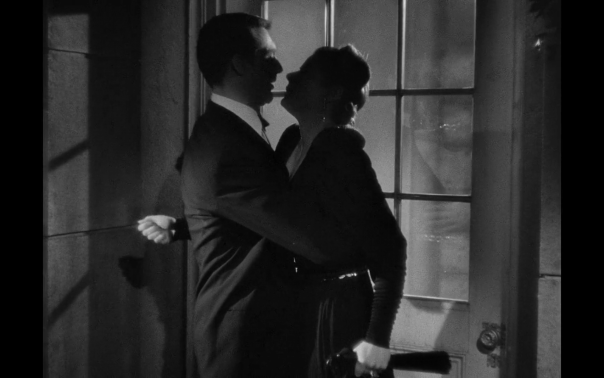
Considered by some to be his best film, Alfred Hitchcock’s Notorious comes to the mac in a beautiful 4k restoration. We explore its sumptuous close-ups, complex characterisation and smart, effective editing, which elicited big responses from the audience. We also have an argument about focus pulling.
Below, you can see several screenshots and four clips of moments and scenes to which we refer in the podcast.
The podcast can be listened to in the players above or on iTunes.
It’s probably fair to say that Pedro Almodóvar’s films seem to be made specifically for José. It’s in every detail: the locations, eras, sexuality, ways of life, attitudes, class, love of cinema and countless other aspects of Almodóvar’s ouevre speak to José on a deep, intimate level. He’s watched every one of his films time and time again, and he considers Pain and Glory, which he has already seen twice and plans to see again, a masterpiece. Mike doesn’t have anything like such a specific relationship to Almodóvar, and indeed has only seen one other of his films, 2016’s Julieta, which he liked very much – and indeed he likes Pain and Glory just as much… though not quite as much as José.
We discuss how Pain and Glory stands alone but might benefit from being seen in relation to Almodóvar’s ouevre. Several of his regular collaborators appear, including Cecilia Roth, Antonio Banderas, Julieta Serrano and Penélope Cruz; this film, as with The Law of Desire, Broken Embraces and Bad Education, is about a filmmaker; it makes use of art as an unconscious but pointed visual layering and underlying theme; images of characters writing on typewriters or computers show up – this is a film about, amongst other things, writing. Mike brings up the way chance events are used to drive the plot forward and thinks about how they’re contextualised; José praises how fluid Almodóvar’s storytelling is here, effortlessly bringing together disparate timelines and plot strands.
Is this autofiction, as the mother in the film accuses her filmmaker son of so often indulging in? José considers the appearance of Almodóvar’s own mother in his previous films and how so many of his previous films are in fact about mothers (All About My Mother and Volver being the most obvious examples). We discuss the structure of the film, the movement from the relationship with an actor who’s an addict to a previous relationship with an addict, through the performance of a confessional monologue titled Addiction, then a sexual awakening seen from a young boy’s point of view. Representations of Spain in the 50s, memories of the past and a present setting fluidly intermingle. We also consider its themes of illness, ageing and loss, and how it’s a film about cinematic expression, the revelation that half of the diegetic world is in fact a film within a film recontextualising half the story, similar to Bad Education but to different effect here.
It’s a film on which as soon as we finished, José regretted not saying more: The references to Lucrecia Martel’s La niña santa, the clear allusion to Fellini’s 8½, the use of Rosalía to sing the song by the river, the section on films that feature water such as Splendor in the Grass and Niagara. He’s only scratched the surface of a great film.
The podcast can be listened to in the players above or on iTunes.
There’s a remarkable female gaze in Animals, Sophie Hyde’s adaptation of Emma Jane Unsworth’s novel, and a wonderful sense of insightful observation in the world occupied by and behaviours of the two friends whose stories it tells.
Mike, who’d been anticipating it keenly since seeing the trailer, feels a little shortchanged by the triteness of the larger themes on which the film builds and the relative lack of excitement in comparison to what the trailer conveyed. José shares a little of that feeling but is keen to express his pleasure at seeing a film so confidently and originally expressive of a female perspective, particularly in its sex scenes. And we both adore the stars, Alia Shawkat for her fabulously performative comic theatrics, and especially Holliday Grainger for her extraordinary, sensitive, soulful expression of a girl falling in and out of love and friendship and upset with her own failings.
Animals is a film that explodes with creativity and expressiveness in the details, but whose big picture leaves us wanting.
The podcast can be listened to in the players above or on iTunes.
Mike feared it might be the most tasteless film ever made. José doesn’t look forward to Quentin Tarantino films. But we both came away from this fantastical reimagining of a near-mythological era of Hollywood history having had a great time. Tellingly, for a film that exceeds two and a half hours, we both felt the time fly by.
Tarantino’s love for and expert knowledge of Hollywood and cinema informs all of his work, and arguably not that consequentially – he cribs shots, pastiches genres, and evokes styles and tones specific to cinema, but to debatable significant effect beyond the superficial. But in Once Upon a Time in Hollywood (OUATIH for brevity’s sake), the decision to bring this passion to the surface and tell a story directly about Hollywood results in Tarantino’s most meaningful and personal film. What he values is brazenly displayed here, and, Mike suggests, isn’t entirely pleasant to examine. He finds OUATIH initially troubling in this regard – with a day’s reflection on it, he comes to see it as deeply conservative and protective of privilege. In digging this up, we discuss its sexual politics, the way it uses race, and the clash it represents between the old and the new in a rapidly changing 1969 Hollywood. Mike argues that, as in 2009’s Inglourious Basterds, Tarantino’s revisionism revealingly reflects his fantasy of what an ideal world would look like and contain, and in this case it’s a little uneasy to stomach. He also takes issue with the way the Manson family are used, but not, as he feared, for reasons of taste – Charles Manson wasn’t in Hollywood by chance, he wanted stardom, and for a film in which the desire for and loss of stardom are interests, to show no interest in drawing a thematic link here is more evidence of Tarantino’s retrograde attitude.
The flip side to this coin is that the things Tarantino loves are wonderfully, warmly depicted. OUATIH is as much about television as it is cinema, if not more so, and Tarantino offers imagined and reimagined TV shows of many types in evoking in detail the time and place in which he grew up. To José, about the same age as Tarantino, there abound countless nostalgic pleasures; to Mike, disgustingly born 30 years too late, the film’s enthusiasm and obvious knowledge about its setting rubs off easily. The film easily convinces you to love what it loves, be it silly, overblown action movies; cheesy, overblown TV acting; or Brad Pitt’s Hawaiian shirt, which in one scene blows off.
Speaking of Pitt, José considers this his best performance, one in which he switches from evoking coolness and control to dumb and tripping balls. But for all the little touches and tone he brings to his character, Leonardo DiCaprio brings entirely different registers. His performance is a tour de force, his Rick, a declining Western star, constantly performing, even only to himself at times, and at every moment his emotions and thoughts are crystal clear, even under layer upon layer of performance. DiCaprio practically shapeshifts in sketches depicting Rick’s old movies and television appearances, and offers a sympathetic portrait of a star unable to adapt to his changing environment. It’s a rich, demanding role, and DiCaprio is spellbinding in meeting its challenge.
You’d be doing yourself a disservice missing Once Upon a Time in Hollywood at the cinema. It’s an excited, passionate trip through a Hollywood fantasy, hilarious, light, and thoroughly enjoyable – though, like so many fantasies, its underbelly is dark.
A very interesting article by Mark Olsen on the film´s ending can be found in the LA Times
The podcast can be listened to in the players above or on iTunes.