Tag Archives: José Arroyo

The Youssef Chahine Podcast with José Arroyo and Richard Layne, No. 11: Alexandria Why? / Iskandariyya …leh?, 1979

alexandria for real picture intro 2


A discussion of Chahine’s autobiographical film, the first of what would be called the Alexandria TrilogyAlexandria, Why?/ Iskandariyya….leh? (1979), An Egyptian Story/ Haddouta Misriyya, 1982), Alexandria, Again and Forever/ Iskandariyya, kaman wa kaman, 1989 — and would then expand to include a fourth film, Alexandria….New York, 2004.

I made a trailer for the film and the podcast that should give you a flavour of what it’s about if you haven’t already seen it:

Our special guest star is Dr. Andrew Moor from Manchester Metropolitan University who specialises in, amongst other things, LGBTQ cinema and whose enthusiasm for Chahine films at last year’s Ritrovato festival in Bologna is what introduced many of us to these great works.

dyer
with thanks to Adrian Garvey for the image from Richard Dyer’s lecture above

Richard Dyer would use Alexandria, Why? to illustrate a lecture on ‘A History of Gay Cinema in Ten Films’, and it could just as profitably be deployed in relation to Queer cinema. The podcast discusses the very interesting ways the film depicts all kinds of intersectionality in a bildungsroman about a young man who wants a career in the arts just as British Occupying Forces are forced to contend with the Germans arriving in El Alemein. We discuss the way the film mixes genres (the musical, the melodrama, the social problem film). It’s a rare director that elicits commentary in relation to a mix including Ken Loach, Shakespeare, Vincente Minnelli and Shakespeare. The film is also an important contribution to a discussion of colonialism from the perspective of the colonised.

Screenshot 2020-07-15 at 18.31.13


There´s a very interesting review of the film by Jesse Cataldo here:

Richard Layne was thrilled to discover 70s British heart-throb Gerry Sundquist as one of the stars of the film and quickly dug up one of his works, as you can see above. Richard also provided more information for those who want to follow up on that aspect here below:

Review of “Soldier and Me” (his first lead role) which features the best summary I’ve seen of his career and what went wrong
This is by his co-star in “Soldier and Me”. I had the book with Gerry on the cover when I was a kid 🙂
Clip from “Soldier and Me” – Gerry is the guy who rescues the kid from the bullies
The film he made after “Alexandria .. Why?” – British “Saturday Night Fever” rip-off “The Music Machine”

Clip from “The Bill” from 1992, first acting work in 8 years following his drug problems, he died the following year. Gerry is the dodgy guy with the ponytail

https://www.youtube.com/watch?v=lGtoimaJFy0

Very sad story!’


Here are some clips referenced in the podcast that you might find interesting:


a tiny excerpt that is from a film that Chahine himself made as a student:


The very moving search fro the British Soldier:

with


….and the witty conclusion with the arrival in New York:


…and here is the glorious opening scene , which introduces all of the film’s main themes: Hitler promising to get to Alexandria cut to Esther Williams in Bathing Beauty, unruly occupying forces and anti-colonial struggles, the reality of occupation next to the fantasy of Georges Guétary singing ‘I’ll Build a Stairway to Paradise’ in Minnelli’s An American in Paris, anachronistically deployed here as the film starts in 1942 and the film would not be released until 1951; a young lad and his mates living their youth in a beautiful port city under difficult circumstances, a city made up of diverse peoples, represented inclusively and dramatised with feeling and depth. It’s a beautiful film.


Here is a more extended version of the film Chahine made at school:


There is a very interesting article here, perhaps romanticising, on how Chahine was able to finish his stint in America as a student due to a government error:


The podcast barely scratches the surface but will, we hope, enhance viewers’  appreciation and interestingly links it with his oeuvre to this point.

José Arroyo

The Youssef Chahine Podcast with José Arroyo and Richard Layne – No. 10: Return of the Prodigal Son/ Awdet el Ebn el Dal, 1976

A teen musical à la Tennesse Williams with Shakespearean overtones and a blood wedding that would put both García Lorca and Game of Thrones to shame. Richard Layne and I discuss all of this in the context of both Chahine’s career, it was his first film after the Trilogy of Defeat (The Land, The Choice, The Sparrow) –and the political context of the time, with the Civil War in Lebanon, one that was to last fifteen years, starting in 1975, the year before this Algerian-Lebanese-Egyptian co-production was produced.


The film is structured around the Old Testament Story, with a Cain and Abel structuring device also accompanied by a Romeo and Juliet story, in this case, and in keeping with the film’s Marxist analysis, a love made impossible by a class divide. It also borrows from the André Gide short story of the same name which explores the impossibility of having one law that fits all.

The film is a very hybrid generically, but it IS a musical. In The Arab National Project in Yousssef Chahine’s Cinema, Malek Khouri writes,


The first musical number takes place at school where the two young dreamers Rafida and Ibrahim express their friendship and love for each other. The second song accompanies Ali’s release from prison and introduces us to his character through flashbacks of his lost time in prison and his consequent disillusionment with his political dreams and hopes. The third follows the fight between Ibrahim and his father Tulba, as Ibrahim and his father Tulb, Ibrahim and Tafida join other youths in proclaiming ‘The streets are ours,’ reflecting the solidarity and determination of youth in the fight for social change and freedom. The final song is inItially heard when Ibrahim is bit by a scorpion, and is heard once again as a mantra towards the end of the film as the bloody chaos explodes at the Madbouli household’ (p. 108)


The music is glorious, as you can see below in the footage of Sadat’s funeral, that leads to a full-blown musical number, with dancing.

The film’s first musical number is this lovely one about the ending of school.


This is continued by a song that refers both to Egypt after Nasser but also to the love story between our two young protagonists.


A song that. is reprised in the incredible finale for the film, which is as lurid and violent as anything in Titus Andronicus:


…and as always, Chahine puts his hopes in youth and the future:


I made this trailer for the podcast that gives a flavour of the film as a whole:


José Arroyo

The Youssef Chahine Podcast No. 8: The Sparrow/ Le moineau/ Al-Asfour, (Youssef Chahine, Egypt, 1972)

Al-asfour-AKA-The-Sparrow-1972

A dense and rich political film with extraordinary mise-en-scène that begins with an open letter to the Egyptian people and ends with Nasser informing Egypt of the loss of the Six Day War with Israel and announcing his resignation as the people take to the streets. The Sparrow is perhaps the least pleasurable of his films to watch but very rewarding indeed. The more we talked about it and the more we read, the richer the film becomes. The podcast can be listened to below:


I made an ad announcing the podcast earlier in the week. I want to keep it here for the obvious homoeroticism it displays:


AD-FOR-MOINEAU

but one which rhymes on another level this clip below:


In the podcast we discuss this extraordinary scene with the women guerillas and the extraordinary editing that ends the sequence:

We also discuss at length the boy’s attempts to get to the holy shrine, the picaresque hero always cheated, lied to; weak, powerless, and yet determined to go on to his destination. He symbolises the little sparrow in the film, Egypt’s youth, and the future

We discuss the use of zooms in the film, and as you can see below, the edit on the rythm of the zoom itself, whilst also exemplifying Chahine’s way of often placing a figure in a crowd.

ne

One detects a more Sirkian turn in the mise-en-scène, frames within frames, the screen broken up into different partitions compositionally but also bringing in different degrees of depth into play, all of this within the conveyance and critique of a nostalgia for English Colonialism.

We discuss this dream sequence that echoes an earlier critique of the male gaze as a violation.


An finally, the extraordinary last sequence with Nasser handing resigning over the loss of the Six Day War.

Nasser’s resignation rhymes with the Open Letter from Youssef Chahine to his audience that reads as follows:

On the streets of Cairo, Algiers, Tunis, and Baghdad and all Arab capitals young people stope me and ask, “tell us, Youssef, what really happened in June 1967? How did we end up with such a defeat, and why? We thought that we were ready to fight.” All these sincere and courageous people, these sparrows that I love, did not hesitate to flock into the streets in June 1967 to express their readiness to take on the new challenge….To all these people, today we try, through The Sparrow, to illuminate a few of the national and international elements why they, without their knowledge, became victims to”.


People may also want to take a closer look at this image capture for a closer look at mise-en-scène (the use of space, mirrors, the filming from inside, and many other stylistic characteristics we’ve been discussing in the podcasts to now) but also for the way they illuminate thematic issues:


Aside from the books mentioned in the podcast, readers may also find the following interesting, courtesy of Richard Layne:

https://madamasr.com/en/2014/08/30/feature/culture/egypts-cinematic-gems-the-sparrow/

This one is also good. It was available on Filmstruck
Barbican listing from a screening in 2017


José Arroyo

The Youssef Chahine Podcast: No. 6 – The Earth aka The Land (Youssef Chahine, Egypt, 1969)


A discussion of Youssef Chahine’s The Land, also known as The Earth, with José Arroyo and Richard Layne. The film was released in 1970 and is based on Marxist Egyptian author Abd al-Rahman al-Sharqawi’ novel The Egyptian Land, first published in 1954. It was part of a wave of cultural works named Iltizam, referring to a serious, committed approach to fiction, of which we can see Chahine’ film as a cinematic equivalent. We find The Land to be so far the best in the series of works currently being shown on Netflix and which we are watching in chronological order.

The film makes connections between anti-colonial and class struggles. It dramatises how it is the strength of collective resistance that determines the outcome of major social upheavals. We discuss the beauty of its images, such as the opening image, rough hands tending cotton flowers, which is then rhymed with the closing image: a freeze frame of bloodied hands scratching the land so as to try to hold onto it. Each character in The Land is not only a fully rounded three-dimensional character but is also symbolised as an extension of social class and cultural dynamic reflecting the complexity of the village’s life.

We discuss the story of how a rich man wanting a road to his mansion destroys the life of a village, and how its elders and leaders —  Abu Swailam (Mahmoud El-Meliguy), the hero; Sheikh Hassouna, the religious leader;Sheik Yusuf, greedy village merchant; and Muhammad Effendi (Hamdy Ahmed), the local school teacher — are unable to resist what is clearly going to destroy them all, either because they are corrupted, or because individually they don’t have the power to. We also discuss the role of women in the film: Wasifa (Nadwa Ibrahim), Abu Swailam’s daughter and Khadra (Tewfik El Dekn), the landless orphan. The film has a powerful depiction of the intersection between class emancipation and national liberation and was nominated for Golden Palm at Cannes.

There are fascinating scenes: the fight over irrigation which ends when they must come together to rescue a cow; women fighting over shit; the allusions to a previous revolution and ongoing struggles. The film is set in the 30s but has resonances with Egypt’s contemporaneous battles with Israel over land. It is also a fascinating film on gender, with calling a man a woman being the worst insult and yet the women themselves depicted in the film as strong of feeling and of action. What The Land achieves is a firm demonstration of how cinema can allude to dynamic interrelationships between the personal and the social. The film simultaneously provides a perspective on how social dynamics affect and are affected by individual and collective commitments and political struggle.

I’ve been having fun making gif ads:

CHAHINE-PODCAST-6A….and also trailers:


We’ve begun to be better informed and, alongside Malek Khouri’s The Arab National Project in Youssef Chahine’s Cinema, mentioned in previous posts, I also recommend Ibrahim Fawal’s book below, which has proved invaluable for, amongst other things, its account of  the development of the film industry in Egypt.


IMG_1123


I enclose the entry for the film from Ritrovato’s 2019 catalogue:


These are some extraordinary clips from the film that made it neither to the trailer or the gif ad but that are referred to in the podcast:


and to underline the richness of Chahine’s imagery I have extracted these images which are also discussed In the podcast:


Barrie Wharton has written a very interesting article on the creation of national identity in Nasser’s Egypt that references The Land :

Barrie Wharton, ‘Cultivating cultural change through cinema; Youssef Chahine and the creation of national identity in Nasser’s Egypt,’ Africana, Vol.3, No. 1, 2009

and can be found here:

Cultivating-Cultural-Change-Through-Cinema-AFRICANA-Vol3-No1

José Arroyo


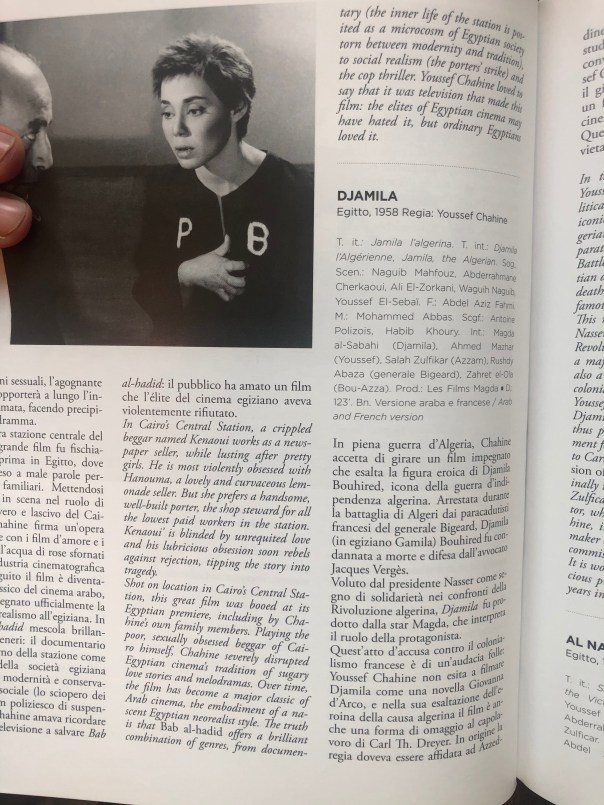
The Youssef Chahine Podcast No. 3: Cairo Station/ Bab al-Hadid (The Iron Gate) (1958)

Our third podcast on Youssef Chahine films, this one on Cairo Station, a combination of Dickensian melodrama, Marxist analysis, neorealist aspirations, film noir techniques, and with a contemporary relevance in its Incel-on-a-rampage theme. A brilliant work, probably the best we’ve seen so far (though those with a penchant for romance might prefer The Blazing Sun or Dark Waters).  The podcast can be listened to here:


In the past few podcasts we´ve been noting how wrong wikipedia is in its description of the films so far, and how it is evident from so many of the reviews that many reviewers haven´t seen the films well enough to describe them accurately.Richard even refers us to the BFI.An exception to this pattern is this brief description of the film in the Ritrovato catalogue.


IMG_1059
Description of Cairo Station from Bologna’s Ritrovato Catalogue


These are excerpts from the film that are described or referred to in the podcast: we. talk about the sensuality in the film and how shocking that must have been in its time

We talk about the conflict between modernity and tradition in relation to this excerpt featuring Mike and His Skyrockets, who have their own website but who interestingly don´t mention their appearance in this film. There is even an update from Mike himself.And it turns out that one of the Skyrockets, Asaad Kelada became a director in Hollywood with extensive creditsin television.

We talk about the film noir elements in a film that has often been described as neorealist and of the extraordinary conceptualisation of shots and use of depth of field, which can be seen in this excerpt-

Likewise the images below are illustrations of some of the aspects discussed in the podcast, the compositions, the themes of sexual obsession, labour organising, the compositions, the way the frame is peopled, etc.:

Lastly, a description of Chahine and his career from the Ritrovato catalogue:

IMG_1054
Introduction to Chahine and his work from the 2019 Ritrovato Catalogue

and lastly Mark Cousins also makes for very interesting reading on Cairo Station in his The Story of Film book


Barrie Wharton has written a very interesting article on the creation of national identity in Nasser’s Egypt that references Cairo Station:

Barrie Wharton, ‘Cultivating cultural change through cinema; Youssef Chahine and the creation of national identity in Nasser’s Egypt,’ Africana, Vol.3, No. 1, 2009

and can be found here:

Cultivating-Cultural-Change-Through-Cinema-AFRICANA-Vol3-No1


More on Mike and his Skyrockets: A whole thread on Cairo Jazz: The article from Ebony linked here is really interesting about the Cairo Rock and Roll scene.

Another interesting podcast on  Cairo Station from Holmes Movies Recommends may be listened to here: José Arroyo

Burt Lancaster 1946-1956, The Man Girls Whistle At.


In the early phase of his career, Burt Lancaster is not only there to be looked at and seen, as all actors are, particularly stars; nor is he just — albeit significantly – characterised by ‘to-be-looked-at-ness,’ something that is seen to be the exclusive and particular lot of women in cinema; and nor is this ‘to-be-looked-at-ness,’ always deflected by action and violence, as is often argued by theorists like Steve Neale. Burt is dressed and undress for the audience’s pleasure. That is true of other stars of the era, one thinks of Rock Hudson, for example, although Burt seems to enjoy it more than Rock. The reason for making this particular video was simply to show how often Burt is propositioned by women, and how that is acknowledged and deflected; how that often sees the characters he plays acknowledge it as an objectifying ploy…one which places him in a position where he has his price and can be bought well….like patriarchal notions of ‘woman’ from the period. He is desirable; can almost always be had on his terms; and can sometimes be bought on others. It’s part of a locus of meanings and actions associated with his star persona at this period that contribute to his representing a particular type of man but one that evokes a certain kind of masculinity in crisis in the post-war period.


José Arroyo

José Arroyo in Conversation With Nicky Smith on Fredric March

Great fun to chat to librarian extraordinaire on her favourite subject, Fredric March: two time Oscar winner; recipient of the very first Tony award; in his time considered one of the great actors of his generation; headliner of films that continue to be seen and appreciated —The Best Years of Our Lives, Dr. Jekyll and Mr. Hyde, Nothing Sacred, etc — yet now relatively forgotten. In the podcast, Nicky and I discuss who is Fredric March? Why is he significant? Why might he have been forgotten? Why should he still be remembered?

There´s a moment in Billy Wilder´s Fedora, where Henry Fonda appears to award Fedora her an honorary oscar and mentions how he envied those great stars who had once worked with her, beginning with Fredric March, a moment that sparked the idea for this podcast.

henry envying Freddy

I have written on some of Fredric March´s lesser known films and those interested can follow up by clicking the hyperlink on:

The Royal Family of Broadway (1930)

Laughter (1930)

My Sin (1931)

Design for Living (1933)

The Dark Angel (1935)

Susan and God (1940)

José Arroyo

The Simulacro Magazine Interview

An interview with moi-même. Julia Scrive-Loyer had the wit to ask the questions. Delighted that it´s for Simulacro, one of the prettiest and most engaging of cinephile magazines . And the photo is by the great Jaime Guerra. It´s in Spanish, so those of you who don´t speak the language get the added thrill of looking it all up in the dictionary like early Anglo cinephiles did with Cahiers:

SCREENSHOT 2019-12-18 AT 06.53.27

The link to the magazine is here: https://www.simulacromag.com/entrevistas/2019/12/17/eavesdropping-con-jos-arroyo?fbclid=IwAR24UMJr0kilgu_KzWoJq99lRrd3iz0Jf2USUxxbVRVXrjQITdghAJzjixQ


José Arroyo


On Flawless, Acting

Originally published in Sight and Sound; London Vol. 10, Iss. 12,  (Dec 1, 2000): 16.

impersonators 1.jpg

impersonators 2.jpg

impersonators 3.jpg

X-men (Bryan Singer, USA, 2000

Originally published in Sight and Sound; London Vol. 10, Iss. 9,  (Sep 1, 2000): 59.

Screenshot 2019-10-23 at 16.26.45.jpeg

xmen

Gendernauts (Monika Treut, Germany, 1999)

Originally published in Sight and Sound; London Vol. 10, Iss. 9,  (Sep 2000): 42-43,3Screenshot 2019-10-17 at 11.40.11

In Conversation with Julie Lobalzo Wright


Julie Lobalzo Wright has written a fascinating book on the concept of crossover stardom and what it tells us about popular male music stars in American Cinema. The book is now on paperback and thus accessible. Julie is also involved in various events around the musicals season at the BFI this Autumn, the highlights of which are: A study day on musicals at NFT3 on October 26th; and a talk on her book on November 4th at the BFI Reubens Library. This matrix of events is the context for the wide-ranging and enthusiastic conversation which you can listen to above, one that touches on, amongst other things, stardom, the musical, Bing Crosby, Gene Kelly, Kris Kristofferson, Justin Timberlake, Barbara Streisand, various versions of A Star is Born, stardom over time, and changes in the musical genre right up to the live network screenings of shows such as Hairspray and Jesus Christ Superstar.

IMG_5861


José Arroyo

The Hanging Garden (Thom Fitzgerald, Canada/UK 1997)

Originally published in: Sight and Sound; London Vol. 8, Iss. 5,  (May 1998): 46,3The Hangin garden

Screenshot 2019-10-02 at 19.49.51.jpeg

From the Edge of the City/Apo Tin Akri Tis Polis (Constantine Giannaris, Greece, 1998)

from

Originally published in: Sight and Sound; London Vol. 10, Iss. 3,  (Mar 2000): 43-44,3.

Titanic (James Cameron, USA, 1997)

Originally Published in Sight and Sound; London Vol. 8, Iss. 2,  (Feb 1, 1998): 16.


Screenshot 2019-09-29 at 07.44.12


Screenshot 2019-09-29 at 07.44.15.jpeg

Screenshot 2019-09-29 at 07.44.20.jpeg

Screenshot 2019-09-29 at 07.44.27.jpeg

The Butterfly Effect/El efecto mariposa, Fernando Colomo, Spain/France/United Kingdom, 1995)

afecto.jpg

Originally published in Sight and Sound; London Vol. 7, Iss. 8,  (Aug 1997): 43-44,3


Mission Impossible (Brian de Palma, USA, 1996)

Originally published in Sight and Sound; London Vol. 6, Iss. 7,  (Jul 1, 1996): 18.Screenshot 2019-09-29 at 07.55.04.jpeg

Screenshot 2019-09-29 at 07.55.09.jpeg

Screenshot 2019-09-29 at 07.55.16.jpeg

Screenshot 2019-09-29 at 07.55.19.jpeg


Flamenco (Carlos Saura, Spain, 1995)

flamenco

Originally published in Sight and Sound; London Vol. 10, Iss. 8,  (Aug 2000): 44-45,3

Screenshot 2019-09-29 at 08.05.45.jpeg

Perdita Durango (Alex de la Iglesia,Mexico/Spain/USA, 1997)

perdita

Originally published in Sight and Sound; London Vol. 9, Iss. 3,  (Mar 1999): 48-49,3.


Screenshot 2019-09-23 at 09.05.13

Amores Perros/Love´s a Bitch, Alejandro Iñarritú, Mexico,2000

Originally Published in Sight and Sound; London Vol. 11, Iss. 5,  (May 2001): 39-40,3.