Coding Lesbianism in Young Man with a Horn (Michael Curtiz, USA, 1950)

I’ve often wondered why Lauren Bacall was a film star for so long. She’s often stiff, mannered, and really not very good. Of course she’s very beautiful. But, as we can see in later films like Written on the Wind (Sirk, 1956),  she didn’t photograph that well in colour. I suppose that her performances for Hawks in To Have and Have Not (1944) and The Big Sleep (1946) sparked a life-time’s interest from several generations of heterosexual men. And I know from personal experience that a certain generation of lesbians became devoted to her on the basis of her performance as Amy North in Young Man with A Horn (1950).

The film is loosely based on the story of Bix Beiderbecke with Harry James dubbing the trumpet. It’s narrated by Hoagy Carmichael as piano-player Willie Willoughby. Nobody does tortured artists like Kirk Douglas, who’s great here as Rick Martin. The film has a wonderful father/son relationship between Rick Martin and black trumpet player Art Hazzard (Juano Herandez). Doris Day sings. And there is great work from Michael Curtiz and cinematographer Ted McCord: there isn’t an image that isn’t worth looking at. The first half-hour of the film charting the background of Rick Martin, how he grew up and how he learned to be a trumpet player must count amongst Curtiz’s best post-war work.

Lauren Bacall only appears 47 minutes into the film but gets a star entrance and definitely makes an impression, the ‘duality’ in her nature rendered visible and contrasted to the ‘normality’ of Joe Jordan, the character played by Doris Day, already being edged out of the frame here and shortly to disappear from the rest of the picture until the end, once Amy/Bacall disappears from view .

Screen Shot 2018-10-29 at 10.54.11.png

We know from the beginning that she’s not ‘normal’ because, as we can see in the clip below, she’s rich, highly educated, ‘always talks like a book and likes to analyse everything,’ and speaks of jazz and mass culture like she does here:’there’s something about jazz that releases inhibitions; it’s a cheap mass-produced narcotic’: probably exactly the thing Amy needs. By the terms of American cinema of the period (and now), she’s already a weirdo.

Bacall’s thoughts on Doris are a favourite moment in the film. Bacall’s lit so only half her face is showing: ‘Jo’s interesting isn’t she? So simple and uncomplicated. It must be wonderful to wake up in the morning and know just which door you’re going to go through’. Amy/Bacall is constantly contrasted with Jo/Doris: Amy’s not so simple, her identity is at least dual, and yet to be discovered by Ricky and maybe herself.

When Kirk/ Ricky starts to get involved with Bacall/Amy, Doris/ Jo comes to warn him, ‘She’s a strange girl, and you’ve never known anyone like her before…inside, way inside, she’s all mixed up’; ‘precisely what I told him myself but he wouldn’t take no for an answer’ says Bacall/Amy as she enters the picture. It’s too late they’re married (see below):

But it’s not just the contrast to Jo/Day, or all that the characters speak about her being ‘mixed up’ and ‘strange’. There’s her apartment, even, actually especially, after Kirk/Ricky marries Bacall/Amy.  We’re shown how female-centric the house is, and not just because her florid cockatoo is called Louise. Look at the number of statues that are female Grecian figures, the painting inside and outside her bathroom door that are naked women bathing, even her paintings are of women.

Rachel Mosely pointed out to me something I hadn’t noticed: If you click to a closer look on the image of Bacall playing the piano above, you’ll see that the ancient goddess who is the base of the lamp has an extended broken arm that looks more than a little like an extended phallus, as if to indicate that women provide the only sex and power she needs and Kirk can go blow his own trumpet.

Bacall/Amy doesn’t really like men. We can see it in the clip here below where they embrace. She doesn’t like the kiss, it’s the last time she’ll be honest with him. It ends with him saying ‘call you what?’. I think lesbian audiences knew the answer to that one.

‘How do you know about anything until you try it?’ she tells Kirk/Ricky, presumably about heterosexuality:

At the end, she finds a girlfriend, an artist. She loves her sketches and they’re going to go to Paris together. Kirk finally clocks it and calls her as ‘filth’, ‘dirty’ a ‘sick girl who needs help and better see her doctor’; you can also read the bit about him almost ‘forgetting about his trumpet’ but now ‘getting it back’ metaphorically:


When Bacall disappears from the picture, the film starts getting sanctimonious and goes downhill and for a phoney happy ending with Jo/Doris.

Movies of the time couldn’t represent lesbianism directly; and Young Man with a Horn certainly offers mixed messages that could be disavowed to the Hays Office. But it offered enough so that a generation of lesbians clocked and treasured it. The representation is laced with the typical homophobic language and perspective of the period but, as embodied by Bacall,  it also evoked beauty in looks, intelligence, and attitude.

José Arroyo


Doris dons blackface in ‘I’ll See You in My Dreams’

Screen Shot 2018-10-28 at 07.28.09.png

I always get sad and embarrassed when I see the great stars of the Hollywood musical don blackface, even when, as Fred Astaire does in Swing Time, it’s done as an homage to a black performer, Bill ‘Bojangles’ Robinson. I thought Doris Day might have escaped this blight merely by becoming a star a generation later than Astaire or Garland or so many others. But no, here she is in I’ll See You In My Dreams .(Curtiz, 1951) .and one feels ‘poor everybody’.

The image and the number condenses a concatenation of meanings that evoke both the push and pull, the inclusiveness and hierarchisation of American identity. The number is set in a WW1 camp where Gus and Grace Kahn are entertaining the troops. The film makes much of Kahn’s family having emigrated to America and of Kahn writing the songbook to the lives of several generations of Americans (‘Making Whoopee’, ‘Ain’t We Got Fun’, ‘My Buddy’, ‘It Had To Be You’, ‘My Baby Just Cares for Me’ etc). The film in a way charts a journey of assimilation and inclusiveness. Danny Thomas, gives a great performance as Gus: wide-eyed, wide-open emotionally, overly focussed to the point of autism, very endearing in expressing love of wife and children the character he plays can’t express except through song. Danny Thomas himself was famously of Lebanese origin. So Danny, Danny as Gus, Doris, Doris as Grace, Grace married to Gus, her blondness, his darkness, all speak assimilation and inclusiveness.

Except we have this number, which in spite of the flag and in spite of narrative speaks a hierarchy of exclusions. Doris is not just donning blackface. She’s donning blackface (and drag!) to imitate Al Jolson singing ‘Toot Toot Tootsie Goodbye’, so a blond female Kapplehoff, Day’s real name, is summoning and superceding a male jew, Al Jolson (Asa Yoelson), who himself poked fun, embodied, reproduced and made himself superior to a derogatory stereotype of a black man.

So the image speaks of Doris Day (Doris Ma Anne Kapplehoff) and Danny Thomas (born Amos Muzyad Yakhoob Kairouz) coming together under a flag, just like the characters they play, speaks of assimilation and inclusiveness. But the blackface itself belts out the limits to that inclusiveness, a hierarchy of race and ethnicity, a hierarchy of power which is both gendered and racialised, differential access to belonging and a colour barrier to inclusiveness tout court.


José Arroyo

Pangborn earns his billing in Romance on the High Seas

Screen Shot 2018-10-27 at 11.12.32.png

In Romance on the High Seas, Franklin Pangborn gets sixth billing after the stars and earns it. He gets two little scenes, a couple of good lines, and makes one remember him with pleasure. It’s that talent that enabled him to make a career throughout the whole classic period out of what basically amount to bit parts; and, at a time when those things very clearly delineated a certain kind of standing in the industry,  usually get very good billing for them. The film also has Eric Blore who doesn’t get much chance to shine; S.Z. Sakall who’s a complete ham but very effective with it: he gets laughs out of facial gestures and intonations when there aren’t any to be had in the lines themselves. There’s also Oscar Levant, in a large and tiresome role, doing the same schtick that I adored seeing him do when I was a child in An American in Paris but that now seems very tiresome. But ah Pangborn! His intonations and facial gestures not only succeed in getting the laughs but evoke a whole structure of understanding and feeling, then underground, but still very much with us and now everywhere visible.

His role is little more than the two very short clips I’ve excerpted below:


José Arroyo

Milo Anderson, Doris Day, Romance in the High Seas (Michael Curtiz, 1948)

We’ve heard of Edith Head, Travis Banton, Orry-Kelly, Irene, even the dreaded Helen Rose. But who is Milo Anderson? I had to look him up. He doesn’t even get a wiki entry in English. Luckily the French and Germans are more thorough. It turns out he worked at Warners from the early 30s to the late 50s and designed the clothes for many films you’ve probably seen (To Have and Have Not, Mildred Pierce). The reason you’ve probably never heard of him is that he designed clothes like these for Doris Day’s first film, Romance on the High Seas. Her charm and the positivity she exudes — plus that great voice on hit songs like  ‘It’s Magic’ and ‘Im in Love’ -meant she survived the clothes and became a film star anyway. But she really did have to survive them. Janis Paige wasn’t so lucky.

As you can see below, sometimes, when he doesn’t allow himself to get too matchy-matchy,  a feel for colour can be detected: but the design, cut and fit are atrocious. Though they do make a ‘statement’:

Screen Shot 2018-10-27 at 09.01.52.png

Screen Shot 2018-10-27 at 09.05.39.png

Screen Shot 2018-10-27 at 09.08.14.png

Screen Shot 2018-10-27 at 09.12.25.png

Screen Shot 2018-10-27 at 09.14.32.pngScreen Shot 2018-10-27 at 09.19.25.png

Janis Paige didn’t escape either:

Particularly when she wears what looks like a small ottoman on her head

Screen Shot 2018-10-27 at 09.15.15.png

Fire the make-up person!

Joe Hadley is credited with the make-up in My Dream is Yours and, if so, he should have been fired. Doris Day is saved from the worst excesses because her look, even when fully made-up and in evening-war, was meant to evoke a ‘regular’ sporty girl. But poor Eve Arden walks around with her pronouncedly crimson lips two inches in front of her face, as if with a will of their own and making  their way into another dimension.


The stills don’t do justice to how the lipstick seems so pronounced in motion. I saw Romance on the High Seas afterwards, with the make-up credited to Perc Westmore (he ran the whole department and approved the make-up tests but it was surely done by someone else?), and, as you can see in part of the trailer below, though the lipstick is a very loud shade of red, it’s not as bad. The crimson lips were clearly the fashion of the time. I did also wonder if my digital HD TV does not make it seem worse than it might have been to audiences of the time, highlighting and making vibrate certain colours. I did check the settings but they seemed alright. Perhaps we’ll never know. What we do know, is that the Warners DVD played on HD turns the lipstick into a Brechtian distanciation effect.


José Arroyo

Eve Arden, Career Women and Children

It’s a famous fact that Eve Arden is one of the great treasures of Hollywood cinema. From Stage Door(Gregory La Cava, 1937), through Mildred Pearce (Michel Curtiz, 1945) to Grease (Randal Kleiser, 1978) on film, and as our ever sharp and sardonic Miss Brooks on radio and television, she delights with her wise-cracks, her intelligence, a slightly knowing caparace of cynicism protecting a too-sensitive heart. I loved seeing her in this bit of My Dream is Yours where Jack Carson, who’s already conned her into allowing Doris Day to stay, adds first Doris’ child and then her dog. With regards to children, only W.C.Fields and Clifton Webb expressed the unsayable as well as Eve Arden does here:


Pangborn Pansies in the ’40s

One of the delights of watching Classic Hollywood Cinema is catching sight of character actors, often even more beloved than the stars. My Dream is Yours (Michael Curtiz, Warners, 1949) showcases a host of my favourites — Eve Arden, S.Z Sakall, and above all, and even though he only appears for five minutes, Franklin Pangborn. I’ve written on him several times in this blog in relation to Only Yesterday and Pre-Code Cinema, in William Wellman’s  A Star is Born, a compilation of his best bits from Easy Livinghow he and other ‘effeminate’ character actors were deployed to butch up Fred Astaire in his films, in relation to a consideration of whether Preston Sturges was homophobic, and as one of the joys of watching Mitchell Liesen’s Easy Living or Preston Sturges’ Sullivan’s Travels. It was a delight to see this brief clip below in My Dream is Yours: 

I loved it so much I made a gif, even though one loses his lovely and expressive voice and line readings, one gets his priceless facial expressions on a loop: we’re here, we’re queer, get used to it!

my-dream-is-yours.gif

José Arroyo

Patriotic Billing at Warners in WWII

Warners must have liked the patriotic stars-and-stripes billing for Yankee Doodle Dandy (Michael Curtiz, 1942) so much they kept it for Irving Berlin’s This is the Army (Michael Curtis, 1943) and zinged it up with colour:

Screen Shot 2018-10-23 at 15.19.22.png

Screen Shot 2018-10-23 at 15.20.33.png

José Arroyo

A note on Michael Curtiz’ direction of ‘Irving Berlin’s This is the Army’ (1943)


According to Thomas Schatz in Boom and Bust: American Cinema in the 1940s, ‘While musicals made up a fairly limited proportion of Hollywood’s overall output, they generated a sizeable share of its income. Twenty-five of the Seventy wartime releases earning $3 million or more at the box office were musicals, including three of the top ten (This Is The Army, Meet Me in St. Louis and Yankee Doodle Dandy)’(p.225).
Screen Shot 2018-10-23 at 09.47.26
Of these Michael Curtiz directed the first and the third. Indeed Curtiz directed many musicals,  several with Doris Day, including her first, Romance on the High Seas (1948), huge hits such as White Christmas (1954, and arguably Elvis Presley’s best film, King Creole (1958).  But he is not considered one of the great directors of the genre and seeing Irving Berlin’s This is the Army one easily understands why.
Screen Shot 2018-10-23 at 09.47.49.png

Irving Berlin’s This is the Army (1943) was the highest-grossing musical of WWII. It was part of a cycle of all-star musicals — Thank Your Lucky Stars (David Butler, 1943); Hollywood Canteen (Delmer Daves, 1944) are other examples from Warner Brothers — designed to raise morale and aid the war effort. Seen today, its popularity is understandable: It’s propaganda everyone at the time must have supported and with a cause — propping-up the war effort –most everyone would have wanted to contribute to. But it’s a dreary musical. Even the hit numbers, such as Kate Smith singing ‘God Bless America,’ seem drab and insipid, particularly if one isn’t an American. The flag-waving fervour of others rarely comes across as anything but scary or dull and distancing. This falls into the latter category.

Screen Shot 2018-10-23 at 09.47.26


My favourite number is Irving Berlin himself singing ‘Oh how I hate to get up in the morning’ with that weak but engaging voice of his. It’s supposed to be all-star but none of the stars are known to us today except Ronald Reagan and perhaps George Murphy. Certainly all the stage stars imitated in one of the drag number — Jane Cowl, Lynn Fontanne — will be remembered only by Broadway enthusiasts. There are in fact many numbers in drag which are meant to be funny but now come across as the equivalent of blackface, a combination of desire for and condescension to that which they are imitating. Straight drag — unlike most gay drag –seems to poke fun and laugh at femininity. The film does have a pleasing inclusiveness of ethnicity and race; the former one of the most recurrent and attractive traits of American cinema; the latter relatively rare, indeed almost a structuring absence,  a stain and limit to the much-vaunted claims of democracy in America.  I found it all a bore, underlining how emotionally crude Curtiz could be — note how mothers pack off their sons to war — but also once again demonstrating his eye for visuals and his skill with a camera.

Screen Shot 2018-10-23 at 09.47.54

As you can see in the clip above in the short clip, which is just an announcement that the President and high officials are arriving to see the show. There are 19 shots, each with a different and striking composition, shot from a variety of angles but with a certain rhyming quality: if a the characters in a shot look to the right for example, in the next cut they will look to the left (the four images above after the clip are from consecutive shots). There are high angles looking down and low angles looking up. There are crowd shots and there’s individual inserts with bits of dialogue from the audience. The shots are put together rhythmically, in line with the music, but also with cuts on action. It all culminates with the camera dollying in to the character announcing the President’s in the audience. The technique on display is dazzling; the use it’s put to is not. This seems a recurring curse for Curtiz.


José Arroyo

Eavesdropping at the Movies: 104 – Bad Times at the El Royale


We pick at flaw after flaw in a film we sincerely enjoyed! Drew Goddard’s post-noir, post-Tarantino, post-Hitchcock thriller is an oddball, a delightfully playful collection of stories about secrets and regrets and temptations and damage. A fabulous ensemble cast is split up and paired off in all sorts of ways, histories are exposed, deception is currency, violence is brutal and shocking. And it all happens on one rainy night in a broken old motel in 1969.

We have few issues with Goddard’s screenplay, which, but for the exception of one or two characters who we reckon could have been given a little more flesh, is creative, clever, witty, and energetic. But as a director, we find him lacking – as José phrases it, he has no instinct for cinema. It’s a significant problem in a film that’s building upon and pastiching entire genres and movements of cinema.

We go back and forth on some of the performances, though they’re primarily good, and Jeff Bridges and Lewis Pullman in particular are just perfect. Mike appreciates that the film understands when to pull the rug out from under you and when not to. We agree that it’s destined to become a cult success, the type of film you want to know if your friends have seen. And we like trifle.

The podcast can be listened to in the players above or on iTunes.

With José Arroyo of First Impressions and Michael Glass of Writing About Film.

King Creole (Michael Curtiz,USA, 1958)

king creole

I grew up in Montreal, where Elvis was King en français. The local commercial French station, TVA Canal Dix,  showed Elvis films regularly: the dialogue was in French but Elvis rocked in English. I must have seen all of them and had firm favourites: Viva Las Vegas (George Sidney, 1964) with Ann-Margaret,  Blue Hawaii (Norman Taurog, 1961), and this one, King Creole. I now see that it’s perhaps significant that these were all directed by old-timers of the studio system who knew their craft.

Some fans prefer Jailhouse Rock (Richard Thorpe, 1957), and certainly its famous and eponymous number is a delight. But King Creole is arguably Elvis’ best film. And it’s part of the tragedy of his film career that even his best film is but a derivative and pulpy melodrama. Themes of teenage rebellion, the relationships of fathers and sons, and children looking on pityingly at what they see as the emasculation of their fathers by society and societal institutions, are all themes that are better dealt with, in this very same period, by Nicholas Ray’s Rebel Without a Cause (1955).

As a teenager, I’d read and enjoyed the Harold Robbins novel  the film is based on, A Stone for Danny Fisher. And Curtiz’ film follows the plot quite closely, if exchanging Brooklyn for New Orleans, the boxing world for that of the nightclub scene on Bourbon Street and the 1930 Depression setting for the film’s present.

Presley’s Danny Fisher, a talented singer, is busing tables at a nightclub whilst trying to graduate from high school. The money he brings in is needed to keep the family afloat.  His father’s given up. He’s been a prominent pharmacist but lost it all when his wife’s death led to a spiral of depression and drink. They lost their house and now live in a slum tenement next to a brothel. Fisher keeps failing High School’s  cause he’s just got too much to do. In the meantime the streets offer lots of opportunity for easy money. Danny’s father is willing to lower himself so that his son can get a diploma but Danny can’t bear to see his father so bullied and humiliated. Also, he can make easy money singing. The tangles of family, show-business and the underworld lead to tragedy. King Creole is a mix of teen film, musical, and noir. There are few musical performers more exiting to watch in this period than Elvis. And almost no one in the Hollywood of this time is better at using the camera than Michael Curtiz. Elvis performing and how Michael Cutiz films him performing are what propel this otherwise pulpy melodrama into something great.


A Stone for Danny Fisher.jpg


King Creole is one of the few Presley films, the only one I remember, where he’s presented as a real film star. He gets a great star  entrance with the ‘Crawfish’ number, a duet with rhythm and blues singer Kitty White, written by songwriters Ben Weisman and Fred Wise as a street vendor’s cry, that starts off in the pre-credit sequence, continues on Kitty White post-credits, then cranes up and dissolves to introduce us to Elvis, who is framed behind lace curtains, in turn framed by the window, in turn framed by the shutters, in turn framed by balcony railings.

Elvis opens up the curtains, and comes out, to us, like a fancy chocolate in a box within a box within a box  and next to flowers.  As the song continues, Elvis is intercut with Kitty passing by on her cart, finally we get a reverse shot that shows us the other side of the street, with the ‘hostesses’ on the balcony on the nightclub next door soliciting Elvis. In the shot when he responds, ‘No you don’t, ya gotta pay me’, his sister appears on the right hand side to offer him breakfast. Curtiz masterfully presents what people have paid to see — Elvis — makes us wait for what he’s got to offer, frames him, teases us, and reveals his talent, desirability, family relations and a context in which the drama can unfold all in one scene. It’s a brilliant mise-en-scene of stardom. Something Curtiz is so expert at and that so few other directors ever offered to Elvis.

What Elvis was famous for in 1958 was conveying sex to teenagers. The Los Angeles Mirror-News entertainment editor wrote that  ‘what Elvis offers is not basically music but a sex show’ (cited on p. 438 in Peter Guralnick’s Last Train to Memphis (438).  Guralnick writes that Leber and Stoller’s ‘Trouble’, a Muddy Waters-styled blues was intended somewhat tongue in cheek but was delivered by Elvis with untempered ferocity. ‘It sounded sort of comical to us, but strangely enough to the mass market it wasn’t. It was somewhat generational and somewhat cultural, but they bought it’. (p.449).

In the film, Curtiz stages that sexy ferocity as a challenge to the gangster played by Walter Matthau, as something to entice the gangster’s moll played by Carolyn Jones, and as a source of conflict between the two nightclub owners. That talent, sex and ferocity are once more put in the scene in the context of different narrative threads where his very power and desirability originate the source of the tragedy to come. It’s a lesson in how to mobilise a star persona in narrative and how to narrativise stardom.

Julie Lobalzo-Wright in Crossover Stardom’ writes that there can be no doubt that Presley represented the rebellious image of the 1950s, both within America and worldwide, and his cultural impact cannot be overstated. (p.59)…Presley’s early live performances on The Milton Berle SowThe Steve Allen Sow, and The Ed Sullivan Show in 1956) created a stir displaying Presley’s overt sexuality that consistently presented his sexualized body as an object of desire. Thomas. C. Carlos has described his early television performances as ‘so sexy, not white sexy, not coy sexy, but so humping swaggering black r&b sexy” that they led to a national uproar’.

I’d also like to comment on the quieter ‘Young Dreams’ number (see above). This is such a joyful performance, the dip in his shoulder, the shake of his head during ‘kiss you morning, noon and night’ then again dipping his shoulders and opening his mouth in the pause as if to say, “‘wow’ isn’t this naughty and marvellous’. Presley conveys the saucy and the tender filtered through a joyful amazement, sex combined with feeling in gleeful wonderment. No wonder his girlfriend in the audience is on the verge of tears with longing. Seeing him, we understand her, and understand why Elvis was so appealing to both men and women for so long. It’s a quiet number in the film, but powerful. And made more so by Presley being at the centre of a pool of light amidst the shadows and darkness of the nightclub, a light also highlighted by wearing a shirt that photographs white. Thus in a longer shot he’s the focus bathed in light, and then of course, there are the close-ups, when it’s his singing, his sensuality, and the effect that these things are  having on his girlfriend that Curtiz draws our attention to.

As we can see in King Creole Crutiz constructs  a mise-en-scene of and around Presley’s stardom, both as a musical performer, a sensation really, and as a movie star. I’ve commented on some of the numbers above. But let me just draw your eye to other aspects:

See, for example, how in the scene where he takes his girlfriend to see his old home, the focus is on him even when she’s doing all the talking; and note how he’s lit (see below):

Screen Shot 2018-10-10 at 20.00.49


See also how Curtiz present Presley to us in and through through light. Lighting is accentuating his features, his feelings, his very presence. He’s often shown coming in and out of the light. See some of the pictures below but further down you can also see how he’s lit as a kind of noir hero/film star in the scene were he watches his father get attacked.


Ultimately, the story is hackneyed but professionally told. Curtiz knows how to make his stars shine and how to use what they represent to create context, plot and convey feeling. Elvis’ stardom is part of the mise-en-scene of King Creole. It’s the same kind of care others took to present Judy Garland, Gene Kelly or Fred Astaire; it’s the same kind of care Curtiz used in his musicals with James Cagney and Doris Day; it’s the kind of care Elvis rarely got from any of his other directors.

José Arroyo


Eavesdropping at the Movies: 103 – First Man

An interesting failure. We struggle a little bit to get a read on First Man, Damien Chazelle’s biopic of Neil Armstrong. Not content to adopt a mainstream tone, not willing to go full art movie, it gets lost in the middle somehow. Mike sees Armstrong as incongruously passive in his own story, his – and, for that matter, everyone else’s – drive for the Moon landing, not believable, ultimately making the landing scene feel cheated, the film trying to convince you of the incredible achievement of the mission only at the last minute.

José finds aspects of the film intriguing, particularly the portrayal of marriage, but finds the sub-pot with the daughter imbalances the film. Mike finds the film misunderstands Ryan Gosling’s style – his minimalism requires rich surroundings off which to reflect, and with so little here, Armstrong comes across blank. José disagrees with this but both of us appreciate the physicality of the space sequences, shot almost entirely with close ups on interiors, though the extension of the shaky cam to the rest of the film is irritating.

A confusing film that we find misguided, and a glance at its opening weekend box office doesn’t bode well. Claire Foy is very good though.

The podcast can be listened to in the players above or on iTunes.

With José Arroyo of First Impressions and Michael Glass of Writing About Film.

Butching up Fred


fred 2

There’s a lovely moment in Swing Time (George Stevens, USA, 1936) when Fred and Ginger finally kiss. She’s been after him for most of the movie by then. Bewildered by what she sees as a lack of response, she begins singing her reproach: ‘A fine romance, with no *kisses*’:

A fine romance, my friend this is
We should be like a couple of hot tomatoes
But you’re as cold as yesterday’s mashed potatoes
A fine romance, you won’t nestle
A fine romance, you won’t wrestle
I might as well play bridge
With my old maid aunt
I haven’t got a chance
This is a fine romance

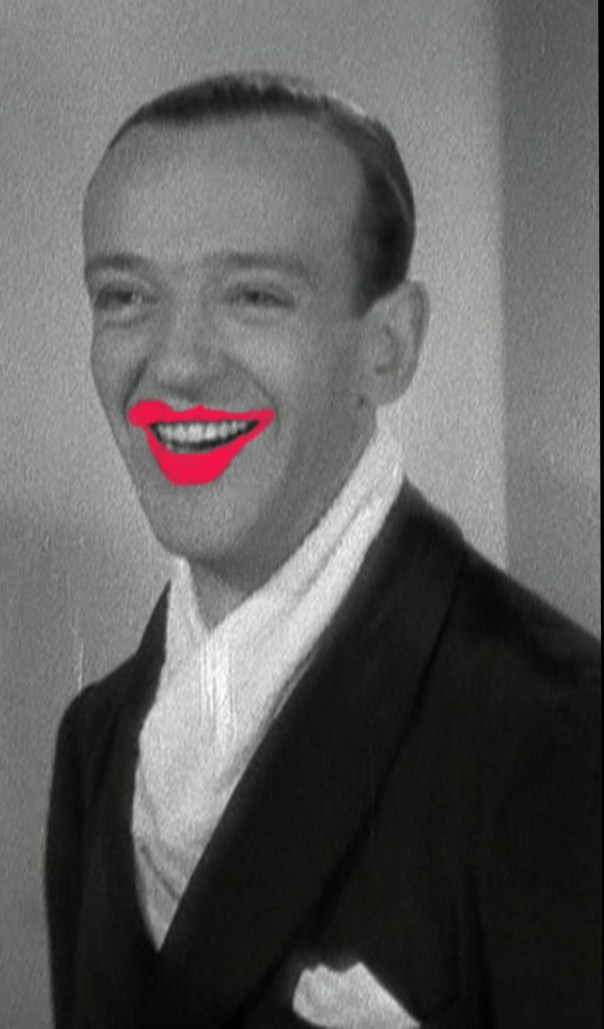
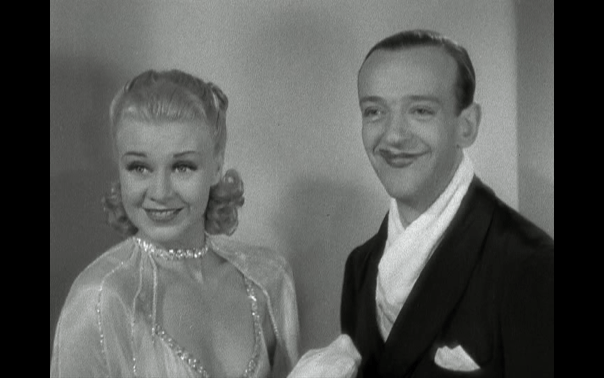
When they finally do begin to kiss, a door closes so that we don’t see the kiss itself. We just know they have because when the door opens Fred’s face is smeared with lipstick, which I’m often tempted to colour in, badly, as above.

What compels me is not that I think that elegant symbol of love, romance and Hollywood cinema is gay or even ‘feminine’. Indeed the image above is a cut-out of the image below. I’ve removed and then restored Ginger from where she rightly belongs, figuring that dream of love and romance *with* Fred.


Screen Shot 2018-10-17 at 16.04.14.png

The films, however,  in trying so hard to reassure the audience that Fred Astaire is *not* effeminate create so many spaces where other men can be: Fairies delightedly prance through the Astaire and Rogers series inciting dreams of being just as Fred and Ginger themselves incite dreams of love and romance.

Fred is usually surrounded by Eric Blore, or Edward Everett Horton or Franklin Pangborn or Erik Rhodes — all the lovely pansies of Thirties Hollywood — and often a combination of two or more in the same film — to shore up his masculinity. Sometimes as with Erik Rhodes, those characters are doubly othered by being shown as ‘effeminate’ AND foreign. It’ true that they’re there to be funny, to in some sense, be laughed at for their otherness. But they’re there. And they may be the butt of the joke but they’re also loveable and often elegant, witty, well-dressed and just as as at home in the Art Deco splendor of the world of the films as Fred and Ginger.

Thus, so often, butching up Fred results in gaying up the film and leads to moments like the lovely one below with Victor Moore (and let’s draw the veil over the blackface).


I wonder what those moments meant to a gay male audience, to a black audience, and to a black and gay audience in the 1930s?


Jose Arroyo

Night and Day: 1930s Fashion and Photographs


Since you are reading this, I assume you’re interested in movies; and if you’re interested in movies, you’ll be interested in the wonderful ‘Night & Day: 1930s Fashion and Photographs’ exhibition at the Fashion and Textile Museum in London, which runs until the 20th of January 2019.

The title of the exhibition, ‘Night and Day’ is taken from Cole Porter’s superb song which Fred Astaire introduced onstage in 1932’s The Gay Divorce and on film in 1934’s The Gay Divorcee. It is also the title of the famously terrible biopic of Cole Porter directed by Michael Curtiz for Warner Brothers (1946), in which Cary Grant plays Cole Porter. But it is Fred Astaire who the song is associated with.

‘Night and Day’ was written for Astaire. His recording was an enormous success which topped the charts for ten weeks in the early thirties; and indeed the spirit of Fred Astaire haunts this exhibit. Firstly because of the evening dress he so casually wore, the glamorous and glistening Art Deco which was the background to his dancing the final number in so many of his films with Ginger Rogers at RKO, and the beginnings of a sporty elegance he is associated with. Well-cut clothes that enhance and adorn the figure but also allow one to move in them well enough to burst into dance. Fred who from the twenties was a superstar of both Broadway and the West-End, embodied the mid-atlantic best of both worlds: He was always associated with ‘ Top Hat, White Tie & Tails’ but wasn’t limited to that look. His clothes and how he wore them is analogous to the sentiment behind Coco Chanel’s great contribution to fashion. She made the combination of casual and elegant possible for women in the way that it was for men like Astaire: American men who were as free in their movements as in their outlook but were dressed by Saville Row.


The Spirit of Fred Astaire

The movies in general and Fred Astaire in particular are everywhere evident in this exhibition. The sections are named after popular songs of the Thirties, which are either the names of movies or taken from movies of the period and which in turn evoke the period of The Great Depression (1929-1939): ‘Brother….can You Spare a Dime?’ (also written for the stage and made into a hit by Bing Crosby; ‘Whistle While You Work’ (taken from Disney’s Snow White and the Seven Dwarves, 1937); ‘I’ve Got a Pocketful of Dreams’ (Bing Crosby again from Sing You Sinners, 1938); ‘Let’s Face the Music and Dance’ (Astaire again, this time from Follow the Fleet, 1936: you can see the marvellous excerpt below); ‘Somewhere Over the Rainbow’, eternally associated with Judy Garland and from 1939’s The Wizard of Oz;’Life is just a Bowl of Cherries’ ; ‘Happy Days Are Here Again’; ‘The Way You Wear Your Hat,’ which is a lyric from ‘They Can’t Take That Way From Me’ Astaire again, this time from Shall We Dance (1936). 


More Movies:

Along with the glorious clothes, the exhibit also features movies stars, and shows them to us in the very collectible cigarette cards so evocative of a way of life and a structure of feeling in the Thirties. We also see how Madeline Carroll and Ronald Colman are featured in the Miss Modern magazine below, demonstrating how interlinked movies were with other mass media and how fashion was a thread which knit them together. Movie stars wore the clothes ordinary people dreamed of wearing and and manufacturers made sure they could, as for example with Joan Crawford’s famous Letty Lynton dress. The movie popularised the dress, the magazines popularised the dress and movie, the availability of the dress sanctified the star and increased the fandom for both magazines and movies.


Cecil Beaton: Thirty from the 30s: Fashion, Film and Fantasy

The exhibit also features a mini-exhibition within it with Cecil Beaton’s photographs of the famous: royalty, writers, society people but more than anything film stars (see below)


This being a British exhibition, royalty of course features:


But Hollywood’s influence dominates:


Sonja Henie, to left; Ruby Keller, top right; Tallulah Bankead bottom: From Cecil Beaton’s Scrapbooks

The exhibition is very good at contextualising the developments in fashion. The guide, for example, tell us: ‘Women’s fashions, which had reached giddy heights of youthful freedom (and brevity) during the Roaring Twenties, reflected the more mature and sober decade that followed. By the end of the 1920s the styles had already begun to change as the flapper grew up. Waits returned to a normal, rather than dropped, position. Skirts, which had begun to dip in the back by 1927-1928, fully descended to the knees and mid-calf for suiting, and the ankle for the afternoon and evening dresses. Structure infiltrated the relaxed shapes of 1920’s dressing: ‘hard chic’ became a watchword as couture houses such as Schiaparelli introduced a stylised and emphatic shoulder line.

As a decade the 1930’s presented the extremes: from the depths of poverty for many to a sparkling party-filled escape for the wealthy and international set’.

The exhibition’s great care with contextualisation really does pay off, though it also gives rise to moments of amusement, such as in the timeline below where Hitler’s rise is juxtaposed on the timeline right in between the drop of a hemline and the rise of the neckline.

DSC06399


The the main reason to see this exhibition is the clothes. No photos do them justice. You really need to see them in three-dimensions to see how they hang, to get a real sense of what the fabric is like, to walk around them and get the whole picture. I really recommend the exhibition. But for those of you who can’t go, here are some examples of what you are missing:


José Arroyo


José Arroyo in Conversation with Josh Schulze on ‘Alternate Takes’

Joshua Schulze is the new editor of Alternate Takes. James MacDowell one of the original founders of the digital site devoted to film and television criticism tells me that,

‘The aim of Alternate Takes is to provide analysis of cinema that is informed by academic debates, but also walks a line between the journalistic review and the critical essay. It publishes long-form essays that embody this ethos, but the most obvious way the site has achieved this compromise position between reviewing and scholarly criticism is by writing about new films twice. First there is a short, evaluative piece that ‘spoils’ as little as possible about a film, but still grants a sense of the sorts of experience it offers; the idea is that this is a review to read before you see a film. Then, after you’ve watched it, you can read our Alternate Take – a longer, more in-depth critical piece, which usually digs more deeply into a particular critical issue that the movie raises. While over the years this dual-review format has become less rigidly enforced, the overall approach it fostered has remained the same, and the site has continued to publish film criticism that is in-depth, critical, mindful of social and artistic contexts, but also accessible and enjoyable.’


The impetus for this conversation with Josh Schulze was merely to find out if there was a new direction he, along with co-editors Matt Denny, Patrick Pilkington and Leanne Weston, wanted for the now celebrated digital platform and what that might be.

In the podcast Josh and I discuss Pauline Kael, cinephilia, the pressures of writing quickly and its effects on film reviewing, the nuances of film criticism and how Alternate Takes is devoted at looking at films and television in depth. We also discuss our admiration for the video essays of Adrian Martin, Catherine Grant and Kogonada, and how contributing to Alternate Takes is a great way for early career people and students to explore their ideas and take new approaches to film.

You can find the website here: www.alternatetakes.co.uk/

James MacDowell’s thought provoking piece on the raison d’être and purpose of the platform can be found here: www.alternatetakes.co.uk/?2011,3,240

José Arroyo

IMG_3576.jpg


MUBI and Cinephilia


cinemaThere are broadly two large cinephiliac discourses on cinema currently, each with a multitude of sub-divisions: a global, festival-based one, with internationally shared points of reference, largely inaccessible in the UK outside London. And the other, a more populist but also more insular one, also with many sub-divisions, which surrounds Hollywood, commercial British cinema, and the odd Indie or foreign film that gets nationwide distribution in the UK. In this very interesting podcast the discussion focusses on how MUBI might help bridge that divide.

https://itunes.apple.com/gb/podcast/cinema-mondial-podcast/id1437047056?mt=2


José Arroyo


Eavesdropping at the Movies: 102 – A Star Is Born


Hyped up, already very successful, and widely well-received, A Star Is Born earns strong reactions from us. To Mike it’s at points truly reprehensible, to José simply a confused failure. Mike has never seen any of the previous versions – he tried and couldn’t make it – while José finds writer/director/star Bradley Cooper’s new remake unworthy to share their company. The novelty of seeing Lady Gaga unmasked soon wears off, her performance opaque and lacking in presence. We agree that Cooper is very good and truly a star, though with the opprobrium he receives from one half of us, he must have done something to Mike in a previous life.

We discuss and debate what we make of the film’s characters – Mike finds them deeply unlikeable, toxically compatible, which isn’t in itself a bad thing but for the fact that the film wants to render it romantic. (Cooper has a real problem with consent and personal space.) José finds their love difficult to believe in, particularly Gaga’s for Cooper. Quite why she’s so hot for him is barely even told, let alone shown.

Cooper’s take on the music industry is out of date and simplistic, which is more than disappointing considering he was working with one of the biggest pop stars of the last decade. We each have our reasons for finding the suicide scene nonsensical. And Mike describes his problem with the film’s ending.

A lot to talk about, most of it negative. See you again in between twenty and forty years for the next version.

The podcast can be listened to in the players above or on iTunes.

With José Arroyo of First Impressions and Michael Glass of Writing About Film.

An excellent piece by Richard Dyer on the films can be accessed here: 


Eavesdropping at the Movies: 101 – The Little Stranger

You find us in contemplative mood, picking apart a film described by José as “genuinely puzzling” and Mike as “The House with a Doc in Its Walls”. The Little Stranger builds light gothic horror around class and ambition in 1940s Warwickshire, a stately home providing the setting of the action and focus of Domhnall Gleeson’s town doctor.

With some difficulty, we attempt to grasp the film’s themes and intentions, never quite feeling we get the full measure of it. It doesn’t help that it basks, to some extent, in ambiguity, and also that half the lines are mumbled so as to be rendered truly unintelligible. There are things we like, particularly its sure sense of era and class, and its rich production design, but we can’t overall say we recommend it.

What we can recommend, though, is a visit to Evesham’s Regal Cinema, where we saw the film. A multipurpose venue that hosts live shows as well as regular cinema screenings, it oozes charm and style. A leisurely Sunday drive amongst sunny A roads took us there, and what a lovely day was had by all. Even if the film was a bit disappointing.

The podcast can be listened to in the players above or on iTunes.

With José Arroyo of First Impressions and Michael Glass of Writing About Film.