Monthly Archives: March 2020

The Barbara Stanwyck Show, The Miraculous Journey of Tadpole Chan, d: Jacques Tourneur, 1961)


I saw this episode of The Barbara Stanwyck show mainly to see what Jacques Tourneur could do in what is basically a twenty minute television format but became entranced by the way each episode started.

As you can see above Barbara Stanwyck turns her head, the camera pulls back, the name of the show appears and leaves us only with her silhouette. It then fades to black, starts with her silhouette and the camera moves in to reveal the new dress she’s wearing ending with a medium shot above the waist as Stanwyck recounts the plot and informs us of who the writer and the director is.

The show was clearly influenced by the Loretta Young so which had been running since 1953 and would enjoy its final season just as Barabara Stanwyck would start her new one. Loretta was famous for modelling a new dress each show. I assume that the producers of the Barbara Stanwyck show also imagined that female audiences would tune in to see what its star was wearing. Barbara, however, does not twirl. It’s an elegant and informative opening.


The producers have clearly taken care to provide the star with as many changes of outfit as possible and they manage to cram quite a few in twenty minutes (see below).


The format of this series is an anthology one, with different stories each week, which gives everyone involved more scope but is perhaps less satisfying for an audience. Here Barbara Stanwyck is a silk entrepreneur who goes to the see the US Vice Consul in Hong Kong (Ralph Bellamy) guest starring and bumps into Hong Kong waif who has already found adoptive parents but can´t find the papers necessary to prove who he is and has a deadline in which to get them. Needless to say Ralph and Barbara help, everything is resolved at the end and US services abroad get praised in Barbara´s concluding chat, a visual and structural rhyme to the beginning.

The format allows for little preparation, few set-up, little camera movement in the story itself. What I noticed is that Tourneur frames judiciously, often keeping the accent on the boy. Stock footage is used extraordinarily well to give the impression that all the action happens in Hong Kong, and the actors give extraordinarily accomplished performances given the material. It´s also worth noting that the potential for racism is extremely high and the show largely avoids it even though I did wonder if it had in any way inspired the character of  Short Round in Spielberg´s Indiana Jones and the Temple of Doom. Stanwyck won an Emmy for her performance in the serious. As to Tourneur, he directed quite a lot of episodic television, and I will see some more, but…episodic television of this period is not a director´s medium.

José Arroyo


A quick note on Yuzo Kawashima´s ‘Sun in the Last Days of the Shogunate/ BAKUMATSU TAIYODEN’

sun

I´m too distracted at the moment to write even a note on Yuzo Kawashima´s great ‘Sun in the Last Days of the Shogunate’, currently on MUBI, so I merely urge those who can to see it. It´s set in a whorehouse at a time of great social change where everyone seems to be running through the corridors and up and down staircases, very bawdy and funny, with a handling of diverse characters even Altman might envy, and with a nonjudgmental look on the very questionable things people often have to do to survive. It´s a picaresque film with a typical rascal hero, Saheiji, who lives by his wits. One of the things that makes this film great is that it lacks the cynicism of the picaresque: everyone has their reasons here, understanding and usually sympathy are offered to almost every character, and the look on the situation is that of humour tinged with a bit of nostalgia. Times of change are difficult ones and everyone needs to get by as best they can. The film usually comes out third or fourth in lists of favourite films in the history of Japanese cinema and one can understand why after seeing it.

José Arroyo

Further image/notes

Doña Francisquita (Hans Behrendt, Spain, 1934)

Do_a_Francisquita-927055723

Doña Francisquita is a musical film based on Amadeo Vives 1923 zarzuela. It was highly praised upon its release. According to Fernando González García in the program notes provided by the Filmoteca Española, of the Spanish films released that year it came third in the list of films that remained longest in distribution that year. It was a critical success also, with the cinematography of Henrik Gaertner –later Enrique Guerner — coming in for particular praise. Only the odd critic raised the issue that the mise-en-scène seemed a bit German for such a Spanish theme.

One of the elements that distinguish this film from the rest of Spanish cinema of the period is that all the cinematography design, editing, musical adaptation, one of the screenwriters, and director Hans Behrendt were jews already fleeing persecution in Germany.

Another distinctive element  is the way that Doña Francisquita makes female desire central to the narrative. All three female protagonists of the film, the eponymous Francisquita (Raquel Rodrigo), her mother Francisca (Antonia Areolo), and her rival, Aurora La Beltrana (Matilde Vazquez), express their desires freely and it is these desires that drive the narrative. Its worth remembering that the film was made in the context of the Second Republic´s passing of a whole array of new and progressive civil legislation in 1932, including a law permitting divorce.

Screenshot 2020-03-18 at 16.02.35

Screenshot 2020-03-18 at 16.02.30

You can see a trailer for the film here:


The last element that distinguishes the film is the lush look, the mobile camera, the expressive compositions that are rare to find in the Spanish cinema of this period.

According to Jacasta Berry:

When Hitler came to power in 1933, German Jewish citizens lost almost all their basic rights. UFA fired 100% of all its Jewish employees. David Oliver sensed the time had come to leave Germany. He visited Spain and set up a film company there called Iberica Films. He then invited his cousin, Kurt Flatau to become his partner. Several German Jewish exiles, who were well known filmmakers, emigrated to Spain and joined the film company. From 1933-1936, the company made four films, ” Dona Francisquita”, ” Aventura Oriental,” “Poderoso Caballero” and “Una Femana Felicidad.”

The films featured Spanish actors, but almost all of the crew members were German Jewish exiles, including Hans Behrendt, the director, Max Winterfeld, the film composer, Enrique Guerner, the cinematographer, Hans Jacoby, the screen writer, and Herbert Phillips, the art director.

In 1936, the Spanish Civil War erupted and the German Jews were driven into exile again. Some managed to survive and emigrated to France, England and America. But others weren’t so lucky. Hans Behrendt was captured by the Gestapo and sent to Auschwitz. David Oliver and his family managed to migrate to England and  Kurt Flatau and his family went to France and then emigrated to the United States in 1941.


The story of the company that produced this film is also a fascinating one, and you can follow that here: The Story of Ibérica Films  or in the bibliography provided by the program notes above:

I’ve made a screen capture of one of the musical numbers for the film (below) to give a flavour for how they’re handles, narratively in the going back and fro from what’s happening backstage, onstage, and amongst the principal protagonists in the film; and visually to demonstrate the variety of angles deployed. The poor quality is a pity, particularly considering the Filmoteca’s wonderful restoration and the gorgeous copy it made available through ‘Doré en casa’.


In 1936. the Civil War erupted and by the its end in 1939 all the new progressive social legislation was rescinded and the jewish filmmakers who hadn´t managed to flee to a freer place, were sent back to Germany and concentration camps. Behrendt died in Auschwitz. Florian Rey´s Carmen, la de Triana with Imperio Argentian, another musical, this one made by Spaniards at UFA at the height of Nazism in 1938, would seem to me to be the logical companion piece for a double screening.

The film can be seen here (at least for the duration)

https://vimeo.com/channels/1546070/398254525

Further image/notes:


Noventa minutos/Ninety minutes (Antonio del Amo, Spain, 1949)

noventa minutos


Screenshot 2020-03-16 at 14.38.17

Congratulations and thanks to the Filmoteca Española for this inventive and valuable response to the current pandemic. They´ve had to close the Cine Doré in Madrid, but have put up the newly restored Noventa minutos/ 90 minutes, along with program notes and a report on the film´s restoration, online so people shut indoors can continue to see and discuss film classics and the nation´s film heritage, often, and certainly in the case of Noventa minutos, not the same thing. The online program is titled ‘Doré en casa’/The Doré Cinema from Home and can be seen here:

They´ve included programme notes on the film by José Luis Castro: 90 minutos José Luis Castro hola de sala

and a report on the history and various factors involved in the film´s restoration: restauración 90 minutos María Muñoz.

I thought it a pity they didn´t include a version with English sub-titles as it would certainly have increased the potential audience for the film. But then it is a service for Spanish people in Spain so why should they?

Noventa minutos/ Ninety minutes is a film that people interested in Francoist Spanish culture will be fascinated by. It was made by a team of filmmakers who´d fought on the Republican side of the Spanish civil war –something of an achievement in itself in the late forties, years of hunger and retribution — and by a filmmaker from a poor peasant background, Antonio del Amo (Pedro Almodóvar is the only other one I know of comparable background). When I saw it I thought of doing a video essay on how it exemplifies aspects of Francoist culture (the military, gender, religion, motherhood) but then read in the essay notes accompanying the film that it brushed against the censorship norms of the time, due to its advocacy for peace, and that according to J.C Seguín the fim is ‘a clear reflexion on and condemnation of the civil war and its disasters ({se trata de hecho} de una clara reflexión y una condena de la guerra civil y sus desastres), something I´d not cottoned on to, and all of which makes it even more fascinating.

The film is interestingly set in London during the Blitz and should be of particular enjoyment and interest to British friends. It begins with  a set of bobbies (see below, it’s worth looking it just to see how much like a Pepe the character of Preston [José Maria Lado] looks like). They  look nothing like bobbies so might in fact be military police patrolling the neighbourhood or it could just be part of the aesthetic of poverty so prevalent in Spanish cinema of the period. The bobbies talk about, and introduce us to, the inhabitants of a particular building :Mrs. Winter (Julia Caba Alba) who lives with and strictly controls her daughter Helen (Lolita Moreno),  a Spanish colonel and his grandson: a Spanish Doctor, Eugenia Suárez (Nani Fernández), a nervous Mr Marchand (Fernando Fernán-Gómez in an early role) and his wife who´s expecting at any moment; and key to our narrative, Mrs. Dupont (Mary Lamar) and her husband (José Jaspe)


Mrs. Dupont was once in love with and wrote letters to Albert (Jacinto San Emeterio) now in her home trying to blackmail her with them. He wants 500 pounds and sex. She´s only got 300 and is about to be taken advantage of at the very moment her husband walks in. She leads Albert into another room to hide , and that´s where the blackmailer comes face to face with a burglar, Richard (Enrique Guitart). They know and dislike each other, the burglar finding the blackmailer a cad. As they tussle with each other a bomb goes off, the blackmailer escapes, but the burglar, hurt now, is forced to descend into the bomb shelter along with the other inhabitants of the building.

Most of the action takes place in one set, the bomb shelter, a good way of making films in the cheap, and particularly economical considering the whole film was shot at night to take advantage of the sets used during the day for El santuario no se rinde [A. Ruíz-Castillo, 1949). There´s a deadline as well: once all the inhabitants are in the bomb shell they only have ninety minutes worth of oxygen. How will each face the possibility of death? Will they get out? The set-up reminded me of Jean-Paul Sartre´s Huis Clos, the being enclosed, the feeling of having no way out, the way each of the characters is a jumping point to a discussion of ideas. It´s filmed bu Juan Mariné with great skill and careful use of lighting, with skilful compositions, and expressive shallow focus. These are filmmakers who knew what they were doing but didn´t quite have the means to realise their ideas or make the best use of their skills.

The film innocently expresses very rigid notions of gender (you´re a real man), the delight when the baby born is a boy) and of romance (like when the doctor who´s now fallen in love with the burgler rushes to say it´s her first kiss’; on Spanishness  ´you as a Spaniard will understand’; and on Catholicism, Catholicism is the most beautiful religion, the urge to baptise the baby, the significance of the cross. How this ideology brushes up against it also being ”a clear reflexion on and condemnation of the civil war and its disasters’ is one of the reasons the film remains so interesting. But it´s not the only one. The plot is ingenious. The cinematography, carefully considered. We have on view already several different types of traditions of Spanish acting (Julia Caba Alba vs. Fernán-Gomez etc.


I´m grateful to Cine Doré for allowing me to see something I´d otherwise have great trouble accessing.


José Arroyo


Further image/notes:


Dark City (William Dieterle, USA, 1950)

Dark City

Danny Haley (Charlton Heston) is a vet suffering the after-effects of his wartime experiences. But it wasn’t the fighting that got to him. He had a good war. What caused his fall was a woman, a woman whom he married and whom he caught in bed with a fellow soldier from his own squadron, his best friend. He killed the friend, was court-marshalled for it, and let off lightly due to his wartime record. His life is like a ride on the Styx, on his way to the underworld, and he’s never been able to trust a woman since. He’s going out with Fran (Lizabeth Scott) and she’s crazy about him but he can’t commit. The past is a darkness he carries throughout the film.

Screenshot 2020-03-13 at 08.58.29


Danny has fallen low. His father was a West Point man. He graduated from Cornell. As the film begins he’s lucky to escape a police raid on a gambling joint he’s got a share in. Danny and his friends hustle  Arthur Winant (Don DeFore) out of a 5000 check and Arthur commits suicide as a result. But it turns out the mark has a psycho brother, recently in from Montreal, who’s discovered the cause of his brother’s death and is out to kill each of the people involved in the hustle, one by one.

The story is rather hackneyed and the device of showing the murderer only by a ringed hand  (see above) until the end is worse than that. But this is a film that vibrates with longing and disappointment. It’s Charlton Heston’s first Hollywood film. He gets an ‘Introducing’ credit. But his is the leading part and he comes off as a star from the first: the handsome face, the deep voice, the huge height softened by an endearing duck waddle of a walk. In The New York Times Bosley Crowther declared him a new star: ‘tall, tweedy, rough-hewn sort of chap who looks like a triple-threat halfback on a midwestern college football team…He has a quiet but assertive magnetism, a youthful dignity and a plainly potential sense of timing that is the good actor’s sine qua non. (p.47).

Screenshot 2020-03-12 at 11.26.28

Heston is very good, an indication of the actor he could have been had he not seen himself as an exceptional person destined to tower over ‘great’ roles, by which he usually meant merely historical personages. He’s down and out here, anguished and troubled. Young still with a potential future ahead of him; and though he’s burdened by the past, he´s not yet been done in by it. Heston is all brooding intensity here, always present in relation to other actors, and capable of exciting bursts of action.

In his biography of Charlton Marc Eliot writes that Heston himself didn’t really like the film: ´Dieterle was a good director and I gave him a good performance, if no more than that…’ With the passage of time, however, Heston grew less kind about his first film outing: ‘I don’t think Dark City is a good film…It’s like The Movie of the Week, strictly a television movie….after you’ve done six or seven films, you can survive a mediocre one. But when a mediocre one is your first film, it’s a little dicey (p.48).’

To call this a television movie is indeed to disparage just how much Dieterle does for the film. The opening sequence (see stills above) is rendered dynamic by the moving camera, the canted angles, the close-ups of things like microphones when the police barge in. Look at how beautifully Dieterle deploys film form in the clip below: the close-up on the mark, the camera moving backward to encompass everyone around the table; the choice of dissolve to edit with to convey the passage of time; the interesting choice of angles, often keeping the cards within the frame, and so on.

I resent Heston´s statement because he´s incapable of noticing or appreciating just how much the filmmakers are doing for him personally, that he comes across as a star in his first Hollywood outing is not entirely due to him. See in the clip above how the light favours Heston in almost every instance. Even when it´s sidelight it´s to show him to advantage (see how the light hits his lips below and not his friend on the left)

Screenshot 2020-03-13 at 12.15.08

Screenshot 2020-03-13 at 12.36.34

Even the narrative is designed to favour him. Lizabeth Scott is given some great songs to sing: ‘I Don´t Want to Walk Without You’, ‘A Letter From a Lady in Love’, ‘That Old Black Magic’. ‘I Wish I Didn´t Love You So’, ‘If I Didn´t Have You’.  Whilst she constantly demeans her own skill in singing, she´s actually not bad. She sings her feelings for him in the nightclubs, and it´s all unrequited. He doesn´t want her to crowd him, fence him in: for him, it´s a casual affair. But note that in their conversations, she´s given the job of recounting plot that usually befalls supporting or even bit players whilst he´s given the star´s job of reacting, feeling. The narrative favours him in lighting and even in the shadowiest of composition.

Screenshot 2020-03-13 at 12.57.42

I´m sure the filmmakers didn´t intend to do in Scott but her June Allyson haircut is definitely not to her advantage. Also, for all her fame, Edith Head isn´t doing her any favours here. That ridiculous thing glued to her chest in the third picture below, the way the top falls over the skirt in the second, the bunched up stuff on her right shoulder in the first. Mind you Scott is playing a simpering masochist of a part, and the songs are great. But she´s not filmed with half the attention Heston is.

The movie has many pleasures, including a brilliant bit with a cat (see below):


cat-dark-city-2


Dark City has a great supporting cast, including Viveca Lindors playing the part of the mark’s ex-wife, and a metaphor for what might have been for Danny. It also has a great noir look executed by cinematographer Victor Millner (see below):

Dark City is not a great film but it’s a very enjoyable noir with an intense performance from Heston made more brilliant by its setting: achieved by creating an underworld he can travel through, positioning him amongst two pulls (Scott and Linfors), enveloping him in a cloud of torch songs sung to and for him, and shining a light on him throughout. Ingrate.

José Arroyo

Further image/notes:


Cat gif, Dark City

cat-dark-city-2

Hungry Soul, Part II (Yuzo Kawashima, Japan, 1956)

Hungry Soul Part II

A melodrama of exquisite sadness and a worthy successor to Hungry Soul. The action seems to take place in a cloud of of jazz and melancholy. Will Mayumi (Yukiko Todorki) marry Mr. Shimotsuma (Shiri Osaka) in spite of her children´s disapproval? Will Reiko (Yoko Minamida)  leave her crude and cruel husband for Tachibana (Tatsuya Mihashi), the dreamy man who loves her? If they do, what effect will this have on their children? It´s 1950s Japan, we see in the credit sequence it´s a Japan of industry, TV, neon. But have social mores modernised along with industry?

These women are given impossible choices, romantic love vs social respectability and the well-being of their children. Society will punish whichever choice they make…and so we must cry. Hungry Soul leads us, gently, understandingly, to the tears that follow in the gap of that which is vs that which should be.

I´m beginning to be more attentive to Kawashima´s skillful mise-en-scène. The lovely shot of Reiko after her dance, when the camera shifts from her with Tachibana´s flowers onto the mirror – is another life, one of soul, spirit, feeling really possible for her? The shot in the mirror shows us hope, a contrast between her current oppressive conditions of existence and …a possibility of something else.


Screenshot 2020-03-11 at 09.46.15

I also noticed a lovely tracking shot as Mayumi goes to return money to her sister and the camera tracks horizontally through every room in that happy house, the type of house and home Mayumi longs for, even as her pragmatism leads her to managing a type of love motel.

Screenshot 2020-03-11 at 10.53.08

The film accents the melo in melodrama. After characters are done speaking, often of melodramatic stock pharses, beautifully expressed, the music takes over and the situations soar into the real of feeling.

Note too the shadows throughout, some of it like in a noir, This is a wold where such feelings can oly be contemplated in the shadows, behind screens, in secret.

Screenshot 2020-03-11 at 11.12.10

The mise-en-scène is clever in so many ways. Note how at the end , when Reiko and her husband are in the plane and he´s reading the paper, we know he´ll eventually get to the article announcing the death of Tachibana. Then the camara cuts to the newspaper article and we think he´s seen it. But no, the article is facing us. He´s reading the other page and she remains completely oblivious to the fact that all her hopes are dashed. And there´s an omniscient narrator, a gentle and kind one, who will allow a lingering of this moment of happiness which will soon come to an end.

Screenshot 2020-03-11 at 09.33.47

Hungry Soul is a quick moving film that is not afraid to linger over people´s feelings, make them worthy of scrutiy, spin out every development and ramification of sadness. It´s gorgeous.

José Arroyo


Image/notes:

*Many thanks to Edmund Yeo for helping me match the names of the characters to the names of the actors. Much appreciated.

Anne Bancroft models Jean Louis in Tourneur’s ‘Nightfall’

Nightfalls offer many pleasures: the realisation of it’s influence on the Cohen Brothers’ Fargo; the sight of Aldo Ray, Frank Albertson, Brian Keith and Anne Bancroft; all looking so young; the gruff squeakyness of Aldo Ray’s voice; and much much more. One of the oddest of its pleasures is this clip below: Anne Bancroft modelling Jean Louis gowns whilst Brian Keith and his henchman use her as bait to catch Aldo Ray. The fashion show seems even more out of place than filming a noir amidst snowy mountains:


José Arroyo

Masculinities: Liberation Through Photography Exhibition Catalogue


I often buy catalogues for exhibitions that I´ve found particularly good or informative. I don´t spend as much time as I should at the exhibition itself, and like to have the catalogue to refer back to if a thought comes to mind or a question arises after I´ve left the exhibition. The Masculinities: Liberation Through Photography Exhibition Catalogue gets my vote for best catalogue of season. It´s beautiful, with a hard cover that´s a work of art in itself: The essays y Alona Pardo, Chris Haywood, Edwin Coomasuru, Tim Clark, Jonathan D. Katz and Ekow Eshun are excellent, and really expand and deepen the scope of the exhibition.

IMG_9764

The catalogue has a whole section on the categories that frame the exhibition itself: Disrupting the Archetype; Male Order: Power, Patriarchy and Space; Too Close to Home: Families and Fatherhood. Queering Masculinity, Reclaiming the Black Body, and Women on Men: Reversing the Male Gaze.


As you can see above, the catalogue not only contains a bibliography and exhaustive image credits but also excellent biographies of the artists and a very handy glossary of terms. Too many catalogues are overly focussed on exploring with greater depth the interests of the curator(s). This one does this whilst keeping the focus on enhancing the understanding of the visitor/viewer/ reader. I highly recommend.

I loved the Masculinities exhibition at the Barbican but also love and understand this piece byJason Farago, which finds all kinds of fault with it

José Arroyo


Eavesdropping at the Movies: 217 – Portrait of a Lady on Fire

A delicate, intelligent love story, Céline Sciamma’s Portrait of a Lady on Fire undulates with complex, interlocking themes and emotions. It’s a film about looking: who looks, who is looked at, how one should be seen, for whom the gaze is intended and what the rules are. Héloïse, a young aristocrat, refuses to have her portrait painted for the approval of a Milanese nobleman; an artist named Marianne is commissioned to do just that, but in secret, forcing her to steal glances at her subject and, outwardly, act merely as her companion. The women’s relationship quickly develops, and soon they are collaborating on the portrait to which Héloïse had hitherto objected.

Sciamma demonstrates an eye for beautiful, sensitive composition, and with cinematographer Claire Mathon creates some simply stunning imagery, evoking 18th and 19th century Romantic art; truly, this film understands what it means to paint with light. We consider the differences between the characters: one formerly resident in a convent, brought home to take over her sister’s role to be betrothed; the other a skilled worker, whose life experience Héloïse is keen to probe – and this is to say nothing of Sophie, the maid, who forms friendships with both Héloïse and Marianne, and the drama of whose life experience surely outweighs theirs combined. We discuss how the boundaries between the three – particularly Héloïse and the two workers – are broken down; without the rule-keeping figure of Héloïse’s mother present, the young women are able, to an extent, to reshape the world in which they live. But patriarchy overhangs the entire film, even with men physically absent throughout; the painting into which Marianne and Héloïse are investing their love is the very thing, intended for the Milanese suitor as it is, that will seal their fate to live separate lives.

Portrait of a Lady on Fire is an ambitious, confident, complex and beautiful film whose imagery soars on the cinema screen. See it.

With José Arroyo of First Impressions and Michael Glass of Writing About Film.

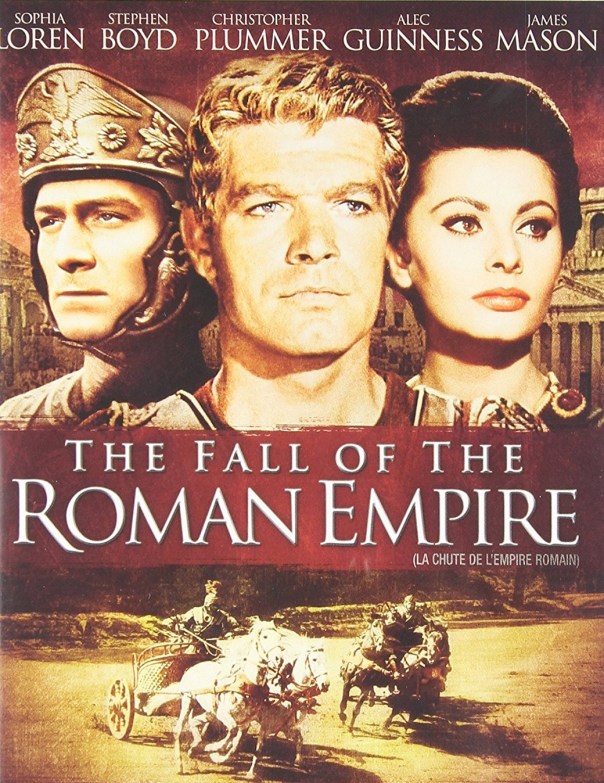
An observation on The Fall of the Roman Empire (Anthony Mann, 1964)

fall-of-the-roman-empire


I´m a great admirer of Anthony Mann. He´s not only the director of some of the greatest Westerns ever but a kind of celebrity in Spanish pop culture as he married Sara Montiel, the reigning diva of Spanish Cinema of the late fifties to Mid-sixties. The producer Samuel Bronston, is also an important figure, bringing in to Spain big-budget runway productions such as El Cid (1961)and 55 Days at Peking (1963)and, along with them, lots of money and employment. I somehow missed The Fall of the Roman Empire. I enjoyed it very much but would have to see it again to offer more valuable observations.

The one thing that led ,me to write the post is that I was idly watching the film and thought, ‘oh those hills look just like the ones of the area in Spain I was born into’. Then I search in wiki and realise the film was indeed shot there. And it was weird to see *my* landscape figured by all those blond blue-eyed faces: Stephen Boyd, Alec Guinness, John Ireland, Christopher Plummer, Mel Ferrer. Even Omar Shariff, Sofia Loren and James Mason, though darker and more plausible, didn´t quite fit in.

It was a kind of blondfacing of landscape, a cultural erasure where the world belongs to some types of faces — at home in and ruling all kinds of landscapes — and not to others. Of course I grew up watching this kind of thing in Canada, where Montreal and Toronto stand-in for New York and British Columbia stands in for Colorado or whatever. But this felt different somehow, the landscape of the Sierra de Guadarrama standing in for an ancient Rome peopled by lbondes (at least the red hair of the invading German Barbarians was motivated by the plot). A thought, though one probably not worth very much as millions of Syrians are denied safety in Turkey and in Europe.


José Arroyo

Beardsley at Tate Britain


IMG_9755The queerest show currently on in London is the Aubrey Beardsley at Tate Britain. And he´s got a lot of competition: Tom of Finland at House of Illustrations; Warhol at Tate Modern; Masculinities at the Barbican. Beardley´s work includes beautiful innovative drawings, illustrations, graphic design, erotica.  His work is refined and artificial, irreverent and playful, erotic and grotesque. The masculinities on display are often ridiculous, even, or particularly, at their most phallic. The genders, non-conforming. The influences ranging from Russia to Japan. The friendships include Wilde, Burne-Jones, Arthur Symons, W.B. Yeats. It´s extraordinary to think his career only spanned seven years. He died of consumption at the age of only twenty-five but his influence is extensive and wide-ranging: you´ve seen it even without knowing it (The Beatles´Revolver album). I first came across his work when Susan Sontag referred to it as an exemplar of camp in her famous essay. It is so  much more than that. Beardsley is a key visual signifier of fin-de-siècle culture in Britain and to us now queer avant-la-lèttre, an ancestor to many queer currents.

Josè Arroyo

Tom of Finland, Love and Liberation, House of Illustrations, London

Tom of Finland´s moved from illicit mail-order to the gallery in under half my lifetime. He´s in vogue. There was a film of his life a few years ago that I was nottoo  keen on.  But it was illustrative of how is work is increasingly circulating in the mainstream. And here we now have an argument for his excellence as an illustrator at the House of Illustration on Granary Square. The exhibition is small-scale but powerful, a vivid record of male desire d’un certain temp. I enjoyed it greatly: the joyous desire and fantasy expressed in the midst of real oppression delights and moves. It was also lovely to see the tools of his early mail-order business. The one disappointment was noticing that he did not have the greatest feel for colour — it looks crude and gaudy —so it´s probably just as well most of the drawings are black and white. His work has exquisite line and I love the playfulness, the joy in sex, particularly since they were made a time when such sex was so illicit and dangerous. It´s like play as defiance, naughtiness as protest, a fantasy of youth, powerful bodies, subcultural sexual morays, always with prohibition inked in, crossing the boundary of the legal, often figured and subverted.


This exhibition is part of a whole cycle that queers and interrogates dominant masculinities and should be seen in conjunction with the Beardsley at Tate Britain, Masculinities at the Barbican, and the Warhol at Tate Modern.


notes/illustrations:

Guilty Bystander (Joseph Lerner, USA, 1950)

Guilty_Bystander_1950_movie_poster


One of the reasons I love noir is because it puts failure front and centre, as theme, plot, setting, characterisation. In noir we see men who can´t cope with the aftereffects of the war, social ideals of who they should be, women who are smarter than they are, feelings they should be able to control but can´t. Noir understands and heroicises failure without ever quite redeeming it

. In Guilty Bystander, Max Thursday (Zachary Scott) used to be a cop but took to drink. Now he´s working in a fleabag hotel, ostensibly as a house detective but really just dossing in between drinks. His ex-wife (Faye Emerson) turns up to tell him their son´s been kidnapped. Will he be able to put the drink aside and save his son?

The narrative takes us through dimly lit corridors, passageways, subway stations and what used to be called the tenderloin: cheap dives, doss houses, docks, abandoned warehouses. The underbelly, dimly lit.

Zachary Scott, probably best remembered as Mildred Pierce´s weak, amoral and incestuous lover, is perfectly cast here. That handsome face and velvety eyes, but slight, weak willed, his hands shaking due to drink and his mind flitting from desire to oblivion, The plot is pulpy, and not very well conveyed, I got lost in bits of it. But it doesn´t matter. What makes this film are the way it´s lit, the shadows and bars, the hard-boiled dialogue that sometimes crosses over into the risible, a surprising villain, and a last great performance from Mary Boland as Smitty. The film ends with happy families that are easy to ignore and easier to forget. What one remembers is the trembling, the shadows, the bars that symbolically convey the protagonists many and varied forms of imprisonment, A true B, newly restored, and worth seeing.

Image-notes in chronological order:

José Arroyo

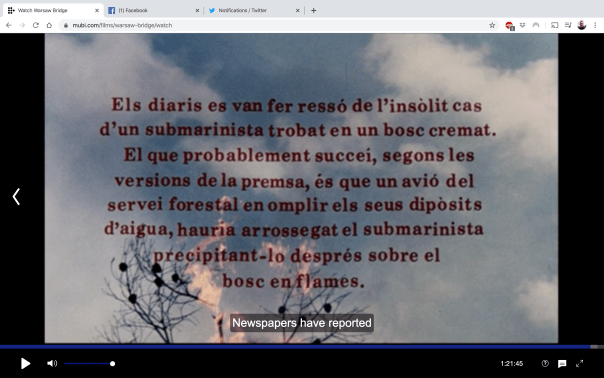
Warsaw Bridge/ Pont de Vàrsovia (Pere Portabella, Spain, 2020)

Pont de Varsovia


I´ve read much about Pere Portabella but had never seen any of his films until now. I´ve simply never had the opportunity and I´m grateful to MUBI for providing one. Ostensibly, for a long time he didn´t allow any of them to be released on VHS, DVD or blu-ray. As you can see from the kind comment below there are now box sets with English sub-titles so rather than  a rare chance to see his films as I initially thought, this might better be seen as a great introduction to his work. .

Warsaw Bridge is a gorgeous meditation on the nature of art and the role of the artist; a measure taken of the differing relations between the chattering classes, working people, and the connection of each to art, interpretation, whether reality can be known objectively or whether it is always mediated through signs and paradigms of knowledge.

The film has a loose narrative involving a university biology teacher, a prize-winning author and a publisher but often takes flights of fancy, usually motivated by music: an orchestral score played through a neighbourhood in Barcelona, with pianos in the rooftops, and with the orchestra conductor leading on from a television monitor. We get naked women posed as classical tableaus, who sing and as they do so, their image becomes signs, which then get reduced to outlines and finally to computer code. This is a gorgeous, seductive, intelligent film about science and the body, memory and history, a history of art, and the value of aesthetics as mediated through various arts. I loved it.


Note: the images accompanying this text are image/notes for future reflections on the film.

Screenshot 2020-03-05 at 13.11.25

José Arroyo

Lipstick on Chuck

Charlton Heston, so young and handsome in Dark City, his first Hollywood film. The New York Times said he looked like a linebacker for a mid-west college football team. Does he still do so with lipstick? I tried for Marilyn lips but failed. Still….


Eavesdropping at the Movies: 216 – Dark Waters

Listen on the players above, on Apple Podcasts, or on Spotify.

A legal drama about the biggest corruption scandal you’ve never heard of, Dark Waters tells the story of lawyer Robert Bilott’s twenty year long fight to expose chemical manufacturer DuPont’s decades of knowing and unapologetic poisoning of a town, a country, and the entire world. Visited by a West Virginian farmer named Wilbur Tennant, whose livestock and falling prey to unusual medical conditions and dying, Bilott – a corporate lawyer who works to help chemical companies pollute within the law – files a lawsuit, and slowly begins to uncover the company’s secrets.

For José, it’s a film that fits neatly amongst director Todd Haynes’ previous work, which often focuses on power relations and the struggles of the oppressed, sidelined or disenfranchised. For Mike, it might be a new Spotlight, another film about the exposure of vast, historical, institutional wrongdoing. But don’t believe the trailer that makes it look all blood and thunder – Dark Waters, though compelling and dramatic, is a slow burner, methodical and careful, and with a scope that looks beyond the details of the law. The town of Parkersburg, WV is shown in portrait, with shots evocative of Depression-era photography, and Bilott is an interesting character, a man who appears uncomfortable within his own body, whose determination to uncover the truth grows alongside his paranoia that something bad will happen to him, and whose relationship with his wife is a constant that is reframed intriguingly in the film’s final movement.

Dark Waters is a fascinating, intelligent, complex thriller that gives its themes room to express themselves and is full of details and moments that speak to entire inner lives and ways of thinking. Make sure you see it.

(Mike would also like to apologise to Bucky Bailey, one of DuPont’s most unfortunate victims and perhaps the film’s central emotional tentpole, for referring to him as Bucky Barnes, who is the guy from the Avengers films who sports a prosthetic arm and does nothing interesting.)

With José Arroyo of First Impressions and Michael Glass of Writing About Film.

A note on Burden of Love / AI NO ONIMOTSU (Yuzo Kawashima, Japan, 1955)

0007_18_Burden_of_Love


Japan has baby fever. Everyone wants to get married and everyone wants to have children. But the fear is that an already overburdened nation will become even more populated. To halt the population explosion Jozaburo Araki, Minister of Health and Welfare, proposes. a bill that would limit information on abortion. and contraception, possibly shut down brothels and teahouses, and delay procreation within the sacred confines of marriage. The only protest comes from the only female in the room, who sees that women and the young are the ones who will suffer most from this.

Burden of Love is a comedy, so situations begin to abound that contradict his politics. First his son Jotaro has gotten his secretary, Godai, pregnant. She´s organised the pregnancy so that the rather weak-willed Jotaro may announce their engagement to the father. She´s beautiful, educated, hard-working. But is she of a good enough family to marry his son? He doesn´t quite think so. To make matters worse, when he arrives home, his 48-year-old wife also announces that she´s got pregnant. To make matters even worse, his daughter who´s scheduled to marry a nobleman, has gotten pregnant and would show. By the end of the film, even the other daughter who hasn´t been able to get pregnant for six years, is expecting the baby and the minister himself discovers that he has yet another child from a youthful adventure of 28 years before. The minister of the in charge of checking the population explosion has caused a population explosion all on his own.

The most distinctive aspects of this comedy, and a kind of reproach to American cinema of the same period, is its ‘adultness’: the way it can talk openly and non-judgementally about abortion, contraception, whorehouses. This is a comedy that sees human relations in a complex manner. Pretty much all of the women, old and young, are pregnant in and out of wedlock. All are good people though sometimes with unattractive character traits. Marriages are loving yet problems still occur. Forgiveness is required and given. Kawashima envelops all these dilemmas with warmth  and humour.   All Kawashima´s characters are good  people, all of them are in trouble. There are lots of misunderstandings. But because this is a comedy, all troubles will get  resolved, in a  loving and funny way.

The influence of American cinema is evident in the film, from the silent cinema hommage at the end, to the singing of My Darlin Clementine. And there are other aspects of American culture embedded in the film: the clothes, the jazz.

What I find most charming about all of Kawashima´s work is evident here, the focus on women in patriarchy, the dramatisation of  social issues in post-war Japan, the examination of gender and power in times of change. But this film has an intelligence, complexity and warmth all its own. It´s  an understanding and  loving look at a social dilemma. I liked it very much and yet it´s my least favourite so far of Kawashima´s  films,  which says a lot more about the qualities of Kawashima´s other work than the faults with this one,


José Arroyo

Hungry Soul, Part 1 (Yuzo Kawashima, Japan, 1956)

Hungry Soul


I have so many DVD´s to see, piles of them, that I tend to think everything is available at will and am shocked when I see that it´s not. The films of Yuzo Kawashima have been such a revelation to me that my first impulse was to go on Amazon to buy some more only to see that they´re not available, so I´m doubly grateful to MUBI: first for allowing me to discover major works from a major director, secondly, by programming five films together, allowing me to compare, to discover actors, to see that what at first seems simple cumulatively adds up to subtlety, complexity, and depth.

Like The Balloon, Our Town,  and. Burden of Love,  Hungry Soul is also about Japanese society in the process of change. Kimonos brush up against pencil skirts in the streets of Tokyo, tea ceremonies share space with westernised nightclubs,  but Patriarchy still rules and there are very strict rules about what it is to be a woman in this culture.

Kawashima´s melodramas bear comparison to those of Douglas Sirk´s, not stylistically but thematically. Moments of Hungry Soul made me think of All That Heaven Allows, the widow with the children who are appalled by the idea their mother might have sexual and emotional needs, and their punitive actions once they realise she does.


Thematically the film is blunt. It begins in a hospital (see image capture above). A woman is having a hysterectomy. Peter Baran pointed out to me how one can´t imagine a Hollywood film, even today,  starting with Hungry Soul´s opening line (see below)

hystorectomy

The film then cuts to the patient, recovering in the hospital, telling her friend, ‘being a woman really sucks….Men and women will never be equal…and men have no idea of the pain women go through. At the patient´s bedside is her old friend  Mayumi (Yukiko Todoroki), a lively middle-aged widow with two teenage children who´s getting by and supporting her children through school by working as an estate agent (Á very unwomanly job´). Soon Reiko (Yoko Minamida), a relative also arrives to visit. Reiko´s a young and beautiful woman trapped in a loveless marriage with a much older man for whom she´s not much more than a decorative maid and who treats her tyranically.

As the film unfolds Mayumi and Reiko develop hungry souls but they´re ones that can´t be fed. Their individual desires come crashing against social rules and regulation, spoken and unspoken, putting them in danger and leading to further loss and pain. Reiko meets a young and handsome politician, Mr. Tachibana (Tatsuya Mihashi) who awakens all the desires that she´s repressed. Mayumi is chased by Shimotsuma (Shiro Osaka), her deceased husband´s best friend. They finally have a fulfilling night but are awakened by a phone call urging her to return home where she finds that her young daughter has tried to commit suicide because she thought her mother might do what she in fact did. The suspicion of the relationship also leads her son to leave home, which is where the first part of this film ends.

For Reiko, the idea that the young politician will follow her wherever she goes both thrills and scares her. It´s awakened a passion, an idea for a future that had been dormant if not dead. For Mayumi, her whole life comes crashing around her. Moreover, the film shows us that none of these men are prizes. Reiko´s husband is an insensitive pig, but what we see of the young politician when the film allows us to see him on his own is not very appealing either: a selfish playboy who treats women badly. If he does finally seduce Reiko, will he in fact treat her any better. Even nice Mr. Shimotsuma is no prize. His wife is on her deathbead and there he is chasing the widowed Mayumi around Tokyo and Kyoto.

When I first encountered Kawashima´s work I didn´t think much of him as a visual stylist. And he´s certainly no Sirk. But as you can see below, he makes for simple, measured, but interesting and expressive images. Everything counts in these films, and the films are wise, tender and side with the powerless, like all good melodramas should. And like all good melodramas should, they certainly succeed in eliciting feeling. I want to see them all again and get to know them better.


José Arroyo


**Many thanks to Edmund Yeo for helping me match the names of the characters to the names of the actors. Much appreciated.