A poster for Youssef Chahine’s 1963 action film ‘Saladin’ (original title: ‘El Naser Salah el Dine’) starring Ahmed Mazhar. (Photo by Movie Poster Image Art/Getty Images)
A discussion of Youssef Chahine’s Saladin which offers some context on the cinematic representation of Saladin in relation to Richard the Lion Heart, some historical information in its relation to Egyptian President Gamal Abdel Nasser’s efforts to maintain a United Arab Republic, and Chahine’s attempts to narrate those aspirations through the story of Saladin. We admire the film’s use of the CinemaScope frame, its staging in depth, its use of colour, and editing; and bemoan the way some of the action is directed. A huge popular success in its day. An Arab answer to the epics then so popular in Hollywood, not least in offering an Arab point-of-view on the Crusades; and a cultural mainstay through its regular rotation on television: this was also reputedly Nasser’s favourite film.
As time goes on, Richard and I are becoming better informed, partly just through watching more of Chahine’s work, but also through the arrival of different types of information that we will post on here as and when we get it. This week’s arrivals are a wonderful book on Chanine’s work by Malek Khouri, The Arab National Project in Youssef Chahine’s Cinema (Cairo: The American University in Cairo Press, 2010).

According to Khouri, ‘When Chahine embarked on the making of Saladin (1963) the atmosphere in Egypt and the Arab world was still experienced (sic) the negative effects of the failure of the attempt to create a United Arabl Republic (AUR). The disbanding of the Union in the aftermath of a secessionist military coup d’état in Syria in 1961) was a major blow to the Nasser revolution and its pan-Arab project. Whilt the move in Damascus exposed frustrations with repressive Egyptian administrative and political praactices in Syria with the miliatry and economic elite, the secession, nevertheless, did not reflect the deep-rooted pro-Arab unity sentiments in Syria. Jst two years later a counter coup took place in Damascus, restoring pro-union supporters to power. TheUnited Arab Republic, however, did not re-emerge after the change of leadership in Damascus, and Egypt alone remained in the union until its name was changed in 1971 after the death of Nasser’ (p.42).
Khouri sees Chahine’s film as ‘the most pivotal of the 1960’s) and one ‘clearly informed by this critical moment in contemporary Arab history with all its preoccupations, hopes, and anxieties over the prospect of national unity’ (p.44).
According to Chahine himself, ‘in Saladin, I was not hesitant in telling Christians that they were wrong in coming over to occupy our land. I, myself a Christian, have lived in the heart of Muslim culture where 90 per cent of the people whom I loved were Muslims…From the time of Andalusia to (today’s) Alexandria, the idea of diversity within a predominantly Muslim culture has been much more integrated than it has ever been within mostly Christina societies. There are not just words…This is exactly how I feel (cited in Khouri, p.45). The podcast can be listened to below:
I have included some clips we refer to in the podcast. Here the murder of the pilgrims which Khouri praises for its use of colour and for its focus, ‘on the symbolic rathe than on literal interpretation and presentation).
The film has marvellous cutting and a very inventive use of CinemaScope. Khouri notes how ‘Theatrical and print advertisements touted its Cinemascope technology (a first in Arab Cinema), its star power (an ensemble featuring many popular Egyptian actors), and its massive number of extras.
You can further admire the use of widescreen and staging in depth in the clip below, though I posted it mainly for its unusual portrait of female warriors (though admittedly Virginia is also the villain of the piece)
The film has brilliant use of a dramatic, theatrical, split screen:
The film provides further proof of the sensuality evident in Chahine, such as in the clip below where a dancing girl is paid to gather information.
and the homoeroticism is also evident:

According to Khouri, ‘The film positions Saladin as a man of moral integrity, in radical contrast to the way he has traditionally been imagined in western cinema’ (p.45). Richard, however, argues that this is not quite the case, pointing to De Mille’s The Crusades (1935) and providing the original New York Times review of the film which argues that, ‘A gallant victor, Saladin abandoned his plan to add Berengaria to his harem, sent her back to Richard and threw the Holy City open to Moslems and Christians alike.It is Saladin, in fact, who emerges as the real hero of the photoplay.’ This view is ratified by a recent review of the same film in The Guardian.
Richard also pointed me to a youtube clip from the Doctor Who version – Saladin played in blackface but sympathetic in opposition to Richard the Lionheart (we discuss Saladin’s ‘whitefacing’ of westerners in the podcast); and a trailer for the 1954 version of King Richard and the Crusaders, which looks hilarious. But again it seems to be a sympathetic portrayal of Saladin and the villains are Richard’s underlings.

The other arrival this week that enhanced my understanding of Saladin was Twflik Hakem’s book of interviews with Chahine, Youseff Chahine, Le révolutionnaire tranquille (Paris: Capricci, 2018). There, Hakem claims Chaine convinced President Nasser that Saladin could be no other than himself and charmed him into putting his army and his administration at Chahine’s disposal so he could make the film (Tu as pu faire croire au président Nasser que Saladin ça ne puvait être autre que lui et il a mis à ta dispoition son armée et son administration pour que tupuisses mettre en chantier une superproduction et réaliser ton rêve hollywoodien’ (loc 256 of 1750 on Kindle).
We learn from Hakem that Nasser adored the film and Chahine tells him, ‘yes, he wanted a copy on hand (by his bed). Whenever a visitor came to see him, he had the film projected. He would usually fall asleep because he’d seen it hundreds of times but would wake up at the end and say ‘good he?’ All of that is true but the first truth is that the film is not at all to the glory of Nasser, it’s nreally not. (Oui, il avait une copie du film sous le lit. Chaque visiteur qui venait le voir, il lui faisait projeter dans sa salle de projection. Lui dormait, parce qu’l avait vu cent foies et il se révellait juste avant la fin pour dire au visiteur: v”Alors? C’est bien hein? Tout cela est vrai mais la véritér première est que le film n’est pas du tout à la gloire de Nasser, mais vraiment pas.’
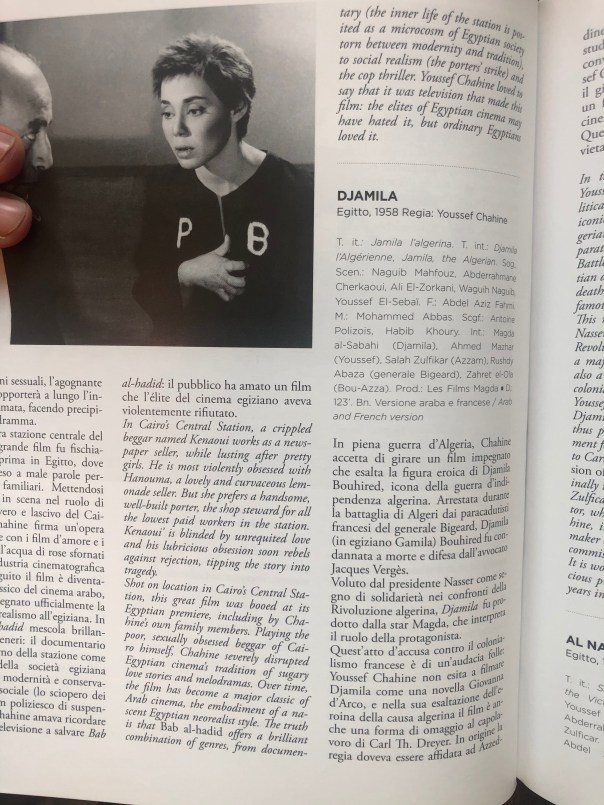
The Ritrovato Catalogue’s entry on the film is below:
According to Khouri, Saladin was extremely popular, ‘in a contemporary assessment of the overwhelming popular uccess of the film, a local newspaper described how Saladin played to full houses in almost every large theatre in Cairo and Alexandria for weeks in order to allow pople to watch it along with their entire families: ‘This is a film which makes us all feel proud…and it is a miracle indeed that it was made in the first place (p.49)! The film continues to resonate across the Arab world. Over twenty-six years after the film was released, according to Khouri, one local critic wrote, ‘I asked a friend of mine, a woodworker, did you see the film Saladin last night and he said, If this film was shown a hundred times in a hundred days I would still sit and watch it.
In the UK however, Time Out, wrote a very dismissive three-line review.
Barrie Wharton has written a very interesting article on the creation of national identity in Nasser’s Egypt that references Saladin:
Barrie Wharton, ‘Cultivating cultural change through cinema; Youssef Chahine and the creation of national identity in Nasser’s Egypt,’ Africana, Vol.3, No. 1, 2009
and can be found by clicking here:
Cultivating-Cultural-Change-Through-Cinema-AFRICANA-Vol3-No1
José Arroyo