Tag Archives: Horror

Eavesdropping at the Movies: 456 – Together

Commitment is scary. It’s especially scary when you drink water from a cursed puddle that wants to make a hybrid of you and your partner. Together tells the story of a couple moving to a new home during a questionable period in their relationship: she has a new job and is responsible for the move away; he’s emotionally distant since the death of his parents and relies on her for transportation and financial security. They love each other, but will they last?

First-time director Michael Shanks demonstrates a good instinct for tone, effectively combining comedy and horror – that Alison Brie and Dave Franco (married in real life) are both experienced comic actors helps the film draw out the absurdity of the events it depicts. What quibbles we might have with details of its supernatural basis are easily ignored because its focus always remains on the central couple. It doesn’t matter that some specific detail might not be explained to our satisfaction: the question is always, how do the couple respond to their predicament? Together never loses sight of what’s most important, and that makes it one of the best horrors – maybe one of the best films full stop – that we’ve seen in a while.

Listen on the players below, Apple PodcastsAudibleSpotify, or YouTube Music.

With José Arroyo of First Impressions and Michael Glass of Writing About Film.


Eavesdropping at the Movies: 454 – Weapons

One of the most hotly-anticipated horror films in recent memory, Weapons begins with seventeen third-grade children in a Pennsylvania town mysteriously waking up at 2:17am one Wednesday and running from their homes into the darkness. The shocking, unexplained disappearance and imagery of an empty classroom alone suggest an allegory of school shootings, and we ask what else can be read into the film, and discuss the depth with which it handles its themes. We have our issues with Weapons but enjoy it very much all the same, and find a lot to like. It’s probably just a little overpraised.

Two weeks later, with the film still on his mind, Mike opens up further discussion and proposes that maybe there’s more to it than he gave it credit for – or that you have to be American to properly get it.

Listen on the players below, Apple PodcastsAudibleSpotify, or YouTube Music.


With José Arroyo of First Impressions and Michael Glass of Writing About Film.

Eavesdropping at the Movies: 449 – Bring Her Back

YouTubers-turned-directors Danny and Michael Philippou demonstrate a real eye for visual design and an ability to create imagery to truly disgusting effect in Bring Her Back, in which Sally Hawkins plays a foster parent whose daughter’s death leads her to search for answers in the occult. The filmmaker twins are 32 years old, which, perhaps unfairly, leads us to ascribe the film’s lack of depth and prioritisation of visual shock to their youth. Bring Her Back shows a certain immaturity, but great potential, and we’re interested to see if the pair’s storytelling and sensitivity to theme improves.

We also discuss child actors in horror, as the film drives Mike to question the ethics of using children as Jonah Wren Phillips is here, both in terms of the desired effect on the audience and the potential unintended effect on the child. Not all unease is good unease, and Bring Her Back makes us ask: what cost is too high for such entertainment?

Listen on the players below, Apple PodcastsAudibleSpotify, or YouTube Music.

With José Arroyo of First Impressions and Michael Glass of Writing About Film.

Eavesdropping at the Movies: 448 – Jurassic World Rebirth

The seventh instalment in the Jurassic Park (now Jurassic World) series, Jurassic World Rebirth might be the first of the sequels to really come close to capturing the kind of wonder, excitement and horror that the 1993 original offered. That might be in part because it cribs liberally from it, with both moments and entire sequences closely evocative of their 32-year-old counterparts. But there’s plenty else that’s new here, and Rebirth is a characterful expansion to the Jurassic Park story.

Thoughts of containment have finally been totally discarded – dinosaurs have now been roaming the Earth for some time, to the point that they’re dying out everywhere other than a narrow band around the equator, which is illegal for human travel. So that’s where we’re headed, of course, as a pharmecutical exec seeking to make a fortune from dino-sourced drugs hires a team of mercenaries to extract blood from three creatures: one that swims, one that walks, and one that flies. It’s a decent structure that tells you what to expect and allows for a variety of settings and action, into which are placed such charismatic stars as Scarlett Johansson, Mahershala Ali, Jonathan Bailey and Rupert Friend. Director Gareth Edwards builds the world beautifully, exploiting it for that sense of scale that so defines his aesthetic, and reminding Mike in particular of his feature debut Monsters; and although in simple terms – this is, ultimately, a blockbuster sequel – the film has a moral message worth expressing.

Jurassic World Rebirth is easily the best of the Jurassic sequels and equally easy to recommend. Just try not to focus too much on how it reminds you of a better film from 1993.

Listen on the players below, Apple PodcastsAudibleSpotify, or YouTube Music.


With José Arroyo of First Impressions and Michael Glass of Writing About Film.


Eavesdropping at the Movies: 442 – Sinners

Sinners, written and directed by Ryan Coogler, is a horror musical set in 1930s Mississippi, shot in part on IMAX 70mm film, starring Michael B. Jordan as a pair of identical twins who return to their hometown for a new start, only to encounter vampires. It’s as ambitious as that sounds and full of ideas and culturally specific nuance, and José loves it. Mike doesn’t.

We discuss how the music draws on several influences, not just from the blues of the era but also from Irish folk and hip-hop; the getting-the-band-back-together feel of the opening, in which the twins bring their influence and riches to bear on the creation of the juke joint; the visual design, simultaneously confident and careless; the crowd-pleasing fantasy of an anti-racist Rambo; and the theme of vampirism – what it means and how it’s used.

Listen on the players beloe, Apple PodcastsAudibleSpotify, or YouTube Music.

With José Arroyo of First Impressions and Michael Glass of Writing About Film.

Eavesdropping at the Movies: 435 – Nosferatu (2024)

Writer-director Robert Eggers, whose reputation for aesthetically rich, deeply-researched and idiosyncratic horror precedes him, has long been working on a remake of F. W. Murnau’s Nosferatu, the 1922 German Expressionist classic whose influence has been felt in the horror genre for a century. It’s a big fish to try to take down, but it’s source material that feels like it exists especially for him – how does he do?

Very well, as it turns out… although, in classic fashion, we manage to talk around what a fantastic time we had by concentrating on our criticisms. Ignore them until you’ve taken yourself to the biggest cinema you can to see it – it’s an experience you should have. Then come back and listen to us discuss the debt Eggers’ Nosferatu owes to the colour tinting processes of the silent era, how the second half gets bogged down in tropes and plot, the delineation between sex and love, the pressure to be accessible, whether horror needs to be scary, and the important lesson we learned from Shrek Forever After.

Listen on the players below, Apple PodcastsAudibleSpotify, or YouTube Music.

Listen to our podcast on F. W. Murnau’s original, silent Nosferatu here.


With José Arroyo of First Impressions and Michael Glass of Writing About Film.

Eavesdropping at the Movies: 432 – Heretic

Hugh Grant brings his idiosyncratic brand of English charm to the world of horror in Heretic, in which he isolates and tests the faith of two young Mormon missionaries. It’s a film that leaves you asking all sorts of questions, such as, “did anything he was up to actually make any sense?”, but for a horror film so heavy on the dialogue and relatively light on the scares, it’s fabulously enertaining throughout – a real achievement of direction and writing. See it!

Listen on the players below, Apple PodcastsAudibleSpotify, or YouTube Music.


With José Arroyo of First Impressions and Michael Glass of Writing About Film.


Eavesdropping at the Movies: 427 – Alien: Romulus

A welcome new instalment in the Alien franchise, which has moved between genres and directors, remained popular for over four decades, and offered fascinating expansions of its internal mythos, Alien: Romulus moves with the times to give Generation Z the opportunity to die in space. It goes like the clappers, orchestrates loads of entertaining, tactile action, and is unbelievably good-looking. It’s also underwritten, arguably overstuffed with reference to previous films in the series, and features one of those entirely uncontroversial and ethically pure reanimations of a deceased actor through CGI and other technologies. Perhaps after seeing the muted responses to the ideas on offer in Prometheus and Alien: Covenant, the series has decided to seek refuge in the cloying bosom of nostalgia – but we differ on how excessive it is, while enthusiastically agreeing that Romulus is great fun, and easy to recommend.

Listen on the players below, Apple PodcastsAudibleSpotify, or YouTube Music.

With José Arroyo of First Impressions and Michael Glass of Writing About Film.


Thinking Aloud About Film: The Witch’s Mirror (Chano Urueta, Mexico,1962)

The Witch’s Mirror/ El Espejo de la bruja (Chano Urueta, Mexico, 1962) is an immensely entertaining film that is being screened on MUBI as part of their ‘Spectacle Every Day: The Many Seasons of Mexican Cinema’ series. There are claims that it is a ‘uniquely Mexican Gothic’ but we don’t quite agree. Indeed, in the podcast we relate it to Rebecca, Frankenstein, Eyes Without a Face, The Skin I Live In, The Beast With Five Fingers and other well-known films it was clearly influenced by or itself influenced. It is a derivative if visually inventive film, with a director who has an eye for composition, who keeps the camera moving, tells the story at a clip, and who knows how to make the most out of roughly a cast of four performers doing their outmost in about three sets. It’s a considerable achievement in its own terms and great fun to see though those looking for depth will be disappointed.

The podcast may be listened to here:


The podcast can also be listened to on Spotify here: https://open.spotify.com/show/2zWZ7Egdy6xPCwHPHlOOaT

and on itunes here: https://podcasts.apple.com/gb/podcast/first-impressions-thinking-aloud-about-film/id1548559546


Here’s the American dubbed version https://cors.archive.org/details/the-witchs-mirror-1962
They removed the Goya etchings and the introductory voiceover.
This is the review Richard found which comments on the dubbed US release: 
José Arroyo

Eavesdropping at the Movies: 400 – The Nun II and The Exorcist: Believer

Listen on the players above, Apple PodcastsAudible, Google Podcasts, or Spotify.

You can also hear our discussion of 2018’s The Nun, and our podcast on The Exorcist, part of our exploration of the oeuvre of William Friedkin.

For our 400th episode we indulge in a pair of horror sequels, both heavy on faith, possession, and Christianity. One is part of a modern universe of interconnected stories, characters, and demons, the other represents the reignition of a series whose sequels have been produced intermittently for fifty years without receiving anything like the acclaim of the film that spawned them. The Nun II is the eighth film in the ten-year-old Conjuring Universe; The Exorcist: Believer is only the sixth Exorcist film in half a century. Truly, they don’t make them like they used to.

Neither film in this double bill is very good in totality, but The Nun II contains imaginative and effective set pieces and visual ideas, while The Exorcist: Believer is content to discard a reasonably interesting first act in favour of useless and charmless reference to, and pathetic reenactment of, William Friedkin’s 1973 original. We discuss what we think the films are about, wittingly or otherwise – horror is commonly understood to often allegorise and express the ills and worries of the societies that produce them, and we consider the ways in which these films might be doing so. And there’s much to compare and contrast between them, including their characters’ attitudes to the supernatural; the ways in which religion, be it Catholicism specifically or Christianity more generally, plays into their stories and atmospheres; and the kinds of imagery through which they attempt to instil fear in their audiences. And we take time to criticise many, many examples of the weakness of the storytelling in Believer.

The Nun II, like its 2018 predecessor, is not very good, but it is fun. The Exorcist: Believer is neither good nor fun. Happy 400th episode!

With José Arroyo of First Impressions and Michael Glass of Writing About Film.

THE TENDERNESS OF THE WOLVES/ Die Zärtlichkeit der Wölfe (Ulli Lommel, West Germany, 1973)


THE TENDERNESS OF THE WOLVES / Die Zärtlichkeit der Wölfe (1973), is a film directed by Ulli Lommel but produced by Fassbinder, written by and starring  Fassbinder stalwart Kurt Raab, and peopled by everyone who seems to have appeared in previous Fassbinder films, including his lover (El Hedi ben Salem), his current and future wives (Irm Hermann and Ingrid Caven), the stars of THE MERCHANT OF THE FOUR SEASONS (Hans Hirschmüller) and ALI: FEAR EATS THE SOUL (Brigitte Mira); and many others. There is a real sense of Fassbinderlandia about this film and a reminder of the influence of Warhol’s factory on his style of filmmaking. Fassbinder’s own appearance in this film as a fat pimp and small-time crook, sexually and physically confident in spite of his size, crotch thrust out, is a signifier of how confrontational Fassbinder liked to be.

And confrontational this film certainly is. It’s inspired by the same ‘Vampire of Düsseldorf’ that was the basis for Fritz Lang’s M (and there’s an homage to it here, the bit with the young girl in the playground) but set in the aftermath of WWII rather than the interwar years after WW1. Kurt Raab’s look is a combination of Peter Lorre in M and Max Schreck’s in Murnau’s NOSFERATU. THE TENDERNESS OF THE WOLVES brings out the homosexual dimension to the fore. Here the serial killer is gay, in love with a no-good pimp (Jeff Roden), living in an underworld of petty theft, black marketeering and prostitution (both men and women) that brings to mind John Henry Mackay’s THE HUSTLER: THE STORY OF A NAMELESS LOVE FROM FRIEDRICHSTRASSE. Lommell’s film also brings out the vampiric dimension to the fore as Raab’s serial killer, though with no special super-natural powers, likes to bite his victims in the neck and suck their blood before dismembering their bodies and selling their flesh to restaurants through the black market where the customers adore the ‘pork’.

THE TENDERNESS OF THE WOLVES is a very impolitic film, one that I doubt could be made now. Jack Babuscio began his review in Gay News (Gay News No 06, June 3-16th, 1976) by asking: ‘Ulli Lommel’s TENDERNESS OF THE WOLVES (1973) is a film that will certainly set the blood of many Screen Gay readers boiling. Does this mean you?’ (See below and thanks to Andrew Moore for the images).

A creepy gay man luring adolescent runaways to his home with promises of money and employment, then having his way with them (in this film before or after he kills them, with their naked bodies splayed out) must have fed into all kinds of prejudices of homosexual men as predatory paedophiles. It’s a film that would have been a gift to people like Anita Bryant had she been aware of it then. And I wonder to what extent Fassbinder, Lommell or Raab took this into account or whether the social impact of any of these particular narratives and representations on already vulnerable queer communities still living under the repressive Paragraph is something that would have entered their minds. Was it freedom or thoughtlessness?

Frank Noack tells me that, ‘TENDERNESS OF THE WOLVES was attacked in West Germany, by gay activists and gay-friendly straight reviewers, for its sinister portrayal of the gay world, but Fassbinder couldn’t care less. His point, more explicit in PETRA VON KANT and FOX AND HIS FRIENDS, was that gays and lesbians exploit one another as much as straight people do. Neither Fassbinder nor Raab, who has written a deliciously lurid tell-all book right after the maestro’s death, expressed any interest in or sympathy for the gay movement. Because of its explicit male nudity, the film nevertheless won a gay cult following’.

The film’s perspective is that an oppressive world creates its own monsters. Raab’s character (Fritz Haarmann) is arrested by the police under paragraph 175 and made to be a police informant. But his compulsion for young male flesh is his own. I suppose the achievement of this handsome-looking film (Jürgen Jürges first job as dop, deploying a whole arsenal of expressionist devices) is in so well evoking a particular underworld of petty criminals, cheap taverns, dark railways, and dangerous attic flats; in shocking and frightening like a good horror film should, and in arousing sympathy for a queer serial killer.
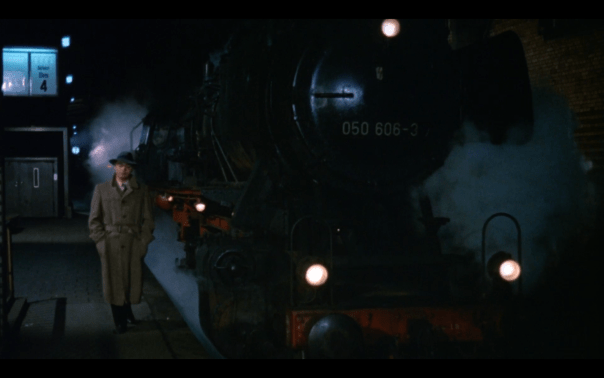
I suspect Raab’s appearance here had a role in inspiring the skin-head look that would become so prevalent a decade later in London and Berlin.

From the handsomely produced Arrow Box Set of Fassbinder films (vol 1.) chock-a-block with great extras, including interviews with the director, actors, cinematographer.

José Arroyo

Eavesdropping at the Movies: 379 – The Old Dark House

Listen on the players above, Apple PodcastsAudible, Google Podcasts, or Spotify.

If you’re tempted to explore this cult classic, the restored DVD and Blu-Ray of The Old Dark House is available as part of Eureka Entertainment’s Masters of Cinema series.

José gave an introduction to the MAC’s screening of The Old Dark House, a 1932 comedy horror directed by James Whale, focusing on queerness. James Whale was openly gay – although what it meant to be openly gay in the 1930s is up for discussion – and knowledge of his sexuality has led to interpretations of his work in that light, including Frankenstein (1931) and The Invisible Man (1933). The Old Dark House arguably invites such readings more explicitly than those, with the demeanour of Ernest Thesiger as Horace Femm (not to mention his surname), the relationship between Morgan (Boris Karloff) and Saul (Brember Wills), and the casting of a woman in the role of patriarch, with actress Elspeth Dudgeon credited as John Dudgeon.

As well as its queerness, we discuss its preponderance of tropes and how well they cohere, its use of distorted imagery, its pacing and more.

With José Arroyo of First Impressions and Michael Glass of Writing About Film.

Eavesdropping at the Movies: 373 – Smile

Listen on the players above, Apple PodcastsAudible, Google Podcasts, or Spotify.

Trauma as metaphor has become a trope of horror in recent years, and Smile features it more bluntly than you’ve ever seen. We discuss its messaging, storytelling, and camerawork, and remark upon the ways in which 2014’s It Follows may have inspired it. In the sense of Ali Baba and the Forty People Who Were Inspired.

With José Arroyo of First Impressions and Michael Glass of Writing About Film.

Eavesdropping at the Movies: 370 – Nope

Listen on the players above, Apple PodcastsAudible, Google Podcasts, or Spotify.

Nope, Jordan Peele’s third film as writer-director, following his zeitgeist-capturing Get Out and complex, ambitious Us, invites its audience to speculate on audiences and spectacle. The kinds of things it wants us to think about are clear, and we discuss its themes of commercialised tragedy, fear of the audience, and photography as truth, among others – but what it has to say about them is at best muddled, and, more frankly, disappointingly uncritical. Like Peele’s previous films, Nope is a terrific conversation starter, but unlike them, its contribution to that conversation is weak.

With José Arroyo of First Impressions and Michael Glass of Writing About Film.

Eavesdropping at the Movies: 368 – Psycho (1960)


Listen on the players above, Apple PodcastsAudible, Google Podcasts, or Spotify.

We visit the MAC for a screening of the new 4k restoration of Psycho, one of the most analysed films of all time, and arguably director Alfred Hitchcock’s most famous. It’s a film we’ve both seen several times, but not for a few years, and in the cinema setting for which it’s meant, instead of the classroom, there’s a renewed and reinvigorated wonder to its imagery and editing.

We share our feelings about this screening, remark upon things we’d forgotten or had never noticed before, discuss how elements of the film have aged, and compare it to Brian de Palma’s Dressed to Kill, which was, shall we say, inspired by Psycho, and which we recently saw. We find plenty of room for criticism, but although we conclude that Psycho works for us more as a collection of a few iconic scenes than a thoroughly engrossing story from beginning to end, those scenes shine, and nowhere more vividly than on a cinema screen.

With José Arroyo of First Impressions and Michael Glass of Writing About Film.


Eavesdropping at the Movies: 364 – Men

Listen on the players above, Apple PodcastsAudible, Google Podcasts, or Spotify.

Alex Garland’s Men is as blunt as its title, with nothing of the profundity it would like to think it possesses. It’s slow and boring, too. Very pretty though. Well done to the cinematographer.

With José Arroyo of First Impressions and Michael Glass of Writing About Film.

Eavesdropping at the Movies: 348 – X (2022)

Listen on the players above, Apple PodcastsAudible, Google Podcasts, or Spotify.

Referential and reverential of classic slashers from decades past, Ti West’s X is likely just the sort of thing the dedicated horror fan wants to see – but to Mike, it’s a pretty unsophisticated and tedious imitation of much better films, and to José, it’s unpleasant, racist, sexist, and ageist. But on the plus side, no film has made him – a man who is decidedly not delighted by being frightened – jump and yell with the kind of regularity and energy that X inspired, which really livened things up for Mike. Unfortunately for you, José won’t be watching it a second time, and if you can’t drag him along, it’s not worth it.

With José Arroyo of First Impressions and Michael Glass of Writing About Film.


Eavesdropping at the Movies:

Listen on the players above, Apple PodcastsAudible, Google Podcasts, or Spotify.

We talk feminism, body horror, monsters, trans tropes, masculinity and more in our discussion of writer-director Julia Ducournau’s shocking, transgressive, and surprising Titane.

Polina Zelmanova’s video essay, “Horrible Bodies: The (New) Body Politics of Horror”, to which we refer in the podcast, is included below, and her accompanying essay can be read at this link.

With José Arroyo of First Impressions and Michael Glass of Writing About Film.

Eavesdropping at the Movies: 325 – Last Night in Soho

Listen on the players above, Apple PodcastsAudible, Google Podcasts, or Spotify.

Edgar Wright’s highly anticipated psychological horror, Last Night in Soho, reaches cinemas, and we dive into its themes, its visual magnificence, its relationship to the era and environment it portrays… and its problems. It’s impossible not to admire this film for its lush cinematography, impressive special effects, and the best of its performances, but its screenplay leaves a huge amount to be desired, not just in how it conceptualises the world and people it portrays, but also, more simply, how clumsy it is in telling its story, bafflingly dropping entire character threads that seem like they obviously have places to go, and handling at least one secondary character’s entire subplot very poorly. We discuss the film’s dream logic, or lack thereof; its fear of the very lure of the grimy world it needs to show us, and the moralism that accompanies it; how it trades in nostalgia of Sixties Soho, despite being keen to exhibit is dark side; and the thematic simplicity of almost everything – things are good or bad, to be loved or feared, and room for complexity, there is none.

With all that said, it’s still a very enjoyable couple of hours, a discussion piece, and thanks to its fabulous imagery and in particular the performances of Anya Taylor-Joy and Matt Smith, easy to recommend.

P.S. Mike would like to acknowledge that he is aware that in the course of speaking too quickly for his brain to issue timely corrections, he wildly overstated how much the ghostly figures in Last Night in Soho are referred to as “blank” or “blanks”. It happens maybe once or twice, if he remembers rightly, and in passing. But he asserts that nonetheless, their faceless, amorphous, anonymous design and relentless, zombie-like behaviour does make them a fair point of comparison with the Blanks in The World’s End. So nyah.

With José Arroyo of First Impressions and Michael Glass of Writing About Film.


Eavesdropping at the Movies: 324 – Nosferatu (1922)

Listen on the players above, Apple PodcastsAudible, Google Podcasts, or Spotify.

In a chilly outdoor screening at the Coffin Works in Birmingham, we indulge in Nosferatu, F. W. Murnau’s 1922 German Expressionist classic. José’s seen it many times, Mike never in its entirety. We discuss how this 100-year-old film holds up today and still entertains a general audience, its differences from and similarities to Dracula, its source material, and more. Including how cold it was. Mike only wore a t-shirt.

With José Arroyo of First Impressions and Michael Glass of Writing About Film.