Tag Archives: Cleopatra

A Triple Bill at BFI Southbank

Had a perfect day yesterday with a triple bill of pre-Coders at the BFI Southbank, SHANGHAI EXPRESS, HOLD YOUR MAN (In 35 mm) and then De Mille’s CLEOPATRA with Claudette Colbert. I’d not seen HOLD YOUR MAN, and it’s barely above an MGM programmer but worth seeing for Gable and Harlow, neither yet quite good but both fizzing and sparkling on their own and with each other and machine-gunning 30s wisecracks – my favourite mode of film speech — at all and sundry. I’d never seen CLEOPATRA on a big screen and it’s sexy and shocking (Colbert’s costumes in Cleopatra’s unfurling onto Ceasar). It’s kitsch of course, and the audience laughed out loud at various moments but it’s gorgeously designed, it moves beautifully, DE Mille has a clear eye for visuals (which are dazzling) and for a narrative that never ceases to move and communicates to all the audience’s instincts (including the basest). What I got from this big screen presentation was the sensuality of fabric (Claudette lounging in feathers and skins that vibrated and seemed alive. Claudette is tremendous, which I did not expect, thinking her too modern. I’ll say nothing about SHANGHAI EXPRESS — what more is there to say about this masterpiece? — except that the audience audibly gasped and swooned at some of Lee Garme’s lighting effects. We also went to see THE ORESTIA at The Bridge, which I loved, and which more on later; and even managed to get home in time to catch the last third of the football and see England win the match.

José Arroyo

My Life With Cleopatra: The Making of a Hollywood Classic by Walter Wanger and Joe Hyams


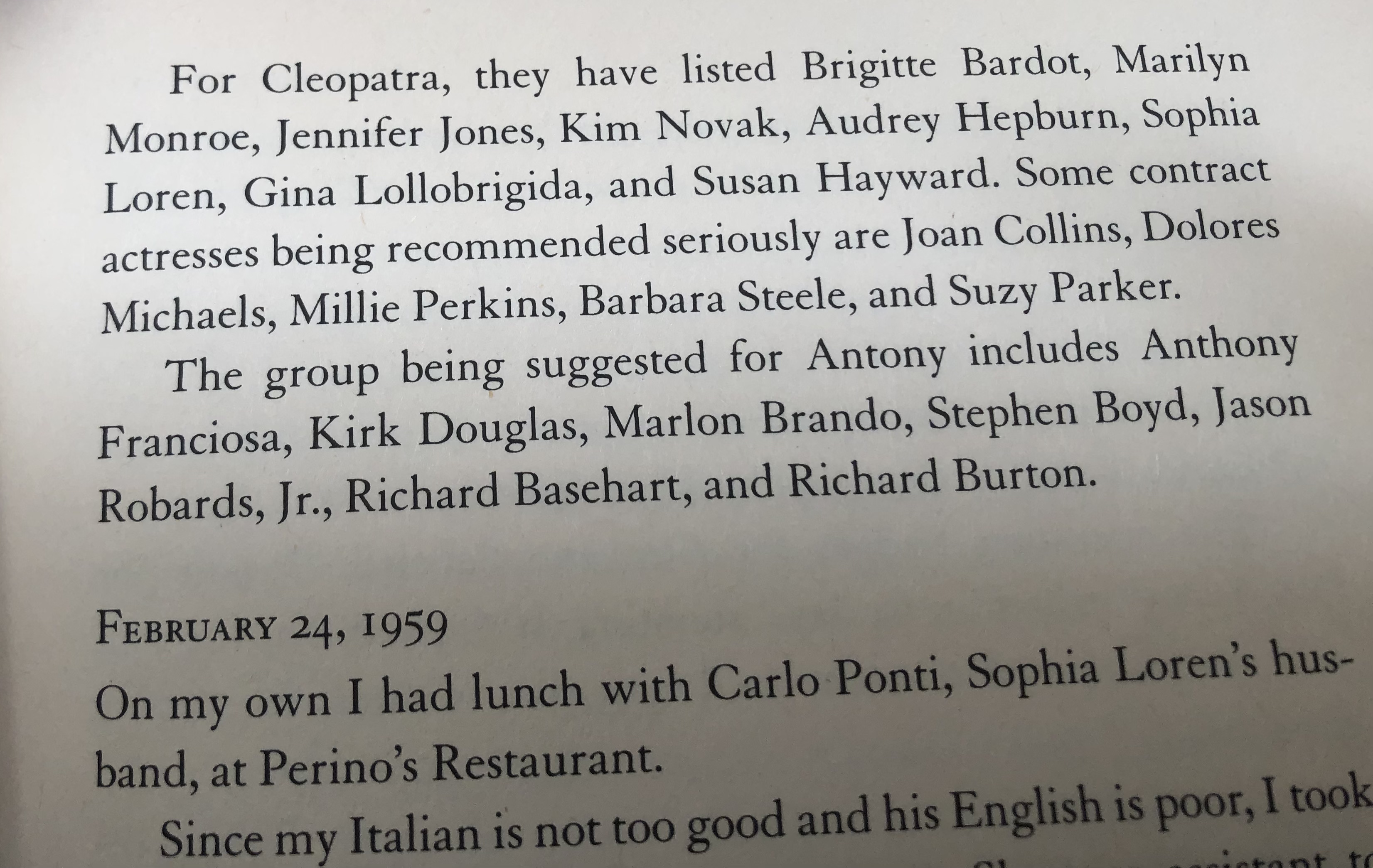
An Oxfam find. I think I first read this forty years ago or so. This editions was re-published to coincide with the 50th anniversary blu-ray release in 2013. It’s a book that’s useful for many reasons, the first being that it’s a producer’s account so one’s allowed in from the very first stages of planning, casting decisions (Cary Grant, Audrey Hepburn, Burt Lancaster, Joan Collins, Noel Coward — all were discussed seriously), the hiring of key personnel and the production planning. We get to see why it was decided to film in the UK (the Edy plan) and Egypt (free use of military as extras) and why the eventual move to Rome and Cinecittà. We eventually understand why Rouben Mamoulian was hired and why he was eventually replaced by Joseph L. Mankiewicz. There are lots of pages about getting Sidney Guilaroff to do Taylor’s hair, how the British unions were against this, and the bribes involved to get them to aquiesce. Taylor comes across as supremely sane, intelligent, and helpful. Wanger, married to Joan Bennet for many years, and a distinguished independent producer since the thirties knew how to deal with stars, what to expect, how to make things comfortable. It’s the other producers who come off badly here, power-hungry, indecisive, incompetent. In a line that’s become a commonplace recently, ‘I don’t care what the facts and figures say, just make it happen’. Well something did happen: the most expensive film ever to that time. We get a complete budget breakdown of the final version, and we’re also told — that contrary to its legend — the film went into profit in 1966 with its $5 million dollar sale to ABC. According to Kenneth Turan in the afterword, ‘Cleopatra became one of the highest grossing films of 1963, ended up playing in New York for sixty three weeks, and went into profit in 1966′ (p.224) .

Turan writes, ‘On one level the limited success Cleopatra achieved in the face of ungodly obstacles can be seen as a triumph of the system, the victory of industry worker bees over snarky gossipistas. But from another point of view the lesson of this film fifty years down the road is how little remembered that triumph is and the recognition of how often perception becomes reality in this town ‘(224-225).

An entertaining and useful read.

José Arroyo