Tag Archives: Burt Lancaster

Jim Thorpe — All American (Michael Curtiz, 1951)

jim Thorpe

Jim Thorpe — All American is one of three films Burt Lancaster did in the 1950s that explored discrimination against native peoples in the US and that in their modest way pushed the boundaries of representation in American popular culture. Apache (Richard Aldrich, 1954) and The Unforgiven (John Huston, made in 59 but released in 1960) are the others. ‘When white man lick Indian, he win battle’, one of Thorpe’s room-mates tells him, ‘Indian lick white man – ‘massacre’. The film’s very title harks back to Knute Rockne — All American (Lloyd Bacon, 1940), and the discrimination of native peoples, who should be equal by law, is the overt theme of the film, as indicated from the very first with Burt Lancaster’s star entrance (below):


Burt-star-entrance-Jim-Thorpe

The film is a sports biopic of Jim Thorpe, an Algonquin from Oklahoma Territory who went to Carlisle Indian Industrial School in Pennsylvania to keep a promise to his father. With the help of football coach Glen Scobey (“Pop”) Warner (Charles Bickford), Thorpe, whose native name is ‘Bright Path’, became one of the legendary athletes of the day, excelling in football, baseball and track, for which he won several medals at the Olympics. He was stripped of those medals for having played baseball ‘professionally’ during the summer, although he barely made enough to cover food and rent whilst playing, underlining the class underpinnings of ‘amateur.’ He recovers professionally, overcoming the debacle with the medals and racial discrimination, only to be brought low once more by the death of his only son and the subsequent dissolution of his marriage. Near the end of the film we see him in full cigar-store Indian drag, desultorily mc-ing a  dance marathon in 1930. Burton is great at expressing a deadness in the eyes that speaks of struggles to maintain dignity in the face of alienation and humiliation.

Screenshot 2020-05-04 at 07.10.21


Curtiz symbolises the break-up of Jim Thorpe’s marriage via the bed, and Burt, star that he is, manages to find the pin-lights with his eyes before collapsing in grief:

burt-finds-pinlights

Alex K. Rode, Cutiz’ biographer writes that ‘The picture received generally positive reviews and grossed nearly a million dollars over its cost. Jim Thorpe — All American was characteristic of Curtiz’ postwar Warner films: a well-made, profitable picture that quickly faded from the public’s memory’.

Curtiz was the top director at Warners in the classic period for a reason. The integration of stock footage into the banquet scenes that bookend the film and in the Olympics sequence are seamlessly integrated, and must have considerably cut down on the film’s budget. The editing of the sports sequence, often in mid-motion to give flow to Lancaster’s movement and whoever doubled for him, is also very fine. It has some lovely bits, such as here below with Burt, Phyllis Thaxter and the baby.

burt-with-baby-swoon

The more emotional moments are in striking expressionist shadows that are very characteristic of the ‘shadow’ pay one sees throughout Curtiz’ oeuvre.

Screenshot 2020-05-03 at 15.15.48


…and the compositions, superbly filmed by Ernest Haller, are original and striking:


In spite of all the above, the film also feels emotionally crude, pat, everything beautifully directed as to image and pacing but lacking in depth, understanding or delicacy. It vividly conveys the outline of feeling, but it always feels like it’s walloping the main point at the expense of the subtler, more complex, more contradictory dimensions of character and story. Burt Lancaster, who’s never given the credit he deserves, is superb.


José Arroyo

A note and gif on The Scalphunters (Sidney Pollack, 1968)

The Scalphunters


The Scalphunters is anti-racist Western directed by Sidney Pollack. Burt Lancaster is the trapper whose furs, a whole winter’s work, get stolen first by Apaches, then by a gang of scalphunters led by Telly Savallas. Ossie Davis is the runaway house-slave hoping to get to Mexico and freedom. They have great chemistry and are very funny together. The film begins with Burt rescuing Ossie but planning to sell him, to them after a fight, encased in a mud that metaphorically erases their colour differences, sharing a horse and continuing in their quest to get the furs back. Shelley Winters plays the Western equivalent of a gangster’s moll, a completely stereotypical part, and is rather miraculous with it: nothing has dated about her performance except her hairdo. This gif, your daily Burt, is from near the end of the film:


Burt-and-Ossie

Burt Lancaster, Audrey Hepburn: The Unforgiven

Burt-funforgiven

A quick note on revisiting Visconti’s The Leopard

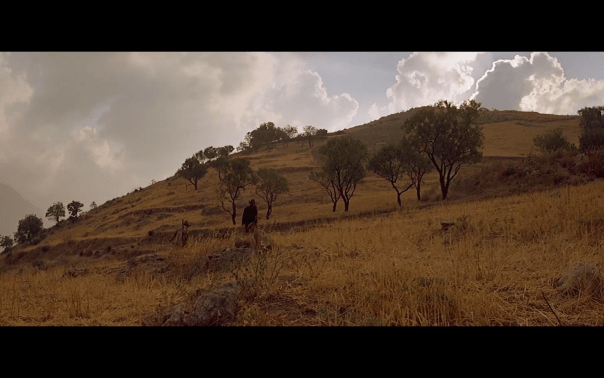
The Leopard is so beautiful and resonant to me. It really is every frame a painting, but also so much more than that. A simple image of Lancaster and Serge Regianni, in long shot, walking down a hill after the hunt, as shot by Giussepe Rottuno, is enough to move me. I thought it beyond great the first time I saw it, so I can´t honestly say it gets better with each viewing, but my understanding of it does, though, like with all great works of art, it´s so rich it always remains that little bit out of my reach.

Screenshot 2020-05-02 at 07.00.10Screenshot 2020-05-02 at 07.00.21Screenshot 2020-05-02 at 07.00.30Screenshot 2020-05-02 at 07.00.38


The landscape above moves me, partly because it reminds me of my childhood, but partly also because they are so beautifully lit. The screen-caps above don´t do justice to the gorgeous blu-ray I saw, with the gradations of light and the dense texture of the image.

Screenshot 2020-05-01 at 13.38.13Screenshot 2020-05-01 at 13.39.53Screenshot 2020-05-01 at 14.26.39


The mise-en-scène of the ball sequence, almost the last third of the film, is exquisite. If you look closely, it´s beautifully lit, shot in depath, with each minor bit part player offering major characerisation. It´s a thing of wonder.

José Arroyo

Burt Lancaster ‘to-be-looked-at-ness’

Burt’s was a career and a persona characterised by ‘to-be-looked-at-ness,’ even at the age of fifty, as here in The Leopard , and on to almost old age.

burt-leopard

A note on The Devil’s Disciple (Guy Hamilton, 1959)

Seeing The Devil´s Disciple and thinking that in the space of a decade or so Burt Lancaster essayed Shaw, Inge, Williams, Rattigan, Miller, Odets: All the major dramatists of his day. I can´t think of another major star who did that (and yes I know Brando did Shakespeare and Williams). On another note, Kirk Douglas is so much better in the film than Laurence Olivier, who acts 25 expressions for every word, and every word is given a different intonation.

Olivier ‘acts’:

olivier-2

Burt plays a saintly minister until he can’t take British oppression any more and is forced to take care of the action:


burt-long

José Arroyo

Burt in Scorpio

Michael Winner’s films are remarkable in that his camera placements always seems off. How he got to make so many is one of the great mysteries. Luckily you can’t go much wrong with close-ups of stars. This is from Scorpio, which also stars Alain Delon and Paul Scofield:


burt-scorpio2

Burt on the Trapeze

At the very opening of Trapeze, we see an aerial act on the trapeze, from a distance, then from below, and finally the acrobat lands, turns around and it’s …Burt Lancaster! Doing his own stunt! Its own thrilling moment of spectacle. No other special effect needed. We have not forgotten that extraordinary people doing extraordinary things with their bodies is graceful, beautiful, awe-inspiring, amazing, spectacular. Youtube is full of such moments from sports. But the movies seem to have forgotten. It’s not the thing being done (easily imaged through CGI) as it’s the demonstration that it is people doing those extraordinary things. This is one example:

yes-sir-it's-burt

The Hallellujah Trail (John Sturges, 1965)


hallellujah trail

‘See how the west was FUN’ says the poster. Except we can’t really, the film is a superlong super production in Ultra Panavision 70. There are various versions, 35mm and 70mm, the longest being 165 minutes, replete with overture and intermission, and it’s neither funny nor exciting enough to support such a length.

Screenshot 2020-04-18 at 09.11.29

Burt Lancaster, now over 50 is cast as Colonel Thaddeus Gearhart, the father of a grown daughter (Pamela Tiffin), engaged to one of his underlings (Robert Hutton) but taken up with the combination of women’s liberation and the temperance movement preached by the very popular Cora Templeton Massingale (Lee Remick), who preaches that women can only be free from patriarchy and equal to men once men stop being enslaved to the demon drink. This poses a bit of a problem as the Colonel’s forces are meant to accompany 40 wagons of whisky to Denver, who’s running short and afraid of running dry once winter sets and travel rendered impossible. Thus the women accompany the army, the owner of the whisky (Brian Keith), the Denver town drunks lead by a very funny Donald Pleasance, and various tribes of native peoples who are after the whisky for themselves. It’s all meant to be funny but all that ‘poking fun’ at Indians and Feminists often crosses the line into offensiveness. That Martin Landau is cast as a greedy Indian Chief and that the role is just a patronising punch line to many of the situations is all you need to know to understand what I mean.


The film is shot in Ultra Panavision 70, some of the shots of horses and caravans amidst the great outdoors are truly spectacular. There is a consistency of tone established by a voice-over, often verbally ironising what one sees on screen. Donald Pleasance has some lovely moments as an oracle who can only foresee the future with the aid of whisky, with his sky-blue eyes lighting up amidst the dirt of his face every time he has a vision. It’s a dreamy, delirious and affectionate turn. One of the few things in this film that does actually work. Lastly,  I think the film is also worth seeing for the insertion of a then nascent second-wave feminist movement into the Western genre, almost certainly a response to the emerging movement in the States at that point, but which is rare enough for me to want to include the clips below:


The sign ‘Women Can Remake the World’, the singing, Robert Hutton’s reactions, all are pleasurable.  ‘If we are to enjoy equal rights with men then we are to respect him and if we are to respect him we must save him from himself and the poison of alcoholic spirits. Do you agree?’  says Cora/Lee Remick. Emancipation, Freedom for Women, Women Can Remake the World: These are phrases not normally heard in a Western.  The singing of the Hymn of the Republic then wraps this feminism in the flag and inserts it into a narrative of the founding of the US, gives it a history, represents the First Wave so to speak, except it’s a comic one, played for laughs, though the women are not as offensively the butt of jokes as the Native Peoples or the Irishmen threatening to strike.


In the clip above you can see Burt Lancaster’s reaction to Lee Remick’s discourse: ‘Our enemy has two heads, first the enslavement of women by men and secondly the enslavement of men by the remorseless tyrant alcohol. We must reach out for freedom and tear this tyrant from the lips of men.’ The cutting always returns to Lancasters’ reaction, which the audience is asked to identify with, particularly as his daughter has joined up with the cause.   And when the women decide to march along with the wagons to Denver, the Colonels’s underling asks, ‘What are we to do Sir? What happens if we run into Indians?’ ‘I pray for the Indians,’ says the Colonel.


JA

An observation on the blondness of Sturges’ West in Gunfight at the OK Corral

My Burt Lancaster film of last night was Gunfight at the OK Corral (John Sturges, 1957), a landmark hit of the fifties, with one of those ballads sung throughout (by Frankie Laine), that help pace and narrate and that Cat Ballou (Elliot Silverstein, 1965) would parody to great effect a decade later. What struck me most was not just the whiteness of Sturges’ West– there isn’t a black person, Indian or Mexican in the whole movie — but its blondness. Everyone seems fair haired or blu-eyed or both: not just Kirk and Burt and Joan Van Fleet, but the supporting cast as well: Earl Holliman, John Ireland, Martin Milner, DeForest Kelly, Lee Van Cleef. Rhonda Fleming’s red hair is about the only bit of diversity. Dennis Hopper as the youngest Clanton brother, fresh from his appearance in Rebel Without A Cause (Nicholas Ray, 1955), lit very beautiful to underline the tragedy of his death to come, still to shed his baby fat, and half the size of Burt, is what led to this thought.

Screenshot 2020-04-17 at 05.57.37

The film pays subtle hommage to John Ford’s My Darling Clementine (1946):

Screenshot 2020-04-17 at 05.49.32

It’s worth comparing what this film might signify in contrast to Burt and Kirk’s first pairing as two Depression gangsters caught up in a postwar world of passion, crime and shadows a decade earlier in I Walk Alone (Byron Haskin, 1947).

It’s also worth contrasting to the presence of native peoples, Mexicans and blacks –the latter often in tiny or non-speaking roles but as soldiers or figures of authority — in the Robert Aldrich/ Burt Lancaster westerns such as Apache and Vera Cruz, both released in 1954.


The film was a worldwide success that left an imprint on several generations and was easily parodied. As you can see here in the Goodies episode of Bunfight at the OK Tea Rooms that  Nicky Smith directed me to:


And Richard Layne has also pointed out to me that there’s also the Doctor Who version, complete with a song:


Villainous Burt in Vera Cruz

Villainous-Burt-2

Burt Lancaster in Bellissima

In Visconti’s Bellissima, all of Ana Magnani’s dreams of cinema get crushed. But then she hears Burt Lancaster’s voice…..Her husband’s a naysayer. But then, some people just don’t get it. It’s perhaps significant in Visconti that we see John Wayne in Red River but that it is Montgomery Clift and Burt Lancaster that are referred to by name as objects of admiration. And of course Lancaster would go on to work with Visconti in The Leopard and in Conversation Piece, and even before that, with Magnani in The Rose Tattoo.

Screenshot 2020-04-13 at 09.17.08Screenshot 2020-04-13 at 09.17.10Screenshot 2020-04-13 at 09.17.15

More Burt in Apache

These are such fun to make: Apache-gunfight

An image from Come Back, Little Sheba (Daniel Mann, USA, 1952)

When Burt’s whole body isn’t sprawled out as spectacle to encompass a widescreen frame, ie when he attempts ‘serious’ acting in ‘serious’ drama, as in Inge’s ‘Come Back, Little Sheba’, he goes all Greer Garson prim and buttons up even his pyjamas:

Screenshot 2020-04-12 at 11.08.35