Mike and I return to a galaxy far, far away, in search of new perspectives and thoughts on The Last Jedi. Mike in particular has been itching to talk more about it since he feels he was unfairly lukewarm the first time. We ruminate on what makes Star Wars feel different to other sci-fi; how films may feel tighter and shorter on second viewing (this one does); Han’s dice; confusion on the resistance cruiser; we give proper due to the character and performance of Rosie; talk about the great uses of sound in the film; we compare seeing the film in 3D-IMAX and 2-D; whether a Jedi can survive in space; and the differences between the First Order and the Empire, and Hux’s construction as a figure of fun. We still disagree about Mark Hamill’s performance and end the podcast by talking about love.
The podcast can be listened to in the player above or at this link.
I loved looking at it. I loved the action. I loved the world it created. I loved Laura Dern and Benicio del Toro in it. Adam Driver is filmed as a Byronic hero, anguishingly romantic and at his sexiest. It’s my favourite film in the series, including Star Wars V — The Empire Strikes Back (1980). Mike felt differently. Matt Moore, also a bit lukewarmish about the film as a whole, joins us for this discussion and points to how the film focusses on female characters and interestingly alters the focus of the series.
We discuss how the film represents a shift from an aristocratic focus on blood and destiny to a more democratic purview on social change everyone, of whatever class, race or ethnicity can engage in. Mike came out of the film gleefully playing with a light-sabre only to sit down and slash through what he saw as the film’s weaker points, though he also points out how he believes Rian Johnson is the right director for the film and how, in spite of its faults, it truly does feel like a Star Wars film. Lots of spoilers.
The podcast can be listened to in the player above or at this link
Otros Cines Europa (Other Cinemas in Europe) has published a list of Spanish directors’ choices for best film of 2017. The list is a fascinating one for many reasons, one of them being a revelation of the extent to which we in Britain are cut off from the major currents of culture in mainland Europe: the majority of the titles on the list are still unknown to me.
I thought I’d extract and translate Almodóvar’s choice, which has been distributed in the UK, and which many of you will have seen, because there’s already the beginnings of a backlash amongst those most self-identified with queer theory/ queer cultural production and I thought that perhaps what Almodóvar likes about the film might be of interest to those amongst you who do not speak Spanish and would like to know:
Pedro Almodóvar: Luca Guadagnino’s Call Me By Your Name. Everything is pretty, attractive, desirable and moving in this movie: Boys, girls, breakfasts, fruit, cigarettes, pools, bicycles, open-air dances, the 80s, the protagonists’ doubts and dedication, the sincerity of all the characters, the relationship of the protagonist with his parents. The authors’ (André Aciman, James Ivory and Luca Guadagino) commitment to sensual passion. The light of the north of Italy, and most especially, Timotée Chalamet, the great revelation of the year.
José Arroyo (translation my own and any corrections gratefully received)
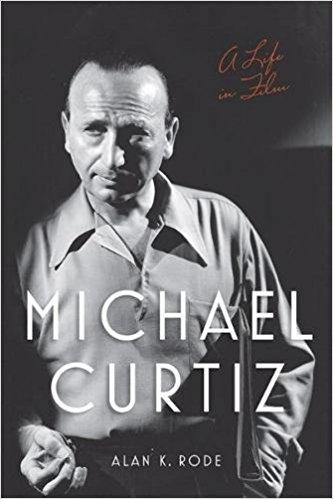
Michael Curtiz was the most important director at Warner Brothers during the whole of what has come to be known as the ‘Studio Era’ and the period of ‘Classic Hollywood Cinema’. He was at Warner Brothers from 1926 when he directed The Third Degree starring Dolores Costello and Louise Dresser to 1955 when he left Warners for Paramount to direct White Christmas, a classic probably still playing at a screen near you (it’s screening near me at the Electric Cinema in Birmingham today at 18:00). You may want to take note, as I did yesterday, that the film is billed as ‘Irving Berlin’s White Christmas.’
A still from the visually astonishing 20,000 Years in Sing SingIn between he directed such landmarks as Noah’s Ark (1929). Mammy with Al Jolson (1930), 20,000 Years in Sing Sing with Spencer Tracy and Bette Davis, Female, Captain Blood (1935), The Adventures of Robin Hood (1938), Angels With Dirty Faces (1938), Yankee Doodle Dandy AND Casablanca, both in 1942, Mildred Pierce (1946), and many, many others. He made stars of Errol Flynn AND John Garfield AND Doris Day. He directed Elvis Presley’s best performance on film (King Creole, in 1958).
So many of his movies are still so beloved today that the question around Curtiz has always been why he hasn’t been awarded the kind of respect ritually thrown at John Ford, William Wyler, John Huston, Alfred Hitchcock, George Cukor or any other director working in Hollywood during that period who is routinely ranked as ‘great’? As Rode states, ‘It is a striking paradox: one of the most accomplished film directors became virtually anonymous while his films remain pillars of popular culture'(p. xiii).
Alex Rode’s meticulously researched book goes a long way towards unpacking that paradox as well as answering many other questions on Curtiz, European filmmaking in the ‘Silent’ period and Hollywood filmmaking in the Studio Era. Curtiz was the company man par excellence, assigned to a wide array of projects from crime (Marked Women, 1937) adventure yarns (The Sea-Hawk, 1940), westerns (Dodge City, 1939), patriotic musicals (This is the Army, 1943), film noir (Mildred Pierce, 1945), biopics (Young Man With a Horn, 1950). He routinely directed as many as six pictures a year (In 1930, 32, 33, 35, 37 and 39, a prodigious output). He also maintained a prodigious batting average: of the five films he directed in 38, two (Angels with Dirty Faces and The Adventures of Robin Hood) continue to be seen and admired; Four Daughters made a star of John Garfield and all (including Gold is Where You Find It) were major hits except Four’s A Crowd. An extraordinary achievement.
But that level of productivity might also explain why his films, so often praised as entertainments, of generic (Mildred Pierce) or sociological (This is the Army) significance are rarely thought to offer depth or nuance. The man who made what is arguably the most beloved film of all time (Casablanca) is nonetheless not thought to have made anything truly great, like say Vertigo or The Shop Around the Corner or even The Searchers. Curtiz’s film are praised for their pace, their visual sense and sometimes also for the clarity and wit of their story-telling. But there are no moments in Gurtiz’s oeuvre like, say, the ending of Tokyo Story, that move the heart with understanding.
One of the discoveries of this book is that Curtiz’ command of story in his Hollywood period might to an extent be due to his second or third wife Bess Meredyth (he was married to Ilonka Kováks who became a film star under the name of Lucy Doraine from 1918-1923 but we don’t know if he actually married Lily Damita who he became seriously involved with in the late twenties). Meredyth had been an actress. She and her first husband Wilfred Lucas had had their own production unit at Universal. She’d been the first professional screenwriter to work in Australia, had been a production supervisor in Rome on Ben-Hur, and remained a top Hollywood screenwriter at the time she met Curtiz. According to Rode, ‘Curtiz’s most enduring relationship would be with a woman who became much more than a lover. Meredyth would become his most trusted collaborator — someone he could bounce ideas off and work closely with on story and script development’ (p.81). They would remain married until his death in 1962.
Lily Damita with what may be her first husband on the right (Michael Curtiz) and her second on the left (Errol Flynn), on the set of Captain Blood
C.B. De Mille represented the figure of the Hollywood director for the masses. But for many in the know Curtiz embodied the worst cliché of the Hollywood director. Like De Mille, Curtiz wore jodhpurs and boots on the set (though interestingly not in the majority of set stills one now finds on the web — presumably they had become a cliché by then though Rode’s book offers plenty of examples) and screamed from a megaphone. He was famous for mangling the English language: David Niven titled one of his memoirs ‘Bring on the Empty Horses’ after one of his utterings whilst filming a battle sequence in The Charge of the Light Brigade (1936). He cozied up to those in power (Zanuck, Jack Warner): It is Curtiz to whom Darryl Zanuck is said to have said ‘don’t say yes until I finish talking’. Curtiz nonetheless shared in all the moguls’ worst excesses; way into the fifties ,whilst Bess was home voluntarily bedridden and probably working on on one of his films, he was known to keep two mistresses and be open to whatever nubile extras crossed his path on the set, where he was a terror to underlings.
There are several instances recounted in the book where horses, stunt-people and even performers have terrible accidents, some dying, and Curtiz’ main concern is to get the shot and move on. According to Rode, ‘His reputation for explosive temper tantrums, the difficulty communicating in English, and his perceived disregard for the well being of others were notorious within the industry. During his first decade at Warner Bros, Curtiz’s demonic work ethic approached savagery as he pushed casts and crews past the breaking point of twenty-hour days and seven-day weeks. More than any other studio director, Curtiz was, in a perverse way, responsible for the founding of the Screen Actors’ Guild in 1933′ (p.11). Many stars (Davis, Bogart) refused to work with him once they had the power to make a choice.
A Michael Curtiz super-production from 1922 starring his first wife, Lucy Doraine
One of the many things I learned from this meticulously researched book was just how extensive Curtiz’s pre-Hollywood career had been. In all he directed 181 films with roughly a third of them in Europe before the age of 38, which was his age when he landed in America in 1926. Few realise that ‘he started out as a classically trained actor who virtually invented the film industry in his native Hungary. He ran a movie studio and directed scores of impressive films in Europe’ (p. xv). He received training as a filmmaker in Denmark as well as Hungary, made films in Paris, Berlin, Vienna, Prague as well as in his native Budapest. Changes in name accompanied changes in life circumstances. A birth certificate noting his name as Mano Kaminer born on December 25, 1886 is on file at the Jewish Community Archive in Budapest. He later changed his name to Mihály Kertész when he went on the stage as an actor, then Michael Kertész when he went to make films in Vienna and finally Michael Curtiz for his Hollywood career.
According to Rode, Curtiz was a cinematic pioneer who ‘made a seamless transition from the earliest hand-cranking cameras in silent films to directing the first sound feature at Warner Bros. in which the characters spoke their parts. He led the way in two and three-color Technicolor productions, directed the first motion picture produced in VistaVision, and worked extensively in CinemaScope (p. xvi).
A Tolong/ The Undesirable, 1915
The book is wonderful at delineating different historical contexts, from technological developments to budgets, from the effects of the industry’s divestment of theatres on filmmaking to changing styles of acting and performing that help us understand the changes and developments in Curtiz’s career. The one I appreciated the most, maybe because I knew of it the least, was his time in Hungary and the artistic and intellectual circles to which he belonged to there: Bela Lugosi, Ferenc Molnár, Ladislav Wajda, Alexander Korda, S.Z.Sakall all mingled together in the cafés of Budapest.
What comes across in this book is a fundamentally kind man of enormous discipline, ferocious energy and extraordinary concentration, driven by fear, almost entirely focussed on sex and film-making, not necessarily in that order, and living for the moment. If one can find fault with Rode’s monumental work, and it’s hard to, I would have liked to know, if one can, the extent to which his being born a jew in Hungary during the Austrio-Hungarian Empire and then landing a success in Hollywood at the time when all the people he knew and loved back home were quickly being denied rights, rounded up into concentration camps and killed fuelled his actions, way of life and his art. This bubbles under and around the book’s narrative without quite being brought into focus as much as I’d like it to have been. But in the light of the achievements of this superb work, this is a minor quibble indeed. It’s a great book, a must read for anyone interested in the history of cinema.
The second of a series of conversations about books on cinema with their authors. The intention is to expand and disseminate our understanding of cinema and its diverse histories and various cultures by bringing attention to recently published books in the field in order to enhance understanding of and access to the knowledge the books provide.
This one is with Pamela Hutchinson, founder of the great Silent London website and a regular correspondent for Sight and Sound,The Guardian and many other outlets on various aspect of Silent Cinema. The occasion for the chat is the publication of her wonderful new book on G.W. Pabst’s Pandora’s Box, a BFI Film Classic, so recent that it’s literally hot off the press, and as witty as it is informative.
What you hear in the background is the bubbles in a glass of champagne and one can only hope that our chat is as fizzy. The conversation ranges from the film’s aesthetic achievements to its continued influence, the appeal of Louise Brooks, what Marlene Dietrich might have done with the part and what the film has to tell us on sexual desire, the options open to women and the prevalence of rape culture then and now. Pandora’s Box seems more pertinent than ever and just as powerful and hypnotic as it always was. Pamela Hutchinson’s book is not just a beautifully written introduction to the film but one which provides new information and enhances our understanding in various ways and does so with great charm and wit.
I hope that the quality of the chat compensates for that of the editing and recording. It can be accessed above.
This is the photograph that led to Lauren Bacall’s movie career. It is currently on display, along with other works by Louise Dahl-Wofe, at the Fashion and Textile Museum in London. Ostensibly, Nancy ‘Slim’ Hawks saw this and thought her husband should test that striking presence on the cover for a new film he was planning. Howard did and cast her in a secondary role in To Have And Have Not, where she was so charismatic that he built up her part into Bogart’s leading lady. Men still go woozy when they watch her ask Bogart if he knows how to whistle. Bacall slinking provocatively on a piano, legs crossed as President Truman tickled the ivories, was enough make a whole nation woozy, some with indignation.
Kitty Hawks divorced Hawks and married Leland Hayward, legendary producer of some of the greatest hits of mid-Century Broadway (South Pacific, Mr. Roberts, The Sound of Music). Leland Hayward had gone out with Katharine Hepburn in the 30s and later married Margaret Sullavan, the immortal star of The Shop Around the Corner; Margaret Sullavan had earlier been married to Henry Fonda, who later in life wrote of how he spied on his wife making love to Jed Harris (‘the meanest man on Broadway’) through the window outside their own flat, riven with jealousy but immobilised by powerlessness, and wept; Brooke Hayward, one of the Hayward-Sullavan children, married Dennis Hopper and wrote – beautifully –about the childhood they shared with the Peter and Jane Fonda in Haywire. Slim herself was one of the super-rich ‘Ladies Who Lunch’ on the edges of Truman Capote’s ‘Swans’, Babe Paley, Lee Radziwill, Marella Agnelli, C.Z. Guest, and all the other ultra-fashionable consorts of the jet-setting 60s super-rich.
In a superb article, ‘Looking American: Louise Dahl- Wolfe’s Fashion Photographs of the 1930s and 1940s’, Rebecca Arnold writes of how Dahl-Wolfe’s photographs, of which the above isn example, ‘represent and help to shape feminine identities that evoke myths of America: the pull between visions of a vast Edenic landscape of opportunity and the cosmopolitan modernity of the city’ (p.46) and how, ‘her photographs provide a rich source for examining the growing confidence of the New York fashion trade and the crystallization of the “American Look,” which framed national identity in terms of active sportswear that spoke of functionalism and freedom. Dahl-Wolfe’s warm color schemes and light-filled images present a fiction of stability and cohesion during a period of turmoil. They smooth away contradiction and anxiety, providing unproblematic and coherently constructed ideals of American femininity'(p. 46, Fashion Theory, Volume 6, Issue 1, pp. 45–60)
Louise Dahl-Wofe shot for Harpers during the time it was edited by the legendary Carmel Snow. In the relatively recent A Dash of Daring: Carmel Snow and Her Life in Fashion, Art and Letters (2010),Penelope Rowlands recounts how Snow revolutionised fashion publishing by drawing on the European avant-garde to create a distinct, modern American view of life. Harper’s Bazaar during this period was part of the huge Hearst publishing empire that encompassed newspapers across the US but also National Geographic and Good Housekeeping, thus creating a taste for what Thomas Veblen had already termed conspicuous consumption. Hearst would be Orson Welles’ model for Citizen Kane. Welles himself, baby-faced but already a Broadway legend, was photographed by Dahl-Wolfe in 1938 (see below).
One can spin out a whole history of Hollywood and a whole series of social histories from one photograph, or one of Dahl-Wolfe’s at least. But one doesn’t have the time to do so now.
José Arroyo
‘Louise Dahl-Wolfe: A Style of Her Own’ is on show at the London Museum of Fashion and Textiles until the 21st of January.
Mike and I watched the film separately, he on a big screen, I on a HD stream from Amazon, and we speak of the different viewing experience, the transnational funding, the address of the film to adults; how it’s a film that doesn’t try to sell you anything but attempts to express a world-view, poetically without sound but with very expressive imagery, beautifully realised. We discuss how it’s a film that actively induces a range of interpretations, what those might be and the extent of their validity. The Red Turtle is a beautiful film, fully deserving of all the accolades it’s received but one which we also have reservations about, and we certainly give them an airing at the end whilst nonetheless making sure the accent’s firmly placed on the film’s very considerable achievements.
The podcast can be listened to in the player above or at this link
A disaster of a film about a disaster of a film that nonetheless made us laugh; a film that tells more than it shows; an in-joke dramatised in James Franco’s fan project about the worst film ever made. We discuss the mean-spirited nature of finding films so bad they’re good, the lack of direction in The Disaster Artist, the quality of Franco’s central performance, and why we find the film so self-indulgent. I contradict myself by saying he’s only ever good with other directors and then talking about how great he here.
The podcast can be listened to in the player above or at this link.
Oklahoma! is one of the great scores of American musical theatre but not the greatest of musical films: the two often get confused, Rodgers and Hammerstein’s own South Pacific being the most obvious example (though it can be argued that even that isn’t Rodger’s and Hammerstein’s best work; the film, however, is dreadful).
The stage show, coming as it did in 1943, just after America’s entry into WWII, was thought, erroneously, to introduce American musical theatre to the integrated musical (Show Boat, produced in 1927 with music by Jerome Kern and lyrics by Hammerstein came considerably earlier and has a greater claim to the honour).
Bambi Linn as Dream Laurie and James Mitchell as Dream Curly
The Broadway show of Oklahoma did nonetheless revolutionise American musical theatre, showing as it did, how musical theatre was capable of bringing not only joy but also depth, seriousness, unity, and cutting edge inventiveness (with Agnes De Mille’s dream ballet in the show receiving particular praise for this. The dream ballet here inspired all the subsequent dream ballets in Hollywood musicals. So blame Agnes de Mille.). The show was thought so important it won a special Pulitzer Prize for literature to acknowledge its contributions. It was certainly influential, and from the mid-forties onwards, the integrated musical became the norm on Broadway.
The score is one of the great wonders of American musical theatre. Hearing the rising O’s in ‘Oklahoma!’ alone is enough to put a smile in my face. But the score also contains ‘Oh What a Beautiful Mornin,’ The Surrey with the Fringe on Top’, ‘People Will Say We’re in Love’, ‘Many a New Day’, ‘All er Nothing,’ and many more hits. It’s no exaggeration to say that it became the soundtrack of a generation throughout the forties and well into the fifties and is known to be a particular favourite of the Queen. The songs have been covered by pretty much all the great singers (from Sinatra and Lena Horne to Blossom Dearie) and are considered staples of ‘The Great American Songbook’.
Too much of the dream ballet filmed so that you can’t actually see the dancers dancing.
Both the show and the film convey the way America liked to see itself in the middle of the last century: equal (‘I’m no better than anybody else but I’ll be danged if I ain’t just as good’), modern (‘everything’s up to date in Kansas City, they’ve gone about as far as they can go’), inclusive (Persian peddlers marry in, cowboys and farmers end up friends, a territory becomes a state), with a cornfed energy and open-air sexual innocence (‘People Will Say We’re in Love’) that often enveloped or was a front to more exciting things (‘I’m just a girl who cain’t say no’). The tone throughout is one of homespun hickness layered in the common-sense toughness so prized by Americans.
Many scenes are shot full-on frontal
But the film of Oklahoma! is a stately and ponderous affair, a dilemma for a show that’s got an exclamation point in its title. Zinnemann has no fun with this material. Everything is filmed to highlight the seriousness and importance. We get to see Curly (Gordon McRae) riding from a low angle amongst the corn so rendered majestic. Even Will Parker (Gene Nelson) jumping of a train onto a horse is rendered unexciting, from far away in a long take that emphasises the landscape rathe than the action. Many scenes are shot full-on frontal, in compositions that seem haphazard. And whilst songs are often shot in long takes from a fixed angle (see the clip below), Agnes De Mille’s great dream ballet is butchered so that sometimes all you see of the dancers is from the waist up. And often one notices how landscape is favoured over character, and though it is beautiful, and the show is meant to be about Oklahoma, it distances us from the characters.
Too many abysmal compositions
The film was shot in two versions, the then new 70 mm Todd-AO process for select theatres and a CinemaScope 35mm version for wider distribution. They are in fact two different versions, made up of different takes. I saw the 35mm version, meant to be the weaker one, as the first takes where generally used for the Todd-AO version, and though the restored version is generally a handsome affair, some shots still look quite murky.
In spite of my reservations, there are many things I love about this version: It’s a treat to see James Mitchell, so important to Agnes De Mille’s work and indeed to the development of American dance, as the dream Curly actually dancing (unlike in Minnelli’s The Band Wagon where he merely plays Cyd Charisse’s Svengali choreographer); Shirley Jones had not yet learned to act but she’s got a delectable chocolate box prettyness; I love the tone of Gordon McRae’s voice even though his performance lacks the zest, energy and sex-appeal Hugh Jackman brought to the role of Curly in the Trevor Nunn production for the National Theatre in London (see above); Gene Nelson’s been thought one of the burdens poor Doris Day had to put up with in her Warners Days but I like his dim Will Parker very much.
These performers, though not quite of the top rank, are not the problem with the film. In fact, to me, Rod Steiger has never been better. He could be, in fact he usually was, a terrible ham. But here he brings a broody, hulking presence to the role of Judd. And he’s so restrained throughout most of the film, that when he does explode, it becomes powerful and meaningful, rather than an annoying characteristic of his style of acting. Likewise, whilst there are other performances of Gloria Grahame that I like at least as much (I love her in everything I’ve seen her in really but particularly in Human Desire, The Big Heat, and In a Lonely Place) her Ado Annie — all stylised and pitched high but soft — is a joy, as is her duet with Gene Nelson in ‘All ‘er Nothing’ (the former is from the 35mm CinemaScope print, the latter from the 70mm Todd-AO, for comparison)
From the 35mmm CinemaScope version
From the 70mm Todd-AO version
Fred Zinnemann has no feel for the homespun rural Americana the film idealises. His greatest hits (The Search, A Nun’s Story,A Man for All Seasons, Julia, and even — famously —High Noon) and his dream project that got away (a film of Malraux’ Man’s Fate) are indicators of how distanced his sensibility is from this material. The main lacks are pace and energy, which in fact should be the very motor of this material.
My main reason for seeing this, however, was Gloria Grahame (I’m on a bit of a marathon of her films at the moment). She did not disappoint, and in fact the film brought an increased appreciation of her talents and an increased understanding of why Rod Steiger once meant something as an actor. Plus the score is an undiluted joy in any version.
One of those all-star multi-strand melodramas so typical of the 1950s (Not as a Stranger, The Best of Everything, This Earth is Mine). But this one directed by Vincente Minnelli, and perhaps only he could get away with structuring all of the drama around the hanging of drapes: Mrs. McIver (Gloria Grahame) wants some chic ones from Chicago; Miss Inch (Lillian Gish) wants some practical ones, at a discount; and Doctor McIver (Richard Widmark) and Miss Rinehart (Lauren Bacall) have a project to get the patients at the psychiatric institute (Jon Kerr, Susan Strasberg, Oscar Levant etc) to design their own. Charles Boyer is Dr. Devanal, the former head, now usually too soused to do much except letch around between institute and motel room , spicing up the intrigue and thickening the plot as the drapes go up and down.
Gloria Grahame
The standout performances are Grahame’s, all seething sexual frustration as the girl who every guy but her husband is hot for, and Gish who does something much deeper and complex with her performance of Miss Inch, the administrator desperate to be needed and hiding it all an aggression born out of a lifetime’s neglect.
The worst performance, and its worth mentioning because she spoiled so many 50s movies, is Bacall’s. She’s a sour, haughty and humourless presence here as in so many movies of this period (Written on the Wind) and later (Murder on the Orient Express). Here she looks great, which hasn’t always been the case when photographed in colour. But even her glossy tawny looks can’t hide a performance that is all attitude without emotion and seems composed entirely of poses.
Bacall *looks* spectacular
In interviews, Bacall’s talked about how in this movie Minnelli cared only for drapes and the only thing he contributed to her performance was to move her knee from one side to the other. What she doesn’t mention is that that’s probably the best anyone could have done for her (See her performance in How to Marry a Millionnaire — at least *here* she’s photographed beautifully and looks terrific). Minnelli knew about drapes and about moving the camera and arranging people within the cinemascope frame in ways that are still tremendously exciting to watch. What Bacall accuses Minnelli of is in fact what she herself is guilty of: great surface with nothing evident underneath.
Sadness, doubt, regret, vulnerability, force of will: all mingle in Lillian Gish’s wonderful face, surely one of the most expressive in film history.
Readers interested in questions of the representation of gays and lesbians in cinema might find it interesting to know that the character played by Oscar Levant, Mr. Capp, was a homosexual fixated on his mother in William Gibson’s original novel. The Hays Office prevented the character from being so characterised in the film. Perhaps because of that, Minelli visually coded the character of Mrs. Delmuth as lesbian in what for the 1950s passed as the strongest and most clichéd terms possible: with the short hair, the men’s shirts and in jodhpurs, wearing riding boots, and later on in the film, at the woodwork shop, working at her lathe. The title of Mrs. a cover and alibi for the visual representation where dress nonetheless trumps address. I at first and tellingly thought the part of Mrs Delmuth was played by Mercedes MaCambridge, one of the most vibrant and exciting signifiers of lesbianism in 50s cinema, but I see that the role is actually played by Jarma Lewis. The confusion is, as I hope you can see below, understandable.
James Dean was originally cast as the troubled young artist but studio politics prevented the casting. John Kerr, who would subsequently be cast as the the young man accused of homosexuality in Tea and Sympathy, is dull in spite of all the histrionics his character is given to perform, rather a feat.
If the film is a visual treat, the sounds are no less of an achievement: According to Laurence E. MacDonald in The Invisible Art of Film Music: A Comprehensive History, the score for The Cobweb is ‘basically atonal’ and is considered to be ‘the first Hollywood film score to contain a twelve-tone row. The main-title music features two elements that return throughout the score: agitated figures for strings and glissandos on the kettledrums. These elements account for much of the impact of this score, which is understandably a difficult listening exercise for viewers’ (p. 157′)
In spite of extraordinary performances from Jamie Bell and Anette Benning, we didn’t like the Film Stars Don’t Die In Liverpool much, so the discussion ranges from the why of this to who Gloria Grahame was, film noir, why so many fading film stars marry gay men, and what it’s like to watch films at the Electric Cinema.
Caught up on The Accountant, which I missed at the cinema and found great fun though not quite good. There’s something slightly sordid and underhanded about tying the support of people with autism to wanton destruction. Ben Affleck is very good as the accountant/killer who can’t express any emotion; one only gets to know how he feels about people by seeing whether he helps them pay less tax or shooting them some bullets, usually two, one in the head to make sure they’re properly offed. Jon Berthal is Afflec’s opposite: expressive, graceful in movement, sexy. Just as deadly, a lot more expressive with it. I wonder if his performance here led to The Punisher? Anna Kendrick, J.K Simmons and John Lithgow are also in it, the latter excellent as a vainglorious philanthropist billionaire who gets the finale he deserves.
Lots on Minnelli’s being ‘effeminate’ and on his wearing of eyeshadow in public places but still interestingly inconclusive on his sexual orientation. I find it so interesting how in current discourse anything other than ‘queer’ is kind of looked down upon, and yet there is this desperate insistence on claiming anything slightly effeminate as homosexual, which to me is almost the opposite of the fluidity ‘queer’ is supposed to espouse. I find it intriguing and amusing in equal measure.An enjoyable book that’s illuminating on his life and career; there are better — though not yet enough — books on his films.
Paddington 2 wins us over in the end. We found it accomplished, lovely to look at, and with Brendan Gleeson and Hugh Grant giving career-best performances. The film sent us home on a high with a final, gloriously campy musical number that has Grant tapping down a staircase à la Stairway to Paradise to delight his captive audience in borstal (think pink!).
The beginning of the filkm irritated both of us: Its cosy, idealised version of England as a large, racially inclusive community of upper middle-class toffs with clipped accents and impeccable manners; its view of London neighbourhoods as small villages where everyone knows each other; the way all of it seems encased in the same cloud of amber-tinted nostalgia so familiar from Ms Marple films — perhaps it’s depicting the way we would all like it to be and perhaps it’s asking us to measure the distance between what we see and what we know. But it veered dangerously close to sap-land and brought out the ornery in me. This feeling disappeared once the film tossed in some acidity to brighten up proceedings.
We discuss the film’s glorious visuals, with various styles of animation seamlessly incorporated into the film’s clear but complex storytelling; the similarity to Wes Anderson; we diss Peter Capaldi, Julie Walters, Jim Broadbent. It’s not as perfect as everyone seems to say — offering us plenty of scope to criticise — but we both left the cinema in admiration and in a cloud of good feeling. A feel-good, Brexit Paddington (and negotiations would be going much better with him at the helm). Mike mentions the word masterpiece.
Sean Baker’s The Florida Project incites ruminations on the representation of underclasses in cinema; the emergence of a new American neorealism; clichés of slice-of-life and childhood films; what audiences owe to films that are truly reaching, even beyond their grasp; and why a man who can cry at Toy Story can’t open himself up to stories of genuine human pain. One of us finds the colour lilac revolting.
Delon, cigarette dangling, stops to play the piano. Deneuve steps out to look. He’s the object of her gaze but it’s her the camera lingers over. She catches his eye. He smiles knowing that she’s been looking. A third person enters and he’s called away. He blows her kisses. She does the same. But she’s already betrayed him. All this smokey perfection wafts through on a gentle jazz piano, sound and image masterfully conceptualised by Melville. It’s hard to think of who and what’s more perfect: he, she or the direction that’s orchestrating all of it.
The costumes are atrocious, the look busy and garish, few of the jokes land, Wonder Woman is reduced to mothering the boys: there’s little to love in Justice League. We, however, have a hoot pointing out its many, many faults. Join in the laughter.
I didn’t know Anthony Rapp had written a memoir until a friend recommended it to me the other day, for which I’m grateful. I was interested in reading it because I wanted to know what kind of man it was that broke the Kevin Spacey story. It turns out he’s the kind of actor for whom it was important to be out quite early on (from when he was a teenager to his mother; and from the early nineties, when he was in his early twenties, to the world at large) and who somewhat made his career out of being so: until, possibly, the new Star Trek: Discovery, Rent remains what he’s best known for.
Much of the book is concerned with family acceptance, with community service in New York, with trying to do the right thing whilst his Mom is dying of cancer and he’s enjoying his biggest triumph on Broadway in Rent. The AIDS crisis which is the subject of Rent is layered onto the cancer his mother is dying from; art illuminating and helping make life and its loss bearable. The bohemians of the musical, and the busy and glamorous life he’s leading in New York always put in tension with what’s happening back home in Illinois. His attempts to find love and not be alone is also played against the very large and relatively oppressive extended family which nonetheless is present to varying degrees in order to help and to ritualise important moments.
Reading the book, one can see why there might be a soupçon of ressentiment from an actor who takes all the risks of being out during the height of the AIDS crisis (Rapp goes right from an AIDS memorial service to his audition for Rent) to one who arguably, by not being so, went on to greater and greater fame. Rapp recounts an anecdote of going out with an actor and breaking up with him because he wouldn’t accompany him on the red carpet thus marking himself as a ‘gay partner’ due to his career.
An interesting and illuminating theatrical memoir from a sincere, sensitive and well-intentioned person that, as is expected of anyone whose star gets a chance to shine in the Great White Way, is somewhat self-absorbed and self-indulgent and relatively unfocussed on any subject that isn’t himself. I’m very glad to have read it.


![20.000.anos.en.Sing.Sing.avi_snapshot_00.00.18_[2013.11.23_11.24.49].jpg](https://i0.wp.com/notesonfilm1.com/wp-content/uploads/2017/12/20-000-anos-en-sing-sing-avi_snapshot_00-00-18_2013-11-23_11-24-49.jpg?resize=604%2C456&ssl=1)


