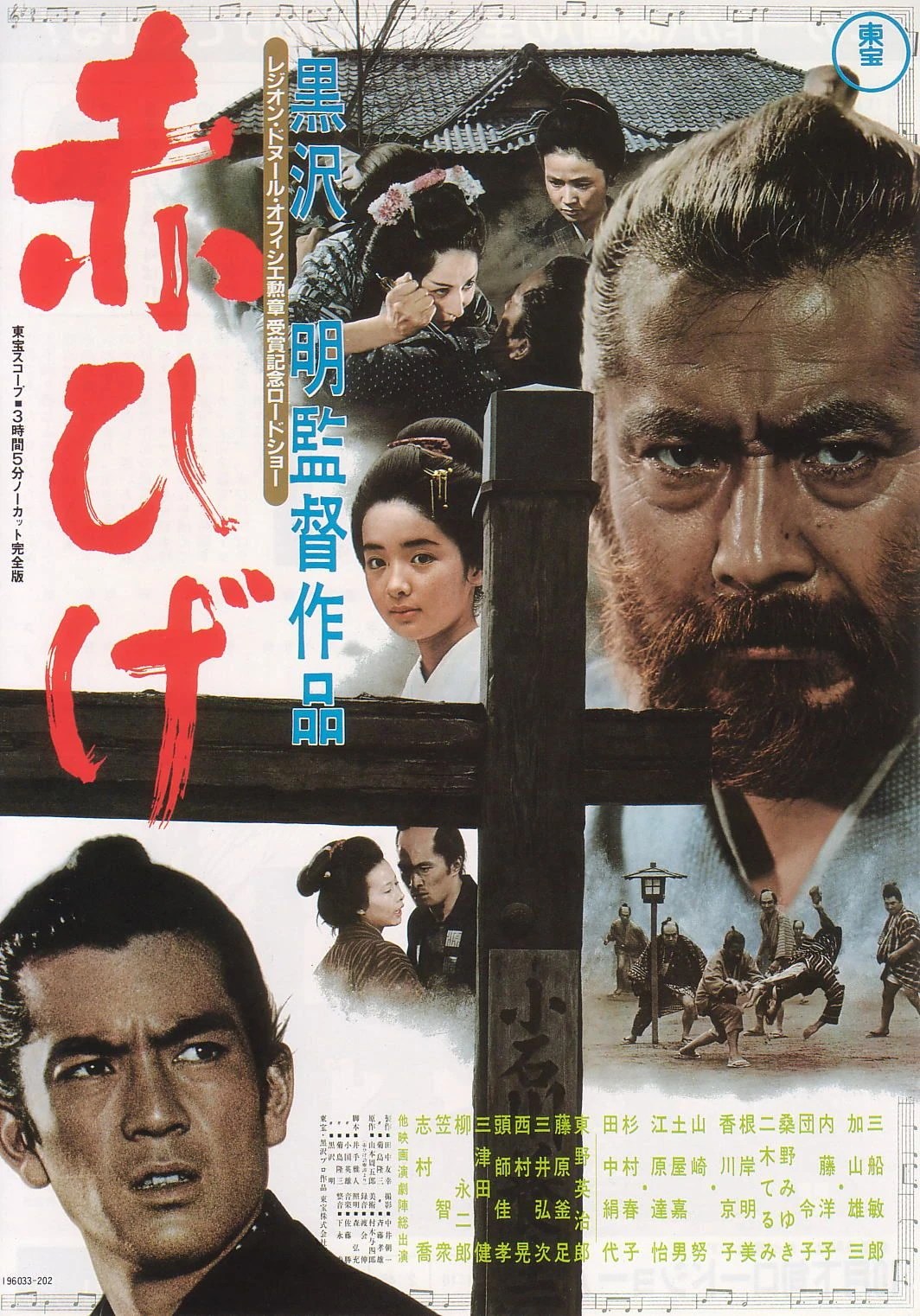
Kurosawa saw RED BEARD (1965) as a turning point in his filmmaking, acknowledging that his subsequent films would be different. The film shows no traces of all the experiments with sound, editing, portable cameras or narration that younger filmmakers from all over the world were engaging with at the time. It’s classic, humanist cinema in the best sense. Structurally it’s almost Dr. Kildare -ish: a young doctor (Yuzo Kayama) learns wisdom from a gruff wiser one (Toshiro Mifune) who gently guides him through whatever ethical or medical problems present themselves. A comparison to MARCUS WELBY MD would also not be inappropriate, given the episodic structure of the Kurosawa film. But these are only surface comparisons.
The episodes in RED BEARD are much grittier, harsher: A young mad woman tells stories of sexual abuse as she kills men with her hairpin (Is this where Almodóvar got his opening for MATADOR?) The second story is of a woman who rejected her husband for his younger clerk and married off their daughter to him so she could continue her relationship with him. When the clerk asked his now wife to ask her father for money after he’d stolen his wife and his daughter, she stabbed him. The third story starts with a body found after a mudslide. A man reveals it’s his wife and tells of an impossible love – she’d been bonded for ten years to another — that led her to commit suicide. We see also a young girl captured into sexual slavery at the age of 12; of a young boy who causes his whole family to attempt suicide after he’s caught stealing food. ‘ Poverty’s a political problem they say. But what has politics ever done for the poor?’ asks Red Beard.
The story is the young Doctor’s. He’s been educated in Western medicine and expected to work for the Shogun but circumstances and politics force him into this clinic for the poor, who he initially sees as smelly and inhuman. The change and journey are his. Red Beard’s guidance and his own experience lead him to understand fragility, empathy, compassion, kindness. In his marvellous review of the film, David Denby said that it should be required viewing for all doctors.
RED BEARD is 185 minutes with an intermission half-way through at 1h47. It took two-years to make and would be Kurosawa’s final collaboration with Mifune. The film is set in the 19th century and it views a bit like the equivalent of reading a 19th-century novel, with sweep, detail, and a moral centre. It has a touch of soap which makes the viewing compulsive but cut through with the style of telling and the grit of the tales themselves. The mise-en-scene is as precise, economical and evocative as good writing. And it’s a film that is always conscious of the viewer: Mifune’s fight scene outside the brothel being the most blatant example. It’s a film that can seem old-fashioned but which I prefer to call classic. I loved it.
Images


José Arroyo