Monthly Archives: July 2018

Eavesdropping at the Movies 71 – Hereditary – Second Screening


DSC03722.jpg

We go deep on Hereditary, occult/folk horror, and indeed horror in a wider perspective with guest contributor and horror guru Dr. Matt Denny from the University of Warwick, a film scholar with a particular interest in precisely the milieu Hereditary occupies.  He brings an insightful and informed perspective to the film, picking up the baton where Mike and I dropped it in the previous podcast, and running off with it.

We consider what the occult sub-genre is, what makes such stories interesting and where Hereditary in particular digresses from them, and the effects that has. Matt offers a historical perspective on the treatment of women in horror and how the film puts forth a muddled version of that, and the influence of Kubrick (in particular The Shining) on the film. We consider Mike’s dislike of how the film hides information or clues behind codes, and Matt suggests that this is really just a function of how this type of film works – and indeed how the occult works. And is it reasonable that Mike associates the occult film with British cinema in particular? We also discuss the cost and benefit of  the film operating in between genres and return to the question of whether the film might be misogynist. Andrew Griffin raised the question of the film as an allegorical attack on the US religious right that José forgot to bring into the discussion but that some of you might have views on (and if you do please share them.

All this and more in a fascinating discussion.


The podcast can be listened to in the player above or on iTunes.

With José Arroyo of First Impressions and Michael Glass of Writing About Film.
Eavesdropping at the Movies 70 — Hereditary

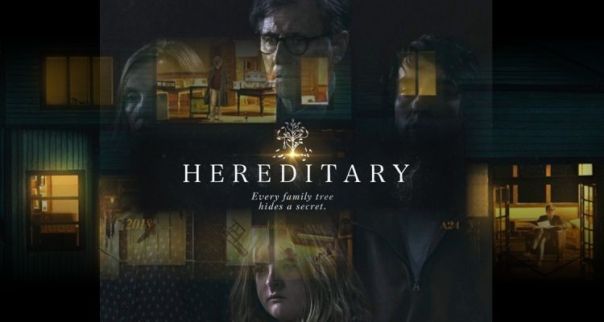
hereditary-poster-featured-image-750x400

An accomplished film, with good use of long takes that nonetheless feels visually and narratively unsatisfactory. I hated the grey look of the film and how little attention seems to have been paid to the use of colour. Our conversation includes considerations of the compositions and props, including repeated imagery of miniature models of the family’s home, and complaints that it feels that the film’s various patternings don’t add up, or at least we can’t add them up: we feel they’re meant to be expressive but we can’t figure out what layers of expression they might be adding.

The Horror genre has been the most consistent and incisive of genres in critiquing American culture recently but is this a particularly good example of it?. What are these film’s themes and what is it saying? Mike compares it to Kill List, It Follows and we digress onto a discussion of The Exorcist. We wonder if it might be part of the film’s project to go off the rails. If so, it succeed. We both love Toni Collette but we discuss also how  in its cruel and brutal treatment and imagery of women there might be a whiff of misogyny, in spite of a potentially feminist slant of Toni Collette’s character voicing things women might feel but are rarely allowed to express. Is it as clever as it thinks it is? What is it about? Mike really likes the way the camera is used, how it frames and re-frames in long-take, how that enables an appreciation of the performances and earns the trust of the viewer. Gabriel Byrne is wasted.


The podcast can be listened to in the player above or on iTunes.


With José Arroyo of First Impressions and Michael Glass of Writing About Film.

Bob & Carol & Ted & Alice (Paul Mazursky, USA, 1969)

Screen Shot 2018-07-01 at 10.48.49

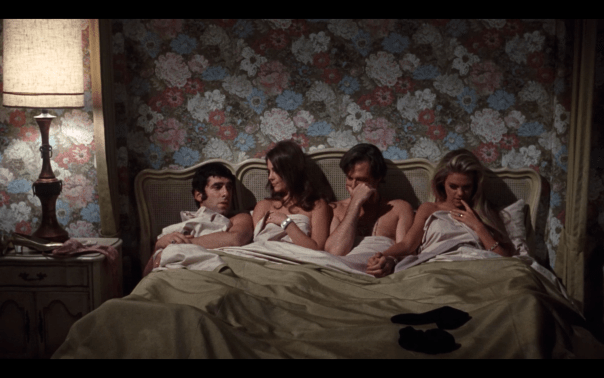
A film from a time when movies were America’s national theatre; ideas were explored and dramatised in order for the audience, which was then the nation, to have a discussion on how to be, how to love, how to strive for personal freedom without hurting others and in a world where the old certainties no longer held and new ways of being hadn’t yet been codified and entrenched. Bob & Carol is very much a film of its time, a Hollywood film of its time. Bob (Robert Culp) and Carol (Natalie Wood) go to a seminar where they learn that the path to personal freedom is to be honest about their feelings and express them. This leads to their exploring an open relationship, which at first shocks their closest friends, Ted (Elliot Gould) and Alice (Dyan Cannon) and subsequently disturbs Alice and entices Ted. At the end they all end up in the same bed and the closing song is the Burt Bacharach hit, ‘What the World Needs Now (Is Love Sweet Love)’.

Screen Shot 2018-07-01 at 10.52.20 1
Natalie rocking a mini

Bob & Carol & Ted & Alice was an enormous success, reportedly grossing over 30 million on a 2 million dollar budget. It was the fifth top grossing film of 1969 and it’s worth mentioning that the films above it were, in order, Butch Cassidy and the Sundance Kid, Midnight Cowboy, Easy Rider and Hello, Dolly! Below it were Paint Your Wagon, True Grit, Cactus Flower, Goodbye Columbus, and On Her Majesty’s Secret Service. The struggles between the old dying Hollywood (Hello, Dolly! Paint Your Wagon, True Grit) and the new and emerging one (Midnight Cowboy, Easy Rider) playing out in the list itself, with Cactus Flower, On Her Majesty’s Secret Service and Goodbye, Columbus attempting to manoeuvre new ideas and ways of being into old forms.

Bob &Carol is more adventurous, both formally and thematically. It’s a zeitgeist film that still holds up well today. The opening scene with nude women basking in the sunshine as we hear Handel’s Hallellujah chorus; Robert Culp’s Nehru jackets, frilly collars and cuffs, and multiple beaded necklaces; Elliot Gould, giving a great performance but then seen as ‘ethnic’-looking and with the hairiest back in the history of the movies;  the mini-skirts; the pot-smoking scenes, and the final orgy: all speak their time. The glossy cinematography by Charles Lang is lovely to look at and it’s worth saying that Natalie Wood, who is less ‘good’ than Gould or Cannon, is nonetheless filmed as the movie star she was, and there are moments where she seems to glow and refract light; it’s a great pleasure to see. Quincy Jones’ score is a triumphant mix of the classic and the mod or the melding of two types of classic as when Sarah Vaughn sings Handel.  Paul Mazursky’s take is always a funny and loving one, and in this instance, made both more pleasurable but less complex by being glitzed up, yet still asking questions pertinent today (see for example the great scene with Ted and Alice discussing consensual sex in marriage) . It’s a film that still holds up, hugely enjoyable and currently on MUBI.

Screen Shot 2018-07-01 at 10.56.11

José Arroyo