Monthly Archives: July 2018

Eavesdropping at the Movies: 75 – Hotel Artemis

hotel artemis

A tight yet sprawling high-concept thriller, Hotel Artemis features glorious performances from Jodie Foster and the wonderful cast that surrounds her, surprising pathos and a beautifully built world. José expounds upon his love for Foster and explores the details of her performance here; Mike discusses what makes the world-building so effective and elegant. We’d have liked to have seen stronger, more expressive visual storytelling – there’s so much potential in this single sanctuary hidden within an unforgiving world – but, well, nobody’s perfect.

The podcast can be listened to in the player above or on iTunes.

With José Arroyo of First Impressions and Michael Glass of Writing About Film.

A Visit to The Cinema Museum/Lambeth Workhouse

DSC05875.jpg

The entrance to the Lambeth workhouse complex Chaplin suffered through as a child. Inmates were checked in at the black door, then separated by age and gender. Chaplin and his brother Sidney got their heads shaved on the right. The Master’s House is on the left.

DSC05877.jpg

The substantial house of the Warden of the Lambeth Workhouse is now the site of the Cinema Museum. We went there knowing nothing about it, ignorant even of the opening hours, so we found it closed. A very nice man called Ronald, came down, explained that the museum gets no funding and that its opening hours are restricted but nonetheless took the time to explain the connection of the workhouse and the area around it to Chaplin. Nicky Smith subsequently directed me to this BBC World Service Program, where that nice Ronald, turns out to be Ronald Grant, the co-founder of the museum in 1986, who gives an enlightening and moving account of his love of cinema, his career as a projectionist in Aberdeen and London, and what led to his co-founding of the museum with his friend Martin: on a trip to Aberdeen in 1981, Mr. Grant was made aware of the availability of the contents of 13 cinemas, which formed the basis of the museum in 1986. The museum moved around various locations until 1998, where they were offered the current building. It is now threatened with closure as the building is being sold right from under them. At worst, the collection could end up dispersed but even if another location is found, the oh-so-important and poignant connection to Chaplin will be lost.


IMG_2796.jpg

Whilst I looked wistfully at all the old projectors, cameras, posters and artifacts that I wouldn’t be able to study properly, Ronald kindly went in search of pen and paper to draw us a little map of the areas’s various connections to Chaplin: homes, schools, taverns, the Oval tube that is an inspiration for some of the scenes in City Lights, etc. It was a hot day so we only made it to a few (see below).

I did manage to buy Stephen P. Smith’s illuminating The Charlie Chaplin Walk (London: Sigma, 2010) which is very poignant on this episode of Chaplin’s life: The fortunes of Hannah, Chaplin’s mother, ‘spiralled downwards. Charlie’s father ceased his payment of ten shillings a week. She started having migraines and when she became unable to work, her sewing machine was repossessed. She sought legal guidance and was advised to seek support from the Lambeth Borough authorities: this meant the workhouse’.

IMG_2865.jpg

‘The family were to spend time both here in the Lambeth Workhouse and the Newington Workhouse on Westmoreland Road. A workhouse was for people unable to sustain themselves. They were designed to be as unattractive as possible with dormitory accommodation, separation of men, women and children and a rough workhouse uniform. Food was basic, such as gruel, bread and cheese. The able bodied had to work at breaking stones or picking apart old ropes. ….Look up at the austerity of the old water tower, the brick tower with the dark capping. Standing out as it does, an ironic beacon to the poor, it would not have looked out of place on the drawing board of Albert Speer’ (pp.31-33).

Chalin’s Little Tramp is still the dominant signifier of cinema worldwide. In recent travels from Istanbul to Ljubjlana (above left) to Zagreb (above right), his is the name or image that crops up most often in relation to cinema. It seems appropriate to me that the Cinema Museum in London be housed in the workhouse he was condemned to in his youth.

IMG_2814

The poverty that condemned Chaplin to the workhouse might also be responsible for condemning the museum out of it. The museum is currently threatened with closure. A host of stars have come out in support (see above) and there’s a petition going around to save it, which I hope you will sign (simply click on petition above).

I was also quite taken with the image below. At a time when London was the capital of the biggest and richest empire in the world, Chaplin was in the workhouse. The last ten years of austerity are surely a factor in the Cinema Museum’s current woes. And nostalgia for a time when Britannia ruled the waves is a factor in the current Brexit folly. It all ties together neatly, if also sadly.


IMG_2812

José Arroyo


Eavesdropping at the Movies 74 – Skyscraper

0206-the-rock-skyskraper-poster-2

The Rock is the action star of the moment and despite Skyscraper‘s lacklustre title, we enjoy his latest vehicle a lot. It’s mechanical, predictable, corporate, obvious, and not even shot and edited that well, but we don’t really care. It features a gem of a setting, a great central performance from an enormously likeable star, depicts disability in a remarkably sensitive way, generates decent threat and tension despite obvious flaws in how it does so, is wholesome as hell, and Mike wants The Rock to be his dad.


The podcast can be listened to in the player above or on iTunes.

With José Arroyo of First Impressions and Michael Glass of Writing About Film.


Seeing films in Ljubjlana


IMG_2339.jpgWe had some trouble seeing films in Ljubjlana. We visited the Kinoteka, the exhibition venue for the Slovenian Cinémathèque but that was closed for the Summer, a loss to us, as the remnant of the previous programming we saw was very exciting. We looked at what was on offer in mainstream cinemas and were enticed by some offerings: the new Ant Man film seemed to be on release there and still to arrive in England. However, all the screenings were in Slovenian, sub-titled films were only on offer on Tuesdays and we would be off on the rest of our travels before then. There did seem to be a thriving film culture, with a video store advertising all the latest releases, including a wide array of art house (see above).

Lucky for us we chanced on the open air screening of Ildikó Enyedi’s On Body and Soul, winner of this year’s Berlin Film Festival Golden Bear, and in its original Hungarian but with English sub-titles at Ljubjlana Castle, a most romantic and appropriate venue for the movie, as you can see from the little bit I filmed (above), taken from perspective of the park in the city centre, which was hosting a dance show (thus the accompanying music).

DSC05254.jpg

One can walk up to the castle or take a cable-car up. The price of the film and the cable-car is around seven euros, very reasonable, and offers extraordinary views of Ljubjlana (see above).

Once you arrive at the Castle-keep, there’s a large screen at the centre with hundreds of fold-out seats, and tables at the back where one can order drinks, sit back and watch the film above. It’s a lovely way of seeing films in Summer (see below).

It was delightful to be up high in the open air, sip cocktails, and watch an audience riveted by a demanding film such as On Body and Soul. The film is set in an abattoir, with lots of quite frank and rather brutal butcherings of animals; the camera often links the cows in the abattoir to the people who are butchering them and who are also in some ways imprisoned by the demands of their work-place;  ethical questions are raised about what the workers feel and whether they pity the animals such a fate; there’s a lot of sexual shenanigans going on; who’s cheating on whom, who’s sleeping with whom; who has sexual power when and how that power is gendered. But the focus is on Endre (Géza Morcsányi) the soft-spoken director with a cool head and useless arm who seems to have given up on love and the slaughterhouse’s new safety inspector, Mária (Alexandra Borbély) an obsessive compulsive on the autism scale who has an aversion to touch.

IMG_2343They meet only in their dreams, which they share and where they take on the form of a buck and a doe. The beautiful animals in a snowy pastoral setting are contrasted with the brutal carnal fate of the cows. Endre and Mária share a dream life as beautiful animals in a snowy pastoral setting and a work-life in space designed to profit out of filling. Can they reconcile or surmount dream and waking lives? It’s a beautiful film; and Ljubjlana Castle was a beautiful place to see it in.

IMG_2233.jpg

The venue and the film did raise questions for me about the increasing embourgeoisement of at least one kind of cinematic culture which I’ll have to give some more thought to.

José Arroyo


Eavesdropping at the Movies 73 – Incredibles 2

inc

After a fourteen-year wait, The Incredibles are back! We discuss how well the comedy is directed, how full of ideas the action is, and our love of Edna Mode and the mad baby. José finds food for thought in the conceptualisation of the antagonist, while Mike makes sure the animation, somehow so often overlooked in animated films, is given its due. And we discuss the imbalance in the treatment of the two main characters, Mr. Incredible and Elastigirl.

The podcast can be listened to in the player below or on iTunes.

With José Arroyo of First Impressions and Michael Glass of Writing About Film.

Zagreb School of Animated Film

The Zagreb City Museum also has a superb display on the Zagreb School of Animated Film.  A film studio for animated films was established in Zagreb in 1956. Success came quickly and Samac/ Lonely Guy, a short by Vatroslav Mimica won the Grand Prize at the Venice Film Festival in 1958By 1959, at the Cannes Film Festival, George Sadoul was already writing of the Zagreb School of Animation, with comic-strip artists Adrija Maurović and Walter Neugebauer providing a central influence and offering a particular direction. In 1962 the studio won an Oscar for Surogot/ Surrogate by Dušan Vuckotić, the first non-American Oscar recipient.

Apart from the photographs and original drawings, which were used in films produced by some of the most famous artists from the Zagreb school, the fantastic display at the Zagreb City Museum also shows some of the original celluloids from the Professor Balthazar animated television series which ran from 1967 to 1968 and was an international success.


IMG_2616.jpg
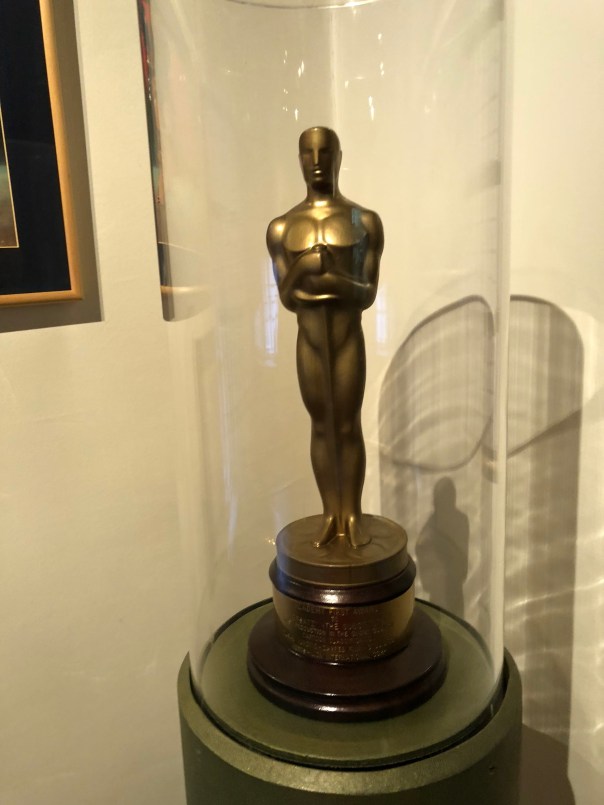
Oscar for The Surrogate


The traditional mode of filming was to draw the first sketches on the basis of a script and a storyboard, produce them on a drawing board, and then transfer them to celluloid with a rostrum camera (above). Twenty four drawings, one per frame, were required for a second of animated film (see examples below from Surrogate).

The reason for posting on this is that I was thrilled to see the rostrum camera (above) and thought some of you might be as well and also because I wish more people would visit the City Museum of Zagreb. It’s a great place.

IMG_2615.jpg

IMG_2611

José Arroyo

Mechanical music devices at the Zagreb City Museum

The City of Zagreb museum has the most extraordinary collection of mechanical musical devices, running the whole gamut from pianolas, to automatic music scrolls, to victrolas, to very impressive painted and lacquered cabinets. I think some of you will find this interesting, particularly those of you interested in early cinema (a lot of the scrolls feature Edison).

IMG_2677

IMG_2678.jpg

IMG_2669.jpg

IMG_2684.jpg

IMG_2686.jpg

IMG_2697.jpgIMG_2681.jpg

IMG_2688.jpg

IMG_2702.jpgIMG_2672.jpg

Haine, Amour et Trahison

A rather dull melodrama directed by Mario Bonnard, barely worth a look in except for the fact that it co-stars Brigitte Bardot and Lucia Bosé. It’s about two brothers, Austrian nobles, one is artistic and good and sides with Italy; the other is the kind who’d have his own brother killed and naturally sides with Germany. Bardot and Bosé, both extremely young and extremely beautiful, never appear together: a loss to cinema.Screen Shot 2018-07-14 at 09.52.56.png

I’m here interested only in costuming, placement, attributions of character through visual associations. Bardot here is the good, sober, religious, child-loving, nursing and nurturing good woman, i.e the kind of role she’d stop playing as soon as she got any say. I here want to simply show a series of images, in chronological order, of how she’s presented in the film:

Brigitte Bardot, cast against what would later become her type, and exemplifying ‘eternal’ virtues :

Buttoned up and leading a choir

From choir to ball to marriage proposal

straight-laced, even in decolletée

braided, hatted, collared-up and married

With priest, baby, as a nurse, and near Jesus

Screen Shot 2018-07-14 at 10.23.12 copy.png
As if all the above weren’t enough, Brigitte sews!

In the country in peasant dress exemplifying the virtues of the countryside; in the middle, the virtuous and self-sacrificing mother; and, on the right, with priest, in lace, demonstrating forgiveness. She’s a Saint that Bardot.

Lucia Bosé: She’s a double-crossing spy in this one, in love with the man Bardot will marry and out for revenge. How can you tell she’s bad? She sings in a cabaret, she smokes, she’s draped in lots and lots of fur, adorned with feathers, and in public places women shouldn’t really be in, holding her own, looking beautiful, and smoking. It will all end in tears, but sad and glamorous ones. 

What fool of a director was Bonnard to not give these two a single scene together? Two very limited, very stereotyped, and very sexist views of womanhood. And yet, not without their pleasures.But for whom?


José Arroyo

From ‘Le regazze di piazza di Spagna’

renato-and-lucia.gif


Lucia Bosé and Renato Salvatore from Le regazze di piazza di Spagna

*sigh*

José Arroyo


Learning How to Be Gay via Sara Montiel in Almodóvar’s La mala educación/ Bad Education

sara el ultimo cuple

In his chapter on Judy Garland in Heavenly Bodies, Richard Dyer talks of how he and a generation of homosexual men learned how to be gay by learning a particular way of appreciating Judy Garland. One might be born homosexual but one learns how to be gay. Discourses on film stars in a particular period were a way of learning how.

One could also gather this knowledge then from finding particular ways of appreciating a variety of stars. See for example the fan-boy tizz Christopher Isherwood gets into at the thought of meeting Lana Turner in his diaries or Tab Hunter’s account in his biography of being gobsmacked at the sight Marlene Dietrich when he met her by accident at Dot Records were they both recorded; or simply look at Rock Hudson’s duet with Mae West at the Oscars. Each leaves a trace of a process of learning how to be gay, each which involves an element  of camp.

For later generations the learning of an identity involved the particular significance to gay men of what Cher or Liza or Diana represented (Warhol’s diaries are fascinating on this). For later generations still, Madonna, or later than that Britney. I’m to old to know who the current gay divas are and I’m not sure if in the West they’re even necessary. But they once were. And every country had them. Think of how Dirk Bogarde writes of Jessie Matthews, what María Felix meant to gay subcultures throughout Latin America, or the cult of Arletty in France. In Spain, during the late Franquist period, that figure is Sara Montiel.

Screen Shot 2018-07-11 at 16.28.45.png

In Bad Education, Almodovár dramatises this beautifully when, after they’ve acknowledged their attraction, the young boys Ignacío (Nacho Pérez) and Enrique (Raúl García Forneiro) go to the talismanic Cine Olympo to see Sara Montiel, in Esa Mujer/ That Woman (Mario Camus, 1969). She plays a former nun, who renounced the order but now wants to return. Who she asks, will remember her sins now? But it seems the mother superior does, and can’t forgive, ‘It is not God who rejects you but I…In the name of my order!

Screen Shot 2018-07-11 at 16.29.39

The boys share an appreciation of Sara: ‘Sara is so beautiful’; what they’re watching is a performance of femininity, one which involves transgression, being sexual, behaving against established norms, sinning against religion, being outcast and surviving. Below, in the middle of their first sex act, Almodóvar intimates, that the boys already know all of this, that Sara is teaching them. It will foreshadow and rhyme with what will happen to them subsequently.

Screen Shot 2018-07-08 at 14.35.05

Later in the seminary dorm, where the boys’ beds are filmed like coffins with crosses, indicating that the Church, which should be protecting these children, is in fact damaging them in many different ways that are each a kind of death, Ignacio tells Enrique, ‘what we did in the cinema wasn’t right’. ‘I liked it’. ‘So did I. But I think it was a sin and God will punish us’. ‘I don’t believe in God’ ‘What do you believe in?’ ‘I’m a hedonist’. ‘What’s that?’ ‘People who like to have fun’. But that fun will also lead them, like Sara, to being cast out, rejected, and unlike Sara, not all will survive.One’s hurt will become the other’s film.

Screen Shot 2018-07-12 at 08.53.40.png

Our first introduction to Sara happens in fact earlier in the film, extra-diegetically in Gael García Bernal’s title credit at the very beginning of the film (see above), and diegetically, in the first flashback, which is done narratively through Enrique Goded (Fele Martínez) reading the story, but which we will later learn is in fact a film within the film.

The first presentation of Gael/fictional Ignacio/Angel as Sara is already done prismatically, through several kinds of refractions that distance even as they compose a mosaic of a figure and a memory. It’s a spectacular unveiling of a drag version of a star persona.  ‘She defines herself as a mixture of desert, hazard (which is also the fictional name of Enrique’s production company — El hazar, S.A.) – and cafeteria,’ says Paquita (Javier Camará), accentuating the camp, and then she presents, ‘the mystery, the fascination of the one and only Zahara’.

It’s also done through camp, and one can see several discursive characteristics of the term displayed in the clip above: aestheticism, detachment, irony, theatricality, frivolity, parody, effeminacy and sexual transgression, a sub-cultural form of communication here at play in different registers in a mainstream bar (see Fabio Cleto’s excellent introduction to a historiography of the term in his introduction to Queer Aesthetics and the Performing Subject: A Reader. It’s worth reminding ourselves of Sontag’s characterisation of the term as a ‘private code’ and a ‘badge of identity’, or as Richard Dyer and Jack Babuscio would see it later, as a subcultural form of communication not available to everyone in the same ways.

According to David Bergman in Cleto’s collection, there are a few points of agreement when it comes to accounts of what ‘camp’ is and how it functions: ‘First everyone agrees that camp is a style (whether of objects or of the way objects are perceived is debated) that favours ‘exaggeration’, artifice’ and ‘extremity’. Second, camp exists in tension with popular culture, commercial culture and consumer culture. Third, the person who can recognise camp, who sees things as campy, or who can camp is a person outside the cultural mainstream. Fourth, camp is affiliated with homosexual culture, or at least with a self-conscious eroticism that throws into question the naturalization of desire’.

The unveiling of Ignacio/Angel as Zahara through Jean_Paul Gaultier’s costuming of Gael García Bernal and Almódovar’s filming of it is quite extraordinary. We first hear the music to one of Sara Montiel’s biggest hits, ‘Quizas, quizas, quizas’, then the camera pans up a trail of see the back, glistening with sequins on a figure hugging dress, accentuating the bum. Then Zahara turns around and we see what is meant to connote her sex, here depicted as an irregular and out of place triangle of tightly-coiled material. Next to it is the red carnation Sara was so famous for. Zahara brings it up to her lips and as she does so we see the externalisation of faux breasts, hiding the breasts beneath, which we know to be falsies. Zahara then begins to sing one of the songs most associated with Sara Montiel, in that breathy, naughty ironic way, hiding and revealing, indicating transgression whilst hiding that which it promises to reveal, so characteristic of Sara herself (see clip below)


What I want to draw attention to is Almodóvar’s extraction of a key set of characteristics entirely associated with one star — Sara Montiel — in a re-enaction of those characteristics — so meaningful to so many, yet so little known by Zahara’s audience in the bar and to so little effect — that is not just a re-enaction of Sara by someone else but a performance through Sara’s star persona that creates and communicates something new but largely only to those in the know (and I say this not only via reference to the customers in the bar in the clip above but as someone who’s taught the film in England to students who know nothing of Sara Montiel).

I include the clip above to indicate some of the characteristic Sara-isms (from Varietés) and the process by which Ignacio/ Angel goes about learning them (see clip below)

I also want to indicate a difference in the way that the boys’ shared appreciation of Sara is part of the process of learning to be gay and the way Angel/Ignacio sets about learning about how to perform Sara. Both are inductions into a culture. And Angel/Ignacio will have to learn about  how Sara is meaningful before being able to perform her in a way that is legible to an audience. But the difference is that the young boys see Sara as a way of making sense of their lives and being able to survive society’s judgment of who they are through what she represents; For Angel/ Ignacio, heterosexual but gay for pay, it’s a queerer experience: it’s something that can be learned, and he will learn it, he’ll be able to express it through what it means to others but not to himself, it’s so meaningful that he’s willing to kill for it, but only as a means of gaining success, not as a way of living through, working, through, surviving, identities that are marginalised and oppressed. There’s much more to be said about this, remember Angel/Ignacio’s line, ‘you don’t know what it’s like to grow up with a brother like Ignacio (feminine, transvestite in the process of becoming transsexual) in a small village’. And of course that must have been difficult. But imagine what it must have been like to be  Ignacio himself.  I suppose that’s the difference in the learning how to be Sara that’s most salient to me from that of the boys in the cinema to that process of learning/imitating/performing gendered identity that Angel/Ignacio/Zahara undergoes.


José Arroyo

Varietés (J.A. Bardem, Spain 1971)


Sara Montiel, with the most intricate eye-shadow I’ve ever seen a film star wear in a movie, is the main reason to see Varietés. The film was her idea. In her memoir, Sara Montiel, Memorias, Vivir es un placer (Barcelona, Random House 2000), she writes of how she convinced producer Eduardo Manzanos that  ‘we could make a film to our taste, a musical, luxurious, if that’s what he was interested in making. And Juan Antonio said yes; even though he’d never made a musical, that was no problem, because I could take care of that aspect’. She writes of how she loved his script so that she didn’t change a thing. How she believed he’d been a marvellous director and how she needed a film of a director of that calibre. ‘For me’, she adds like the diva she is, ‘Juan Antonio’s best film is Varietés; (pp. 367-368).

varietes disco

For fans of Sara Montiel, and they were legion at that time — she was not only the superstar of Spanish cinema but also box office throughout Latin America and in countries like Italy and Roumania —  the film is full of pleasures, many of them campy. She sings some beautiful standards (Te lo juro yo, Lagrimas negras, La bien pagá, Toda una vida), is carefully photographed through more gauze than Doris Day in her later years, is always at the centre of everything — this is a true vehicle for her — and brings that slightly ironic naughtiness around issues of sex, interwoven with and superseded by the full-blown romanticism that is a trademark of her films.

For fans of Juan Antonio Bardem, Varietés is a sadness. Here he is cannibalising one of his great 50s films, Cómicos (1954), which in turn had been derived from All About Eve (Joe Manckiewicz, USA, 1950)As you can see in the two clips below, Varietés borrows not just plot and structure but situation, lines of dialogue, even, later on in the film, tropes like the use of mirrors.

Varietés is a musical remake of Cómicos: instead of telling us about the life of actors in provincial theatre troupes, he tells us the life of performers in provincial music-hall troupes. But the older film is more concrete, more complex, with more inventive compositions. It’s not quite up to his collaborations with Berlanga like Bienvenido Mr. Marshall or his own  Muerte de un ciclista (1955) or Calle Mayor, but it’s very good indeed and has become a classic. Varietés is a great vehicle for Sara Montiel, which is why she thinks its his best film, but those are quite different things.


As a musical, Varietés if full of pleasures: Sara herself, the great songs, the clear attempt at making glossily produced musical numbers à la MGM. Sara and her producer had set out to make a luxurious musical, by which I think they meant expensively produced, and by the standards of Spanish cinema they succeeded. The songs, the costumes, the back-up dancers, the choreography. It’s all there. But Spanish cinema’s idea of luxury in that period was often not much more than a musical number in the Sonny & Cher Show: the back-up dancers are relatively meagre in number and not always in step, the costumes are embedded with shiny rhinestones but nonetheless look a bit cheap, the choreography lacks inventiveness and rarely done for the camera as in the great Arthur Freed musicals. The film aims for an international standard but succeeds only on a national one.

There are two further things about Varietés that caught my eye. In the original Cómicos, shot at the height of Franquist repression, the young ingenue Ana Ruiz (Elisa Galvé), tired of waiting by the wings, is offered the opportunity of headlining her own show but the price is that she’d have to sleep with the producer Carlos Márquez (Carlos Casaravilla). She considers it, struggles with it, but ultimately turns him down. In this film, Sara being Sara considers it all too briefly, wishes that that weren’t the bargain, but succumbs. The change in representation marks a difference between what was permissible in the dictadura (the hard dictatorship) and the later dictablanda (the soft dictatorship).

The last thing that I’d like to comment on here is a question. Did Bardem invent the musical montage of the kind so typical of the 80s, where a series of shots are rendered coherent by a song so as to evoke a feeling? See the montage below, where Sara succumbs to her producer’s demands but instead of feeling shame she feels joy (very Sara: It’s why so many gay men loved her). It’s from 1971.

José Arroyo


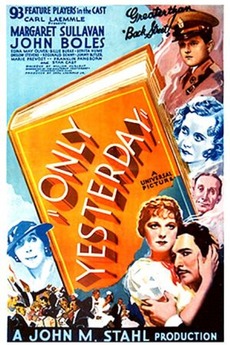
Only Yesterday: Pangborn Pansies and Pre-Code Feminism

92547-only-yesterday-0-230-0-345-crop

On the 29th of October 1929, James Stanton Emerson loses everything in the Wall Street Crash. He returns to his Manhattan penthouse apartment to see his wife with her new lover throwing a party even as the husband of one of the guests has already committed suicide. He excuses himself to go to his study to do the same but discovers a thick letter. As he reads it, the film flashes back to the story of Mary Lane (Margaret Sullavan), how she fell in love with him, had his child and said nothing. We also get to see how, though he’d forgotten who she was much less what he did with and to her, there were several instances where he was once more drawn to her, once more tried seducing her, even though he’d forgotten he’d done it before and forever altered her life. In the end, Mary dies, all too young. But James Stanton Emerson, played by John Boles with all the stuffiness the name suggests,  finds a new reason for living in recognising as his the son he never know he had.

Screen Shot 2018-07-10 at 14.03.12.png

It’s melodrama, typical of the ‘Fallen Woman’ cycle of the early thirties. But it’s one of the better exemplars. Tom Milne compares director John M. Stahl’s filmmaking in Only Yesterday to Bresson. George Morris compares it in Back Street to Dryer. I can understand the comparisons but the three things that struck me most watching Only Yesterday were as follows:

1) whilst the film is ostensibly based on a popular history (not, Lawrence Napper informs me, a novel as is commonly assumed)  by Frederick Lewis Allen, the plot is directly lifted from Stefan Zweig’s Letter from an Unknown Woman, the 1922 novella that Ophuls would turn into a masterpiece of a film in 1948 with Joan Fontaine and Louis Jourdan.

2) I was also very excited to see the clip I’ve extracted below, another Pangborn pansy, but this time accompanied by what is clearly coded as a boyfriend. I thought I was discovering something new but I see that in the imdb entry, under ‘Trivia’,  we’re told, ‘This movie, made shortly before the tightening of the Production Code is the only one in which “screen queen” Franklin Pangborn had a boyfriend’.


‘That heavenly blue against that mauve curtain. Doesn’t it excite you? It does something to me’.

3) The feminism of Aunt Julia played by Billie Burke. I’m often surprised to see it so clearly and problematically asserted in ‘Pre-Code’ cinema. Another example of this is Bette Davis in Ex-Lady. Here Aunt Julia tells her niece Mary (Margaret Sullavan) ‘Women have cut more than their hair. That’s just a symbol. We’ve cut a lot of the old silly nonsense. We can get good jobs now. We’re not dependent any longer. What’s more we’ve kicked the bottom out of that old bucket called the double standard’.

Tom Milne in the Monthly Film Bulletin wrote that the feminism of Aunt Julia  ‘is considerably undercut by the fact that she is engaged in a dithery romance which follows the conventions it seemingly denies.’ I don’t agree. It’s true that she ends up marrying a much younger lover. But that he is much younger is in fact a defiance of the conventions of the period and an assertion of a particular kind of freedom.

Only Yesterday is a very good ‘fallen woman’ film of the period, shot in the style characteristic of Stahl in the 1930s: the long fluid takes; the going back in time to a moment that alters one’s life — that could have altered anyone’s life — the sobriety of the treatment, the self-sacrifice made less saccharine by stoicism, by it being embedded in a kind of American self-reliance; the minimalist elegance of the storytelling (see how a change of lights indicates the movement of the elevator in the penthouse scene at the beginning, and all that it opens up dramatically); the making legible, felt, and understood that which is socially prohibited. It’s a lovely film. But what struck me most is the three things listed above; with the last two still seeming as relevant and as modern today as ever.


José Arroyo


Eavesdropping at the Movies 72 – Sicario 2: Soldado

sicario2.jpg

Sicario 2 is the best movie for watching on a plane we’ve ever seen. It’s pacey, entertaining, catchy, and entirely insubstantial. José discusses some issues he has with the film, including how many Mexicans it’s happy to kill while keeping every American alive, and the lack of tension in scenes that are crying out for it. Mike agrees with everything Jose says and knows he should have a problem with this stuff but just doesn’t. We agree that it’s a joy to see so much of Benicio del Toro and Josh Brolin, and when they share the screen they bring a special feeling to their interplay, but the conscience that Emily Blunt brought to the first film is perhaps lacking here.

Mike keeps repeating sentences like ‘I should have a problem but I don’t.;’I know what you mean but I don’t care’. In the end we agree that it doesn’t live up to the first Sicario, and really, how could it? But it’s good, rough, dark fun.

Recorded on 2nd July 2018.

With José Arroyo of First Impressions and Michael Glass of Writing About Film.

The Cave by ODC Ensemble (Greece)


DSC03823.jpg
Lovely communal meeting and eating after the show

I love BE festival; and I admire the different shows they put on, the community atmosphere, the European emphasis. I’ve praised them many times on social media and here I think also. But there are also moments like these:

‘I went to see some performance art at BE festival yesterday. I know. I had it coming. A Greek ensemble used synthesisers, and screens to dramatise the continued power of Plato’s allegory of the cave. They sang ‘operatically’ too. Every once in a while, some disaster would be hurled out of tune to puncture your eardrums and jangle your nerves whilst the performers writhed onstage. There were a lot of disasters; every bit of fake news, the ills of social networks. Each occasioned a spasm and screech; each slashed at your eardrums. We’re meant to reflect on the walls and shadows we build around us but a young woman one seat next to me turned on her phone ten minutes into the show and left it on, cooly ignoring what was happening on stage and oblivious to her phone’s effect on the rest of the audience.. I don’t know if it was the performance or the phone  but after half an hour or so I couldn’t stand it any more: ‘Do you have to keep your fucking phone on all the time?’ The lady between us bristled, at least as upset by my language and tone as by the phone or the show. I also felt bad and tried to concentrate more fully on the show, a mistake: one really just wanted the world to end so the screeching would stop. Ugh.’

The final night was very badly programmed. The 7:00 performance was Be Festival attempt at community inclusion and was the culmination of a week’s workshopping with teens. They were marvellous: charismatic, energetic. But they’d only had a week to come up with what had taken professional ensembles months. It was a disservice to them to ask them to come up with half an hour’s worth of material in such a short time, and it was certainly an imposition on the audience. This, followed by the long ODC ensemble piece I mentioned above, plus then the dinner, made one go to Sotterraneo’s Overload, witty, intelligent, warm — surely one of the best pieces in the festival — tired, groggy, and not best placed to receive. Though actually Sotterraneo were so great that it made the audience rise to their feet at the end.

José Arroyo

A Moment from Victimas del Pecado

A friend just delighted me by mentioning that his favourite film from the 2018 ‘Il Cinema Ritrovato Festival’ was Emilio Fernández’ great Victimas del pecado/ Victims of Sin (Mexico, 1951). If you haven’t yet seen this great transgressive clip, one of the great delirious moments of melodrama in the history of world cinema, simultaneously masochistic and subversive, do. I’ve conveniently provided it for you here, with sub-titles.

\

Hollywood and the Production Code: Criticism and History (July 6, 2018, KCL)

I didn’t intend to write on the ‘Hollywood and the Production Code: Criticism and History’ one-day symposium held at King’s College London on the 6thof July 2018, so this will probably be a partial account; my notes were taken in the service of my own thinking rather than with the aim of writing  for others and is thus probably partial and incomplete. But it was such a great event –informed, instructive; a scholarly context taking into account the intellectual debates of the day on the subject at hand with the aim of creating dialogue through which to increase our knowledge, instruct us all, and point to areas where further research may be profitably undertaken – that I felt I needed to at least jot down some developments in my own thinking that resulted from the day.

The idea was structured as a combination of workshops and sets of curated and complimentary papers on particular areas. The day before the event two films were screened: John M. Stahl’s Back Street from 1932, a celebrated ‘Pre-Code’ film; and Preston Sturges’ The Miracle of Morgan’s Creek, famous for making comedy of a young girl (Betty Hutton) getting drunk, getting pregnant, and not being able to remember who she slept with, thus getting around many of the taboos the code prohibited. Participants were asked to view the two films with the aim of contributing to the two workshops the following day, in which the two films would be the focus of case studies on the influence and deployment of the Production Code. So contrary to the usual assumption underpinning the standard academic conference, which is to showcase the state of one’s own research, this event was more along the lines of, ‘lets set some guidelines for discussions, have major figures in the field (Lea Jacobs, Doug Pye, Ed Gallafent) contextualise and set some parameters for it, let’s present some leading research, and let’s all collectively contribute to the discussion and see where it takes us to by the end of the day’. The developmental and pedagogic element was built into the structure of the day, with great success.

Tom Brown introduced the event with an account of what had led him and John Gibbs to pursue the subject. The goals of the day were contextualised within the landmark work in the area by Richard Maltby (“’Baby Face’ or How Joe Breen Made Barbara Stanwyck Atone for the Wall Street Crash’ in Screen). Thomas Doherty (Pre-Code Hollywood: Sex, Immorality, and Insurrection in American Cinema, 1930-34); Hollywood Censors: Joseph I Breen and the Production Code Administration), Leonard Leff (The Dame in the Kimono: Hollywood, Censorship, and the Production Code); and Lea Jacobs (The Wages of Sin: Censorship and the Fallen Woman Film, 1928-1942).

Brown also praised the new work on historiography such as The New Film History: Source, Methods, Approaches (James Chapman, Mark Glancy, and Sue Harper eds.) and how recent developments in the field on the uses of archival materials has transformed the study of film. However, great as this all is, Brown also drew on Dyer’s question of ‘Where is the ‘film’ in Film Studies’ to highlight how all this new work on film risked side-lining the films themselves. He mentioned recent accounts of Hollywood cinema that argue that the introduction of the Production Code led to no discernible difference in film style, and drew on Stanley Cavell’s discussion of the Jericho scene in It Happened One Nightin Pursuits of Happiness to argue differently. So the aim of the day was really to explore this difference that started off as intuited and felt and to bring considerations of film style back into a productive interplay with the fruits born from historiographical and archival work.

IMG_1298
Adam Vaughn offers archival evidence

The day started off with Adam Vaughan presenting his paper ‘Queering the Code’ where he examined the influence of the Code on the work of queer filmmakers and performers in 1930s Hollywood. His case studies were two films by George Cukor, Our Betters(1933) and Sylvia Scarlett(1935) and he argued that the enforcement of the Code changed representation from the explicit to the allusive and connotative. Vaughan’s demonstration of the censors’ objections to the heavy make-up on one of the queer characters in Our Betters was very illuminating.  Olympia Kiriakou also drew on archival sources to demonstrate how MGM had to negotiate the presentation of adultery in MGM’s The Women ([1939], also directed by Cukor) focussing on the scene where Mary (Norma Shearer) discusses her husband’s infidelity with her mother. The paper traced the development of the scene from the original theatrical script through the cinematic adaptation, via all the discussion with Joseph Breen, and, finally, to the finished version of the film that we get to see today. One of the interesting things that came out of the workshop was that rather than debate which is the original version, the director’s cut, that which most people saw, etc., what’s important is to at least initially keep in play the whole process in its entirety, as that might result in different questions; or, the possibility that a look at the process in its entirety might result in different, richer, answers to the same question.


IMG_1299
More archival evidence from Olympia Kiriakou’s presentation on The Women (1939)

This set of papers was followed by a workshop led by Lea Jacobs and Ed Gallafent on Back Street, part of the ‘Fallen Women’ cycle Jacobs  writes so brilliantly on in her magisterial The Wages of Sin: Censorship and the Fallen Woman Film, 1928-1942. The workshop began with a discussion of the film as an adaptation of the Fannie Hurst best-seller, pointing out how the novel was more explicit on the issue of class and race keeping the lovers apart than Stahl’s movie (the character of  Walter Saxel played by John Boles in the film is Jewish in the novel). The discussion touched on the various film versions of the novel, not only Stahl’s but also the 1941 version directed by Robert Stevenson and starring Charles Boyer and Margaret Sullavan, as well as the 1961 version directed by David Miller starring Susan Hayward and John Gavin. Which scenes changed, how were they developed, and how were they visualised from the novel to the ‘Pre-Code’ version to the subsequent ones?

Ed Gallafent offered a lovely reading of the scene between Ray (Irene Dunne) and her sister (see clip below), highlighting the way it begins by Ray looking at herself confidently in the mirror before meeting Walter’s mother, deciding not to put her make-up on, moving her belongings from a black purse to a white purse in order to make a better impression. But the song she’s humming is ‘After the Ball’:

After the ball is over,
After the break of morn –
After the dancers’ leaving;
After the stars are gone;
Many a heart is aching,
If you could read them all;
Many the hopes that have vanished
After the ball.


Gallafent underlined the importance of that song in Dunne’s career (she performed it earlier on stage in Show Boat and would perform it later still in James Whale’s 1936 film version) and also highlighted the significance of several elements in the scene: the way the sister enters the room, locks the door, and leans against it barring the way, something of a trope in ‘women’s’ films throughout the whole ‘Classic’ period; the way the sister asks questions without ending them, ‘he’s got to stay here and….’; ‘If mama were to find out anything she’d…’.;the way that Ray earlier tosses a coin about whether Walter’s mother will like her but, because of the sister’s interruption, never gets to find out which side the coin faced, and how this all underlines the element of chance in the scene.

Lea Jacobs noted how what was unspoken but clearly understood is that Ray’s sister is pregnant. The discussion teased out how the film had at the beginning set up a tension around virtue with Ray’s step-mother protecting her biological daughter’s but questioning Ray’s; how this scene demonstrates how the tables have now turned; how later on in the film the sister herself, with the husband, home and children Ray made possible, will stand in judgment of her sister, forgetting what had happened before. The discussion also indicated how the tracking shot at the end of the next sequence, where we see the band packed-up and walking down the bandstand with their instruments, rhymes with the Ray’s humming of ‘After the Ball’; and how all of this underlines chance, the ‘might-have-been’, the ‘it could happen to anyone’ which the film will underscore in its sad, final flashback. It was a very illuminating, inclusive and generative workshop.


In the afternoon papers, Kathrina Glitre in her ‘Sacred Intimacies: Sexual ambiguity and performance in My Favourite Wife(1940)’ explored the issues around performance and suggested meaning, comparing the PCA’s recommendations to key moments in the finished film. ‘How exactly’, she asked, ‘does screwball performance style enable the kind of ambiguity necessary to render sexual content appropriately ‘innocent’? The paper demonstrated how memos to and from the Breen office often remarked on something ‘as agreed’ though never putting on paper what exactly was agreed upon. Glitre also showed how the PCA’s correspondence directly addressed questions of performativity.

IMG_1304.jpg
From Kathrina Glitre’s excellent presentation

In the same panel, Martha Shearer argued that the Busby Berkeley Warners musicals of the early 30s often appear in accounts of ‘pre-Code Hollywood’ usually contrasted with the Astaire and Rogers cycle, a contrast that seems dramatic. Shearer instead focuses on Warners’ own Dames(1934) to argue that the ‘the principal of deniability’ continues to operate but through a ‘more gradual, more complex and less melodramatic evolution of systems of convention in representation’. What Shearer brought out also is that many of these films were re-released so which ones were not allowed a re-release subsequent to the more stringent enforcement of the code, which ones were edited, and what was edited out and for which reasons, may also prove a useful way of illuminating the effects of the code on the style of later representations of that which was forbidden. Lastly, James McDowell offered a thought-provoking presentation on ‘Irony, Intention and the Production Code’ arguing for how the working through, against and in the shadow of, the Production Code, should lead us to re-think the question of intentionality in relation to film interpretation.


IMG_1306.jpg
Martha Shearer, surrounded by Ruby Keeler and Dames


The afternoon workshop revolved around a discussion of The Miracle of Morgan’s Creek led by Lea Jacobs, Kathrina Giltre and Douglas Pye. Lea Jacobs offered an absolutely brilliant reading of the scene where Betty Hutton as Trudy Kockenlocker goes to the dance, gets drunk (see clip below), and later gets married to God knows who and gets pregnant. As Kathrina Giltre demonstrated, none of it was allowed by Code. Jacobs not only showed how Sturges treated it as a game to get around the censors (you never see Trudy drinking anything other than what’s listed as lemonade, though her expression highlights its sourness due to sugar being conserved as part of the war effort, a ‘sourness’ that the audience understands as her drinking alcohol; later on in the country club, drinks are offered to each and everyone but Trudy’s out of sight, etc. etc.). However, what Jacobs so brilliantly underlined is that in all the games of not showing the drinking whilst communicating that Trudy’s getting drunk, what’s really being displaced is the sex; how because she dances with so many different men, some people have talked of her having multiple partners that night, or the even darker possibility that in spite of the sexual energy Hutton so convivially evokes, she might have been so drunk she was taken advantage of or worse.

Doug Pye, equally brilliantly, spoke of tone; and the discussion also highlighted how so much of the comedy edges on darkness. Pye offered a timeline on the film from the title, through the various scene drafts, the first day of shooting without completed script or PCA comments, Breen’s response, the granting of a seal approval, the Catholic Legion of Decency’s objections, the film’s release and comments on audience interpretation of the film. Immensely useful. Later in the workshop, the film’s particularly brilliant use of the long takes and how it focuses on the performance, and how the actors brilliantly evoke, and play for laughs that which cannot be said  was highlighted. The use of Brian Donlevy and Akim Tamiroff, intertextually referencing  Sturges’ previous The Great McGinty (1940) as a way of providing a deux ex-machina that resolves every impediment to marriage whilst breaking all the laws was also part of the intriguing discussion in the workshop.

The ‘Hollywood and the Production Code: Criticism and History’ symposium was a brilliant event. It made use of recent developments in theory, history, and the Archive and brought them productively into play with criticism – raising fascinating questions about the effects of the Production Code process, with an underlining of process in its entirety — on film style in a way that put back the film into ‘Film Studies’ as the central object of study it deserves to be.


José Arroyo


Back Street (John M. Stahl, USA, 1932)

Back_Street_1932

Does John Boles make his leading ladies look good by being so boring or is he simply so dull they have to sparkle twice is brightly to keep a scene going? Enquiring minds want to know. Whatever appeal he had to Thirties audiences is now lost in the mist of time. Irene Dunne, however, interjects everything with life and good nature. Her voice alone makes one feel good. As Ray Schmidt, she shows how she can have a good time without giving travelling salesmen what they want. She knows about numbers and can do bookkeeping. When she moves to New York City, she becomes the highest paid women in her firm. She can turn her hand at ceramics and make money out of it if need be. She’s got a millionaire automobile entrepreneur begging for her hand in marriage, something he’s been doing since he was a teenager. But no, she loves John Boles’ Walter Saxel and is happy to give it all up – career, children, social position, respectability….. for him?

4170131643_3ae20dc862

Nobody gets it. But you don’t have to. This is a handsomely mounted movie, with Dunne allowed to age from a teenage good-time girl to a back street woman to expensively dressed mistress to an old lady with a great death-bed scene. She gets to emote, sadness, longing, patience, understanding, all whilst wearing beautiful clothes and giving great veil. There is one great moment in the film, the one the film pivots on: if Ray Schmidt had arrived at the concert in time to meet Walter’s mother, she might have been the wife instead of the mistress. That ‘might-have-been’ moment is what justifies and feeds the masochism the film draws on and audiences revel in.

Screen Shot 2018-07-05 at 16.49.40.png
Irene Dunne gives great veil

John Stahl directs it beautifully. Ray, happy at the prospect of the date is humming whilst getting herself ready. But the song she’s humming is ‘After the Ball’:

After the ball is over,
After the break of morn –
After the dancers’ leaving;
After the stars are gone;
Many a heart is aching,
If you could read them all;
Many the hopes that have vanished
After the ball.

That’s when her step-sister come s in and asks for her help. At the beginning of the film her mother makes a distinction between what her own daughter is allowed to do and what Ray, who is not her real daughter and is not under her authority can get away with. The implication is that Ray might be loose with her virtue, though we know better. Now the tables are turned. Ray’s step-sister has threatened suicide if she doesn’t go talk to the man she loves and prevents him from leaving town. The implication is that she’s pregnant. Ray knows, and tells her sister, that being at the bandstand at three o’clock is the most important thing in her life.  However, she does right by her sister but arrives too late for her own date. The sister will end up with the husband, children, and home that Ray will long for to no avail for the rest of the film. Part of the appeal is that it’s all chance. There but for the grace of God…This could happen to anyone, even someone as smart, loving, and good as Ray.

When she arrives in the park, the crowd is already dispersing. As you can see in the clip above, we see the crowd before the carriage arrives, Ray dismounts, and starts searching for Walter and his mother, sometimes moving with the crowd, sometimes against. In the second shot the camera dollies back with her walking against the tide of the crowd, looking. There’s a cut to a closer shot, but it’s initially of her back, before she turns, surrounded a number of women all wearing hats as she continues looking. She moves towards the camera. Moves towards the camera some more, but in vain.

The last, and most important, most expressive shot of this scene, is the last one, which starts in close-up then dollies backward to reveal her full length, the bandstand in the background, the musicians packing up and going home, as she continues searching. The shot tracks back quite a distance and then holds for a quite a long time, underlining the importance of this moment for Ray, until the scene fades and we get a fade to an inter-title, telling us we’re now on Wall Street, New York. This shot rhymes and is a reply to her humming of ‘After the Ball’. It’s very expressive. She’s calm, but her inner anguish is shown by her movement through the crowd, and the feeling that she’s in a transformative moment in her life, one that she’s let pass her by, is beautifully conveyed by the backward tracking shot at the end.

Back Street is seen by many as Stahl’s masterpiece. ‘Stahl’s approach to the women’s film is as uniques a it is personal,’ writes George Morris in Film Comment, ‘In lieu of Borzage’s transcendetal romanticism and Sirk’s subversive irony, Stahl confronts his unlikely narratives with quiet directness. There are no undue frills or stylistic flourishes in a Stahl film.’ Morris compares Stahl to Dryer.

Christian Viviani in Positif called him, ‘without a doubt the American filmmaker most centrally and obstinately glued to melodrama: it is perhaps only with the Italian Raffaello Matarazzo that we observe so instransigent and exclusive a choice/ ”sans dout le cinéaste américain qui s’est le plus obstinément et frontalement colleté au mélodrame: ce n’est peut-être que chez l’Italien Raffaello Matarazzo qu’on observe un choix aussi intransigeant et exclusif’  (trans. my own).

According to Viviani, ‘The filmmaker focuses on an admirable task: how to make us admit that we live melodrama daily? How to reconcile the exceptional character of the melodramatic event with the banality of the credible? Stahl succeeds by  bringing together precision, sobriety and emotion/ Tâche admirable que le cinéaste s’est fixée: comment nous fair admetre que nous vivons quotidiennement dans le mélodrame? Comment concilier le caractère exceptionnel de l’événement mélodramatique avec la banalité du credible. Stahl y parvient en conciliant précision, sobriété et émotion’ (‘trans. my own’.

My own view is that there can be a great deal of skill and feeling in trash; or not quite the same thing, that when treated as soberly and skilfully as Stahl does here, trashy material can communicate complex structures of feeling audiences can identify with and connect to in direct but complex ways. It’s part of the picture’s triumph.


José Arroyo

The Long Goodbye (Robert Altman, USA, 1973)


Screen Shot 2018-07-02 at 07.11.40

The Long Goodbye is by now an acknowledged classic. It wasn’t always so. As Pauline Kael writes in her 1973 review, ‘It’s a knockout of a movie that has taken eight months to arrive in New York because after being badly reviewed in Los Angeles last March and after being badly received (perfect irony) it folded out of town. It’s probably the best American movie ever made that almost didn’t open in New York.’ Charles Champlin, one of the initial culprits, titled his review ‘A Private Eye’s Honour Blackened’. But as early as 1974, Stewart Garrett in Film Quarterly was already underlining its importance and influence: ‘‘the masterwork of America’s most interesting working director….In watching Chinatown, one can feel The Long Goodbye lurking behind it with the latent force of a foregone conclusion’. All I want to do here is add my praise, point to a couple of aspects of the film’s particular brilliance, and also indicate some problems with the film that its biggest fans have been too quick to gloss over.

The movie begins and ends with an extract from the song ‘Hooray for Hollywood’, a nod to dreamland and part of the film’s homage to noir and the detective genre. Elliot Gould is a different Marlowe than Humphrey Bogart, looser, gentler, even more addicted to tobacco, with cigarettes constantly dangling from his thick, sensuous lips. The car he drives, the apartment building he lives in, the bars he frequents, all conjure up the forties. But the LA he moves through, a character of its own in this film (the skyline, the highways, the all-night supermarkets, Malibu), with the women in the apartment next door making hash brownies, practicing yoga, and dancing topless, all point to the film’s present. And that interplay between past and present, figured through the casting of Elliot Gould as the central character, is one of joys of the film.


elliot gould

Gould’s Marlow,  unkempt, seeming to offer a wry, disbelieving and humours look at everything he sees, is convincingly single, marginal, and over-reliant on his cat for company. He is the most unkempt and bedraggled of leading man: loose, irreverent but convincingly embodying someone who carries the night with him like a halo; a knight errant reeking of stale tobacco, too much booze and too little sleep. His friend Terry Lennox (Jim Bouten) calls hims a born loser.

David Thomson writes of how Altman ‘spends the whole film concentrating on the way Elliott Gould moves, murmurs, sighs, and allows silence or stillness to prevail’. And this at a time when as Pauline Kael writes in her review of the film, by 1973 , ‘Audiences may have felt that they’d already had it with Elliot Gould; the young men who looked like him in 1971 have got cleaned up and barbered and turned into Mark Spitz. But it actually adds poignancy to the film that Gould himself is already an anachronism…Gould comes back with his best performance yet. It’s his movie.’ It certainly is. Next to M*A*S*H and Bob &Carol&Ted&Alice, it’s also become the one he’s most associated with.


The first few scenes in the film dazzle. The whole sequence with the cat at the beginning where Marlowe gets up to feed it, the cat jumping from counter, to fridge, and onto Marlowe’s shoulder is disarming and rather wondrous. Even those who don’t love cats will be charmed. But the scene also conveys quite a bit about who Marlowe is: someone lonely, who relies on cats for company; someone responsible and loving who cares that the cat is well fed and willing to go out in the middle of the night to buy the cat’s preferred brand; a good neighbour too, prepared to get the brownie mix the women next door ask for  and unwilling to charge them for it: a gent or a chump? The choices Altman makes to show and tell us the story are constantly surprising, witty and wondrous on their own. See above, a minor example, that begins inside the apartment, showing us the city’s skyline, then the women, then the women in the city, before dollying down, something that looks like a peek at a little leg action before showing us, perfectly framed, Marlowe arriving in his vintage car.

Screen Shot 2018-07-02 at 07.09.55

In The Long Goodbye much  is filmed through windows, which sometimes look onto something else, allowing action to happen on at least two planes. However the dominant use of this is to show the play of what’s happening between foreground and background, with the pane of glass, allowing partial sight of what’s beyond the glass and the reflection itself only partially showing what’s in front of it; and both together still only adding up to two partial views that don’t make a whole but which suggest there’s a background to things, and things themselves are but pale reflections of a greater underlying reality. You can see an example of this in the still above, from the the interrogation scene at the police station with the two way mirror. It’s a beautiful, expressive composition. According to Richard K. Ferncase, ‘the photography by Vilmos Zsigmond is unlike the heavy chiaroscuro of traditional noir’.  However, as evident in the still above, whilst it might be unlike, it certainly nods to and references it. In fact it’s part of a series of references: the gatekeeper who does imitations of James Stewart, Walter Brennan, Barbara Stanwyck etc; the way Marlowe lights matches a la Walter Neff, the hospital scene where it seems like the Invisible Man or Bogart before his plastic surgery in Dark Passage, etc.

This must be one of Vilmos Zsigmond’s greatest achievements as a cinematographer. Garret writes of how, ‘Altman accentuated the smog-drenched haze of his landscape by slightly overexposing, or ‘fogging’ the entire print.’ Ferncase admires the ‘diaphanous ozone of pastel hues, blue shadowns, and highlights of shimmering gossamer’ Zsigmond created by post-flashing the film. Zsigmond himself attributes this to a low budget: ‘We…flashed the film heavily, even more than we flashed it on McCabe. And the reason was basically because we didn’t have a big budget there for big lights and all that. So we were really very creative about how, with the little amount of equipment that we had, how we are going to do a movie in a professional way. A couple of things we invented on that movie — like flashing fifty per cent, which is way over the top. But by doing that we didn’t have to hardly use any lights when go from outside or inside and go outside again.’.

Robert Reed Altman notes how, ‘On Long Goodbye the camera never stopped moving. The minute the dolly stopped the camera started zooming. At the end of the zoom it would dolly and then it would zoom again, and it just kept moving. Why did he do it? Just to give the story a felling, a mood, to keep the audience an an edge’. Zsigmond describes how this came to be, ”On Images, when we wanted to have something strange going on, because the woman is crazy, we decided to do this thing — zooming and moving sideways. And zooming, and dollying sideways. Or zooming forward. What is missing? Up and down! So we had to be able to go up and down, dolly sideways, back and forth, and zoom in and out. Then we made The Long Goodbye and Robert said, ‘Remember that scene we shot in Images? Let’s shoot this movie all that way’.

They did. But it’s worth remarking that whilst Altman was happy to let actors improvise and to grab and use anything useful or interesting that happened to pass by the camera’s path  (the funeral procession, the dogs fucking in Mexico, etc.), the use of the camera seems to me to be highly conscious and controlled. See the scene below when Marlowe brings Roger Wade (a magnificent Sterling Hayden, like wounded lion on its last legs) home to his wife.

In the scene above Marlowe has just brought Wade back home to his wife Eileen (Nina van Pallandt), who’d hired Marlowe to do just that. As Marlowe heads to the beach, note how they’re both filmed outside a window, Wade cornered into the left side of the frame, his wife on the right; the palm trees reflected on the glass but outside. Inside the house is dark, the conversation pointed. In the next shot we get closer to Wade but stil framed within frames, encased in his situation, with window shades acting like bars behind him. In the third shot, we get closer to where the first shot was but Wade seems even murkier, hidden. When Eileen says ‘milk, is that what you really want,’ The camera zooms in, first on him, then her, then him, and as he walks over to her, we see Marlow behind a second window in the back. So we are seeing a domestic scene through a window, sunny California reflected in the palms in front, in the surf behind, something dark happening inside the house, and Marlow, pondering outside, for the moment their plaything, and playing on the surf behind, seen through two sets of glass. Much of the scene will be played like that until Wade goes to join Marlowe outside. Brilliantly evocative images, vey expressive of the characters, their situation and their dynamic, and they seem to me to be perfectly controlled to express just that. In fact that series of images evoke what the film’s about (see below)


The scene where the Wades and Marlowe are gathered together for the first time, rhymes with their last one. This time it’s Marlowe and Eileen who talk, and the discussion is about the husband, who as the camera zooms past Eileen and Marlowe’s conversation, and through the window, we see heading, fully dressed, into the ocean. The camera cuts to them from the outside, once more seeing through a window, but the darkness is on the outside now, and we don’t hear what they’re saying. What we hear now is the sounds of night on the beach — the waves, the surf — , and what we see, clearly and without mediation is Wade letting the surf engulf him. It’s a perfect riposte to the first scene, taking elements of the same style, but accentuating different ones — analogous to the way the film uses ‘The Long Goodbye’ song but in completely different arrangements as the film unfolds –, and creating a series of images that remain beautiful and startling in themselves but beautifully express what’s going on, what’s led to this. Had I extended the scene longer, you’d be able to see Eileen and Marlow also engulfed by the sea, the Doberman prancing by the shore, and that indelible image of the dog returning only with Wade’s walking stick. It’s great.


Screen Shot 2018-07-02 at 07.13.45

Schwarzenegger makes an uncredited appearance in The Long Goodbye, screaming for attention by flexing his tits, and looking considerably shorter than Elliot Gould. An interesting contrast between a characteristic leading man of the 70s and how what that represents gave way to Schwarzenegger’s dominance in the 80s and 90s, and what that in turn came to represent. But though this is a fun moment in the film, its also what I liked least about it: i.e. the stunt casting. Nina van Pallandt is beautiful and she’s ok. But think of what Faye Dunaway might have brought to the role. Director Mark Rydell as gangster Marty Augustine is also ok but imagine Joe Pesci. As to Jim Bouton, a former ballplayer and TV presenter as Terry Lennox, to say that he’s wooden is to praise too highly. There’s a place in in cinema for this type of casting– and a history of much success — but see what a talented pro like David Carradine brings to the prison scene — not to mention Sterling Hayden and Elliot Gould both so great — and imagine the dimensions skilled and talented actors might have brought to the movie. The Long Goodbye is great in spite of, not because of, the casting of these small but important roles.


Many thanks to Dave Stewart for bringing this Jack Davis ‘Mad’-esque poster of the film to my attention:

*The Vilmos Zsigmond and Robert Reed Altman quotes are taken from Mitchell Zuckoff’s great book on Altman, Robert Altman: The Oral Biography, New York, Knopg, 2009.


José Arroyo

La mort en ce jardin/ Death in the Garden (Luis Buñuel, France/ Mexico, 1956)


32891969104_f4d72c48e1_z-300x388

La mort en ce jardin/ Death in the Garden is the second of what Raymond Durgnat has labelled Buñuel’s  “revolutionary triptych”, along with Cela s’appelle l’aurore (1956and La fièvre monte à El Pao (1959) : “Each of these films is, openly, or by implication, a study in the morality and tactics of armed revolution against a right-wing dictatorship.” Each is also a France-Mexico co-production with big stars. In this one Simone Signoret, Charles Vanel, Georges Marchal and, as Phillip Kemp tells us in the fine essay on the film accompanying the Masters of Cinema Blu-ray, Michel Piccoli, in the first of seven films he would make with the director,  more than any other actor.

Screen Shot 2018-07-05 at 15.05.42.png
Revolt and Death

The film is split in two halves. In the first, diamond prospectors in some Latin American country are arbitrarily revoked their rights to the claims they bought and given twenty-four hours to vacate the area with all their goods the risk of forfeiting them. The ruling powers are authoritarian: might is power; power is law; power is wielded capriciously and unjustly. The people rebel but don’t act cohesively and lives are lost without much ground being won. Both Tony Rayns and Victor Fuentes have written of how in the first half of the film Buñuel drew on his understanding and knowledge of the Miners’ Strike in Asturias in 1934 and also on some of the happening during the Civil War.

Screen Shot 2018-07-04 at 07.22.37

The second part of the film is when the main stars have to escape and get stranded in the jungle: the criminal adventurer (Georges Marchal) the prostitute (Simone Signoret), the priest (Michel Piccoli), the rich prospector (Charles Vanel) and his daughter Michèle Girardon) all struggle to survive; and as they do social categories fall asunder, old dreams die, Paris gets torn to burn and illuminate, pen and paper can lead to freedom, The Garden becomes a jungle, prayer books can light fires, ants eat snakes before people do, diamonds get thrown into the sea, the jungle can bring forth jewels and champagne, some go mad, and some survive…at least for now.

Screen Shot 2018-07-05 at 15.09.21.png
Prayer books do have their uses…

It’s a very great film, a complex one that dramatises Buñuel’s perennial themes of exile and entrapment but also deals with authoritarianism, colonialism, people’s natures and their capacity to change, religion as passive upholder of exploitation; and allegories on the Edens in the real world and those in our minds. Phillip Kemp mentions one can trace an attempt to replicate the success of Clouzot’s Le salaire de la peur (1953)/ The Wages of Fear: Charles Vanel is in both. Tony Raynes and Victor Fuentes both see Nazarín (1959) as Buñuel’s subsequent development of the character of the priest, here played by Michel Piccoli and then by Francisco Rabal in the later film.

Screen Shot 2018-07-05 at 15.10.04.png
A priest in exile

In a very illuminating interview that is an extra in the Masters of Cinema edition, Tony Rayns says, ‘We can see his very fluent, very neutral, anonymous visual style. The film is filmed almost entirely in follow shots, pans following action. There are not attempts at expressiveness in the compositions. There are no particular emphasis or editing tropes that are there either in the film language or in the composition of individual shots. This is studiedly neutral from Buñuel’s point of view, and that became his trademark style….He didn’t look for emblematic compositions. He didn’t look for shots that would startle us. His version of Surrealism is that the uncanny, the inexplicable, the mysterious, should be integrated as much as possible within the flow of seeming naturalism so that it would be more effective as a startling device. He didn’t want the sudden shock. He wanted the underlying disquiet or the underlying wonderment. For him that’s what Surrealism meant.’

Screen Shot 2018-07-05 at 15.12.23.png
Jewels in the jungle

La mort en ce jardin/ Death in the Garden deserves much more attention than I’m able to give it here. All I want to point to now is that Simone Signoret, beautiful and in a gorgeous Eastmancolour, gives a performance that must rank amongst her very greatest (though there’s so much to choose from). Phillip Kemp writes that Signoret proved particularly difficult, ‘because she didn’t want to do the film..She had to go through New York on her way to join us in Mexico so she slipped some Communist documents into her passport, hoping to be turned away by American immigration, but they let her through without a murmur. Once here and on the set, her behaviour was at best unruly, at worst very destructive to the rest of the cast’. If so, she was worth it. Her presence at the height of her beauty and in colour plus her performance are in themselves reasons enough to see the film today (though there are many others). Death in the Garden is now available on blu-ray in a very beautiful transfer as part of the Masters of Cinema series.

Screen Shot 2018-07-04 at 07.21.44

José Arroyo