Link Archives

The Inheritance by Matthew Lopez, Young Vic, Saturday 29th of April, 2018

DSC01802.jpgWatching The Inheritance was an unforgettable experience. It is epic theatre — it runs in two parts from 1:15 to about 4.30 and then from 7:15 to 10.45 — but not in the Brechtian sense. There’s no distanciation here: The Inheritance is theatre as a form of social communion. The theatre seemed to hush at the right moment, without cues, as if guided purely by anticipation. It’s a state-of-the-queer-nation play which touches on the last thirty years of queer histories, the inheritance one generation bequeathed to those that followed, dramatised through a varied cast of characters. I was so moved by the whole experience that, for the first time ever, I actually bought the play at the intermission to re-read later, just in case I’d missed anything.

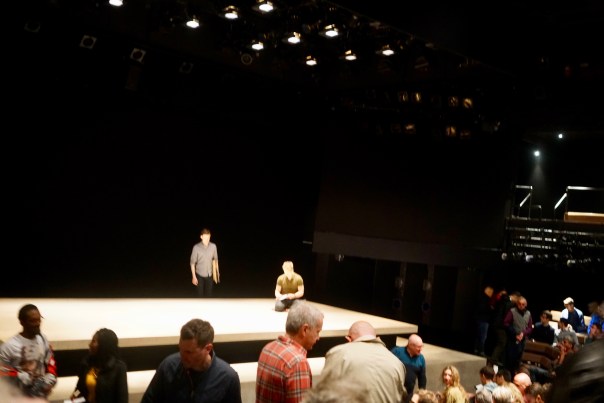
The mise-en-scène seems on the surface of the utmost simplicity. One empty platform with levers, beautifully designed by BobCrowley so it can be lifted and dropped,  first used as a floor, then as a table on which all of the characters, who often step on the performance space through the audience, act out. But the entrances, exits, line readings, even arm movements — all of which earn some effect — belie that first impression of a ‘simple’ mise-en-scène. It’s minimalist in terms of look and what’s visible — though behind it is a hidden screen which sometimes parts to reveal houses and trees occasionally and to great effect; as symbols, cues and setting — but very complex and worked-on in terms of conceptualisation and direction (by Stephen Daldry).
DSC01795

E.M.Foster appears as a narrator who critiques, offers motivation and changes the action. In the writer’s note in the programme of the production, Michael Lopez writes, ‘Foster himself is in it, for the story of my life cannot be told without him’. The play uses the structure of Howards End. Lopez acknowledges how he first saw The Inheritance as a straightforward adaptation, ‘an almost tit-for-tat contemporary updating with gay men from different generations as its central characters. I knew my story needed to be in part about AIDS, for the story of gay men cannot be told without it. Yet almost as soon as I began to write it, I discovered that I was creating something new.’

howard's end

‘If Howards End, for me, was a gay man in 1910 reaching a hand across time to a young gay boy in 1993 assuring him that he was seen and that he was not alone, The Inheritance is that young boy now grown up, reaching back and saying thank you. It is my act of gratitude to Foster for rescuing me when I was most in need of it.’  This inter-generational conversation about identity, love, desire, loss and death is what The Inheritance is about.

In The Inheritance, the opening line of Howards End, ‘we may as well begin with Helen’s letter to her sister’ becomes ‘we may as well begin with Toby’s voicemails’. Here the two Schlegel sisters are conceived of as a gay couple, Eric Glass (Kyle Soller) and Toby Darling (Andrew Burnap), together for seven years, and agreeing to marry shortly after the play begins. The unfolding of their relationship is the spine of both parts of the play. The character of Leonard Blast is split to encompass both a performer (Adam) and a hustler (Leo), both wanting to acquire culture, and both played by Samuel H. Levine: and there’s a moment where Levine moves in and out of each character within one moment that is a theatrical tour de force.

inhertance
E.M Foster communicates with young Manhattanites.

In fact there’s a lot of ‘doubling’ in the play. Paul Hilton who plays E.M Foster (Morgan), and who as Morgan is an active narrator who gets quite a lot of say in shaping the action, also plays Walter, the kind and gentle man who’s been with Henry Wilcox(John Benjamin Hickey) for 36 years and whose relationship with him is damaged over fundamental issues of ethics and morality when he takes in an old friend in the last stages of dying from AIDS: Henry not only disapproves but actively forbids. Walter befriends Eric, who will later also end up marrying Henry after Walter’s death, and who will also have fundamental differences of opinion when he too decides to open up their house, his house, to the ill and marginalised. Eric in some ways is a new generation’s Walter, acting ethically with the same kinds of compassion and in the face of very familiar forms of discrimination.  So the doubling happens by actors playing more than one role, by characters exhibiting similar character traits but from different generations, and through thematic rhymes across both parts of the play.

For example, when we’re introduced to Toby Darling, we assume he’s a flighty, superficial middle-class mannered queen. But we then find out he’s a working class  boy from the boondocks. The character he writes for a play, Elan, and which he passes off as autobiographical, is in fact who he wants to be: ‘Rich kid, seventeen, raised on the Upper West Side, sexy as fuck, sarcastic, rude, yet undeniably compelling. He’s basically me.’ is what Toby says. But in fact the person who is like that is Adam, who will get to play Elan. Toby inscribes his book to Adam as ‘To Adam, whom I hope to be when I grow up’. Yet Toby is more like the lost Leo, out of the house by 17, and exchanging the use of his body for substances and subsistence.

Toby will desire Adam and ruin Leo. The only reason Toby didn’t end up like Leo is because Eric saved him. Eric will also save Leo later, like Walter saved so many people earlier; and Eric and Walter will both love Henry, though the older one stayed with him in spite of his faults, and the younger one has different expectations and is able to make different choices. All this doubling takes place amidst a narration that starts off with anonymous people like ‘Young Men 8’ but then goes on to take concrete form, e.g. Young Man Number 8 becomes Toby Darling. The general, generational, social, illustrated by the concrete: individual characters and experiences. Structurally, it’s a marvel.


There’s a terrific theatrical moment, the very end of Act I,  where Eric tells Walter, ‘I can’t imagine what those years were like. I don’t eve know how to…

I can understand what it was like. But I cannot possibly feel what it was’.

I’ve reproduced Walter’s response from the published play so you can imagine how powerfully it works on stage (see below)

03-VR-vanessaredgrave-howardsend
Vanessa Redgrave as the dreamy Mrs Wilson in the Merchant Ivory film adaptation

When Vanessa Redgrave, the dreamy first Mrs. Wilcox of the Merchant-Ivory film, appears near the end of the play as Margaret Avery, the elderly caretaker of the house, here formerly a hospice for the terminally ill, and stabs her womb with her hand remembering how careless she’s been with the son who she didn’t know had so little time to live — well, you could *hear* the audience sniffling and sobbing.

Redgrave plays the house’s caretaker here with a dreadful southern accent. She seemed at times amateurish but then also simultaneously poetic and heartbreaking. Her rendering of the extraordinarily long soliloquy about her son; her love for him and guilt; and what led her to to help Walter turn his house into a hospice is beautiful, moving: quite something to see. And her presence, the aura of her history of politics and performances, adds something to this experience aside from her playing. A day of theatre where even the unsatisfactory bits seemed to add rather than subtract from the experience.

redgrave
Redgrave as the Caretaker, who shunned her own son but can now comfort Leo

The first part curtain, with the dead from thirty years ago rising from their graves to talk to the new one, had me in tears. And at the end of the second part — when in a flashback Henry asks Walter for guidance: ‘What do I do now Walter? Tell Me what to do?; ‘You do what they could not’, says Walter, ‘you live’ — the audience did literally leap to its feet: cheers, whistles, tremendous outpouring of emotion. The play’s a bit didactic, with attempts to educate that seem clunky and inorganic. In fact there are many issues: it’s a bit preachy, and creaky, and repetitive. It could all be shorter. But I was fascinated by how to me at least it didn’t matter. Even what on the surface seems wrong with it worked for it, and certainly on the audience


DSC01838.jpg

Much of the plot of The Inheritance revolves around gifts those who are bequeathed them are thwarted from recognising or accepting. Walter leaves the house to Eric, but like in Howards End,  Henry and his sons decide not to honour that pledge. In the end Henry says ‘no man should have to ask for what is rightfully his’ before turning the house over to him. And we can see this plot point as a metaphorical discourse on gay history in the culture at large. The film not only uses Forster as a starting point but references Edward Carpenter, Baldwin, Hollinghurst, even Call Me By Your Name. Though there comes a point half-way through the play when Morgan tells the current generation: ‘You are essential to the story I like to believe I was helpful to you as you started it. But I cannot help you finish it. It isn’t my right to. The past must be faced. It must be learned from. But it cannot be revised. I had my time. Now it’s yours’.

The history of the plague years, the place of so much death and dancing, the birthplace of all the gay activism that directly shaped all the recent gains, from film festivals to gay marriage to the existence of this play, is the rightful inheritance of a younger generation of gay men. But it too has been thwarted, partly through the death of so many men so many years ago now, partly through social exclusion, partly by the fact that so many who get to write history died before they could. The HIV virus itself is also a form of inheritance, in this case an unwanted one, but certainly one passed from generation to generation.This larger social argument is paralleled by individuals like Eric not recognising their own gifts; those which they’ve inherited but in turn also developed, and which need the support of others to come to the fore and be recognised even by the subjects themselves.

This play, and films like 120 Beats Per Minute, are one generation’s attempts to reclaim what is rightfully theirs: the legacy of a history. A ghost of one generation is disinterred to illuminate the gains and grievances, losses and achievements, the culture of another: so that a new generation could rightfully claim the inheritance that is theirs. It might have problems as a text. But it’s an extraordinary experience in the theatre. Kudos to writer, director, actors and all the others for making it so.

José Arroyo

Eavesdropping at the Movies 60 – Rampage

One of the stupidest films we’ve seen for a long time, but was it fun? We discuss its lazy and crass writing, the treatment of its female star, its lack of balance between entertainment and boredom, missed opportunities, and just how many people we think died.

The podcast can be listened to in the player above or on iTunes.

We appreciate your feedback so do keep on sending it.

José Arroyo and Michael Glass of Writing About Film

Margarita Lozano in A Fistful of Dollars

Seeing a restored version of A Fistful of Dollars a few days ago at the BFI on a big screen was a gorgeous experience. The Morricone score, the melodrama, the sweep of the camera, a young Clint Eastwood. It’s almost like a great silent film of the 1920s but with bits of dialogue and a great score. Beautiful print also. fistful

Part of the thrill of watching A Fistful of Dollars was recognising Margarita Lozano as Consuelo Baxter, the matriarch of the Baxter clan. She gives a great, controlled performance. Why isn’t more made of her presence and her performance in A Fistful of Dollars? There are only two women in the film, the other being Marianne Koch as Consuelo. And for those who know their film history Lozano is a cinema immortal, the mousy maid who gets pounced on in Luis Buñuel’s Viridiana. You’d think  an actress who’s made classics with Buñuel, Leone, the Taviani Brothers (Good Morning Babylon, The Night of the Shooting Stars), Pasolini (Porcile), Claude Berri (Jean de Florette) and so many others would at least rate more of  a mention. Is it xenophobia or is Brexit just making me paranoid?


José Arroyo

Eavesdropping at the Movies #59 – Journeyman

Journeyman_QUAD_final_online-840x630

A boxing film that opens with its climactic fight and develops drama in its aftermath. We find Journeyman disappointingly contradictory – a showcase of performance, writing, and observation, executed with no cinematic nous or flair. Paddy Considine lacks credibility as a world champion boxer, but captures beautifully the impotent rage and misery of such a star physically and mentally diminished. His road to recovery is a clever and interesting twist on the typical boxing film formula of training for a life-changing fight, executed too sappily and casually.

A film we like but don’t admire.

Plus Bouquets to the Broadway Cinema in Nottingham. What a pleasure it is to see films in such a great place.


The podcast can be listened to in the player above or on iTunes.

We appreciate your feedback so do keep on sending it.

José Arroyo and Michael Glass of Writing About Film

Recorded on April 17th, 2018

Eavesdropping at the Movies 58 – Love, Simon

love simon


In an illuminating article in The Guardian, Anne Smith quotes Russell T. Davies, writer of Queer as Folk as saying: ‘Love, Simon’s director has championed gay characters in many TV shows, from Dawson’s Creek to The Flash: “Greg Berlanti is a TV man through and through. He’s got acres of successful gay stories behind him. To see him bringing that into the multiplexes is a glorious victory.” In this podcast we discuss the film as a young adult romance with a twist: Love, Simon gives gay teens a high school movie with a decent budget and aimed at a wide audience. We both have mixed feelings on it, but find it a well-meaning and substantially positive film. We discuss some shortcuts it takes – the use of a queeny character to render Simon more acceptable, the setting in upper middle class suburbia making Simon’s sexuality the only issue in his life, a certain generic formulaicity – and ideas the film depicts as simple that could and should be more complex, including conversations we’d like to have seen Simon have with his best friend and the aforementioned queen. Not to mention the rather flat aesthetics.

It’s a discussion that does almost nothing but pick out flaws but nonetheless finds that the breadth of the film’s intended audience mitigates them and its goodness of heart shines through. As Davies says in the article above: ‘“I think we should be very careful if we imagine these changes are permanent. It’s been almost 20 years since Queer As Folk but still, every time I write a gay character, someone somewhere complains, and someone somewhere says, ‘This is new!’ It’s not one battle, it’s a constant fight.”’

Worth a watch!

Recorded on 6th April 2018.

The podcast can be listened to in the player above or on iTunes.

We appreciate your feedback so do keep on sending it.

José Arroyo and Michael Glass of Writing About Film


57 – A Wrinkle in Time


a-wrinkle-in-time-poster-oprah-winfrey.jpg

I hated the bad costumes, pap morality, and smug tone. Mike considers the age of the intended audience a mitigating factor but largely agrees. A Wrinkle in Time inclusively opens the big-budget Hollywood fantasy film to new audiences, but while we agree on the positivity of that aim, we find the film flawed and overly simple.

The film invites comparison with The Wizard of Oz it’s a comparison in which it comes off far worse. Mike fondly remembers the Macaulay Culkin film The Pagemasterand recommends people watch that instead. A film shaped by the discursive strategies deployed by Dr. Phil and Oprah herself that invites  and deserves all the bitchyness I at least heap on it.


The podcast can be listened to in the player above or on iTunes.

We appreciate your feedback so do keep on sending it.

José Arroyo and Michael Glass of Writing About Film

Eavesdropping at the Movies 56 – A Quiet Place


a quiet place.jpg

Thrilling to be in a cinema where you can hear a pin drop. The film sets up a brilliant premise. The world has been invaded by aliens who respond to sound. Once the aliens hear the sound, the living being who originated it will be killed in a manner of minutes. Thus, endless possibilities for generating suspense; and a platform for many experimentations with style and form, including giving actors the opportunity to convey emotion with their faces, gestures, postures; without dialogue.

We talk over its performances, its ending, the way it manipulates and moves characters to generate threatening situations, the intelligence of its editing in moving between storylines, the shortcuts it takes with its internal logic in order to keep the story moving, the theme of family and whether the film can be read as a metaphor for Trumps America. We also mull over a potential for a sequel and decry one plot decision in particular.

But fundamentally, we urge everyone to see it.


The podcast can be listened to in the player above or on iTunes.

We appreciate your feedback so do keep on sending it.

José Arroyo and Michael Glass of Writing About Film


Approaching Ingrid Bergman


Took a stab at cleaning my office this morning and found this; on the left a poster for a magnificent retrospective of Bergman’s Swedish films, all screened on 35mm. at the Pacific Cinémathèque in Vancouver in 91-92, which I attended religiously, and which greatly informed my knowledge of Bergman’s career; on the left, a box set of some of those films. A more complete box set, mirroring the retrospective from a quarter century ago, is out now from Criterion. Sometimes things take a while to circulate.

51xT5sliKFL._SX340_BO1,204,203,200_

The find made me reflect on how film scholarship and cinephilia have changed since then. As a tween film buff my main point of reference for Bergman was the Curtis F. Brown book on her career for the ‘Illustrated History of the Movies’ series I’d begun to painstakingly accumulate in relentless trawls through Montreal’s English-language second-hand bookshops. Now one looks at these books and it’s clear even the writers had often not seen all of the films they wrote about. But we didn’t know that then, and each volume was  very handy in giving a chronology and a kind of arc to the Hollywood career of each of its subjects.

By reading, one more or less knew what Bergman had done and what she was celebrated for. But seeing the films was another story. I remember magical screenings of Casablanca at the Seville repertory cinema in the late 70s & early 80s; the whole audience with the film every step of the way; I saw it several times there —  it seemed to be on rotation; and each time was the same; the hushed tones; what seemed like a whispered intensity; the glow that seemed to exude from Bergman; the intensity of Bogart’s mingled feelings for Bergman contrasted with his cool irreverence for authority and the law;  the jokes, Dooley Wilson’s songs. It was an incantatory experience.

I also caught Spellbound (1945) and Notorious (1946) at a retrospective of Hitchcock films at Concordia University’s Conservatoire d’art cinématographique. I vividly remember the tiny Place Bonaventure Cinema, the smallest of the two — I saw Star Wars in the other — where I saw Ingmar Bergman’s Autumn Sonata and retain powerful images of Ingrid Bergman and Liv Ullman’s faces in that film. I was also enraptured by her Golda Meir on television in A Woman Called Golda (1982). I have a memory of seeing the original Murder on the Orient Express (1974) that I don’t wholly trust: I have a powerful memory of the newspaper ads for the movie but can’t remember the cinema; and it makes me wonder whether I did see it in a cinema: I would have been twelve. But I did go to movies on my own then. Still, it’s possible I caught it on its first television broadcast. Her ‘African babies’ monologue certainly made an impression and has always, for better and worse, stayed with me.

All of this to say that it was very difficult to see films. One had to grab the rare opportunities that offered themselves. One saw only some things, mostly only once, and randomly, as they appeared. The restrospective of the Swedish work in Vancouver, was the first chance I got to see so many of her films together, in a certain kind of order, where you could chart chronology, progression, compare the contributions of various directors (Gustaf Molander made a huge impression). It was also my first exposure to Bergman’s early work in Sweden. It would take me many more years to see her extraordinary work with Rossellini in Italy; and her wonderful performance in Elena et les Hommes for Renoir; I did manage to see Saratoga Trunk (1945), The Bells of St. Mary’s 1945), Indiscreet (1958), The Yellow Rolls Royce (1964), Cactus Flower (1968) on tv when  I still lived at home. But it was haphazard; whatever randomly came one’s way, by accident: lovely to see, but very difficult to study.

Now it’s all changed. The films can be obtained: even personal ones like Ingrid Bergman in Her Own Words (2015), a wonderful documentary composed of images she filmed herself, and where her love for her children is evident in every composition, in every frame, is available to see currently on BBC iplayer. Anyone can make a project of studying an actor or a director and through purchase (the Criterion set of Bergman’s work in Sweden is superb) or torrenting, be able to see all or almost all of their work that still exists, and in chronological order. The surprise is that so few do.


José Arroyo

Eavesdropping at the Movies 55 – Unsane

unsane-main.jpeg

A low-budget psychological thriller, Unsane is a less involving film than its subject matter and star deserve. Claire Foy is extraordinarily powerful as a paranoid prisoner of mental trauma inflicted on her by a stalker and bureaucratic malfeasance, distressed, knowing, sarcastic, resistant. The film fails her in other areas but is an intriguing experiment nonetheless. We find much to discuss, including its cinematography, relationship to termite art, Soderbergh’s recent efforts, potential audiences and whether the lighting of black characters in this film is inherently racist.

Recorded on 1st April 2018.


The podcast can be listened to in the player above or on iTunes.

We appreciate your feedback so do keep on sending it.

José Arroyo and Michael Glass of Writing About Film


Eavesdropping at the Movies 54 – Isle Of Dogs

wes_isle_of_dogs_tease_index.jpg

Wes Anderson’s Isle of Dogs is a stop-motion story of the utmost beauty and wit. We discuss its cinematography, compositions, lightness of touch, allegorical relationship to reality, and place in Anderson’s body of work. We also reserve particular praise for Bryan Cranston’s vocal performance and Alexandre Desplat’s score.

Recorded on 1st April 2018.

The podcast can be listened to in the player above or on iTunes.

We appreciate your feedback so do keep on sending it.

José Arroyo and Michael Glass of Writing About Film.

Agnelli: Italy’s Playboy Titan (Nick Hooker, 2017)

agnelli

A terrific documentary, currently playing on Sky, about Gianni Agnelli, head of Fiat. Of obvious appeal to those of you interested in post-WWII Italian history or football (he owned Juventus). Others might appreciate its insights into Pamela (first Churchill due to her marriage to Winston’s son; then Agnelli’s mistress; later a key light in 1950s Broadway theatre history through her marriage to Leland Hayward; later still a key figure in the US Democratic Party through her marriage to Averrill Harriman; and, after that and on her own gas, US ambassador to Paris in the Clinton Administration.) Those of you interested in seeing why Truman Capote named his coterie of super-rich, elegantly dressed women ‘The Swans’, will also find it of interest. Agnelli was a leading light in the politics, society, sports, culture and art of the last half of the twentieth century and the documentary presents fascinating footage of this intersection. I love all the glamorous early sections but what I found most fascinating is the footage of the Brigate Rosse in the 1970s, the FIAT strikes, and the kidnapping of Aldo Moro.

marella.jpg
Marella Agnelli

José Arroyo

Eavesdropping at the Movies – 53 – Ready Player One

IMG_0052.jpg

I was bored through most of it and actively irritated by the end of the film. Mike kind of liked it. We talked about references, about address — it’s aimed at boys but some confusion about which generation — the quality of the animation. ‘It’s like a kid’s movie used to be but just not aimed at you,’ says Mike. A work in which the maker of a video game is treated and read as the equivalent of the bible; a sad film indeed. To me further proof that Spielberg doesn’t quite rank with the greatest of filmmakers: incredible technical skills, a prodigy. But to what end? I found it full of pop-cultural references pop-culture geeks will delight in but ultimately dumb and empty. I can’t imagine what people who don’t have an encyclopaedic knowledge of music, film and video games of the last forty years will make of it. There’s no emotional resonance to this film at all; and its view of human nature and the way the world works is as banal as it gets. Brummies will be interested in seeing how their city is used to signify  a dystopic futuristic Columbus, Ohio. West Midlands News was delighted; more sophisticated viewers might get enraged. Throughout, Mike offers much more generous readings than the above.


The podcast can be listened to in the player above or on iTunes.

We appreciate your feedback so do keep on sending it.

José Arroyo and Michael Glass of Writing About Film.


A favourite moment from Easter Parade (Charles Walters, USA, 1948)

Easter Parade is a treasure trove of delights. My favourite moment is not the great Anne Miller ‘Shaking The Blues Away’ number. Nor is it the legendary Garland-Astaire ‘A Couple of Swells’; nor any of the great Irving Berlin songs: (‘Stepping Out With My Baby’; ‘It Only Happens When I Dance With You,’ so many others. The moment I treasure most is this one above: Don Hewes (Fred Astaire) has been ditched by his elegant and sexy dancing partner Nadine Hale (Anne Miller). He vows that he can replace her with anyone and chooses Hannah Brown (Judy Garland), a singing waitress he picks up at a tavern.

Hewes tries to teach her how to dance, how to dress, how to walk. Hannah Brown’s not good enough if he’s going to be as big a hit as he was with Nadine. To replace a Nadine he needs a Juanita, not a plain Hannah Brown. But when that Hannah Brown is played by Judy Garland…. sigh, what bliss. This is the moment where Hannah Brown has to prove to  Don Hewes that she can become the sexy ‘Juanita’ he’s dreamed up for the act and where Garland shows us why plain old Hannah Brown is so much better. They might not look back to her for sex, but boy will they look back. I’ve always delighted in this moment. It seems to me to speak to the best bits of the Hannah Browns in each of us.


José Arroyo


Eavesdropping at the Movies 51 – You Were Never Really Here

you were never really here.jpeg


If there’s ever a movie that needs to be seen on a big screen this is it. A poetic film, a great film made by a great artist. A story that’s told aurally and visual using a wide range of devices. We discuss the extraordinary power of its images, the imaginative use of sound, the depiction  of violence; whether it has a psychologically traumatised editing pattern; how it’s a film that requires visual literacy and what that might mean; the narrative is that of an abused child who goes to the military, suffers post-traumatic stress syndrome and eventually becomes a hitman who’s sent on a quest to rescue a young girl who’s been trafficked sexually. A linear story told in a fragmented way with the narrative making — and changing — sense as it unfolds. Mike is excellent. I remember names better than usually.  At the end of the podcast, we comment on the oscars describing debates the broadcast led to and we forgot to include that engendered by the best foreign language winner: A Fantastic Woman.


The podcast can be listened to in the player above or on iTunes.

We appreciate your feedback so do keep on sending it.

José Arroyo and Michael Glass of Writing About Film.

A Fantastic Woman/ Una mujer fantástica (Sebastian Lélio, Chile, 2017)

mujer fantastica

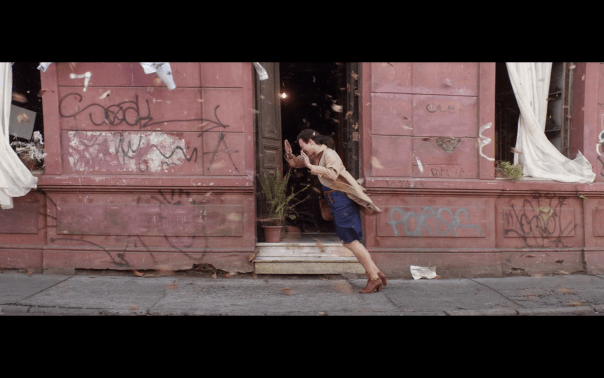
Like the lovers in Wong Kar-Wai’s Happy Together (1997), Marina (Daniela Vega) and Orlando (Francisco Reyes) dream of visiting the Iguazu Falls. Marina and Orlando have just moved in together, and in fact Orlando has bought tickets to go. But he’s older, can’t remember where he’s put them and offers her an IOU. That evening, they go to bed in their usual manner but he suffers an aneurysm during the night. As she searches for the car keys, he goes out the door and falls down the stairs. At the clinic, they ask Marina about her relationship with Orlando, begin to twitch that she’s transgender, and the problems begin. As Orlando is declared dead at the clinic, those problems will get worse.

Screen Shot 2018-03-05 at 15.08.12.png
Everything’s against Marina

The police arrive, and since the change in her ID is still in process, insist on addressing her as a man and treating her as a criminal rather than a bereaved partner. Gabo, Orland’s brother, arrives and apologises to Marina, ‘I’m sorry you had to go through this.’ But his obligation is to ‘the family’, which she is most emphatically excluded from. Soon, the ex-wife comes in to kick her out of the apartment that is the home she shared with Orlando. It starts off polite but ends up being forceful; the police come in, ostensibly to help, but really to humiliate her; the son and his friends will kidnap Marina, distort her face with tape, and dump her on a side street. I expected much worse and find it interesting that the film chooses to end it there and not focus more on physical violence.

Screen Shot 2018-03-06 at 09.26.54.png
Who Am I?


The violence in A Fantastic Woman is all psychological but no less powerful for that. Marina is denied her history, her identity, her relationship, her apartment, her dog; and even the right to mourn the person she loved, which she insists is a human right. Any gay man d’un certain age will be familiar with this story, particularly those who lost loved ones at the height of the AIDS years and before wider legal and social acceptance of homosexuality. The partner who you loved and cared for dies and you’re left with not even a place at the funeral in case your very presence might offend the congregation. The fight for trans rights is a logical continuation of the fight for lesbian and gay rights; this film vividly, in a very personal way, demonstrates the hows and whys.

Screen Shot 2018-03-05 at 15.54.18.png
The violent deformations of ‘respectable’ people

A Fantastic Woman is a complex and fascinating meditation on mourning and on the complexities of identity. Instead of, as is typical, showing us Marina’s effects on people, everything, including that effect, is filmed from her point of view. Her feelings, identities, wishes, desires, dreams are the focus on the film. And people’s well meaning but ignorant, passive-aggressive and ultimately violent denial of her humanity is what the film movingly demonstrates. But she will withdraw, survive and live to fight another day, and with beautiful music.

UMF__alta_J25_0K9A4714_2.jpg

The film is imaginatively shot by Benjamín Echazarreta and there are some very striking and evocative images. The film is directed with a poetic touch as well, as it moves into dance numbers to evoke Marina’s feelings; dream sequences that evoke the complexities of her situation and her desires, and there are thrilling musical moments, first when Marina performs a salsa song in a nightclub (Periodico de ayer) later, the classic numbers she sings, particularly at the end (Handel’s Ombra mai fu).

Screen Shot 2018-03-06 at 11.37.46.png
On genitals and Being.

The film has been compared to Almódovar’s work, which surprises me. Yes, there is a transgender protagonist; and yes, it’s a great film. But what strikes me most about this film is the absence of camp. Marina is strong and she suffers; and there are moments of rage; but it’s her quiet, polite, elegant, strength that is the focus of the film. In her home, she might box away her frustration. But on the street she’s soft-voiced, cultured, polite with a quiet strength that will not compromise winning a particular battle for the thrill of an easy laugh. It’s the quiet strength necessary to achieve justice, one embodied by Daniela Vega’s impassive but understanding gaze, that is to me the central thrust of the film. Particularly, in instances where she gazes directly at the camera, as if saying, ‘bear witness to what the world is doing to me; to what it takes for me to live in this world, your world’. I’d like to see it again.

daniela-vega-a-fantastic-woman.jpg
Singing Handel

Currently available to see on Curzon Home Cinema

José Arroyo

Eavesdropping at the Movies 50 – Lady Bird

lady bird


Our 50th! We finally get around to seeing the one Best Picture nominee we were missing, Greta Gerwig’s Lady Bird. It’s been highly praised, but has the hype hurt it? We discuss its female-centric twists on coming-of-age teen movies, the mother-daughter relationship, its attitude to sex, and the Everyman Cinema in Birmingham, which we visit for the first time.

Recorded on 27th February 2018.


The podcast can be listened to in the player above or on iTunes.

We appreciate your feedback so do keep on sending it.

José Arroyo and Michael Glass of Writing About Film.

Camouflage/ Barwy ochronne (Krzysztof Zanussi, Poland, 1977)

camouflage-zanussi

The awarding of prizes for an academic paper in a linguistics summer camp in a Polish provincial University is the setting for Zanussi’s great exploration of hierarchy, power, knowledge, justice, democracy, morality, conformism, corruption, ethics. A jaded, cynical professor, Jakub (Zbiniew Zapasiwicz) tries to enlighten and manipulate an earnest and idealistic younger colleague, Jeroslaw (Piotr Garlicki) and the verbal jousts between them are the occasion for the explorations of the issues the film dramatises. ‘Why not take things at face value’ asks the younger man? ‘Because it’s not all that simple or honest’ responds the elder.

Zanussi’s frame is always full of people or landscape – students staging sit ins, gangs swimming naked in the river, classes replete with students, dozens at dinner — in a way that makes one realise how thinned out much of contemporary cinema has become, not just visually, but thematically. Here when two characters speak in a two-shot it carries the context of the social so many people earlier helped depict. Place, and society are always the background to the protagonists’ thought and actions.

Screen Shot 2018-03-03 at 14.56.08.png

It’s no surprise that the film was read as an allegory for Poland in the last years of the Communist regime. It’s a film in which signs are often read by the characters as having other referents than its popularly acknowledged ones, but these other referents can only be divulged through avenues of power and knowledge. People are often compared to nature through animals: the cat will have its prey, and only by collaring it with bells will those poor birds and mice have a chance. But the analogy with nature has its limits. Human groups build their own value systems we’re told. But are those honest, just, democratic, ethical; and do they pave the way to knowledge and progress? At the end, Jaky thinks he’s brought out the beast in Piotr but Piotr makes clear that if he had, he’d be dead.

A film that seems particularly relevant in the light of present discussions on the role and purpose of universities. A great film.


Camouflage is currently available to view on MUBI.


José Arroyo


Wùlu (Daouda Coulibali, France/Senegal/Mali, 2016)

wulu

A fine gangster film, novel for being an excellent debut feature from Daouda Coulibali and set in a region of Africa (Mali, Guinea, Senegal, Niger) that is a nexus for transporting cocaine from Columbia to Europe.

The film begins with a series of titles contextualising and explaining as follows:

‘In the Bambara culture, fraternal societies must train their followers to make them into valuable members of the community. In the Ntòmo society new members must pass through five levels:

  1. The lion level teaches a man where he came from
  2. The toad level tells him where he is going
  3. The bird level teaches him who he is.
  4. The guinea fowl level considers the man in the cosmos.
  5. The final level enlightens the member on his place in society. This is the level of the dog (Wúlu).

Screen Shot 2018-03-02 at 11.58.58The Wùlu of this story is Ladji (Ibrahim Koma), who works in a collective taxi. He’s the one who decides who to pick up and he’s figured out all the angles: avoid the elderly, fat and infirm: they can lose you a lot of money. He dreams of driving his own bus. But in spite of being excellent at his job, he’s passed over for the boss’ nephew, who’s got nothing going for him aside from his relations.

The film starts in 2007 in Bamako, and the corruption is shown to pervade everything and everyone, even Ladji’s sister, Aminita (played by singer Inna Modja) is turning tricks to get by. It ends in 2012. Ladji, the dog, can’t live with himself; his sister, the whore, is sunning herself by the pool in the lap of luxury. The final title card tells us:

‘In creating divisions at the heart of the army; in inciting competition between different tribes, and in constituting one of the sources of financing for terrorist organisations, cocaine trafficking largely contributed to the failures the State of Mali underwent during the course of 2012.’

Screen Shot 2018-03-02 at 11.52.14.jpg
Ladji washes away the blood

A very good crime film about the rise and fall of the gangster figure; as in so much of the genre, it is as much a critique of the society its portraying as a depiction of particular characters. And that is a chief attraction for someone like myself: we not only get a film with likeable characters, excellent action and a poetic touch, but we get to find out about the cultures depicted: the tribalism, the meaning of art in these cultures, the corruption of politicians, the way white people are seen, what a rich house looks like to these people, the value of a bus. This is a gangster film in which negotiations takes place in a tent in the desert, in which the way out of a shootout is through a boy with a donkey, a place in which an intelligent, thoughtful and responsible young man has no way out but gangsterism, drugs or death and in which death is preferable to drugs; It’s where whores survive but dogs are put down (there is a slight tinge of misogyny in the film).

Olivier Rabourdin plays the French Entrepreneur who is also the drug kingpin

Screened on MUBI as part of South by South, a collaboration with the South London Art Gallery

49 – Investigation of a Citizen Above Suspicion

investigation

We try out Mubi, a curated streaming service that gives you 30 films at any one time, and only 30 days in which to watch them. Our choice is Investigation of a Citizen Above Suspicion, a 1970s Italian satire on police corruption and the politics of power. It leads to discussions on its expressive imagery, its topsy-turvy plot, sexual kinks, peccadillos, and lifestyles, the performance of power and authority, and male jealousy and rage.

Investigation of a Citizen Above Suspicion is one of the best political films of all time, with a great opening sequence. A satire on politics filmed and played in high style. What does an establishment figure have to do to get arrested?

Winner of the Academy Award of Best Foreign Film in 1971 and with a great score by Ennio Morricone.


The podcast can be listened to in the player above or on iTunes.

We appreciate your feedback so do keep on sending it.

José Arroyo and Michael Glass of Writing About Film.

48 – I, Tonyah (Craig Gillespie, USA, 2017)

i tonya


The story of Tonya Harding raises all manner of issues for us to delve into. I, Tonya is a film about class, domestic abuse, celebrity, opportunity, achievement. We examine its visual design and use of competing aspect ratios, its use of direct address to camera, and the conceptualisation of the working class characters and mother-daughter relationship. Mike believes it insists upon Tonya Harding’s fame too heavily, not aware of how she’s only really remembered in the USA. Jose finds its portrayal of working class people uncomfortable. An energetic discussion.

The podcast can be listened to in the player above or on iTunes.

We appreciate your feedback so do keep on sending it.

José Arroyo and Michael Glass of Writing About Film.