A Moment from Victimas del Pecado

A friend just delighted me by mentioning that his favourite film from the 2018 ‘Il Cinema Ritrovato Festival’ was Emilio Fernández’ great Victimas del pecado/ Victims of Sin (Mexico, 1951). If you haven’t yet seen this great transgressive clip, one of the great delirious moments of melodrama in the history of world cinema, simultaneously masochistic and subversive, do. I’ve conveniently provided it for you here, with sub-titles.

\

Hollywood and the Production Code: Criticism and History (July 6, 2018, KCL)

I didn’t intend to write on the ‘Hollywood and the Production Code: Criticism and History’ one-day symposium held at King’s College London on the 6thof July 2018, so this will probably be a partial account; my notes were taken in the service of my own thinking rather than with the aim of writing  for others and is thus probably partial and incomplete. But it was such a great event –informed, instructive; a scholarly context taking into account the intellectual debates of the day on the subject at hand with the aim of creating dialogue through which to increase our knowledge, instruct us all, and point to areas where further research may be profitably undertaken – that I felt I needed to at least jot down some developments in my own thinking that resulted from the day.

The idea was structured as a combination of workshops and sets of curated and complimentary papers on particular areas. The day before the event two films were screened: John M. Stahl’s Back Street from 1932, a celebrated ‘Pre-Code’ film; and Preston Sturges’ The Miracle of Morgan’s Creek, famous for making comedy of a young girl (Betty Hutton) getting drunk, getting pregnant, and not being able to remember who she slept with, thus getting around many of the taboos the code prohibited. Participants were asked to view the two films with the aim of contributing to the two workshops the following day, in which the two films would be the focus of case studies on the influence and deployment of the Production Code. So contrary to the usual assumption underpinning the standard academic conference, which is to showcase the state of one’s own research, this event was more along the lines of, ‘lets set some guidelines for discussions, have major figures in the field (Lea Jacobs, Doug Pye, Ed Gallafent) contextualise and set some parameters for it, let’s present some leading research, and let’s all collectively contribute to the discussion and see where it takes us to by the end of the day’. The developmental and pedagogic element was built into the structure of the day, with great success.

Tom Brown introduced the event with an account of what had led him and John Gibbs to pursue the subject. The goals of the day were contextualised within the landmark work in the area by Richard Maltby (“’Baby Face’ or How Joe Breen Made Barbara Stanwyck Atone for the Wall Street Crash’ in Screen). Thomas Doherty (Pre-Code Hollywood: Sex, Immorality, and Insurrection in American Cinema, 1930-34); Hollywood Censors: Joseph I Breen and the Production Code Administration), Leonard Leff (The Dame in the Kimono: Hollywood, Censorship, and the Production Code); and Lea Jacobs (The Wages of Sin: Censorship and the Fallen Woman Film, 1928-1942).

Brown also praised the new work on historiography such as The New Film History: Source, Methods, Approaches (James Chapman, Mark Glancy, and Sue Harper eds.) and how recent developments in the field on the uses of archival materials has transformed the study of film. However, great as this all is, Brown also drew on Dyer’s question of ‘Where is the ‘film’ in Film Studies’ to highlight how all this new work on film risked side-lining the films themselves. He mentioned recent accounts of Hollywood cinema that argue that the introduction of the Production Code led to no discernible difference in film style, and drew on Stanley Cavell’s discussion of the Jericho scene in It Happened One Nightin Pursuits of Happiness to argue differently. So the aim of the day was really to explore this difference that started off as intuited and felt and to bring considerations of film style back into a productive interplay with the fruits born from historiographical and archival work.

IMG_1298
Adam Vaughn offers archival evidence

The day started off with Adam Vaughan presenting his paper ‘Queering the Code’ where he examined the influence of the Code on the work of queer filmmakers and performers in 1930s Hollywood. His case studies were two films by George Cukor, Our Betters(1933) and Sylvia Scarlett(1935) and he argued that the enforcement of the Code changed representation from the explicit to the allusive and connotative. Vaughan’s demonstration of the censors’ objections to the heavy make-up on one of the queer characters in Our Betters was very illuminating.  Olympia Kiriakou also drew on archival sources to demonstrate how MGM had to negotiate the presentation of adultery in MGM’s The Women ([1939], also directed by Cukor) focussing on the scene where Mary (Norma Shearer) discusses her husband’s infidelity with her mother. The paper traced the development of the scene from the original theatrical script through the cinematic adaptation, via all the discussion with Joseph Breen, and, finally, to the finished version of the film that we get to see today. One of the interesting things that came out of the workshop was that rather than debate which is the original version, the director’s cut, that which most people saw, etc., what’s important is to at least initially keep in play the whole process in its entirety, as that might result in different questions; or, the possibility that a look at the process in its entirety might result in different, richer, answers to the same question.


IMG_1299
More archival evidence from Olympia Kiriakou’s presentation on The Women (1939)

This set of papers was followed by a workshop led by Lea Jacobs and Ed Gallafent on Back Street, part of the ‘Fallen Women’ cycle Jacobs  writes so brilliantly on in her magisterial The Wages of Sin: Censorship and the Fallen Woman Film, 1928-1942. The workshop began with a discussion of the film as an adaptation of the Fannie Hurst best-seller, pointing out how the novel was more explicit on the issue of class and race keeping the lovers apart than Stahl’s movie (the character of  Walter Saxel played by John Boles in the film is Jewish in the novel). The discussion touched on the various film versions of the novel, not only Stahl’s but also the 1941 version directed by Robert Stevenson and starring Charles Boyer and Margaret Sullavan, as well as the 1961 version directed by David Miller starring Susan Hayward and John Gavin. Which scenes changed, how were they developed, and how were they visualised from the novel to the ‘Pre-Code’ version to the subsequent ones?

Ed Gallafent offered a lovely reading of the scene between Ray (Irene Dunne) and her sister (see clip below), highlighting the way it begins by Ray looking at herself confidently in the mirror before meeting Walter’s mother, deciding not to put her make-up on, moving her belongings from a black purse to a white purse in order to make a better impression. But the song she’s humming is ‘After the Ball’:

After the ball is over,
After the break of morn –
After the dancers’ leaving;
After the stars are gone;
Many a heart is aching,
If you could read them all;
Many the hopes that have vanished
After the ball.


Gallafent underlined the importance of that song in Dunne’s career (she performed it earlier on stage in Show Boat and would perform it later still in James Whale’s 1936 film version) and also highlighted the significance of several elements in the scene: the way the sister enters the room, locks the door, and leans against it barring the way, something of a trope in ‘women’s’ films throughout the whole ‘Classic’ period; the way the sister asks questions without ending them, ‘he’s got to stay here and….’; ‘If mama were to find out anything she’d…’.;the way that Ray earlier tosses a coin about whether Walter’s mother will like her but, because of the sister’s interruption, never gets to find out which side the coin faced, and how this all underlines the element of chance in the scene.

Lea Jacobs noted how what was unspoken but clearly understood is that Ray’s sister is pregnant. The discussion teased out how the film had at the beginning set up a tension around virtue with Ray’s step-mother protecting her biological daughter’s but questioning Ray’s; how this scene demonstrates how the tables have now turned; how later on in the film the sister herself, with the husband, home and children Ray made possible, will stand in judgment of her sister, forgetting what had happened before. The discussion also indicated how the tracking shot at the end of the next sequence, where we see the band packed-up and walking down the bandstand with their instruments, rhymes with the Ray’s humming of ‘After the Ball’; and how all of this underlines chance, the ‘might-have-been’, the ‘it could happen to anyone’ which the film will underscore in its sad, final flashback. It was a very illuminating, inclusive and generative workshop.


In the afternoon papers, Kathrina Glitre in her ‘Sacred Intimacies: Sexual ambiguity and performance in My Favourite Wife(1940)’ explored the issues around performance and suggested meaning, comparing the PCA’s recommendations to key moments in the finished film. ‘How exactly’, she asked, ‘does screwball performance style enable the kind of ambiguity necessary to render sexual content appropriately ‘innocent’? The paper demonstrated how memos to and from the Breen office often remarked on something ‘as agreed’ though never putting on paper what exactly was agreed upon. Glitre also showed how the PCA’s correspondence directly addressed questions of performativity.

IMG_1304.jpg
From Kathrina Glitre’s excellent presentation

In the same panel, Martha Shearer argued that the Busby Berkeley Warners musicals of the early 30s often appear in accounts of ‘pre-Code Hollywood’ usually contrasted with the Astaire and Rogers cycle, a contrast that seems dramatic. Shearer instead focuses on Warners’ own Dames(1934) to argue that the ‘the principal of deniability’ continues to operate but through a ‘more gradual, more complex and less melodramatic evolution of systems of convention in representation’. What Shearer brought out also is that many of these films were re-released so which ones were not allowed a re-release subsequent to the more stringent enforcement of the code, which ones were edited, and what was edited out and for which reasons, may also prove a useful way of illuminating the effects of the code on the style of later representations of that which was forbidden. Lastly, James McDowell offered a thought-provoking presentation on ‘Irony, Intention and the Production Code’ arguing for how the working through, against and in the shadow of, the Production Code, should lead us to re-think the question of intentionality in relation to film interpretation.


IMG_1306.jpg
Martha Shearer, surrounded by Ruby Keeler and Dames


The afternoon workshop revolved around a discussion of The Miracle of Morgan’s Creek led by Lea Jacobs, Kathrina Giltre and Douglas Pye. Lea Jacobs offered an absolutely brilliant reading of the scene where Betty Hutton as Trudy Kockenlocker goes to the dance, gets drunk (see clip below), and later gets married to God knows who and gets pregnant. As Kathrina Giltre demonstrated, none of it was allowed by Code. Jacobs not only showed how Sturges treated it as a game to get around the censors (you never see Trudy drinking anything other than what’s listed as lemonade, though her expression highlights its sourness due to sugar being conserved as part of the war effort, a ‘sourness’ that the audience understands as her drinking alcohol; later on in the country club, drinks are offered to each and everyone but Trudy’s out of sight, etc. etc.). However, what Jacobs so brilliantly underlined is that in all the games of not showing the drinking whilst communicating that Trudy’s getting drunk, what’s really being displaced is the sex; how because she dances with so many different men, some people have talked of her having multiple partners that night, or the even darker possibility that in spite of the sexual energy Hutton so convivially evokes, she might have been so drunk she was taken advantage of or worse.

Doug Pye, equally brilliantly, spoke of tone; and the discussion also highlighted how so much of the comedy edges on darkness. Pye offered a timeline on the film from the title, through the various scene drafts, the first day of shooting without completed script or PCA comments, Breen’s response, the granting of a seal approval, the Catholic Legion of Decency’s objections, the film’s release and comments on audience interpretation of the film. Immensely useful. Later in the workshop, the film’s particularly brilliant use of the long takes and how it focuses on the performance, and how the actors brilliantly evoke, and play for laughs that which cannot be said  was highlighted. The use of Brian Donlevy and Akim Tamiroff, intertextually referencing  Sturges’ previous The Great McGinty (1940) as a way of providing a deux ex-machina that resolves every impediment to marriage whilst breaking all the laws was also part of the intriguing discussion in the workshop.

The ‘Hollywood and the Production Code: Criticism and History’ symposium was a brilliant event. It made use of recent developments in theory, history, and the Archive and brought them productively into play with criticism – raising fascinating questions about the effects of the Production Code process, with an underlining of process in its entirety — on film style in a way that put back the film into ‘Film Studies’ as the central object of study it deserves to be.


José Arroyo


Back Street (John M. Stahl, USA, 1932)

Back_Street_1932

Does John Boles make his leading ladies look good by being so boring or is he simply so dull they have to sparkle twice is brightly to keep a scene going? Enquiring minds want to know. Whatever appeal he had to Thirties audiences is now lost in the mist of time. Irene Dunne, however, interjects everything with life and good nature. Her voice alone makes one feel good. As Ray Schmidt, she shows how she can have a good time without giving travelling salesmen what they want. She knows about numbers and can do bookkeeping. When she moves to New York City, she becomes the highest paid women in her firm. She can turn her hand at ceramics and make money out of it if need be. She’s got a millionaire automobile entrepreneur begging for her hand in marriage, something he’s been doing since he was a teenager. But no, she loves John Boles’ Walter Saxel and is happy to give it all up – career, children, social position, respectability….. for him?

4170131643_3ae20dc862

Nobody gets it. But you don’t have to. This is a handsomely mounted movie, with Dunne allowed to age from a teenage good-time girl to a back street woman to expensively dressed mistress to an old lady with a great death-bed scene. She gets to emote, sadness, longing, patience, understanding, all whilst wearing beautiful clothes and giving great veil. There is one great moment in the film, the one the film pivots on: if Ray Schmidt had arrived at the concert in time to meet Walter’s mother, she might have been the wife instead of the mistress. That ‘might-have-been’ moment is what justifies and feeds the masochism the film draws on and audiences revel in.

Screen Shot 2018-07-05 at 16.49.40.png
Irene Dunne gives great veil

John Stahl directs it beautifully. Ray, happy at the prospect of the date is humming whilst getting herself ready. But the song she’s humming is ‘After the Ball’:

After the ball is over,
After the break of morn –
After the dancers’ leaving;
After the stars are gone;
Many a heart is aching,
If you could read them all;
Many the hopes that have vanished
After the ball.

That’s when her step-sister come s in and asks for her help. At the beginning of the film her mother makes a distinction between what her own daughter is allowed to do and what Ray, who is not her real daughter and is not under her authority can get away with. The implication is that Ray might be loose with her virtue, though we know better. Now the tables are turned. Ray’s step-sister has threatened suicide if she doesn’t go talk to the man she loves and prevents him from leaving town. The implication is that she’s pregnant. Ray knows, and tells her sister, that being at the bandstand at three o’clock is the most important thing in her life.  However, she does right by her sister but arrives too late for her own date. The sister will end up with the husband, children, and home that Ray will long for to no avail for the rest of the film. Part of the appeal is that it’s all chance. There but for the grace of God…This could happen to anyone, even someone as smart, loving, and good as Ray.

When she arrives in the park, the crowd is already dispersing. As you can see in the clip above, we see the crowd before the carriage arrives, Ray dismounts, and starts searching for Walter and his mother, sometimes moving with the crowd, sometimes against. In the second shot the camera dollies back with her walking against the tide of the crowd, looking. There’s a cut to a closer shot, but it’s initially of her back, before she turns, surrounded a number of women all wearing hats as she continues looking. She moves towards the camera. Moves towards the camera some more, but in vain.

The last, and most important, most expressive shot of this scene, is the last one, which starts in close-up then dollies backward to reveal her full length, the bandstand in the background, the musicians packing up and going home, as she continues searching. The shot tracks back quite a distance and then holds for a quite a long time, underlining the importance of this moment for Ray, until the scene fades and we get a fade to an inter-title, telling us we’re now on Wall Street, New York. This shot rhymes and is a reply to her humming of ‘After the Ball’. It’s very expressive. She’s calm, but her inner anguish is shown by her movement through the crowd, and the feeling that she’s in a transformative moment in her life, one that she’s let pass her by, is beautifully conveyed by the backward tracking shot at the end.

Back Street is seen by many as Stahl’s masterpiece. ‘Stahl’s approach to the women’s film is as uniques a it is personal,’ writes George Morris in Film Comment, ‘In lieu of Borzage’s transcendetal romanticism and Sirk’s subversive irony, Stahl confronts his unlikely narratives with quiet directness. There are no undue frills or stylistic flourishes in a Stahl film.’ Morris compares Stahl to Dryer.

Christian Viviani in Positif called him, ‘without a doubt the American filmmaker most centrally and obstinately glued to melodrama: it is perhaps only with the Italian Raffaello Matarazzo that we observe so instransigent and exclusive a choice/ ”sans dout le cinéaste américain qui s’est le plus obstinément et frontalement colleté au mélodrame: ce n’est peut-être que chez l’Italien Raffaello Matarazzo qu’on observe un choix aussi intransigeant et exclusif’  (trans. my own).

According to Viviani, ‘The filmmaker focuses on an admirable task: how to make us admit that we live melodrama daily? How to reconcile the exceptional character of the melodramatic event with the banality of the credible? Stahl succeeds by  bringing together precision, sobriety and emotion/ Tâche admirable que le cinéaste s’est fixée: comment nous fair admetre que nous vivons quotidiennement dans le mélodrame? Comment concilier le caractère exceptionnel de l’événement mélodramatique avec la banalité du credible. Stahl y parvient en conciliant précision, sobriété et émotion’ (‘trans. my own’.

My own view is that there can be a great deal of skill and feeling in trash; or not quite the same thing, that when treated as soberly and skilfully as Stahl does here, trashy material can communicate complex structures of feeling audiences can identify with and connect to in direct but complex ways. It’s part of the picture’s triumph.


José Arroyo

The Long Goodbye (Robert Altman, USA, 1973)


Screen Shot 2018-07-02 at 07.11.40

The Long Goodbye is by now an acknowledged classic. It wasn’t always so. As Pauline Kael writes in her 1973 review, ‘It’s a knockout of a movie that has taken eight months to arrive in New York because after being badly reviewed in Los Angeles last March and after being badly received (perfect irony) it folded out of town. It’s probably the best American movie ever made that almost didn’t open in New York.’ Charles Champlin, one of the initial culprits, titled his review ‘A Private Eye’s Honour Blackened’. But as early as 1974, Stewart Garrett in Film Quarterly was already underlining its importance and influence: ‘‘the masterwork of America’s most interesting working director….In watching Chinatown, one can feel The Long Goodbye lurking behind it with the latent force of a foregone conclusion’. All I want to do here is add my praise, point to a couple of aspects of the film’s particular brilliance, and also indicate some problems with the film that its biggest fans have been too quick to gloss over.

The movie begins and ends with an extract from the song ‘Hooray for Hollywood’, a nod to dreamland and part of the film’s homage to noir and the detective genre. Elliot Gould is a different Marlowe than Humphrey Bogart, looser, gentler, even more addicted to tobacco, with cigarettes constantly dangling from his thick, sensuous lips. The car he drives, the apartment building he lives in, the bars he frequents, all conjure up the forties. But the LA he moves through, a character of its own in this film (the skyline, the highways, the all-night supermarkets, Malibu), with the women in the apartment next door making hash brownies, practicing yoga, and dancing topless, all point to the film’s present. And that interplay between past and present, figured through the casting of Elliot Gould as the central character, is one of joys of the film.


elliot gould

Gould’s Marlow,  unkempt, seeming to offer a wry, disbelieving and humours look at everything he sees, is convincingly single, marginal, and over-reliant on his cat for company. He is the most unkempt and bedraggled of leading man: loose, irreverent but convincingly embodying someone who carries the night with him like a halo; a knight errant reeking of stale tobacco, too much booze and too little sleep. His friend Terry Lennox (Jim Bouten) calls hims a born loser.

David Thomson writes of how Altman ‘spends the whole film concentrating on the way Elliott Gould moves, murmurs, sighs, and allows silence or stillness to prevail’. And this at a time when as Pauline Kael writes in her review of the film, by 1973 , ‘Audiences may have felt that they’d already had it with Elliot Gould; the young men who looked like him in 1971 have got cleaned up and barbered and turned into Mark Spitz. But it actually adds poignancy to the film that Gould himself is already an anachronism…Gould comes back with his best performance yet. It’s his movie.’ It certainly is. Next to M*A*S*H and Bob &Carol&Ted&Alice, it’s also become the one he’s most associated with.


The first few scenes in the film dazzle. The whole sequence with the cat at the beginning where Marlowe gets up to feed it, the cat jumping from counter, to fridge, and onto Marlowe’s shoulder is disarming and rather wondrous. Even those who don’t love cats will be charmed. But the scene also conveys quite a bit about who Marlowe is: someone lonely, who relies on cats for company; someone responsible and loving who cares that the cat is well fed and willing to go out in the middle of the night to buy the cat’s preferred brand; a good neighbour too, prepared to get the brownie mix the women next door ask for  and unwilling to charge them for it: a gent or a chump? The choices Altman makes to show and tell us the story are constantly surprising, witty and wondrous on their own. See above, a minor example, that begins inside the apartment, showing us the city’s skyline, then the women, then the women in the city, before dollying down, something that looks like a peek at a little leg action before showing us, perfectly framed, Marlowe arriving in his vintage car.

Screen Shot 2018-07-02 at 07.09.55

In The Long Goodbye much  is filmed through windows, which sometimes look onto something else, allowing action to happen on at least two planes. However the dominant use of this is to show the play of what’s happening between foreground and background, with the pane of glass, allowing partial sight of what’s beyond the glass and the reflection itself only partially showing what’s in front of it; and both together still only adding up to two partial views that don’t make a whole but which suggest there’s a background to things, and things themselves are but pale reflections of a greater underlying reality. You can see an example of this in the still above, from the the interrogation scene at the police station with the two way mirror. It’s a beautiful, expressive composition. According to Richard K. Ferncase, ‘the photography by Vilmos Zsigmond is unlike the heavy chiaroscuro of traditional noir’.  However, as evident in the still above, whilst it might be unlike, it certainly nods to and references it. In fact it’s part of a series of references: the gatekeeper who does imitations of James Stewart, Walter Brennan, Barbara Stanwyck etc; the way Marlowe lights matches a la Walter Neff, the hospital scene where it seems like the Invisible Man or Bogart before his plastic surgery in Dark Passage, etc.

This must be one of Vilmos Zsigmond’s greatest achievements as a cinematographer. Garret writes of how, ‘Altman accentuated the smog-drenched haze of his landscape by slightly overexposing, or ‘fogging’ the entire print.’ Ferncase admires the ‘diaphanous ozone of pastel hues, blue shadowns, and highlights of shimmering gossamer’ Zsigmond created by post-flashing the film. Zsigmond himself attributes this to a low budget: ‘We…flashed the film heavily, even more than we flashed it on McCabe. And the reason was basically because we didn’t have a big budget there for big lights and all that. So we were really very creative about how, with the little amount of equipment that we had, how we are going to do a movie in a professional way. A couple of things we invented on that movie — like flashing fifty per cent, which is way over the top. But by doing that we didn’t have to hardly use any lights when go from outside or inside and go outside again.’.

Robert Reed Altman notes how, ‘On Long Goodbye the camera never stopped moving. The minute the dolly stopped the camera started zooming. At the end of the zoom it would dolly and then it would zoom again, and it just kept moving. Why did he do it? Just to give the story a felling, a mood, to keep the audience an an edge’. Zsigmond describes how this came to be, ”On Images, when we wanted to have something strange going on, because the woman is crazy, we decided to do this thing — zooming and moving sideways. And zooming, and dollying sideways. Or zooming forward. What is missing? Up and down! So we had to be able to go up and down, dolly sideways, back and forth, and zoom in and out. Then we made The Long Goodbye and Robert said, ‘Remember that scene we shot in Images? Let’s shoot this movie all that way’.

They did. But it’s worth remarking that whilst Altman was happy to let actors improvise and to grab and use anything useful or interesting that happened to pass by the camera’s path  (the funeral procession, the dogs fucking in Mexico, etc.), the use of the camera seems to me to be highly conscious and controlled. See the scene below when Marlowe brings Roger Wade (a magnificent Sterling Hayden, like wounded lion on its last legs) home to his wife.

In the scene above Marlowe has just brought Wade back home to his wife Eileen (Nina van Pallandt), who’d hired Marlowe to do just that. As Marlowe heads to the beach, note how they’re both filmed outside a window, Wade cornered into the left side of the frame, his wife on the right; the palm trees reflected on the glass but outside. Inside the house is dark, the conversation pointed. In the next shot we get closer to Wade but stil framed within frames, encased in his situation, with window shades acting like bars behind him. In the third shot, we get closer to where the first shot was but Wade seems even murkier, hidden. When Eileen says ‘milk, is that what you really want,’ The camera zooms in, first on him, then her, then him, and as he walks over to her, we see Marlow behind a second window in the back. So we are seeing a domestic scene through a window, sunny California reflected in the palms in front, in the surf behind, something dark happening inside the house, and Marlow, pondering outside, for the moment their plaything, and playing on the surf behind, seen through two sets of glass. Much of the scene will be played like that until Wade goes to join Marlowe outside. Brilliantly evocative images, vey expressive of the characters, their situation and their dynamic, and they seem to me to be perfectly controlled to express just that. In fact that series of images evoke what the film’s about (see below)


The scene where the Wades and Marlowe are gathered together for the first time, rhymes with their last one. This time it’s Marlowe and Eileen who talk, and the discussion is about the husband, who as the camera zooms past Eileen and Marlowe’s conversation, and through the window, we see heading, fully dressed, into the ocean. The camera cuts to them from the outside, once more seeing through a window, but the darkness is on the outside now, and we don’t hear what they’re saying. What we hear now is the sounds of night on the beach — the waves, the surf — , and what we see, clearly and without mediation is Wade letting the surf engulf him. It’s a perfect riposte to the first scene, taking elements of the same style, but accentuating different ones — analogous to the way the film uses ‘The Long Goodbye’ song but in completely different arrangements as the film unfolds –, and creating a series of images that remain beautiful and startling in themselves but beautifully express what’s going on, what’s led to this. Had I extended the scene longer, you’d be able to see Eileen and Marlow also engulfed by the sea, the Doberman prancing by the shore, and that indelible image of the dog returning only with Wade’s walking stick. It’s great.


Screen Shot 2018-07-02 at 07.13.45

Schwarzenegger makes an uncredited appearance in The Long Goodbye, screaming for attention by flexing his tits, and looking considerably shorter than Elliot Gould. An interesting contrast between a characteristic leading man of the 70s and how what that represents gave way to Schwarzenegger’s dominance in the 80s and 90s, and what that in turn came to represent. But though this is a fun moment in the film, its also what I liked least about it: i.e. the stunt casting. Nina van Pallandt is beautiful and she’s ok. But think of what Faye Dunaway might have brought to the role. Director Mark Rydell as gangster Marty Augustine is also ok but imagine Joe Pesci. As to Jim Bouton, a former ballplayer and TV presenter as Terry Lennox, to say that he’s wooden is to praise too highly. There’s a place in in cinema for this type of casting– and a history of much success — but see what a talented pro like David Carradine brings to the prison scene — not to mention Sterling Hayden and Elliot Gould both so great — and imagine the dimensions skilled and talented actors might have brought to the movie. The Long Goodbye is great in spite of, not because of, the casting of these small but important roles.


Many thanks to Dave Stewart for bringing this Jack Davis ‘Mad’-esque poster of the film to my attention:

*The Vilmos Zsigmond and Robert Reed Altman quotes are taken from Mitchell Zuckoff’s great book on Altman, Robert Altman: The Oral Biography, New York, Knopg, 2009.


José Arroyo

La mort en ce jardin/ Death in the Garden (Luis Buñuel, France/ Mexico, 1956)


32891969104_f4d72c48e1_z-300x388

La mort en ce jardin/ Death in the Garden is the second of what Raymond Durgnat has labelled Buñuel’s  “revolutionary triptych”, along with Cela s’appelle l’aurore (1956and La fièvre monte à El Pao (1959) : “Each of these films is, openly, or by implication, a study in the morality and tactics of armed revolution against a right-wing dictatorship.” Each is also a France-Mexico co-production with big stars. In this one Simone Signoret, Charles Vanel, Georges Marchal and, as Phillip Kemp tells us in the fine essay on the film accompanying the Masters of Cinema Blu-ray, Michel Piccoli, in the first of seven films he would make with the director,  more than any other actor.

Screen Shot 2018-07-05 at 15.05.42.png
Revolt and Death

The film is split in two halves. In the first, diamond prospectors in some Latin American country are arbitrarily revoked their rights to the claims they bought and given twenty-four hours to vacate the area with all their goods the risk of forfeiting them. The ruling powers are authoritarian: might is power; power is law; power is wielded capriciously and unjustly. The people rebel but don’t act cohesively and lives are lost without much ground being won. Both Tony Rayns and Victor Fuentes have written of how in the first half of the film Buñuel drew on his understanding and knowledge of the Miners’ Strike in Asturias in 1934 and also on some of the happening during the Civil War.

Screen Shot 2018-07-04 at 07.22.37

The second part of the film is when the main stars have to escape and get stranded in the jungle: the criminal adventurer (Georges Marchal) the prostitute (Simone Signoret), the priest (Michel Piccoli), the rich prospector (Charles Vanel) and his daughter Michèle Girardon) all struggle to survive; and as they do social categories fall asunder, old dreams die, Paris gets torn to burn and illuminate, pen and paper can lead to freedom, The Garden becomes a jungle, prayer books can light fires, ants eat snakes before people do, diamonds get thrown into the sea, the jungle can bring forth jewels and champagne, some go mad, and some survive…at least for now.

Screen Shot 2018-07-05 at 15.09.21.png
Prayer books do have their uses…

It’s a very great film, a complex one that dramatises Buñuel’s perennial themes of exile and entrapment but also deals with authoritarianism, colonialism, people’s natures and their capacity to change, religion as passive upholder of exploitation; and allegories on the Edens in the real world and those in our minds. Phillip Kemp mentions one can trace an attempt to replicate the success of Clouzot’s Le salaire de la peur (1953)/ The Wages of Fear: Charles Vanel is in both. Tony Raynes and Victor Fuentes both see Nazarín (1959) as Buñuel’s subsequent development of the character of the priest, here played by Michel Piccoli and then by Francisco Rabal in the later film.

Screen Shot 2018-07-05 at 15.10.04.png
A priest in exile

In a very illuminating interview that is an extra in the Masters of Cinema edition, Tony Rayns says, ‘We can see his very fluent, very neutral, anonymous visual style. The film is filmed almost entirely in follow shots, pans following action. There are not attempts at expressiveness in the compositions. There are no particular emphasis or editing tropes that are there either in the film language or in the composition of individual shots. This is studiedly neutral from Buñuel’s point of view, and that became his trademark style….He didn’t look for emblematic compositions. He didn’t look for shots that would startle us. His version of Surrealism is that the uncanny, the inexplicable, the mysterious, should be integrated as much as possible within the flow of seeming naturalism so that it would be more effective as a startling device. He didn’t want the sudden shock. He wanted the underlying disquiet or the underlying wonderment. For him that’s what Surrealism meant.’

Screen Shot 2018-07-05 at 15.12.23.png
Jewels in the jungle

La mort en ce jardin/ Death in the Garden deserves much more attention than I’m able to give it here. All I want to point to now is that Simone Signoret, beautiful and in a gorgeous Eastmancolour, gives a performance that must rank amongst her very greatest (though there’s so much to choose from). Phillip Kemp writes that Signoret proved particularly difficult, ‘because she didn’t want to do the film..She had to go through New York on her way to join us in Mexico so she slipped some Communist documents into her passport, hoping to be turned away by American immigration, but they let her through without a murmur. Once here and on the set, her behaviour was at best unruly, at worst very destructive to the rest of the cast’. If so, she was worth it. Her presence at the height of her beauty and in colour plus her performance are in themselves reasons enough to see the film today (though there are many others). Death in the Garden is now available on blu-ray in a very beautiful transfer as part of the Masters of Cinema series.

Screen Shot 2018-07-04 at 07.21.44

José Arroyo


Eavesdropping at the Movies 71 – Hereditary – Second Screening


DSC03722.jpg

We go deep on Hereditary, occult/folk horror, and indeed horror in a wider perspective with guest contributor and horror guru Dr. Matt Denny from the University of Warwick, a film scholar with a particular interest in precisely the milieu Hereditary occupies.  He brings an insightful and informed perspective to the film, picking up the baton where Mike and I dropped it in the previous podcast, and running off with it.

We consider what the occult sub-genre is, what makes such stories interesting and where Hereditary in particular digresses from them, and the effects that has. Matt offers a historical perspective on the treatment of women in horror and how the film puts forth a muddled version of that, and the influence of Kubrick (in particular The Shining) on the film. We consider Mike’s dislike of how the film hides information or clues behind codes, and Matt suggests that this is really just a function of how this type of film works – and indeed how the occult works. And is it reasonable that Mike associates the occult film with British cinema in particular? We also discuss the cost and benefit of  the film operating in between genres and return to the question of whether the film might be misogynist. Andrew Griffin raised the question of the film as an allegorical attack on the US religious right that José forgot to bring into the discussion but that some of you might have views on (and if you do please share them.

All this and more in a fascinating discussion.


The podcast can be listened to in the player above or on iTunes.

With José Arroyo of First Impressions and Michael Glass of Writing About Film.

Eavesdropping at the Movies 70 — Hereditary

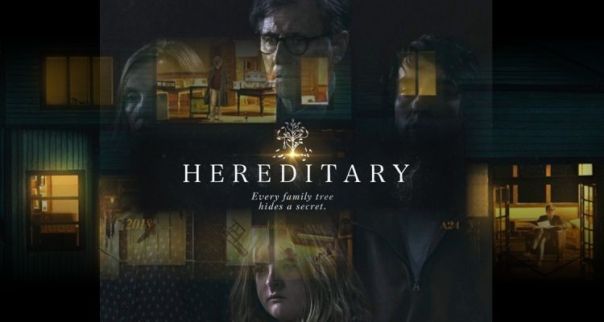
hereditary-poster-featured-image-750x400

An accomplished film, with good use of long takes that nonetheless feels visually and narratively unsatisfactory. I hated the grey look of the film and how little attention seems to have been paid to the use of colour. Our conversation includes considerations of the compositions and props, including repeated imagery of miniature models of the family’s home, and complaints that it feels that the film’s various patternings don’t add up, or at least we can’t add them up: we feel they’re meant to be expressive but we can’t figure out what layers of expression they might be adding.

The Horror genre has been the most consistent and incisive of genres in critiquing American culture recently but is this a particularly good example of it?. What are these film’s themes and what is it saying? Mike compares it to Kill List, It Follows and we digress onto a discussion of The Exorcist. We wonder if it might be part of the film’s project to go off the rails. If so, it succeed. We both love Toni Collette but we discuss also how  in its cruel and brutal treatment and imagery of women there might be a whiff of misogyny, in spite of a potentially feminist slant of Toni Collette’s character voicing things women might feel but are rarely allowed to express. Is it as clever as it thinks it is? What is it about? Mike really likes the way the camera is used, how it frames and re-frames in long-take, how that enables an appreciation of the performances and earns the trust of the viewer. Gabriel Byrne is wasted.


The podcast can be listened to in the player above or on iTunes.


With José Arroyo of First Impressions and Michael Glass of Writing About Film.

Bob & Carol & Ted & Alice (Paul Mazursky, USA, 1969)

Screen Shot 2018-07-01 at 10.48.49

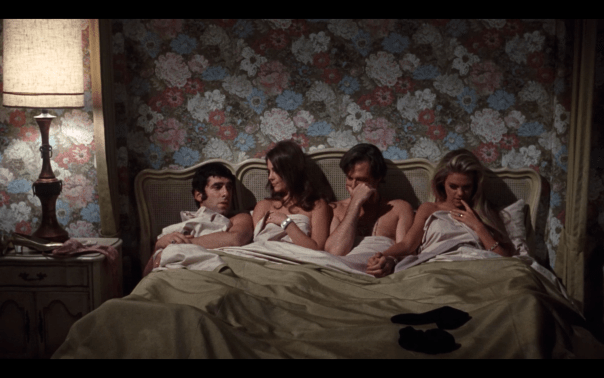
A film from a time when movies were America’s national theatre; ideas were explored and dramatised in order for the audience, which was then the nation, to have a discussion on how to be, how to love, how to strive for personal freedom without hurting others and in a world where the old certainties no longer held and new ways of being hadn’t yet been codified and entrenched. Bob & Carol is very much a film of its time, a Hollywood film of its time. Bob (Robert Culp) and Carol (Natalie Wood) go to a seminar where they learn that the path to personal freedom is to be honest about their feelings and express them. This leads to their exploring an open relationship, which at first shocks their closest friends, Ted (Elliot Gould) and Alice (Dyan Cannon) and subsequently disturbs Alice and entices Ted. At the end they all end up in the same bed and the closing song is the Burt Bacharach hit, ‘What the World Needs Now (Is Love Sweet Love)’.

Screen Shot 2018-07-01 at 10.52.20 1
Natalie rocking a mini

Bob & Carol & Ted & Alice was an enormous success, reportedly grossing over 30 million on a 2 million dollar budget. It was the fifth top grossing film of 1969 and it’s worth mentioning that the films above it were, in order, Butch Cassidy and the Sundance Kid, Midnight Cowboy, Easy Rider and Hello, Dolly! Below it were Paint Your Wagon, True Grit, Cactus Flower, Goodbye Columbus, and On Her Majesty’s Secret Service. The struggles between the old dying Hollywood (Hello, Dolly! Paint Your Wagon, True Grit) and the new and emerging one (Midnight Cowboy, Easy Rider) playing out in the list itself, with Cactus Flower, On Her Majesty’s Secret Service and Goodbye, Columbus attempting to manoeuvre new ideas and ways of being into old forms.

Bob &Carol is more adventurous, both formally and thematically. It’s a zeitgeist film that still holds up well today. The opening scene with nude women basking in the sunshine as we hear Handel’s Hallellujah chorus; Robert Culp’s Nehru jackets, frilly collars and cuffs, and multiple beaded necklaces; Elliot Gould, giving a great performance but then seen as ‘ethnic’-looking and with the hairiest back in the history of the movies;  the mini-skirts; the pot-smoking scenes, and the final orgy: all speak their time. The glossy cinematography by Charles Lang is lovely to look at and it’s worth saying that Natalie Wood, who is less ‘good’ than Gould or Cannon, is nonetheless filmed as the movie star she was, and there are moments where she seems to glow and refract light; it’s a great pleasure to see. Quincy Jones’ score is a triumphant mix of the classic and the mod or the melding of two types of classic as when Sarah Vaughn sings Handel.  Paul Mazursky’s take is always a funny and loving one, and in this instance, made both more pleasurable but less complex by being glitzed up, yet still asking questions pertinent today (see for example the great scene with Ted and Alice discussing consensual sex in marriage) . It’s a film that still holds up, hugely enjoyable and currently on MUBI.

Screen Shot 2018-07-01 at 10.56.11

José Arroyo

Sonatas (J.A. Bardem, Spain/Mexico, 1959)

This is an execrable copy of Juan Antonio Bardem’s Sonatas. The DVD is from the ‘Clásicos Imprescindibles del Cine Español/ Essential Classics of Spanish Cinema’ collection so you’d think they would have taken greater care. The colour is terrible, as if transferred from a highly deteriorated print; the sound is dubbed, badly, and this is before we even get to whatever one of the great directors of Spanish cinema was ever able to achieve with this material.

On the evidence, it’s not much: the dialogue is highly stylised as possibly befits an adaptation of Valle Inclán, but there’s a failure in finding a tone commensurate with such a style; and that failure in turn results in the betrayal of the actors, who perform sometimes in a style one usually associates with provincial touring companies: arch, mannered, often speaking in a declamatory style accompanied by a Delsartean deployment of gestures; and sometimes in a more ‘realist’ psychological style more typical of the cinema. Bardem’s parents, who toured in such companies, both appear here in small roles and both fare better than Aurora Bautista (Concha) or Carlos Casaravilla (Conde de Brandeso). Even Fernando Rey succumbs to the grand arch style intermittently during the course of the film, so one has to assume that the actors were directed to perform in such a way. But it is not a success and some scenes now appear laughable (see below).

The film is an adaptation of Valle Inclán’s Autumn and Summer Sonatas, which El Mundo ranked as amongst the greatest of 20th century Spanish novels. Bardem has said that he was inspired by Visconti’s Senso, and the gap between aspiration and achievement is a sad one to witness. As can be seen from the battle sequences, this was an expensive production. The great Gabriel Figueroa was the dop in the Mexican sequences and Cecilio Paniagua was the dop in the sequences set in Galicia, in the north-west of Spain. The film has a cast most directors or producers of the time would have killed for: did anyone in the history of cinema give better close-up  than María Felix (see a selection below, after an extract of the marvellous but clearly chopped up star entrance Bardem prepares for her)? There’s Paco Rabal, the greatest leading man of the era, with his deep and sonorous voice; there’s also Fernando Rey, a great actor who would go onto international success with his work for Buñuel (Viridiana, amongst many others) and Friedkin (The French Connection); and there’s also Aurora Bautista, whom Bardem himself describes as the ‘only real star Spain had at that time’ (note the difference in billing between what I assume are the Mexican and Spanish posters for the film at the very top).

So what does Bardem do with this dream cast, great crew, excellent budget? As indicated above, the story’s hard to follow, the tone is inconsistent; the battle sequences create neither suspense nor excitement: inserting close-ups of babies crying is no substitute for care with editing and point-of-view. The film was highly censored upon its release but that can only explain some of its problems.

Sonatas was a Mexican co-production with the Spanish production house Uninci, which Rabal, Rey and and Bardem all had shares in. Bardem writes about how their main goal during the making of the film was to convince Luis Buñuel to return to Spain to make movies with them, which he would do with Viridiana, in which both Rabal and Rey would got roles they’re still associated with today. Bardem also writes in his memoirs, Y todavía sigue. Memorias de un hombre de cine (Ediciones B, Barcelona, 2002), that, ‘As I told a journalist then, I was satisfied with having the protagonist of my Sonatas ride on a horse, shotgun in hand, screaming ‘Long Live Liberty’. Well, pip, fucking pip, hurrah. He achieved his goals. But where does that leave the audience?

Bardem writes of how they screened it at the Venice film festival and were surprised at how the film didn’t make an impression. He blames the lack of interest in Spanish literature and culture in the rest of Europe then. To which one can say perhaps.  But one wouldn’t expect the mainstream Spanish cinemagoer to be intimately knowledgeable of the works of Valle Inclán either. Moreover In Valle Inclán’s novels, the focus on the Autumn one is on a melancholy love of the past; the Summer one on erotic love and desire. The film however bounces between something to do with Carlist wars, the Church, and struggles for liberation in the Spanish section; and something to do with Mexican revolution in the Mexican section; admittedly both  as the setting for those depictions of love, but periodically losing focus. One can detect how, wherever he can, and to the confusion of the viewer, the fight for freedom, the critique of totalitarianism and the depiction of questions of conscience, all are privileged at the expense of dramatisations of love.

Bardem blames himself for the miscasting of Aurora Bautista. And as you can see above, in the very first clip, she is indeed terrible. But, and in spite of the film being ostensibly highly censored before its release, Bardem must shoulder a much greater share of the blame than he’s willing to acknowledge. Some of the shots are beautiful (see two instances of wide-shot compositions below). Actually, almost all of the shots are beautiful; almost all shot on location; and the film is worth seeing for that: the compositions are striking and original (see some examples of his characteristic two shots and a very striking close-up above), there is a marvellously intelligent use of the camera throughout with liberal use of long-takes and in depth, and a very poetic use of space. But the lighting doesn’t match from shot to shot, the shots don’t join up into scenes, and the scenes don’t connect into a shape that has rhythm, drama and logic.

On his watch, Bardem, the child of generations of performers, allowed actors, through no fault of their own, to make complete asses of themselves, a terrible betrayal. Only the divine Felix — who clearly had a sense of what worked best for her and performs the whole thing in a silent film star diva style — and to a lesser extent Rabal, escape unscathed.

And yet….some of the compositions, mise-en-scène and the design of shots is so skilled that one still wishes a better copy of this very flawed film was generally available.

The film won the 1959 Prize of the National Syndicate of Spectacle for Best Cinematography in Spain for Cecilio Paniagua and the 1959 Venice Film Festival surprisingly nominated it for Golden Lion, at which one can only scratch one’s head and wonder ‘why’?

José Arroyo

Eavesdropping at the Movies: 69 – Jurassic World: Fallen Kingdom

claw


Jurassic World returns. J.A. Bayona, the director of The Orphanage and A Monster Calls, is in charge, transforming the colourful knockabout thrills of the previous instalment into a volcano disaster-cum-Gothic horror film. We both love the heightened drama of the mansion half of the film and how Bayona finds new life in what has, over the last 25 years, somehow become somewhat stale imagery of reanimated dinosaurs. José adores the casting of Geraldine Chaplin and Mike finds the reduced importance of love stories a positive thing. And seeing businessmen get killed is always fun. Cracking movie. Hugely enjoyable.


The podcast can be listened to in the player above or on iTunes.

With José Arroyo of First Impressions and Michael Glass of Writing About Film.

fallen kingdom

Cela s’appelle l’aurore (Luis Buñuel, France/Italy, 1956)

asi es la aurora

I went to the ballet last night. But what I woke up thinking about this morning was Buñuel’s Celà s’appelle l’aurore. Why isn’t it better known? In the opening scenes a lady faints, insects swarm around dead fish, a man beats a donkey that won’t move, workers get hurt at a factory through the cost-cutting measures of a careless owner and a young girl gets sexually abused by her grandfather whilst the whole family wails around her. ‘Sadly, she’s now old enough to remember,’ says the Doctor (see images below). Buñuel acknowledged it as one of his favourite films, designating it as a ‘love-yes-police-no film’.1


It’s from 1956, the first film Buñuel made upon his return to France, and is relatively conventional and quite extraordinary. Gaston Modot and others from L’Àge d’or appear. Kosma did the music. The film contains Buñuel’s usual witty anti-clericalism (see image below). ‘It was not well received. The film is just one cliché after another,’ wrote Eric Rhomer, a huge ado about nothing’. But John Baxter, in his Buñuel writes that Rohmer was then so right-wing and Catholic that colleagues like Ado Kyrou called him a fascist. (p.244).  Truffaut, writing in Cahiers du Cinéma also dismissed the film: ‘I dislike Celà s’appelle l’aurore because it’s badly acted: that’s all there is to it.’ How wrong he was. There’s much much more to it. But Truffaut was often blind to the political implications of any work.

Screen Shot 2018-06-28 at 09.04.03.png
‘Many people have said, “A Buñuelian detail.” Okay’, says Buñuel, ‘but I’m sorry, sometimes reality inserts its own Buñuelian touches all by itself. When the Americans invaded Africa during the Second World War, they found a monument of Christ and used it to string needed telephone cables. And since the doctor had been in Africa, he has this photograph in his home: Jesus’ face hung full of insulators and cables. This is not an invention of mine.’ 4

The film can be read as supporting armed insurrection and all the usual institutions (the church, the police etc) are shown to be corrupt. That aspect of the plot revolves around a young tenant farmer, Sandro (Giani Esposito) recently back from laying his body at the service of the liberation of his country but now about to be thrown out of his job and home because his wife Magda (Brigitte Eloy) is dying with tuberculosis and he’s been neglecting the fields. The landowner is completely unsympathetic. The tenant’s personal problems are none of his business. Turning a profit is. A new tenant (the aged but still handsome Gaston Modot, see image below) arrives with his own family even whilst the wife of the previous one is on her deathbed). The new tenant is kind enough to drive the couple to stay with friends but the wife dies on the way. The husband loses his mind and decides to kill the person responsible for all of this, the rich-landowner and indusrialist Gorzone (Jean-Jacques Delbo). He does, and in the middle of a party where the police chief, the priest and all of the pillars of the establishment are enjoying the lavish hospitality of the careless murderer. After the deed is done, Sandro runs to the Doctor for help. Who does the Doctor side with? Sides must be chosen in the world that Buñuel depicts for us here, so how does one behave morally and ethically in so choosing? ‘Valerio is led by love and friendship to act against his own class by defendng a worker who has committed a revolutionary act,’ write Bill Crohn and Paul Duncan in Luis Buñuel: The Compete Films, p. 105.


Screen Shot 2018-06-28 at 09.10.48.png
Even a deathbed is no guarantee against eviction

There are scenes in the film that without quite taking flight into the sphere of surrealism nonetheless extend it a hand so as to show the finger to an uncaring world. In the scene below, for example, Doctor Valerio (Georges Marchal) is at a nice restaurant trying to comfort his wife (Nelly Borgeaud) after she’s fainted. She hates Corsica: the poverty, the misery, the lack of culture, the way he’s too busy and never has time for her. She wants to go to Nice, family, civilisation. At that moment, almost out of nowhere comes an elegant figure gliding on a bicycle, sitting on the handlebars, playing a violin and smoking a huge stogie. It’s a thrilling image, a nonsensical one. The camera cuts back to the couple but then the violin player appears, this time on foot. The wife screams ‘I can’t stand it. Make him stop’ at the sound of the music. But the violin player carries on even as they get up to leave and until the moment that he gets paid. This is so typical of Buñuel: the insolence, the black humour, but the dignity too. There’s a feeling of esperpento, that life is to be revealed in all its tragedy, objectively and to the point where one can only laugh. As soon as the Doctor hands over the bill the street performer’s playing, which has been a torture to the wife, stops. But not before. He’s a professional. (I’ve gone to such lengths in describing because the clip below is in French with Spanish subtitles, but worth seeing even if you don’t speak either of those languages).


The doctor sides with the people. Lucia Bosé, who appears to bring love and passion to the doctor’s life and beauty into ours (see below), also makes her choice. She risks her well-being by sheltering the fugitive and in doing so proves she’s more deserving of Valerios love than his wife; so frail, so delicate but, with the help of her father, so firm in taking care of life’s little niggles: They’re the ones who informs the police, thus betraying Valerio and condemning Sandro to his short and tragic fate . It’s great. And increasingly relevant to the time we live in.

bose-love
The pull of Lucia Bosé

There are a few images of undoubted interest to Buñuelians that I’d like to draw your attention to below:

Screen Shot 2018-06-28 at 09.04.51.png
The Police Inspector, Comissaire Fasaro, played by Julien Bertheau, is associated with the writings of the Paul Claudel, the right wing and Catholic writer whose poem to Pétain in 1940 led to accusations of collaboration with the German invaders. Here his work on theatre is interestingly pictured amongst the paper and stamps of officialdom and bureaucracy but also amidst the restraints implied by the handcuffs. He’s also often pictured in front of a crucifixion by Dalí. ‘That is to say that Dalí and Claudel were a poet and painter of the police, thogh both are excellent, of course,’ says Buñuel. 2

Above I’d like to draw your attention to the image of the women, united in their grief for the child who’s been molested, and offering succour and emotional support to the mother prostrated with grief at what she must feel is her fault (she allowed her father, who already had a reputation for that kind of thing, to live with them). Note how the move to the next scene is a dissolve, and how the tragedy and poverty of one class melts into joy and ease of a higher one through the clearly phallic and here central symbol of the palm tree.

Screen Shot 2018-06-28 at 09.07.44.png
The owners of the means of production in the well appointed drawing room of their mansion in Corsica, with a portrait of Napoleon, a native son, posing in an authoritarian stance,  given pride of place, fitting for the owner of the factory where workers are carelessly hurt and the vineyards where peasants are cruelly evicted from their home on their deathbeds
Screen Shot 2018-06-28 at 09.08.56.png
Buñuel’s foot fetishism is not neglected in this film, and the Doctor taking his socks off is given way more time, and more significance, than is usual.

Cats appear throughout the film, in the beginning (see first set of pictures, amongst children and decaying fish) wild, abandoned. The doctor picks up and strokes a street cat by the sea. Sandro, caught between the might of the lion, and the homeless kitty he strokes and nurtures, contemplates murder. We see other animals also, each behaving according to their nature; the donkey who won’t budge in spite of the beating (see first set of pictures), later the turtle, offered as a gift, who turns itself over, and walks away in close-up.

The film often shows us the people it sides with behind bars or filmed outside veiled windows, denied the freedom to move, love, even live.

But the film offers resistance (the murder; Valerio refusing to shake the Inspector’s hand) as well as  love and brotherhood, even in death (right) and ends on an image of love, camaraderie and hopefulness amongst those who offered help and resisted. The sign on the right is an advertisement for Dubonnet that begins with Du Bon, ‘that which is good’. ‘I acknowledge that tht scene is a bit symbolic,’ says Buñuel. 3

It’s a surprisingly rich film and I’m sure a closer look will un-peel even more layers than I’ve been able to draw out here.


According to wiki, ‘Film critic Raymond Durgnat has called this film the first of Buñuel’s “revolutionary triptych”, along with La Mort en ce jardinand La fièvre monte à El Pao: “Each of these films is, openly, or by implication, a study in the morality and tactics of armed revolution against a right-wing dictatorship.”

José Arroyo

  1. José de la Colina and Tomás Pérez Turrent, Objects of Desire: Conversations with Luis Buñuel, edited and translated by Paul Lenti, New York: Marilio Publishers, 1992, p.122
  2. ibid, p.123
  3. ibid. p. 124
  4. ibid p. 126

In Conversation with …Ian Francis

A wide-ranging conversation with Ian Francis, founder and director of Flatpack, about cinema, community, building audiences, and developing the festival from a pop-up in a pub 12 years ago to one of the leading festivals in the UK and a cornerstone of film culture in the West Midlands. We talk about cinephilia in Birmingham, about showing films in canal boats, churches, warehouses; about programming mixed-media, animation, shorts, experimental and expanded cinema and how international art-house might now be amongst the biggest challenges; we talk about funding and about ‘Heritage’ projects, from the recent ‘Birmingham 68’ to a forthcoming project on South Asian film from the region. It was a great opportunity to discuss key aspects of culture in general and film culture in particular that, because they often take place behind the scenes, don’t often get the public airing they merit. You can listen to the podcast below.

José Arroyo

ocean's 8
The billboard Ian refers to in the chat

Muerte de un ciclista/ Death of a Cyclist (Juan Antonio Bardem, Spain, 1955)

Screen Shot 2018-06-13 at 08.05.18

 Muerte de un cliclista/Death of a Cyclist is a salutary reminder that even under the most totalitarian of regimes protest is possible. But Juan Antonio Bardem’s triumph is not only due to his making a Communist film at the height of the Franco regime: this film also has a remarkable way of framing the action, quite extraordinary compositions in 4:3 ratio (see below), an evocative use of space, original modes of cutting, and a way of building scenes to daringly extreme close-ups, rhythmically, in a way that conveys all the necessary story information whilst creating tension. It’s not only a landmark in Spanish cinema but a great film tout court.

Screen Shot 2018-06-13 at 08.15.03
Stiking compositions: Maria José hanging from her car, occupying half the frame, whilst a cyclist looks down from the top right hand corner

In his autobiography, Y todavía sigue: Memorias de un hombre de cine,  Bardem insists the film is based on Tolstoy’s Resurrection (p.204). But it bears more than passing similarities to Antonioni’s Cronaca di un amore, which Bardem had by then seen and subsequently acknowledged as an influence: Juan (Alberto Closas) and Maria José (Lucia Bosé) were teenage sweethearts. She left him to marry a richer and more influential industrialist Miguel (Otello Toso) but they’re now once more involved. Returning to Madrid from one of their trysts in the country, they run over a cyclist. They get out of the car to see whether he’s alive and find out he is. But instead of getting help they flee, worried that if others are involved, their affair will be uncovered and their social position ruined.

Back at work, Juan reads in the paper that the cyclist has died. He’s so distraught that he inadvertently fails a female student when she should have passed, a mistake witnessed by great numbers of people in class. What was previously selfishness now becomes murder. At a party, Rafa (Carlos Casaravilla) hints that he knows what’s happened and threatens blackmail. The rest of the film is a combination of tense Hitchcockian thriller, populated by characters suffering from Antonioni-esque ennui and framed in compositions very much influenced by the Italian modernist’s work, and peppered with sequences that owe a debt to Italian neo-realism, particularly in its Spanish variant such as in Surcos. Compare the sequence in Surcos (below) to the one that follows from Muerte de un ciclista.


The film is an indictment of the Franco regime. The culture depicted is one riddled with corruption. Juan’s brother-in-law is the reason he’s got his post at the University. And he could even be made Dean should he wish to on the basis of this connection. The brother-in-law is satirised giving one of those inflated, smug and florid speeches one so associates with the era. We see the mother who’s had everything in life categorised and measured and has problems understanding that which isn’t. She loves her son, but also understands he doesn’t share her values, not least  her pride in having two sons fallen in the war. We see newsreels as of yore of Maria José, dressing up and looking glam, ostensibly to give money to the poor, whilst we know she let someone die because he was an inconvenience. We’re also shown those in power, like Juan at the university, so careless of those in his charge, he fails his student even without looking at what she’s done and potentially ruins her life. There’s a line spoken by Juan’s sister, at one of those boring cocktail parties that seem to make-up their life, where she jokes that the bracelet Maria José’s husband has given her comes at the cost of a thousand impoverished workers.

Screen Shot 2018-06-13 at 08.06.53
Juan reads the paper whilst his student does her exam

This viewing is the first one I’ve recognised the extent to which the Civil War permeates everything. It’s visible in the bombed out buildings by the tenement flats of the dead cyclist. It’s referred to in conversations with the mother. It’s what interrupted Juan’s love affair with Maria José and gave her the opportunity to marry a richer man. But more importantly, the trenches were Juan fought the war (on the Nationalist side), where he daydreamed of her, are visible from the very place he and Maria José let a poor cyclist die. The culture he fought for, the one his two brothers died to build, is the same one that allows him and his like to walk away from someone they’ve just run over with their car and let die.

It’s interesting that David Melville Wingrove, in an excellent piece for Senses of Cinema,  assumes Juan fought for the Republicans, whilst I assume he fought for the Nationalists. I based the assumption on the his social class, his mother valuing the ‘glory’ of their name and revelling in a particular Nationalist discourse, his ‘fallen’ brothers,  his position at the university, and the knowledge that such a representation of of an ex-Republican combatant would have been unlikely to be permitted representation. It’s worth saying that on his piece on the film in Antología crítica del cine Español, Casimiro Torreiro cites José María García Escudero, ex and future Director General of Spain’s Ministry of Film and Theatre, writing in the pages of Arriba, a Falangist paper, as naming Juan as ‘one of our ex-combattants (un ex-combatiente nuestro).’

Still, I don’t think the side Juan fought on, so important in the history of the Civil War and it’s aftermath, is ever explicitely stated.The fact that he fought in the trenches on the outskirts of Madrid means nothing as the gun could have been facing in either direction. Upon reflection, it might have been left deliberately open: and whatever side one assumes Juan fought in brings interesting, if different, dimensions to his character, and to the story. Seeing him as a Republican would explain his being the ‘black sheep’ of the family; his needing to rely on the patronage of his brother-in-law; his ennui and immobility during much of the film; and his being fired up by the protests. What’s really important in the film is Juan’s acknowledgment that the war is something that affected everybody, that ‘you can blame everything on it’ and the film’s use of it as a context in which Juan must live his existential crisis and begin to take responsibility for his actions.

If in Death of a Cyclist the rich are lazy, bored, corrupt and careless. they’re also made alluring: the men by loving and having a conscience, Maria José by looking so exquisitely beautiful.  The poor are of course victims at the beginning and shown at the end to have the conscience and sense of responsibility the rich lack. The class that comes off worst here is the middle one, those with position, but who have to work for a living, like Rafa, the blackmailing art critic. What is it that the cinema of this period has against critics? They’re either bitchy (All About Eve) or murderous and perverse (Laura)  and why is evil and deviant sexuality so often associated with modern art as here and in Phantom Lady?

Screen Shot 2018-06-17 at 08.37.15
Villainy and modern art: the film makes sure we see a close-up of the painting (which looks like a Miró) before adjusting so that Rafa can enter the frame.

Juan’s unjust and careless failing of Matilde (Bruna Corrà), the young student has resulted in the students protesting against the faculty (see below). This is shown to us through one of the many brilliant cuts in the film, where Rafa’s blackmail scheme has been foiled and in frustration he throws a bottle through the window of the restaurant where they’re all celebrating a wedding. Cut to a similar window being destroyed but this time at the faculty where Juan works as an assistant Professor of Analytic Geometry. The end of the threat of blackmail is thus inter-linked with the student protest. Certainly, Juan sees it as a way out of the ennui and hopelessness he’s been suffering from: ‘isn’t it wonderful?’ he says to Matilde of the protests against him, ‘This selflessness, this unity, this solidarity…your problem — my unfairness — has become their own…They’ve made me feel young and noble and selfless again’.


Screen Shot 2018-06-13 at 08.11.02.png

The student protest, pointedly designated an ‘insurrection,’ is a turning point in the film. From, this point onward, the tragic denouement is set. But let me linger for a moment on the significance of the film’s representation of this uprising. It was of course illegal. And the sight of the students against the army in front of an institutional building (see above) must have been an extraordinary sight in the totalitarian Spain of 1955.  But the critique is built into the very fabric of the film. See for example, how Juan and Maria José’s secret meetings take place in either the circus or the Church, rendering with an equivalence clearly not noticeable to the censors of the time.

Above: We are shown Juan and Maria José (centre) discussing their murder at the circus (left) and with a mass at church in the background, right: both Circus and Church rendered as equivalent ritual distractions and ideal settings for discussions of crime and murder

Once Juan has his consciousness raised and found a purpose for living, the film returns to the noir structure it started with and denies the adulterous couple the happy ending that had in any case begun as an impossibility. The film returns us to the same setting, the place where Juan once fought for the repressive culture he now lives and in and where he dreamed of Maria José. As you can see below at the beginning (image on the left) Maria Jose is running towards Juan who is running after the cyclist. By the end (centre image), in the same setting, she is walking away from him. The distance between the couple is evident in both frames. By the image on the right however, in one of the many beautiful compositions that characterise this film, she’s descended from being the selfish and careless person who runs away from an accident to someone who actively plans to murder.

Rafa is the blackmailer. But as in so many noirs, Maria José is the femme fatale and the true villain of the story. She’s the one who’s driving when they run over the cyclist. The film often deploys unexpected cuts, through her, so as to show the lover when the husband is expected or vice-versa. She’s the one who married for money, avows her love to whichever man she’s with, and tries to hold on to her social position and worldly goods no matter the cost. If Juan changes from pointless ennui to self-liberation inspired by social protest, her trajectory is from that of careless selfishness to outright murder. It is interesting that we see her in newsreels collecting money for charity (see below left) but often, and throughout the film, pictured in, next to, or in font of a bed (see below right). In spite of the film’s left leanings it still hasn’t progressed to the point where it doesn’t blame the woman for everything.

As is shown in every frame visible in this post, the compositions are extraordinary. The other remarkable aspect of the film is the editing, constantly surprising and most effective. In the clip below, for example, note the associative cut, on smoke. Juan exhales the smoke in his bedroom, Maria José blows it away but then we notice that she is not with Juan but in her own bedroom at home, as she leans over, and we’re shown he husband entering the picture. It’s brilliant and one of many examples of unexpected and inventive cuts on action, on things, across people and spaces, even a liberal use of jump cuts.


The scene above deserves its own blog post. But I here simply want to show it to you as a way of bringing the discussion of framing, composition, and editing together in an extraordinary scene in which we are shown Rafa telling the husband of his suspicions. The flamenco blocks out the dialogue, the editing rhythmically raises tension. What is being said? How does it affect them? The camera goes from close-ups back to showing the guilty couple in a social setting, the tension builds through the increase in the close-ups, systematically, whilst occasionally returning them and us to the knowledge that their personal drama is being played out in public. It’s a great scene and characteristic of the cinematic brilliance evident throughout this great film.


The DVD is available on a great print through Criterion.


José Arroyo

L’eclisse in a few words and images

The affair is ended. Money’s made and lost. Empire’s over but colonial relations return as the not-so-repressed oversexed stereotypes, and in black-face. I wish I didn’t love you. I wish I loved you more. But then maybe one shouldn’t love at all. One is fundamentally alone. Even when you have feelings for someone as gorgeous, rich and uncomplicated as Alain Delon, and he’s crazy about you, human relationships are like kissing someone through glass. None of it matters anyway because the Atom bomb will get us all.

Screen Shot 2018-06-14 at 13.21.56.png
Hasta la vista Paco — The end of the affair.
Screen Shot 2018-06-16 at 09.44.48.png
Money’s made and lost


Screen Shot 2018-06-16 at 09.42.45.png
Empire’s over but colonial relations return as the not-so-repressed oversexed stereotypes, and in blackface.

Screen Shot 2018-06-15 at 16.18.55.png

Screen Shot 2018-06-15 at 16.19.04.png

Screen Shot 2018-06-15 at 14.08.18

Screen Shot 2018-06-16 at 09.41.32.png
One is fundamentally alone. Human relationships are like kissing someone through glass.
Screen Shot 2018-06-16 at 09.45.23.png
None of it matters anyway because the atom bomb will get us all

Hanna Leiß has done a wonderful essay on how, ‘Vertical lines in the background of the image composition visually separate the two lovers in each and every shot from each other,’ which can be seen here:

https://mubi.com/notebook/posts/filmadrid-mubi-the-video-essay-l-eclisse-lines

José Arroyo

Surcos/ Furrows (J.A. Nieves Conde, Spain, 1951)

surcos

A landmark film in the history of Spanish cinema, Surcos vividly evokes a way of life and structures of feeling of Francoist Spain and is the best snapshot of that moment in history  I can think of. The Perez family migrates from their village to Madrid in the hopes of a better life. The film begins with their arrival at the old Estación del Norte, with their chickens in their hand-baskets. They already have a son there, Pepe (Francisco Arenzana) who knows the city a bit due to having done his military service there. He find them rooms with a relative in Lavapies whose  daughter Pili (Maria Asquerino),has already been corrupted by the city. Pili’s street-smart, cynical, makes a living off the black market (estraperlo) that was such a feature of life in those days, and is involved with a small time hood, a typical Madrid chulo called El Mellao (Luis Peña) who lives off her and occasionally beats her.

Screen Shot 2018-06-13 at 15.49.39.png
The court-yard of old working-class flats

The Perez family arrive with just about enough money to pay their rent so their first objective is to get a job. They register with the unemployment agency but there’s a huge queue for work and in the meantime the family’s got to live. The father starts selling contraband cigarettes and candy along the Avenida del Prado but he’s too imbued with rural values — love of children, honesty — and ends up giving the candy away and getting arrested and fined by the police for illegal activity. The youngest son, Manolo (Ricardo Lucía), gets a job as a delivery boy at a grocery store but he’s so decent and naive he’s quickly robbed and the family is now in hock for all the father and the youngest son have lost. The father is so emasculated by the city, failing as both a vendor and a factory worker, that he ends up clearing the table and washing the dishes at home. The youngest son is kicked out of the house by the mother- who’s here depicted as one of those monster mamas so typical of Francoist cinema –for losing his job and landing the family in hock to his employers for the goods he’s been robbed  and he ends up on the street, drying his one shirt amidst bombed out buildings, and fainting from hunger.

Screen Shot 2018-06-14 at 09.13.49.png
Manolo, hungry and homeless in front of a poster for ‘Father of the Bride; and below, yearned-for goods, on display but out of reach

The only Perez child who gets and keeps a job is Pepe who Pili hooks up with Don Roque, ‘El Chamberain’ (Félix Defauce), a local gangster. Pepe begins as a driver. He moves up to armed robbery and makes enough money to replace ‘El Mellao’ in Pili’s affections. The daughter Toña (Marisa de Leza) dreams of being a singer but like so many young girls of that generation ends up in service as a maid, in her case to Don Roque’s mistress.  When they leave the house to go to the pictures — one of the neo-realist films so in vogue, the film tells us — Toña tries on her employer’s clothes but in doing so rips a stocking. In this film a pair of silk stockings is an unaffordable dream to a poor family and spells ruin for Toña. This is a film with a palpable yearning for things that to us are basic but to these people in this time is completely out of reach. Toña caresses her mistress’s silk stockings like they’re the most precious of jewels, Pili yearns for years for a winter coat she never gets, Manolo is pictured outside shops stacked with food he can’t have.

Screen Shot 2018-06-14 at 09.16.39.png
The evidence of the still recent Civil War everywhere evident

As the film progresses, the father sees the deterioration of his family. The eldest son is the only one bringing in money  and he thinks that makes him head of the family and gives him the right to bring his girlfriend home to have sex with, such an outrage that the father beats him for it. The daughter Toña gets conned by Don Roque into sleeping with him to comfort her for her failed debut as a singer — a failure Don Roque engineered for precisely that purpose. When the father goes in search for her and finds her ensconced as Don Roque’s new mistress, he beats her too. When he gets home, he hits the mother as well, blaming her for, well, everything.

Above, father beats son, wife and daughter, at different times, for crossing the ever-so-rigid lines of a particular and precisely delineated ways of being

At the end of the film, the family is at the cemetery, burying their eldest and headed back home to their village, accepting the shame their failure will bring on them, but glad of their straight and narrow furrow where things are the way they should be, a typical colloquial phrase from a culture that held those things to be certain; and away from the corruptions of  the city, where they’re not.

Screen Shot 2018-06-14 at 09.23.19.png
The eldest son being buried; the city blamed for the death in the background

The film is a landmark film in the history of Spanish cinema for many reasons: its on-location shooting and its attempt at a neo-realist style; its depiction of prostitution and other ‘immoralities’ then forbidden; its implied critique of the society its depicting, then remarkable because forbidden. It’s intelligent and well-made. But it’s too manichean to be great. It’s view of rural poverty as enobling is in itself a Francoist ideal. Its dichotomous juxtaposition of the rural and the urban, facile.

Screen Shot 2018-06-13 at 15.50.12.png
A dream of a more glamorous life.

Though it might not be great, Surcos is nevertheless a film I love. The story of internal migration in the film has parallels with  external migration now. Hicks from villages in 1950s Madrid were treated just as contemptuously as Latin American immigrants are now. The jobs, the way of getting them, the patriarchal family structures of the day, the strict gender roles are recognisable to me and lasted way past the period in which the film is set. I think many Spanish people would recognise aspects of their own family history or of people they know in this film. Plus, because it was shot on location, the film also acts as a kind of document of how Madrid used to be and I find myself pulled into a haze fo feeling — part nostalgia, part sadness, a kind of mosaic of the many phases of Madrid’s development that I’ve witnessed compared to those I haven’t, such as here, that I find fascinating and satisfying.

Screen Shot 2018-06-14 at 09.16.57.png
The homeless and the hungry

It’s a film those who continue to feel nostalgia for Franco’s Spain should see. Here is a Madrid as poor as some rural villages are now. Compare it to Almodóvar’s Madrid. The places in Surcos are identifiable; the attitudes, ways of life, levels of poverty and hunger are not. In Surcos the characters are constantly placed next to things they can’t have; the riches evident in American films like Father of the Bride, the show-business glamour of the singers and dancers of the Madrid of the era but also food, stockings, bras, new coats. What the film shows as impossible glitz are people’s everyday lives in Almodóvar’s Madrid. The change is not only physical and material but also evident in more expansive, generous and open ways of living, being and thinking.

José Arroyo


Below I’ve enclosed image-capture from the film that those who know Madrid might recognise and get a special kick from seeing:

Screen Shot 2018-06-13 at 15.47.58.png
The family arrives at the old Estación del Norte, which shut down in 1990. The Royal Palace is visible in the background.

Screen Shot 2018-06-13 at 15.48.59.png

Screen Shot 2018-06-13 at 15.48.59.png
They come out of the Metro in Lavapies
Screen Shot 2018-06-13 at 15.50.58.png
This is Plaza Legazpi; the smoke tower still exists today and is part of the Matadero complex
Screen Shot 2018-06-14 at 09.03.56.png
One of the lower Banco de España
Screen Shot 2018-06-14 at 09.07.57.png
One of the entrances to the Plaza Mayor
Screen Shot 2018-06-14 at 09.19.47.png
La Latina, still operating
Screen Shot 2018-06-14 at 12.12.38.png
Selling contraband in Paseo del Prado


Cronaca di un amore: A Investigation of a Woman Under Suspicion


The first image we see in Cronaca di un amore after the credits is that of a woman in a bathing suit, beautiful alluring (see above. The images are in the order they appear in the film). The first line we hear is ‘The usual story eh’ followed by ‘no, it’s not the usual story. It’s not suspicious. In this case, the lady is faithful’. We’re told of how these photos were taken when she was a student in college. How she had a middle-class upbringing — her father’s a professor– and how she’s now an elegant society woman married to Enrico Fontana (Ferdinando Sarmi), a rich industrialist who owns over twenty companies. Her name is Paola (Lucia Bosé). The husband found that cache of photographs and they made him jealous. He wants to know what kind of a woman he married.What did she do before? What kind of friends did she have? There’s a man in one of the pictures but the picture doesn’t reveal his face. The detectives are charged with finding out her secrets so that the husband may know without asking her.  The husband’s investigations start off the narrative, ironically drive his wife into the arms of that very man in the picture, and drive her to thoughts of murder that the investigation will reveal are not unknown to her. The narrative set-up, like so many investigations of women under suspicion in film, is that of noir, and Paola is the femme fatale.

The clip above is our first sight of Paola in motion. The detective has been digging dirt in her home-town. A girl who we will later find out was Guido’s girlfriend fell in an alevator shaft whilst Guido and Paola were present. Did they do it? They were in love. Is Paola capable of murder? The detective’s digging has brought Guido back to Paola, to warn her. How do you picture a woman potentially capable of murder?  Note how we see her coming out of the opera, draped in white fur, dripping in jewels elegant, beautiful; in one fluid shot that pictures her first with her husband, then her elegant society friends. It’s her birthday she reminds him. Then her gaze wonders left and as the film cuts to show us what she sees, out of the past, framed against an industrial billboard, comes Guido (Massimo Girotti) her old love ,her accomplice; from her former world and from another class. Her whole mood changes. Already in the car she’s lying and manipulating. She’s a beautiful lady with a lot to lose. It’s a magnificent, expressive star entrance. A beautiful woman capable of killing for love and perhaps worth dying for.


José Arroyo