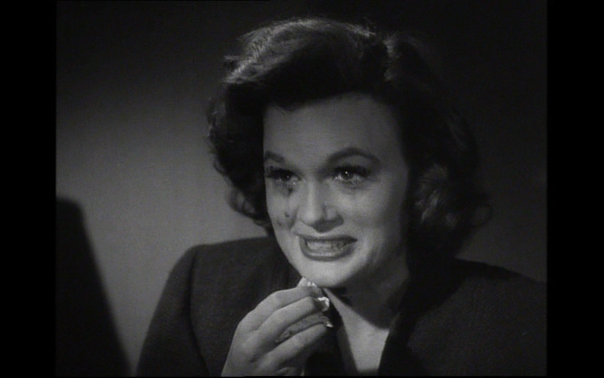
The film noir to end films noir, Billy Wilder’s classic crime drama Double Indemnity made its way to The Electric in Birmingham for a one-off screening, where a packed cinema ensured a great atmosphere. Mike, as usual, hadn’t seen it, while José is very familiar with it, even having taught it before.
Mike didn’t entirely click with it, though he’s able to appreciate much of what makes it a classic. Perhaps the stylistic and thematic elements that identify film noir are so perfectly employed by Double Indemnity that it leads to an ironic, detached mode of viewing – the genre, though it has existed since its inception, is strongly connected to its classical era of the Forties and Fifties, and has been parodied and pastiched more than most, burdening the film with unfair baggage to audiences not in that frame of mind. José, on the other hand, relishes the chance to see it with a paying, enthusiastic audience, finding that he notices different details and appreciates the film differently outside of an academic setting.
Unquestionable is the strength of Barbara Stanwyck’s seductive performance as the femme fatale, her Phyllis Dietrichson the archetype of the dangerous woman who bewitches her doomed victim, in this case a chump played with distracting self-importance by Fred MacMurray. And every time Edward G. Robinson appears on screen he lights it up, capturing the audience, whether with the array of witty retorts and bon mots with which the script furnishes him, or dialogue as ostensibly dull as a recitation of an actuarial table for types of suicide.
With all of this in mind, Mike is sure that a second run at the film would help him appreciate it more. There’s no doubting its place in cinema history, and that it continues to pack out cinemas with eager filmgoers is testament to that.
The podcast can be listened to in the players above or on iTunes.
I’ve seen this great heist film, one of the very darkest of noirs, before. What makes this noir different from all the others is that each character is not only mired in an underworld of greed, corruption and crime but also possessed of a kind of grace, be it Dix Handley’s (Sterling Hayden) code of honour in relation to his friendships and his dignity, or the kindness that’s at the core of Alonzo D. Emmerich’s (Louis Calhern) elegant putridness.
What struck me most this last viewing were the following:
a)It hadn’t quite registered before how striking and original are the compositions of the images in the film. I’ve included a selection below; everything is elegant but also off-kilter, like throwing a curve to the classical; motivated, expressive, almost standard; but by not quite being so making one see things afresh. Often, the camera is placed quite low so one’s always looking up at characters that loom but that are also hemmed-in by ceilings, lamps, shades, doorways
b)I was struck anew by Sterling Hayden’s handsomeness in this film. His Dix Handley is someone who once had it all but lost it, doing his best to get it back but also prone to quick excitement and danger, making a quick buck with a gun but losing it just as quickly on the track. The scar on his face a symbol of the scars he carries inside. The combination of Hayden’s handsomeness, the sadness in his eyes, and the elegant resignation of his bearing evoke fatality (see below). A man dreaming of the fields and horses of his youth but taking a detour on the road to nowhere.
c) Seeing Marilyn Monroe, in one of the first roles in which she made an impression — the other this same year was as a graduate of the Copacabana School of Acting in All About Eve — one is struck again by her charisma. She commands attention and gives this odd impression of being at once amateurish, inept — her line readings are hesitant, artificial — and authentic; of completely being that young girl using herself up with old men who can buy her the things she hopes will make her happy. She’s both fake and real, and at each instance sparks a dialectic where through the falseness she evokes something real and true, the surface but a pathway to depth.
Marilyn
d)I’d forgotten that the ‘Doll’ in the film is played by Jean Hagen, later to be everybody’s favourite character from Singing ‘in the Rain, the immortal Lina Lamont (‘I caiiin’t staaanhd it’). If, like I, you’ve wondered why the purveyor of such a great performance never became a star, you’ll find your answer here. Her ‘Doll’ is needy, loyal, desirious. The film gives her great moments, like the one below where she turns to Dix and takes her eyelashes off. But she also comes across as studied, and artificial, she’s ‘acting’ her carefully considered performance and comes across as too much and too coarse next to Haydn’s pointillism. She’s a better actress than Monroe but her ‘Doll’ comes across as less authentic, real and believable than Monroe’s Angela Phinley.
Jena Hagen
e) What struck me anew watching the film is how beautifully fleshed out all the supporting characters are. Thus Louis Ciavelli (Anthony Caruso) is not only a safe-cracker but a family man with a child that’s ill and a wife who wants him out of the game. Good at his job, part of a large extended Italian family, a guy who’s kept awake nights by the health of his baby and not by the dangers of his profession. Or Dix’s pal, Gus Minissi (James Whitmore), not only loyal to a fault but strong also, protective of the weak (his kicking out of the truck-driver who hates cats); victim of a life-long derision and abuse due to his being a hunchback (the conversation with Ciavelli’s wife) and putting his whole body into railing against injustice (the jail scene). Each character is given so many facets that when they come to the fore in the moments they´re given, they do so on top of carefully textured depth and evoke a character in a world that is connected to but also distinct from the film’s main narrative. Of these, the one that stands out most is Sam Jaffe’s Doc Irwin Riedenschneider, the mastermind of the heist: intelligent, cool, a man who goes about his business weighing the odds calmly until distracted by a pretty girl. The role and Sam Jaffe’s performance of it are surely one of the treasures of film history.
Sam Jaffe as Doc Irwin Riedenschneider
f) The last thing I wanted to comment on here was the symbolism of the final shot. The whole film has taken place at night, in the darkness, viewed only through shafts of light, in the city, the Asphalt Jungle. Dix’s drive has been to return home, to the horse and the farm that were taken away from him. He admits this history to Doll, this past that’s sparked a longing much stronger than his for her, a desire for a place — whether she’s in it is by the bye –a quarter of the way through the film. The only moment of greenery and light is in that shot. He reaches the farm only to die on it, the horses that were his dream and his friends, now licking his corpse. Is it heavy-handed? I don’t think so. For Dix what drove him into the Asphalt Jungle was that loss, regaining the farm and the horses has been what’s propulsed him through the narrative; and in a world where there’s no way out, it makes sense that the only way he’ll reach that farm is as a corpse.
The Asphalt Jungle gets greater with each viewing.
We return to Barry Jenkins’ If Beale Street Could Talk, his sumptuous romantic drama set in 1970s New York, for a deep dive, and take the opportunity to revisit his previous film, 2016’s Best Picture winner Moonlight. It’s an enriching conversation and we’re glad we took the time to engage in it. (The first podcast can be found here.)
We begin with Moonlight, working through our responses to what we experienced differently since having seen it previously (Mike last saw it during its cinema release, while José has seen it a few times on more recent occasions). The film’s final third is given serious thought, José in particular enjoying the opportunity to properly work through his longstanding problems with it, which amount to the film’s fear of the sex in homosexuality, its conscious refusal to openly and honestly depict two gay men being intimate – the film denies them even a kiss at the very end – and the critical establishment’s bad faith in refusing to engage with this particular point. It’s great to have finally discussed this topic, particularly paying close attention to the final few shots, where the problems are condensed and made perfectly clear; as José says, it’s an itch he’s wanted to scratch for a long time.
Moving on to Beale Street, we re-engage with some points we brought up in our first podcast, such as the dissonance between the opening intertitle’s invocation of drums and the soundtrack’s absence of them, and the relative richness of the characters that surround Tish and Fonny to the central couple. And we draw out new observations and thoughts, in particular returning on a few occasions to the conversation between Fonny and Daniel, discussing the lighting that drops them into deep shadow, picking up just the lightest outlines of their features as if to expose their souls instead, and how shot selection, editing and the use of a rack focus develop the drama and bring the characters together but simultaneously isolate Daniel within his own traumatic experiences. Mike picks up on a motif of redness in their eyes, acknowledging that the reading he offers is always going to be a stretch but finding it meaningful nonetheless.
We discuss the use of photo montages to reach for the universality of experience that the title implies and we felt was an issue the first time around, José describing how they thematically focus the film on black male incarceration and the lived experience of black masculinity in the United States. Mike feels that it’s a bit of a hangout movie, wanting to spend time with the characters and in their world, despite – perhaps because of? – the hardships they experience and discuss at times; certainly because of the romantic transparency, the care and love that characters show for each other, and the richness of their conversations. José finds fault with how the Latinx characters are lit and generally visually portrayed to less than their best, arguing that they were excluded from the visual romance that bathes the rest of the film.
And we see direct comparisons between Beale Street and Moonlight. Beale Street‘s sex scene is an obvious point of discussion with respect to Moonlight‘s ending, but we also find parallels in the elements that depict or imply betrayal between friends, Moonlight‘s hazing scene and Daniel’s ostensible usefulness as an exculpatory witness for Fonny sharing complexities around whether the betrayals they depict are truly betrayals.
A hugely enriching discussion that we had great fun having, thanks to two intricate, beautiful, thought-provoking films.
The podcast can be listened to in the players above or on iTunes.
It’s Valentine’s weekend and we take a romantic trip to The Electric Cinema to see It Happened One Night, Frank Capra’s 1934 romantic comedy that is one of only three films to win all Big Five Oscars (Best Picture, Best Director, Best Actor, Best Actress, and Best Screenplay). As usual, Mike hasn’t seen it before, while José’s seen it plenty. Does it hold up?
José talks of its democratic appeal, set largely in the American South during the lowest point of the Great Depression and showing people coming together despite hardship, lack of work and even fainting from hunger. We discuss the development of the relationship between Clark Gable and Claudette Colbert, including the wisdom of sharing a motel room with a man you just met, the propriety depicted (such as forgoing a lucrative reward, instead only claiming your expenses), and of course, the madness of Alan Hale’s singing.
The podcast can be listened to in the players above or on iTunes.
Tom Seymour is the writer on art and photography that’s most incited my interest in the last year. His writing on Bill Viola and Michelangelo in Wallpaper* is what got me to the Royal Academy; his article on Don McCullin, also for Wallpaper*, is what occasioned a trip to Tate Britain. He’s how I was introduced to Chernobyl as a rave site, how I first heard of Sian Davey’s show at the National Portrait Gallery and why I was moved to petition for the release of Turkish photographer Çağdaş Erdoğan. I wanted to talk to him about all of this and more. The podcast below is the result.
Tom graduated with a degree in Film and Literature from the University of Warwick in 2007 and since then has contributed to The Guardian, The Observer, The Financial Times, The Telegraph, Wallpaper, CNN, BBC and other important newspapers and magazines. He was also the digital editor of The British Journal of Photography for several years and has recently become Senior Writer for Creative Review.
The conversation ranges from how he got into writing about photography, the experience of going to and writing about Chernobyl, how he pursued the Çağdaş Erdoğan story, and the changing cultural status of photography as well as the current ecosystem of the medium in London. We end with an extended discussion of the great Don McCullin exhibition currently on at Tate Britain, which we both urge everyone to see.
Achingly romantic and visually rapturous, If Beale Street Could Talk, Barry Jenkins’ adaptation of James Baldwin’s 1974 novel of the same name, utterly bowls Mike over, while José expresses some reservations about it, despite also finding it enormously impressive. A love story set in New York City in the late 60s/early 70s, the film follows Tish (KiKi Layne) and Fonny (Stephan James) as they fall in love, begin to build a life together, but are threatened with its destruction by a racist cop and a false accusation of rape.
The title refers to a street in New Orleans that Baldwin, and subsequently Jenkins, use as a metaphor for the black experience across America, and arguably this is overambitious (if not simply impossible). The universality implied by the title is dissonant with what the film offers, which is much more personal and idiosyncratic. José points out the lack of anger in the film, anger that would be absolutely justified to express given both the general institutional racism the characters face in their place and time, and the specific instance of racist behaviour to which they are subjected: the rape accusation. Instead of fury, we see coping, survival, sadness, resistance and love, all communicated with an extraordinary depth of feeling and a camera that finds the beauty and subtlety in everyone’s face. And ultimately this is wonderful, it’s just that the title and opening intertitle that explains it somehow don’t seem to quite understand their own story.
There’s a huge amount we discuss, including the narration; the film’s excursion to Puerto Rico and how its depiction of the experience of Latinx people might or might not offer an interesting comparison to its central interest, the African-American community; how Brian Tyree Henry shows up for a scene and steals the entire film; how the film aims for visual poetry; how Jenkins conveys rich sense of different people’s lives and environments with just a few shots; and how the film chokes you up with its incredibly tactile depth of feeling that is sustained more or less throughout. We also bring up comparisons to Green Book, Get Out, and in particular, Moonlight, Jenkins’ previous film – José has issues with how he copped out of giving his story of a gay black boy’s difficulties growing up an honest ending, and takes issue with how viscerally one feels Tish’s desire for Fonny due to the way he’s shot, finding it even more disappointing than before that Jenkins didn’t do the same in Moonlight.
It’s a film we want to see again, infectious and emotionally rich, and if you don’t see it in a cinema you’re missing out. It’s great.
The podcast can be listened to in the players above or on iTunes.
It’s already being portrayed as the film that will undeservedly win Best Picture for its cuddly, comfortable, comedy-drama version of American racism in the Sixties, but do we dissent from that view? Green Book tells the true story of a road trip through the Deep South shared by jazz pianist Doctor Don Shirley (Mahershala Ali) and his Italian-American driver Tony (Viggo Mortensen).
Mike immediately seizes upon Tony’s inconsistent characterisation, the film using other characters to describe him as deeply racist, but his actual interactions with Shirley consisting of essentially polite microaggressions rather than real malevolence and anger. José also takes issue with the revelation that Shirley is gay, Tony having no problem with it, saying that in his regular job as a bouncer he sees it all the time – the film makes no attempt to explain how he can be entirely understanding and accepting of sexuality while intolerant of skin colour. Mortensen, though, is very characterful, imbuing Tony with entertaining irreverence, and the love Tony displays for his wife, writing her letters every day, is very sweet.
Ali doesn’t match Mortensen’s level of performance, though he is perhaps asked less of, largely remaining aloof throughout the film. Again, we find problems in Shirley’s characterisation. The film sets him up as a fish out of water, not just as a gay, black man in the Deep South, but also amongst other black people – it’s a quirk too far to believe that he’s never heard a Chubby Checker or Little Richard record. And the movements made in the film’s final minutes to engineer a classic happy ending (at Christmas, no less) are as predictable and obvious as they come, but Mike is moved by the ending nonetheless, leaving the cinema with a smile on his face.
Despite the character issues, lack of subtlety (every aspect of the issues it depicts is explained in dialogue), weak visual storytelling (this film doesn’t appear to actually know that it’s being shown in cinemas, so fully does it lack any sense of cinematic nous or style), and project of delivering an unchallenging, white man’s version of racism in which everyone can learn to get along without having to face any hard truths, we found things to like in Green Book, and recommend it as long as you keep your expectations low.
The podcast can be listened to in the players above or on iTunes.
Concluding a trilogy two decades in the making, Glass brings together the characters of 2000’s Unbreakable and 2016’s Split in an unconventional superhero showdown. We both enjoyed it, though it’s a bit of a trifle, but it’s enjoyably oddball and features a particularly brilliant performance from James McAvoy. And we appreciate M. Night Shyamalan’s direction, staging and camerawork, which, while occasionally a little stilted and ‘filmmakery’, for want of a better word, is thoughtful and always strives to create interesting and meaningful imagery.
The film feels significantly affected by the Marvel Cinematic Universe’s influence on comic book movies and their public acceptance; there are things that Glass does, ways it behaves, that are difficult to imagine having made as much sense prior to that series. Indeed, this trilogy is a universe of sorts, with characters from different films being brought together in a shared world.
The podcast can be listened to in the players above or on iTunes.
Noir, not only in colour but in technicolor, deployed in carefully thought through compositions where colour itself highlights the darkness. I´ll let the images speak for themselves and will only indicate that I find the last images in the bell-tower to be particularly evocative and beautiful.
A very powerful moment when seen in a good print on a big screen.. That first glance — sleepy, boredom mixed with slight disgust followed by that knowing look that´s calculating, superior, sexually sure: She´s got Joseph Cotten´s number, she´s got him fooled and she certainly needs no help in handling him.
On a good print, her lips look lacquered into enamelled perfection: artificial armour, war paint of a colour and with a gloss nowhere found in nature but totally descriptive and evocative of 50s America.
But who´s fighting whom and what for? A fantastic moment in a great film.
A wide-ranging conversation with Kieron Corless, Deputy Editor of Sight and Sound on the magazine itself and issues that arise from it: What is film criticism? What is good criticism? What is the changing function of criticism? How has the digital turn affected not only what cinema is and how we see it but also what film criticism is and how it is now done? How has the eco system or matrix in which audio-visual work is produced, distributed and exhibited changed over the years, with galleries and museums displaying moving image work on one end; and perhaps Netflix on the other.
We talk about cinephilia and film culture at home and abroad; and further discuss the importance of advocacy, particularly in relation to international films that often get seen only in small film festivals. We agree that the online environment has immeasurably improved criticism and helped create a different way of appreciating and writing about cinema, pushing film criticism in new directions, not least the increasing importance of the video essay. It’s an exciting time.
Because I was so gobby in the podcast, I’v also added some excerpts from a workshop Kieron led at Warwick. The short one below is on Sight and Sound itself.
The longer one below is on writing film criticism in general and writing for Sight and Sound in particular. Kieron’s talk ranges from how to pitch, the writing of a draft, right up to the submission and editing stages. Top tips from Kieron, rather choppily edited by myself. But bound to be useful and certainly interesting.